Showing posts with label The Parables of Christ. Show all posts

Thursday, February 21, 2019

Elder Symeon Kragiopoulos: Are we recipients of God’s compassion?

Icon of the Parable of the Prodigal Son (source)
  
Are we recipients of God’s compassion?

The prodigal son from the first moment realised his mistake, his failure, but he did not immediately return to his father. Instead, he tried managing to live far away from him. Stubbornly, he tried to justify himself. But when he ends up in dire need, this causes him to come back to himself, to think correctly, to repent, and to take courage, the courage to go to his father and to confess everything he feels he did against him. There is always a tendency in man to want to appear honourable before God, having the conviction that he is something. Man must be hit hard, to feel that he is unworthy of salvation.  Man ought to rely οn God, οn the Father’s compassion. Every sinner is saved by the sacrifice of Christ and not by any human virtue of his.
  
When someone passes through the misfortune of the prodigal, when he is vanquished like this and is later found in the arms of God and enjoying his love, he will never leave no matter what. He is happy, because he has found the Father. He stays and tastes of his mercifulness.
  
No matter how much we have fallen, God is waiting for us to return without justifying ourselves, so as to give us all his goods. Today’s parable shows that he who fell greatly, very greatly, is saved, because he repented. He repented and was saved.
  
And so I wonder, are we the recipients of God’s compassion?
  
Archimandrite Symeon Kragiopoulos
Holy Hesychasterion “The Nativity of Theotokos” Publications
  
Icon of the Parable of the Prodigal Son (source)
  
Through the prayers of our Holy Fathers, Lord Jesus Christ our God, have mercy on us and save us! Amen!
Friday, December 15, 2017

Elder Symeon Kragiopoulos: God sees into the heart of every man


The Parable of the Wedding Feast (Luke 14:16-24) (source)
  
Elder Symeon Kragiopoulos: God sees into the heart of every man
(On the Sunday of the Forefathers, The Parable of the Great Supper)
Man goes about his business, minds his family and does not take heed of what God says. All the people who refuse to respond to God’s invitation are not ignorant of God. They are, on the whole, honest people, but their heart is stuck on the things of this world; it’s not given to God. That is why man, right away, responds negatively to God’s invitation. And he does not wonder why the negative attitude, why the negative intention. Being christian, we tend to rest on our laurels but deep down in our heart the old man lives together with his rights, in his own “establishment”, in his own kingdom; under no circumstances does the old man surrender to God. And we let the old man be, and we nourish him.
  
God becomes man and dies of love to us, and still, we despise this love. There is nothing worse than that. This world exists for the salvation of those who wish to be saved. And God lets the world be, until his “house may be filled”[1].
  
And God “forces” some people to enter his house. But how can it happen that God “forces” people? That is not difficult to understand. Don’t we often see it happen with people who had no idea of who God is, who had no plan or intention to find God or believe in God, let alone, reach communion with God? Regardless of these, God who sees into the heart of every man and knows what every man intends to do, finds a way to reach man. So, God meets up with the most indifferent person or even the most negatively disposed one at some crossroads: He allows for something to happen to him and as this person finds himself in a difficult situation, as he is shaken up, he realises that this is God calling for him. As a result, man is “made” to follow the path of repentance, is “forced” to humble himself and respond to God’s call. And he is saved.
  
May God find a way for all of us to be saved. And let this happen whichever way God wants, as long as we are all saved.
[1] Luke 14: 23
   
Transcribed talks by Archimandrite Symeon Kragiopoulos
From: Holy Hesychasterion “The Nativity of Theotokos” Publications.
  
Through the prayers of our Holy Fathers, Lord Jesus Christ our God, have mercy on us and save us! Amen!

Saturday, November 1, 2014

Homily on the Parable of the Rich Man and Lazarus, by Metropolitan Avgoustinos Kantiotes


The Parable of the Rich Man and Lazarus (source)

Homily on the Fifth Sunday of Luke (The Parable of the Rich Man and Lazarus - Luke 16: 19-31), by Metropolitan Avgoustinos Kantiotes of Florina (+2010)
"Life beyond the Tomb"
Many things, my beloved, make man afraid. But that which frightens him more than anything is death. Even the word “death” alone brings trembling. Death is a great mystery!

Everyone, more or less, has the question: what happens after death? Is there anything beyond the tomb, or does life end there, and man is extinguished?
The question is an important one. If we believed that life ends in the tomb, then man would be free to do whatever he wishes: to sin, to fornicate, to commit adultery, to break the greatest rules, as long as he evades the eyes of the police and justice. If, however, there is life beyond the tomb, then man must count how he lives in this life, according to the voice of his conscience and the will of God.

To the question as to what is there after death, the answer is given us by today’s Gospel, the beautiful Parable of the Rich Man and Lazarus, which you just heard. What does it tell us?
There was a rich man, who had all of the good things from God. But all of these (houses, fields, everything else), he used for himself alone. He was a selfish self-seeker, and a worshipper of the flesh. He had the best clothes, wore expensive outfits, which only kings would wear, and ate the best food and drank the best wine, and spend his days in his great home. There were people playing music every night there, and sinful women danced unethical dances. Thus he spent his life, “rejoicing radiantly every day” (Luke 16:19). He did not give meaning to anything else.

At his door lay Lazarus, a poor and sick man, alone and abandoned, whom no one gave even the shelter of a roof, or medicine, or any other human help. The rich man never opened his door to show him hospitality, and he tried to survive on the crumbs that fell from the table of the rich man. He was full of wounds, and the dogs licked his wounds. Thus he lived.
But one day, the rich man, who thought that he would live as long as the mountains, heard a knock at the door. Who was it? Death! This is the dark visitor, who comes at an hour that we do not expect him, and seizes old and young, rich and poor, and leads them to the other world. He died, therefore. And his body became the food for worms and odor, and his soul went to Hades, where he sensed the reproaches of his conscience. And he would have preferred, as the Blessed Chrysostom says, to be stung by a scorpion, rather than experience the sting of the conscience. This he learned, when he was in the other world.

Where he was, the rich man sensed a far away other place, a place of light and beauty and joy: Paradise. And he sees in the heart of Paradise, in the bosom of Abraham, whom? Lazarus, the poor man, together with the righteous. Then his soul cried out and said: What did I suffer, why did I believe that there was not another world? And he entreated Abraham for two things. One, to send Lazarus to refresh him with one drop of water, for as he said, he was burning in that abyss. And the other, for Lazarus to go to the world below, to inform his five brothers, that they should remember their ends. But Abraham did not answer his entreaties. He said that there was a chasm between them: “between you and us there is a great chasm that was set” (Luke 16:26). There is no bridge to join the abyss with Paradise, and furthermore, there is no need for anyone to go to the world below, because they have the Scriptures, which bear witness to the other world.
Therefore, my brethren, there is another life. If someone would ask this today, he would find that the majority of so-called Christians do not believe these. What years we are living in! In years past, there were no radios or televisions, and people lived in huts. But within these huts they lived like angels, like holy men, like Lazaruses. Now, God has given them money. Those blessed years, each would wish each other “Good Paradise”. Today, does anyone hear anyone say to another “Good Paradise”? Now, we don’t believe. Children get such an education from schools. In one village, there was a 90 year old woman, who was in danger of dying. Her good spiritual father went to her and told her: “My good Lady, have you ever confessed?” “Never,” she replied. “Have you communed?” “A few times.” “Do you go to church?” “Not much.” “Why, because you are getting ready to go to the other world.” “Bah,” the woman said, “these are myths.” “My Lady, who told you that these are myths?” “My one grandson, who went to university in Thessaloniki, came and told me that there is nothing after death, that man is just physical, flesh and bones…”

Thus faith in the other world is uprooted. To such, the Gospel confirms that that world exists. “And who saw it?” you might say. But have you seen America? Have you seen Australia? Have you seen Canada? Someone else told you that they exist, and you believe. If someone then told you that they did not exist, you would laugh. Thus, as surely as there is an Australia, as there are stars, as this place exists, there is surely the other life, for which man was fashioned. Who confirmed this for us? Christ Himself. And if we do not believe in Christ, who should we believe, the devil?
Therefore, as it is certain—utterly certain that there is another life, what should we do?

First, we should think that the souls will continue to live on there, and that there will come the day when the Lord will stand in judgment inexorably of all, and “those who have done evil” will go to the eternal abyss, but “those who have done good”, to eternal Paradise (John 5:29). You should believe this. You don’t believe this? You are not a Christian, you are a naturalist. You only speak of physical things, and that there is only matter that exists. But man, however, is not just matter.

Second, we should prepare ourselves, we should be ready. We do not know the hour of our death. As the thief does not inform when he will come to break in, it is unknown when death will take us. And when it is time to travel, it is important to have prepared beforehand, and have your ticket in your pocket for when they ask it of you, for without a ticket, you are going nowhere. Our ticket is what? Faith in Christ, our good works, love, philanthropy, showing compassion, whatever is good and beautiful.
I will end with a story. Once, there was a king who had the mindset of the Rich Man in today’s parable. He did not believe in the other world, he partied, wasted time, participated in orgies. In that palace, there was a court jester. What does this mean? They did not have theaters and movies back then, so they had jesters for entertainment. He made the king laugh with the jokes that he said. And he was part of his personal entourage. One day, the king told him: “Take this cane, and I give it to you like a prize. If you ever find someone more senseless, more ridiculous, more wretched than you, give it to him…” He kept the cane. After some years, the king got sick, and was bedridden. He called the doctors, nothing. He took medicine, nothing. He was approaching death. Then, the jester came to him for the last time. “King, what is going on?” he asked. “I am not well. I am leaving for a great journey,” he replied. “And when will you return? he asked.  “I will never return again.” “Have you made any plans, have you prepared?” “No.” “Then, I have found the most wretched one in the world. Take the cane!”
Because of this, my beloved, let us close our ears to the faithless, and let us believe what our Church tells us: “I look for the resurrection of the dead, and the life of the age to come. Amen” (The Creed) Let us be ready, wherever we are, for death, that we might go to the other world, where are the saints and the angels, and where is Christ, the King of the Ages. Amen.
+Bishop Avgoustinos
(preached in the Church of Sts. Peter and Paul, Petron-Amyntaios, 10/30/1983; amateur translation of text from source)
  
Icon depicting the Parable of the Rich Man and Lazarus (source)
  
Through the prayers of our Holy Fathers, Lord Jesus Christ our God, have mercy on us and save us! Amen!

Monday, April 29, 2013

Selected Quotes of the Fathers on the Parable of the Ten Virgins

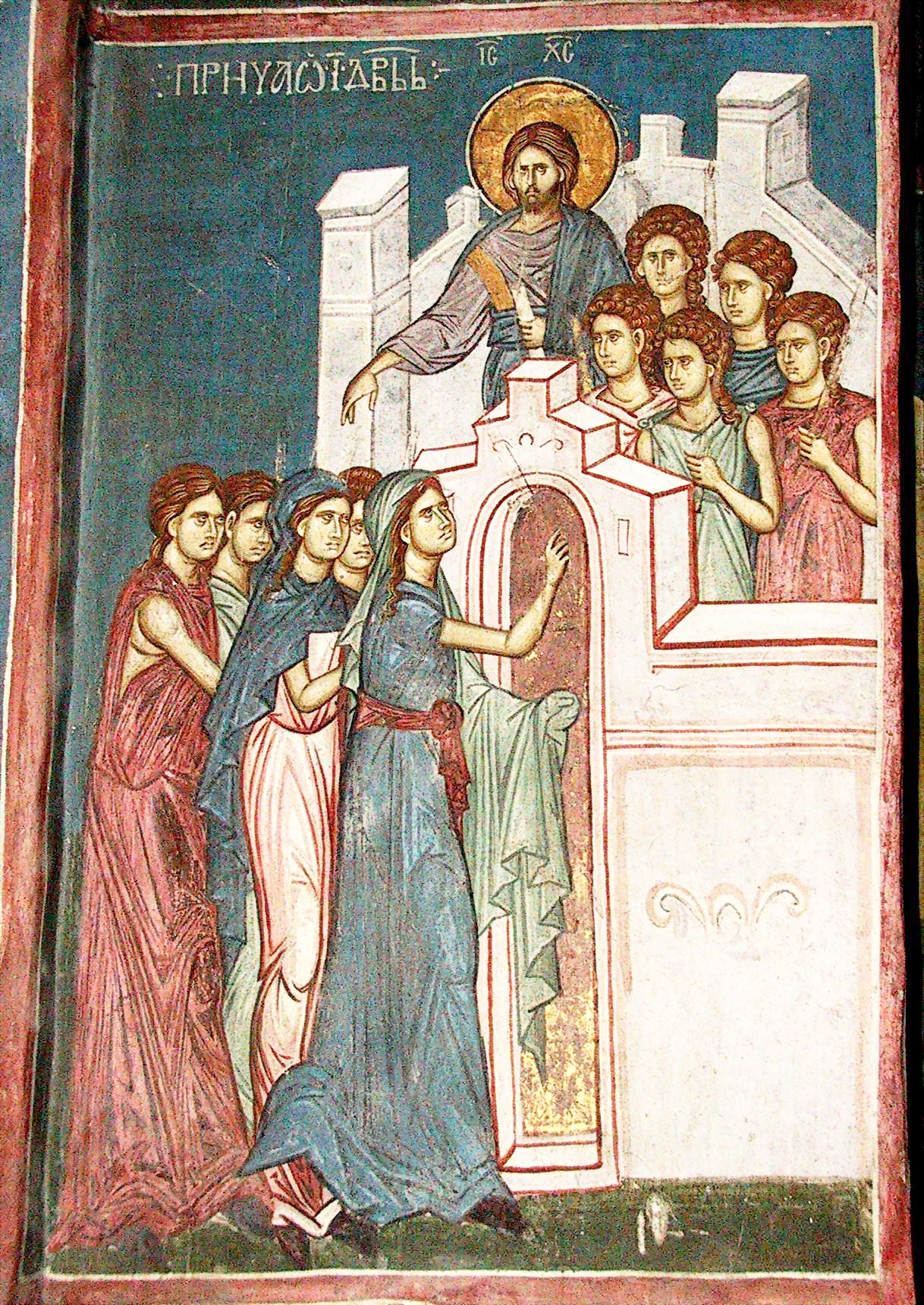
The Parable of the Ten Virgins (source)
    
Selected Quotes of the Fathers on the Parable of the Ten Virgins
The five wise virgins, watchful and alert, had taken oil in the vessels of their heart. That oil, not part of their own nature, means the grace of the Spirit. They were enabled to enter with the Bridegroom into the heavenly bridal chamber. The other five virgins, however, were content with their own nature. They neither watched nor busied themselves to receive the oil of gladness [Ps. 44:6] in their vessels, while they were yet in the flesh. Instead, they sank into sleep through carelessness, slackness, idleness, and ignorance, or even fancied righteousness. Hence, they were shut out of the bridal chamber of the Kingdom, unable to give satisfaction to the heavenly Bridegroom. Held fast by their tie to the world, and by some earthly affection, they did not give their whole love or passionate devotion to the heavenly Bridegroom; thus they were not provided with oil. Souls that seek the sanctification of the Spirit, which is outside of nature, fasten all their affection upon the Lord. It is in the Lord that they walk, pray, and employ their thoughts, turning away from all else. For this cause, they are priviledged to receive the oil of heavenly grace. This enables them to succeed in coming through without falling, giving perfect satisfaction to the spiritual Bridegroom. Those souls, however, content with what belongs to their own nature, creep upon the earth in their thoughts. Not only do they employ their thoughts upon earth, but their minds have their whole existence upon earth. In their own estimation, they appear to belong to the Bridegroom, and to be adorned with the ordinances of the flesh. Nonetheless, they have not been born of the Spirit; and they have not received the oil of gladness.
-Saint Macarios the Great (Fifty Spiritual Homilies, Homily IV)


This parable admonishes us to remain diligent in almsgiving. It counsels us to help our neighbor by every means available to us, since it is impossible to be saved in any other way....For nothing is more sullied than virginity without mercy ... What was the profit of virginity, when they saw not the Bridegroom? Even when they knocked at the door, they did not obtain; instead, they heard the fearful saying, "Depart, I know you not". When he said this, nothing else but hell is left, and that intolerable punishment....This parable was spoken with respect to mercy in almsgiving ... It is also that we might learn how close Christ is joined unto virgins that strip themselves of their possessions; for this indeed is virginity.
-Saint John Chrysostom (Homilies on the Gospel of Matthew, Homily LXXVII)


As it is written: "The day of the Lord shall come as a thief in the night" (1 Thess. 5:2). Then the virgins shall awake, because both good and wicked are roused from the sleep of death. They shall trim their lamps, that is, they shall count the number of their good works for which they hope to receive the reward of eternal happiness. However, the lamps of the foolish virgins shall fail. This is because their works, seen so clearly by men, shall wane and vanish at the coming of the Judge. From God, they shall receive no recompense, for men gave them the praise they esteemed so highly. The blessed will rejoice in their recompense, when they enjoy that vision of Him in Whose presence the elements tremble. They will then go in with Him to the marriage. As they rejoice in the nuptials of the Bridegroom, they themselves will be the bride; for in the bridal chamber of the eternal Kingdom, they are united forever to their God. Thenceforth, that vision can never be snatched from them. The door of the Kingdom will close forever upon those left outside, who then will weep. However, that same door is now open to all penitents. There will be repentance then, but it will be fruitless. When the Bridegroom comes, those that wasted time that might have be used for repentance shall not find pardon. Thus St. Paul warns us: "Behold, now is the accepted time; behold, now is the day of salvation" (2 Cor. 6:2). The Prophet Isaiah says: "Seek ye the Lord, and when ye find Him, call upon Him" (Is. 55:6).
-Saint Gregory the Great (Parables of the Gospel, "The Ten Virgins")
(source)
   

Some say that the shortage of oil of the foolish virgins signifies their shortage of good works in their lives. Such understanding is not exactly correct. How can they be short of good works if they, though foolish, are still called virgins? Chastity is a supreme virtue, the state of being equal to angels, and could itself serve as a substitute for all other virtues. I humbly think that they were actually short of the grace of God's All-Holy Spirit. These virgins did good, and out of their spiritual foolishness supposed that doing good was exactly the point of Christianity. They did good works and by this obeyed God, but they did not care in the least beforehand whether they had received or reached the grace of God's Spirit. This very gaining of the Holy Spirit is that oil which the foolish virgins lacked. They were called foolish because they forgot about the necessary fruit of virtue, the grace of the Holy Spirit, without which no one is saved and no one can be saved, for: ‘it is by the Holy Spirit that any soul is vitalized and exalted in chastity, and any soul is lit by the Trinitarian unity in holy mysteries’. The Holy Spirit moves into our souls, and this installation of the All-Mighty into our souls, and co-existence of His Trinitarian Unity with our spirit is given only through the gaining by all means, the Holy Spirit, which prepares in our soul and body the throne for God’s creative co-existence with our spirit in strict accordance with the word of God: ‘I will dwell among them and will be their God, and they will be my people’. This is the oil in the lamps of wise virgins, oil that burnt bright and long, so that the virgins with the burning lamps could wait until the Bridegroom who came at midnight, and enter with Him into the house of joy. But the foolish virgins, seeing that their lamps were going out, went to the marketplace to buy oil but would not come back in time, for the doors were already shut. The marketplace is our life; the door of the house of marriage (that was shut and did not lead to the Bridegroom) is our human death; wise and foolish virgins are Christian souls; the oil is not works but the grace of the All-Holy Spirit of God which is received through these works, and which converts things perishable into things imperishable, transforms spiritual death into spiritual life, darkness into light, the manger of our being, with passions tied like cattle and beasts, into the Divine Temple, into the glorious palace of never-ending rejoicing in Christ Jesus.
-St. Seraphim of Sarov (Conversation with Nicholas Motovilov) (source)
   

O brothers, let us love the Bridegroom, Let us make ready our lamps, Shining out with brightness and true faith, So that, like the wise virgins at the Lord's coming, We may arrive with Him at the marriage, For He, the Merciful, since He is God, Offers to all as a gift The incorruptible crown!
Thou, O God, the Bridegroom of salvation, the hope of those who hymn Thee, Grant to us who pray to Thee That we find, without stain, in Thy marriage, Just like the virgins The incorruptible crown.
-St Romanos the Melodist - Vol. II, Kontakion On the Ten Virgins I
   

My soul, now we observe these things. There are doors; let my soul not be at the doors; Let it be ready and at hand. It leaves nothing behind, Just as Christ said. As He foretold, all things will happen Famines and pestilence, And continuous earthquakes, And tribe upon tribe will be raised up. Fearful things within and without, Full of battles. It is not possible to be saved anywhere, For everywhere there is danger. Nowhere is there a refuge; there is flight by all men. The gate has been closed, Mercy has been sealed; For we were not chosen To be within the bridal chamber, we are Crying, 'Open.'
-St Romanos the Melodist - Kontakion On the Ten Virgins II
(source)
   
The Parable of the Ten Virgins (source)
    
Through the prayers of our Holy Fathers, Lord Jesus Christ our God, have mercy on us and save us! Amen!

Sunday, October 30, 2011

Selected Quotes of the Fathers on the Parable of the Rich Man and Lazarus

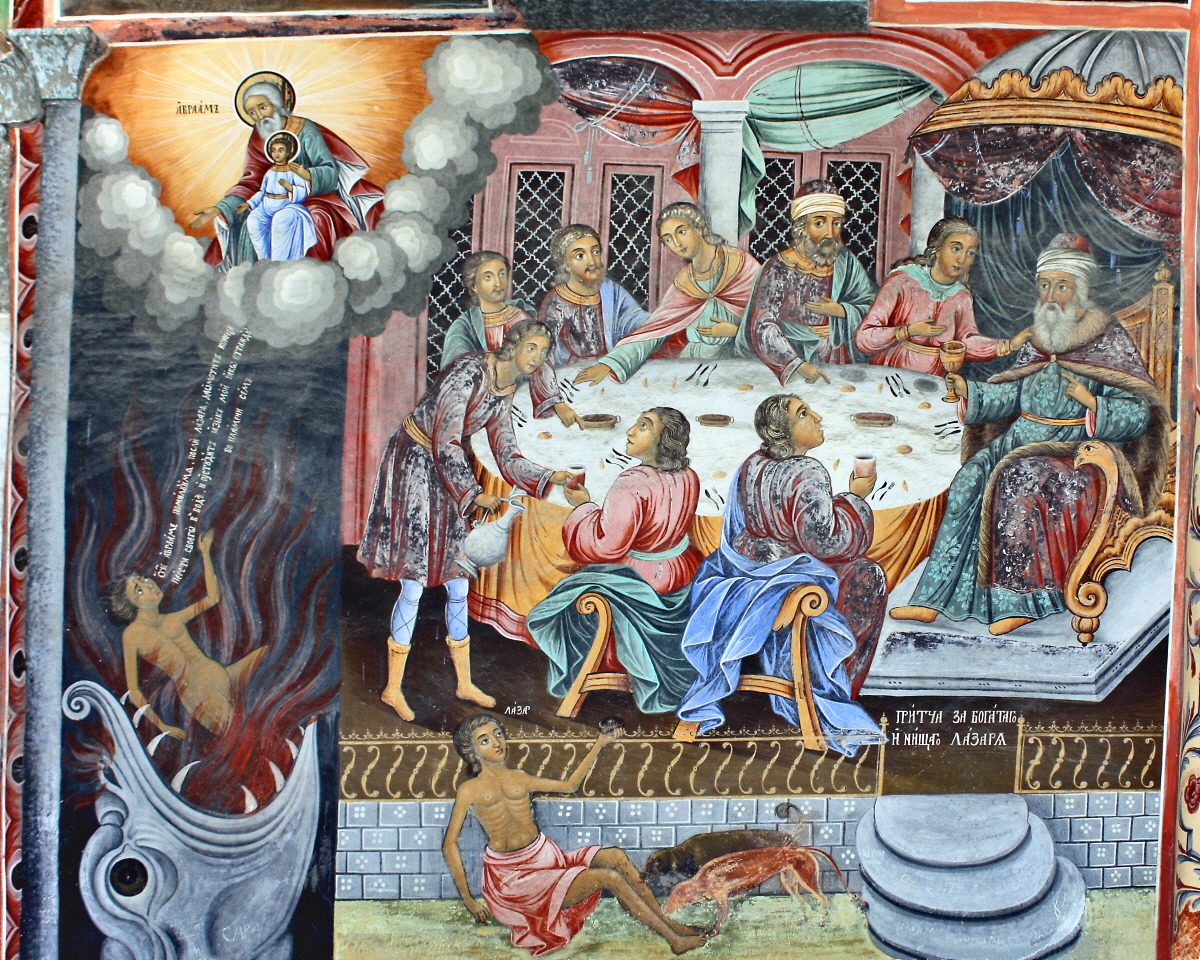
The Rich Man at banquet, and the poor Lazarus, whose sores are being licked by the dogs (http://www.srpskoblago.org/Archives/Decani/exhibits/Collections/PublicMinistry/CX4K2408_l.html)

Selected Quotes of the Fathers on the Parable of the Rich Man and Lazarus (Luke 16:19-31)
"We must observe also, that among the heathen the names of poor men are more likely to be known than of rich. Now our Lord mentions the name of the poor, but not the name of the rich, because God knows and approves the humble, but not the proud."
St Gregory the Great, Pope of Rome

"Lazarus is interpreted, "one who was assisted." For he was poor, and the Lord helped him.
St John Chrysostom

"This discourse concerning the rich man and Lazarus was written after the manner of a comparison in a parable, to declare that they who abound in earthly riches, unless they will relieve the necessities of the poor, shall meet with a heavy condemnation. But the tradition of the Jews relates that there was at that time in Jerusalem a certain Lazarus who was afflicted with extreme poverty and sickness, whom our Lord remembering, introduces him into the example for the sake of adding greater point to His words."
St Cyril of Jerusalem

But the insolence and pride of the wealthy is manifested afterwards by the clearest tokens, for it follows, and no one gave to him. For so unmindful are they of the condition of mankind, that as if placed above nature they derive from the wretchedness of the poor an incitement to their own pleasure, they laugh at the destitute, they mock the needy, and rob those whom they ought to pity."
St Ambrose, Bishop of Milan


"Now if the wearing of fine and precious robes were not a fault, word of God would never have so carefully expressed this. For no one seeks costly garments except for vainglory, that he may seem more honorable than others; for no one wishes to be clothed with such, where he cannot be seen by others."

"And here we must narrowly watch ourselves, seeing that banquets can scarcely be celebrated blamelessly, for almost always luxury accompanies feasting; and when the body is swallowed up in the delight of refreshing itself, the heart relaxes to empty joys."

"But what means it, that when in torments he desires his tongue to be cooled, except that at his feasts having sinned in talking, now by the justice of retribution, his tongue was in fierce flame; for talkativeness is generally rife at the banquet. "
St. Gregory the Great, Pope of Rome


"It may here be observed, that all who are offended by us are exposed to our view. But the rich man sees Lazarus not with any other righteous man, but in Abraham's bosom. For Abraham was full of love, but the man is convicted of cruelty. Abraham sitting before his door followed after those that passed by, and brought them into his house, the other turned away even them that abode within his gate."

"He [the rich man] died then indeed in body, but his soul was dead before. For he did none of the works of the soul. All that warmth which issues from the love of our neighbor had fled, and he was more dead than his body. But no one is spoken of as having ministered to the rich man's burial as to that of Lazarus. Because when he lived pleasantly in the broad road, he had many busy flatterers; when he came to his end, all forsook him. For it simply follows, and was buried in hell. But his soul also when living was buried, enshrined in its body as it were in a tomb."
St John Chrysostom


"And here we must remark what fearful sufferings are heaped upon the rich man in flames. For in addition to his punishment, his knowledge and memory are preserved. He knew Lazarus whom he despised, he remembered his brethren whom he left. For that sinners in punishment may be still more punished, they both see the glory of those whom they had despised, and are harassed about the punishment of those whom they have unprofitably loved."
St Gregory the Great, Pope of Rome

"All this then is said to Him because he chose the happiness of the world, and loved no other life but that in which he proudly boasted; but he says, Lazarus received evil things, because he knew that the perishableness of this life, its labors, sorrows, and sickness, are the penalty of sin, for we all die in Adam who by transgression was made liable to death."
Blessed Augustine

"He says, You received good things in your life, (as if your due;) as though he said, If you have done any good thing for which a reward might be due, you have received all things in that world, living luxuriously, abounding in riches, enjoying the pleasure of prosperous undertakings; but he if he committed any evil has received all, afflicted with poverty, hunger, and the depths of wretchedness. And each of you came hither naked; Lazarus indeed of sin, wherefore he receives his consolation; you of righteous wherefore you endure your inconsolable punishment; and hence it follows, But now he is comforted, and you are tormented. "
St John Chrysostom

"Whatsoever then you have well in this world, when you recollect to have done any thing good, be very fearful about it, lest the prosperity granted you be your recompense for the same good. And when you behold poor men doing any thing blameably, fear not, seeing that perhaps those whom the remains of the slightest iniquity defiles, the fire of honesty cleanses."
 

"Whom does this rich man represent, this man so richly dressed, who enjoyed all those daily banquets? Is it not the Jewish people [or in another sense, hypocritical, false "Christians", for that matter], who made a cult of exterior things, using the delights of the law which they had received, for vain motives, not for true profit? And whom does Lazarus signify, covered in wounds, if not the Gentile peoples? These, when converted to God, were not ashamed to confess their sins, that is to say, they had many wounds and open sores. As when some infection comes from within the body to ulcers of the skin, so showing itself exteriorly, so when we confess our sins, it is in a sense an outbreak of our sores. In confession we manifest in a very profitable way the virus of sin which had concealed its venom within the soul. Exterior wounds bring to the surface the festering sore beneath, and when we confess our sins, we uncover this hidden sore. But the unfortunate Lazarus wished only to eat of the crumbs that fell from the rich man's table, and no one would give him any, because those proud people disdained to admit the Gentiles to the k
nowledge of their law.
St. Gregory the great, Pope of Rome

(http://www.orthodox.net/questions/luke_16_19-31_parable_rich_man_lazarus_22sunape.html)

  
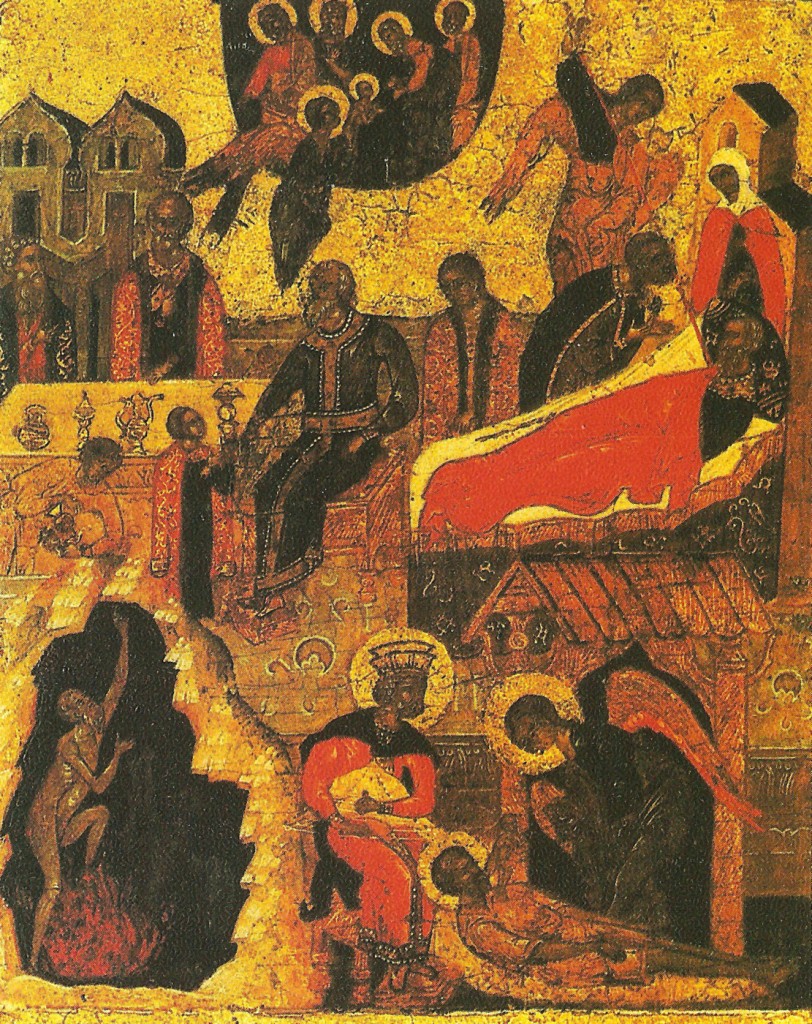
Russian icon depicting the Parable of the Rich Man and Lazarus (source)
  
Through the prayers of our Holy Fathers, Lord Jesus Christ our God, have mercy on us and save us! Amen!