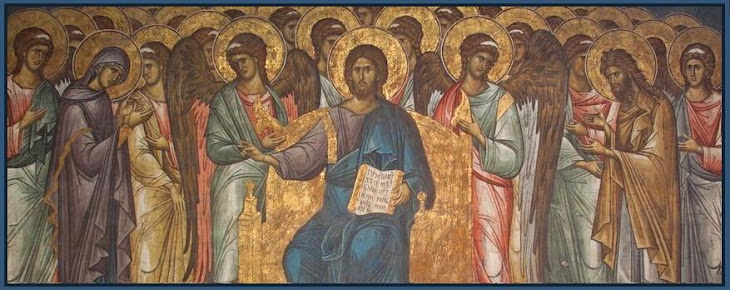

The Nativity of Christ (source)
Homily on the Sunday before Christmas, by Metropolitan Avgoustinos Kantiotes
“...and you will call His name
Jesus.” (Matthew 1:21)
My beloved, how fast time flies! In a
short time we will again celebrate the great feast of Christmas.
Because of this, this Sunday is called the Sunday before the Nativity
of Christ.
Our holy Church ordained to read as the
Gospel today, the beginning, the first chapter of the first Gospel,
that according to Matthew, It is a catalog of the forefathers of
Christ. But, did Christ have forefathers? As the beginningless God,
He did not, He has the heavenly Father. But, as He appeared upon the
earth as a perfect man, except sin, He put on flesh from the pure
blood of the Most-holy Theotokos. And He was born in a supernatural
manner. He has no earthly father, only a mother. His mother is our
Panagia. Her parents are Joachim and Anna, and the parents of Joachim
and Anna are others, and so on. Thus is marked the great chain of the
forefathers.
The first link of the chain of the
forefathers of Christ is a great historical personality, Abraham. To
Abraham, as we hear in the Epistle, was granted a great proposition,
that from his descendants, from the root of Jesse, would be born the
Redeemer.
According to this catalog, from Abraham
until David is 14 generations, from David to the captivity of Babylon
is 14 generations, and from the return from Babylon until the birth
of Christ again is 14 generations (Matthew 1:17). [We hear] about
fifty names, which do not make an impression on us. They are Hebrew
names and seem tiresome, to hear “he gave birth to him”, “who
gave birth to him”, to descend the ladder of the forefathers to
reach the Virgin Mary, from whom Christ was born.
But these names, which we now hear with
indifference, in their era, created a great impression. From them
some were generals, other governors, other prophets, others
patriarchs, others kings, others wealthy, others wise, like Solomon,
David, etc. Now, they don't make an impression. What does this teach
us? Like these names were forgotten, thus those who today make an
impression and are famous and advertised, after 50-100 years, who
will remember them? Somewhere in some page of history, with a small
letter, it will be written that they passed from the earth. All of
the fireworks and lights will be extinguished. The result? “Vanity
of vanities, all is vanity” (Eccl. 1:2). Wealth and positions are
zero, everything is zero. Only one thing remains, for someone to do
the will of God. But while the names of Israeli and universal history
and modern life are drowned in the abyss of time, one name always
remains contemporary, to the spite of the demons. Which? That which
was granted to the Divine Infant. The Angel, according to the command
of the Lord, told Joseph, the protector of the Panagia: “And you
will call His name Jesus.” (Matthew 1:21) What does the name Jesus
mean? It is not Greek, it is Hebrew, and translated it means
“Savior”. The Child that will be born, in other words, is the
Savior. I entreat you to pay attention to this, “the name above
every name.” (Phil. 2:9) Why is Christ called “Savior”? We must
give an explanation.
Here on earth where we live, to where
man was cast from Paradise, in every place, man is scourged by a
variety of misfortunes, which are the consequences of the sinful
life. Hunger, thirst, lacking clothing and shelter, sicknesses...all
of these are dangers, evils which man tries to mitigate. But there
are others as well. There are natural disasters, like earthquakes,
droughts, floods, fires, invasions, incurable sicknesses like cancer,
and ultimately death. All of these are terrible evils.
But still I haven't told you anything.
There is something even more serious—may God enlighten us to
understand it. The number one evil, which forms the root of all evil,
all of our wretchedness—and unfortunately which we do not give
proper meaning to—according to the tongue of the Holy Scriptures,
is sin. From there come all other evils, their cause is sin. We
shudder when we hear of cancer, but sin however does not make us
shudder. We play with her, like children who play with Christmas
presents. We don't perceive anything, and because of this mankind is
scourged. Whether adultery and fornication and lasciviousness,
whether greed and gluttony, whether jealousy and envy, whether anger
and rage and indignation, whether malice and hatred and vengeance and
fear, sin, this is the source of all misery. If we could, with one
miracle, uproot it, then the earth would become Paradise. Who will save
us? And even if we remain silent, the rocks themselves will cry out:
only One saves! Opening the history book, one can count many people
whom the people, for the small service that they offered, were called
“saviors”. But these are small saviors. There is only one Savior:
Christ.
If someone does something good for you,
you remember him, and consider him your benefactor. For example, to
the doctor who healed you, you show gratitude. Above all of those
benefactors however, is Christ, for He saves us from the worst evil:
sin. He saves with His Church.
He is the true Savior. Do we sense
this? Only he who senses his sinfulness and says like the Publican:
“God, have mercy on me, the sinner” (Luke 18:13), or like the
Prodigal Son: “I have sinned against heaven and before you” (Luke
15:18), or like the Thief: “Remember me, O Lord, when You come unto
Your Kingdom” (Luke 23:42), he understands that Christ is the
Savior.
And it is not enough of course to just
say it, that He is the Savior of men in general. We must sense that
He is our personal Savior. God will make you worthy to sense this, if
you bow your head in repentance, and tell your sins to your spiritual
father, if you go to confession. Then, you will sense that a mountain
has been lifted away from you, and you will sense deep gratitude to
Christ.
This is what the Thief on the Cross
sensed, this is what the Apostles, the Martyrs, all the Saints
sensed, like, for example, St. Ignatios the God-bearer, Bishop of
Antioch [whom we celebrate today]. When they led him to Rome in order
to throw him to the beasts, he wrote about Christ: “My eros has
been crucified”, in other words, Christ is the eros of my heart.
There are few loves that move our carnal generation, only sex. I am
not condemning it, God implanted it [within man], but not in order to
quench every other eros. Our generation, the generation of Sodom and
Gomorrah, does not recognize any other loves. It is right what a
philosopher said, that our era is without love. If you don't love
Christ, you have not understood anything, and in vain you came to
earth. Beautiful loves are the eros of science, the eros of the
fatherland, but above all is the eros of Christ.
In older years, the name of Christ was
the sweetest thing. A little child or grandmother would fall to their
knees and make the sign of the Cross, and the first word that they
learned to say was the word “Christ”. I saw such examples. Now,
unfortunately, divine eros not only has been quenched, but some
times, has been turned into utterly satanic hate.
When I was a preacher in Grevena, and
traveled through the high mountains, there where I was walking, I
straightaway heard a blasphemy. The first time I heard such a blasphemy.
My, my! I said, what is going on here? Are there demons dwelling out
here? I approached, therefore, and what did I see? Behind a tree was
sitting a father, who had a little boy at his knees, and was teaching
him to blaspheme Christ! My God, still, the stars have not become
pots to fall upon our heads? Where is the love for Christ? However,
let someone curse and dishonor Christ, His name will remain unto the
ages. Like the black clouds cannot extinguish the sun, thus blasphemies
cannot extinguish the name of Christ. He will remain unto the ages of
ages, to the spite of the demons.
I pray that in our land, that not even
one blasphemy would be heard, but that small and great, man and
woman, all together will say: “Blessed is God, and glorified is His
name”, Whom, O children of the Greeks, praise and exalt supremely, unto all the ages. Amen.
+Bishop Avgoustinos
(delivered in the Church of Sts.
Constantine and Helen, Amyntaiou, 12/20/1987, amateur translation of text from source)
Through the prayers of our Holy Fathers, Lord Jesus Christ our God, have mercy on us and save us! Amen!


