Showing posts with label St. Gregory the Wonderworker. Show all posts

Sunday, March 25, 2012

Second Homily of St. Gregory the Wonderworker on the Annunciation to the Theotokos


Second Homily of St. Gregory the Wonderworker on the Annunciation to the Theotokos
It is our duty to present to God, like sacrifices, all the festivals and hymnal celebrations; and first of all, the annunciation to the holy mother of God, to wit, the salutation made to her by the angel, “Hail, thou that art highly favoured!” For first of all wisdom and saving doctrine in the New Testament was this salutation, “Hail, thou that art highly favoured!” conveyed to us from the Father of lights. And this address, “highly favoured,” embraced the whole nature of men. “Hail, thou that art highly favoured” in the holy conception and in the glorious pregnancy, “I bring you good tidings of great joy, which shall be to all people.” And again the Lord, who came for the purpose of accomplishing a saving passion, said, “I will see you, and you shall rejoice; and your joy no man takes from you.” And after His resurrection again, by the hand of the holy women, He gave us first of all the salutation “Hail! ‘ And again, the apostle made the announcement in similar terms, saying, ‘Rejoice evermore: pray without ceasing: in everything give thanks.’ See, then, dearly beloved, how the Lord has conferred upon us everywhere, and indivisibly, the joy that is beyond conception, and perennial. For since the holy Virgin, in the life of the flesh, was in possession of the incorruptible citizenship, and walked as such in all manner of virtues, and lived a life more excellent than man's common standard; therefore he Word that comes from God the Father thought it meet to assume the flesh, and endue the perfect man from her, in order that in the same flesh in which sin entered into the world, and death by sin, sin might be condemned in the flesh, and that the tempter of sin might be overcome in the burying of the holy body, and that therewith also the beginning of the resurrection might be exhibited, and life eternal instituted in the world, and fellowship established for men with God the Father. And what shall we state, or what shall we pass by here? Or who shall explain what is incomprehensible in the mystery? But for the present let us fall back upon our subject. Gabriel was sent to the holy virgin; the incorporeal was dispatched to her who in the body pursued the incorruptible conversation, and lived in purity and in virtues. And when he came to her, he first addressed her with the salutation, ‘Hail, thou that art highly favoured! The Lord is with you.’ Hail, thou that art highly favoured! For you do what is worthy of joy indeed, since you have put on the vesture of purity, and are girt with the cincture of prudence. Hail, thou that art highly favoured! For to your lot it has fallen to be the vehicle of celestial joy. Hail, thou that art highly favoured! For through you joy is decreed for the whole creation, and the human race receives again by you its pristine dignity. Hail, thou that art highly favoured! For in your arms the
Creator of all things shall be carried. And she was perplexed by this word; for she was inexperienced in all the addresses of men, and welcomed quiet, as the mother of prudence and purity; (yet) being a pure, and immaculate, and stainless image herself, she shrank not in terror from the angelic apparition, like most of the prophets, as indeed true virginity has a kind of affinity and equality with the angels. For the holy Virgin guarded carefully the torch of virginity, and gave diligent heed that it should not be extinguished or defiled. And as one who is clad in a brilliant robe deems it a matter of great moment that no impurity or filth be suffered to touch it anywhere, so did the holy Mary consider with herself, and said: Does this act of attention imply any deep design or seductive purpose? Shall this word ‘Hail’ prove the cause of trouble to me, as of old the fair promise of being made like God, which was given her by the serpent-devil, proved to our first mother Eve? Has the devil, who is the author of all evil, become transformed again into an angel of light; and bearing a grudge against my espoused husband for his admirable temperance, and having assailed him with some fair-seeming address, and finding himself powerless to overcome a mind so firm, and to deceive the man, has he turned his attack upon me, as one endowed with a more susceptible mind; and is this word ‘Hail’ (Grace be with you) spoken
as the sign of gracelessness hereafter? Is this benediction and salutation uttered in irony? Is there not
some poison concealed in the honey? Is it not the address of one who brings good tidings, while the end of the same is to make me the designer's prey? And how is it that he can thus salute one whom he
knows not? These things she pondered in perplexity with herself, and expressed in words. Then again
the archangel addressed her with the announcement of a joy which all may believe in, and which shall
not be taken away, and said to her, ‘Fear not, Mary, for you have found favour with God.’ Shortly have
you the proof of what has been said. For I not only give you to understand that there is nothing to fear,
but I show you the very key to the absence of all cause for fear. For through me all the heavenly powers hail you, the holy virgin: yea rather, He Himself, who is Lord of all the heavenly powers and of all creation, has selected you as the holy one and the wholly fair; and through your holy, and chaste, and pure, and undefiled womb the enlightening Pearl comes forth for the salvation of all the world: since of all the race of man you are by birth the holy one, and the more honourable, and the purer, and the more pious than any other: and you have a mind whiter than the snow, and a body made purer than any gold, however fine, and a womb such as the object which Ezekiel saw, and which he has described in these terms: ‘And the likeness of the living creatures upon the head was as the firmament, and as the
appearance of the terrible crystal, and the likeness of the throne above them was as the appearance of a
sapphire-stone: and above the throne it was as the likeness of a man, and as the appearance of amber;
and within it there was, as it were, the likeness of fire round about.

Clearly, then, did the prophet behold in type Him who was born of the holy virgin, whom you, O holy
virgin, would have had no strength to bear, had you not beamed forth for that time with all that is
glorious and virtuous. And with what words of laudation, then, shall we describe her virgin-dignity?
With what indications and proclamations of praise shall we celebrate her stainless figure? With what
spiritual song or word shall we honour her who is most glorious among the angels? She is planted in
the house of God like a fruitful olive that the Holy Spirit overshadowed; and by her means are we
called sons and heirs of the kingdom of Christ. She is the ever-blooming paradise of incorruptibility,
wherein is planted the tree that gives life, and that furnishes to all the fruits of immortality. She is the
boast and glory of virgins, and the exultation of mothers. She is the sure support of the believing, and
the succourer of the pious. She is the vesture of light, and the domicile of virtue. She is the everflowing
fountain, wherein the water of life sprang and produced the Lord's incarnate manifestation. She is the monument of righteousness; and all who become lovers of her, and set their affections on virginlike
ingenuousness and purity, shall enjoy the grace of angels. All who keep themselves from wine and
intoxication, and from the wanton enjoyments of strong drink, shall be made glad with the products of
the life-bearing plant. All who have preserved the lamp of virginity unextinguished shall be privileged
to receive the amaranthine crown of immortality. All who have possessed themselves of the stainless
robe of temperance shall be received into the mystical bride-chamber of righteousness. All who have
come nearer the angelic degree than others shall also enter into the more real enjoyment of their Lord's
beatitude. All who have possessed the illuminating oil of understanding, and the pure incense of
conscience, shall inherit the promise of spiritual favour and the spiritual adoption. All who worthily
observe the festival of the Annunciation of the Virgin Mary, the mother of God, acquire as their meet
recompense the fuller interest in the message, ‘Hail, thou that art highly favoured!’ It is our duty,
therefore, to keep this feast, seeing that it has tilled the whole world with joy and gladness. And let us
keep it with psalms, and hymns, and spiritual songs. Of old did Israel also keep their festival, but then it was with unleavened bread and bitter herbs, of which the prophet says: ‘I will turn their feasts into
afflictions and lamentation, and their joy into shame.’ But our afflictions our Lord has assured us He
will turn into joy by the fruits of penitence. And again, the first covenant maintained the righteous
requirements of a divine service, as in the case of our forefather Abraham; but these stood in the
inflictions of pain in the flesh by circumcision, until the time of the fulfilment. ‘The law was given to
them through Moses’ for their discipline; ‘but grace and truth’ have been given to us by Jesus Christ.
The beginning of all these blessings to us appeared in the annunciation to Mary, the highly-favoured, in
the economy of the Saviour which is worthy of all praise, and in His divine and supra-mundane
instruction. Thence rise the rays of the light of understanding upon us. Thence spring for us the fruits of wisdom and immortality, sending forth the clear pure streams of piety. Thence come to us the brilliant splendours of the treasures of divine knowledge. ‘For this is life eternal, that we may know the true God, and Jesus Christ whom He has sent.’ And again, ‘Search the Scriptures, for in them you think you have eternal life.’ For on this account the treasure of the knowledge of God is revealed to them who search the divine oracles. That treasure of the inspired Scriptures the Paraclete has unfolded to us this day. And let the tongue of prophecy and the doctrine of apostles be the treasure of wisdom to us; for without the law and the prophets, or the evangelists and the apostles, it is not possible to have the certain hope of salvation. For by the tongue of the holy prophets and apostles our Lord speaks, and God takes pleasure in the words of the saints; not that He requires the spoken address, but that He delights in the good disposition; not that He receives any profit from men, but that He finds a restful satisfaction in the rightly-affected soul of the righteous. For it is not that Christ is magnified by what we say; but as we receive benefits from Him, we proclaim with grateful mind His beneficence to us; not that we can attain to what is worthy therein, but that we give the meet return to the best of our ability. And when the Gospels or the Epistles, therefore, are read, let not your attention centre on the book or on the reader, but on the God who speaks to you from heaven. For the book is but that which is seen, while Christ is the divine subject spoken of. It brings us then the glad tidings of that economy of the Saviour, which is worthy of all praise, to wit, that, though He was God, He became man through kindness toward man, and did not lay aside, indeed, the dignity which was His from all eternity, but assumed the economy that should work salvation. It brings us the glad tidings of that economy of the Saviour worthy of all praise, to wit, that He sojourned with us as a physician for the sick, who did not heal them with potions, but restored them by the inclination of His philanthropy. It brings us the glad tidings of this economy of the Saviour altogether to be praised, to wit, that to them who had wandered astray the way of salvation was shown, and that to the despairing the grace of salvation was made known, which blesses all in different modes; searching after the erring, enlightening the blinded, giving life to the dead, setting free the slaves, redeeming the captives, and becoming all things to all of us in order to be the true way of salvation to us: and all this He does, not by reason of our goodwill toward Him, but in virtue of a benignity that is proper to our Benefactor Himself. For the Saviour did all, not in order that He might acquire virtue Himself, but that He might put us in possession of eternal life. He made man, indeed, after the image of God, and appointed him to live in a paradise of pleasure. But the man being deceived by the devil, and having become a transgressor of the divine commandment, was made subject to the doom of death. Whence, also, those born of him were involved in their father's liability in virtue of their succession, and had the reckoning of condemnation required of them. ‘For death reigned from Adam to Moses.’ But the Lord. in His benignity toward man, when He saw the creature He Himself had formed now held by the power of death, did not turn away finally from him whom He had made in His own image, but visited him in each generation, and forsook him not; and manifesting Himself first of all among the patriarchs, and then proclaiming Himself in the law, and presenting the likeness of Himself in the prophets, He presignified the economy of salvation. When, moreover, the fullness of the times came for His glorious appearing, He sent beforehand the archangel Gabriel to bear the glad tidings to the Virgin Mary. And he came down from the ineffable powers above to the holy Virgin, and addressed her first of all with the salutation, ‘Hail, thou that art highly favoured.’ And when this word, ‘Hail, thou that art highly favoured,’ reached her, in the very moment of her hearing it, the Holy Spirit entered into the undefiled temple of the Virgin, and her mind and her members were sanctified together. And nature stood opposite, and natural intercourse at a distance, beholding with amazement the Lord of nature, in a manner contrary to nature, or rather above nature, doing a miraculous work in the body; and by the very weapons by which the devil strove against us, Christ also saved us, taking to Himself our passible body in order that He might impart the greater grace to the being who was deficient in it. And ‘where sin abounded, grace did much more abound.’ And appropriately was grace sent to the holy Virgin. For this word also is contained in the oracle of the evangelic history: ‘And in the sixth month the angel Gabriel was sent to a virgin espoused to a man whose name was Joseph, of the house and lineage of David; and the virgin's name was Mary; ’ and so forth. And this was the first month to the holy Virgin. Even as Scripture says in the book of the law: ‘This month shall be unto you the beginning of months: it shall be the first month among the months of the year to you.’ ‘Keep the feast of the holy passover to the Lord in all your generations.’ it was also the sixth month to Zacharias. And rightly, then, did the holy Virgin prove to be of the family of David, and she had her home in Bethlehem, and was betrothed rightfully to Joseph, in accordance with the laws of relationship. And her espoused husband was her guardian, and possessor also of the untarnished incorruption which was hers. And the name given to the holy Virgin was one that became her exceedingly. For she was called Mary, and that, by interpretation, means illumination. And what shines more brightly that the light of virginity? For this reason also the virtues are called virgins by those who strive rightly to get at their true nature. But if it is so great a blessing to have a virgin heart, how great a boon will it be to have the flesh that cherishes virginity along with the soul!

Thus the holy Virgin, while still in the flesh, maintained the incorruptible life, and received in faith the
things which were announced by the archangel. And thereafter she journeyed diligently to her relation
Elisabeth in the hill-country. ‘And she entered into the house of Zacharias, and saluted Elisabeth,’ in
imitation of the angel. ‘And it came to pass, that, when Elisabeth heard the salutation of Mary, the babe
leapt with joy in her womb; and Elisabeth was filled with the Holy [Spirit].’ Thus the voice of Mary
wrought with power, and filled Elisabeth with the Holy [Spirit]. And by her tongue, as from an everflowing fountain, she sent forth a stream of gracious gifts in the way of prophecy to her relation; and while the feet of her child were bound in the womb, she prepared to dance and leap. And that was the sign of a marvellous jubilation. For wherever she was who was highly favoured, there she filled all
things with joy. ‘And Elisabeth spoke out with a loud voice, and said, Blessed are you among women,
and blessed is the fruit of your womb. And whence is this to me, that the mother of my Lord should
come to me? Blessed are you among women.’ For you have become to women the beginning of the
new creation. You have given to us boldness of access into paradise, and you have put to flight our
ancient woe. For after you the race of woman shall no more be made the subject of reproach. No more
do the successors of Eve fear the ancient curse, or the pangs of childbirth. For Christ, the Redeemer of
our race, the Saviour of all nature, the spiritual Adam who has healed the hurt of the creature of earth,
comes forth from your holy womb. ‘Blessed are you among women, and blessed is the fruit of your
womb.’ For He who bears all blessings for us is manifested as your fruit. This we read in the clear
words of her who was barren; but yet more clearly did the holy Virgin herself express this again when
she presented to God the song replete with thanksgiving, and acceptance, and divine knowledge;
announcing ancient things together with what was new; proclaiming along with things which were of
old, things also which belong to the consummation of the ages; and summing up in a short discourse
the mysteries of Christ. ‘And Mary said, My soul magnifies the Lord, and my spirit has rejoiced in God
my Saviour,’ and so forth. ‘He has helped His servant Israel in remembrance of His mercy, and of the
covenant which He established with Abraham and with his seed for ever.’ You see how the holy Virgin
has surpassed even the perfection of the patriarchs, and how she confirms the covenant which was
made with Abraham by God, when He said, ‘This is the covenant which I shall establish between me
and you.’ Wherefore He has come and confirmed the covenant with Abraham, having received
mystically in Himself the sign of circumcision, and having proved Himself the fulfilment of the law
and the prophets. This song of prophecy, therefore, did the holy mother of God render to God, saying,
‘My soul magnifies the Lord, and my spirit has rejoiced in God my Saviour: for He that is mighty has
done to me great things, and holy is His name.’ For having made me the mother of God, He has also
preserved me a virgin; and by my womb the fullness of all generations is headed up together for
sanctification. For He has blessed every age, both men and women, both young men and youths, and
old men. ‘He has made strength with His arm,’ on our behalf, against death and against the devil,
having torn the handwriting of our sins. ‘He has scattered the proud in the imagination of their hearts;
’yea, He has scattered the devil himself, and all the demons that serve under him. For he was
overweeningly haughty in his heart, seeing that he dared to say, ‘I will set my throne above the clouds,
and I will be like the Most High.’ And now, how He scattered him the prophet has indicated in what
follows, where he says, ‘Yet now you shall be brought down to hell,’ and all your hosts with you. For
He has overthrown everywhere his altars and the worship of vain gods, and He has prepared for
Himself a peculiar people out of the heathen nations. ‘He has put down the mighty from their seats, and
exalted them of low degree.’ In these terms is intimated in brief the extrusion of the Jews and the
admission of the Gentiles. For the elders of the Jews and the scribes in the law, and those who were
richly privileged with other prerogatives, because they used their riches ill and their power lawlessly,
were cast down by Him from every seat, whether of prophecy or of priesthood, whether of legislature
or of doctrine, and were stripped of all their ancestral wealth, and of their sacrifices and multitudinous
festivals, and of all the honourable privileges of the kingdom. Spoiled of all these boons, as naked
fugitives they were cast out into captivity. And in their stead the humble were exalted, namely, the
Gentile peoples who hungered after righteousness. For, discovering their own lowliness, and the hunger that pressed upon them for the knowledge of God, they pleaded for the divine word, though it were but for crumbs of the same, like the woman of Canaan; and for this reason they were filled with the riches of the divine mysteries. For the Christ who was born of the Virgin, and who is our God, has given over the whole inheritance of divine blessings to the Gentiles. ‘He has helped His servant Israel.’ Not any Israel in general, indeed, but His servant, who in very deed maintains the true nobility of Israel. And on this account also did the mother of God call Him servant (Son) and heir. For when He had found the same labouring painfully in the letter and the law, He called him by grace. It is such an Israel, therefore, that He called and has helped in remembrance of His mercy. ‘As He spoke to our fathers, I to Abraham and to his seed for ever.’ In these few words is comprehended the whole mystery of the economy. For, with the purpose of saving the race of men, and fulfilling the covenant that was made with our fathers, Christ has once ‘bowed the heavens and come down.’ And thus He shows Himself to us as we are capable of receiving Him, in order that we might have power to see Him, and handle Him, and hear Him when the speaks. And on this account did God the Word deem it meet to take to Himself the flesh and the perfect humanity by a woman, the holy Virgin; and He was born a man, in order that He might discharge our debt, and fulfil even in Himself the ordinances of the covenant made with Abraham, in its rite of circumcision, and all the other legal appointments connected with it. And after she had spoken these words the holy Virgin went to Nazareth; and from that a decree of Caesar led her to come again to Bethlehem; and so, as proceeding herself from the royal house, she was brought to the royal house of David along with Joseph her espoused husband. And there ensued there the mystery which transcends all wonders,—the Virgin brought forth and bore in her hand Him who bears the whole creation by His word. ‘And there was no room for them in the inn.’ He found no room who founded the whole earth by His word. She nourished with her milk Him who imparts sustenance and life to everything that has breath. She wrapped Him in swaddling-clothes who binds the whole creation fast with His word. She laid Him in a manger who rides seated upon the cherubim. A light from heaven shone round about Him who lightens the whole creation. The hosts of heaven attended Him with their doxologies who is glorified in heaven from before all ages. A star with its torch guided them who had come from the distant parts of earth toward Him who is the true Orient. From the East came those who brought gifts to Him who for our sakes became poor. And the holy mother of God kept these words, and pondered them in her heart, like one who was the receptacle of all the mysteries. Your praise, O most holy Virgin, surpasses all laudation, by reason of the God who received the flesh and was born man of you. To you every creature, of things in heaven, and things on earth, and things under the earth, offers the meet offering of honour. For you have been indeed set forth as the true cherubic throne. You shine as the very brightness of light in the high places of the kingdoms of intelligence; where the Father, who is without beginning, and whose power you had overshadowing you, is glorified; where also the Son is worshipped, whom you bore according to the flesh; and where the Holy Spirit is praised, who effected in your womb the generation of the mighty King. Through you, O thou that art highly favoured, is the holy and consubstantial Trinity known in the world. Together with yourself, deem us also worthy to be made partakers of your perfect grace in Jesus Christ our Lord: with whom, and with the Holy Spirit, be glory to the Father, now and ever, and unto the ages of the ages. Amen.
(Note: hosted by a non-Orthodox site: http://www.newadvent.org/fathers/06092.htm)
  
  
Most-Holy Theotokos, save us!
Through the prayers of our Holy Fathers, Lord Jesus Christ our God, have mercy on us and save us! Amen!

Thursday, March 25, 2010

First Homily of St. Gregory the Wonderworker on the Annunciation to the Holy Virgin Mary

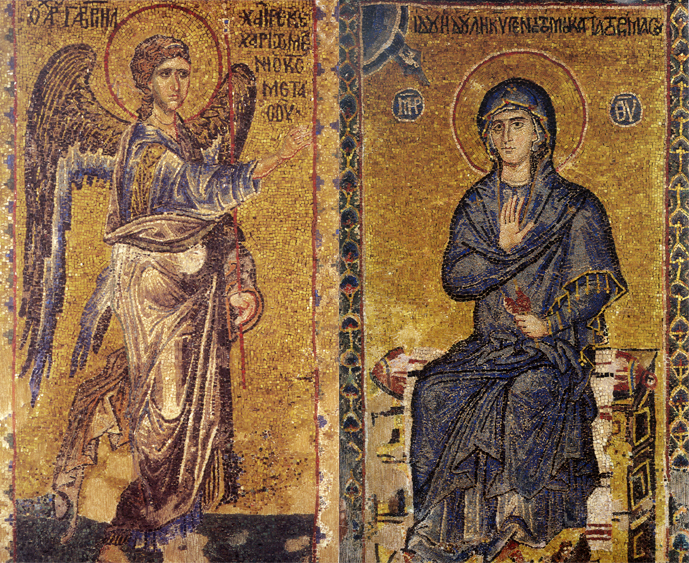
The Holy Annunciation to the Most-Holy Theotokos (14th Century Mosaic from the Katholikon of Vatopedi Monastery, Mount Athos, from: http://vatopaidi.files.wordpress.com/2010/03/evagelismos.jpg)

First Homily of St. Gregory the Wonderworker on the Annunciation to the Holy Virgin Mary
"To-Day are strains of praise sung joyfully by the choir of angels, and the light of the advent of Christ shines brightly upon the faithful. Today is the glad spring-time to us, and Christ the Sun of righteousness has beamed with clear light around us, and has illumined the minds of the faithful. To-day is Adam made anew, and moves in the choir of angels, having winged his way to heaven. To-day is the whole circle of the earth filled with joy, since the sojourn of the Holy Spirit has been realized to men. To-day the grace of God and the hope of the unseen shine through all wonders transcending imagination, and make the mystery that was kept hid from eternity plainly discernible to us. To-day are woven the chaplets of never-fading virtue. To-day, God, willing to crown the sacred heads of those whose pleasure is to hearken to Him, and who delight in His festivals, invites the lovers of unswerving faith as His called and His heirs; and the heavenly kingdom is urgent to summon those who mind celestial things to join the divine service of the incorporeal choirs. To-day is fulfilled the word of David, "Let the heavens rejoice, and let the earth be glad. The fields shall be joyful, and all the trees of the wood before the Lord, because He cometh." David thus made mention of the trees; and the Lord's forerunner also spoke of them as trees "that should bring forth fruits meet for repentance," or rather for the coming of the Lord. But our Lord Jesus Christ promises perpetual gladness to all those who believe on Him. For He says, "I will see you, and ye shall rejoice; and your joy no man taketh from you." To-day is the illustrious and ineffable mystery of Christians, who have willingly set their hope like a seal upon Christ, plainly declared to us. To-day did Gabriel, who stands by God, come to the pure virgin, bearing to her the glad annunciation, "Hail, thou that art highly favoured! And she cast in her mind what manner of salutation this might be. And the angel immediately proceeded to say, The Lord is with thee: fear not, Mary; for thou hast found favour with God. Behold, thou shalt conceive in thy womb, and bring forth a son, and shalt call His name Jesus. He shall be great, and shall be called the Son of the Highest; and the Lord God shall give unto Him the throne of His father David, and He shall reign over the house of Jacob for ever: and of His kingdom there shall be no end. Then said Mary unto the angel, How shall this be, seeing I know not a man? " Shall I still remain a virgin? is the honour of virginity not then lost by me? And while she was yet in perplexity as to these things, the angel placed shortly before her the summary of his whole message, and said to the pure virgin, "The Holy [Spirit] shall come upon thee, and the power of the Highest shall overshadow thee; therefore also that holy thing which shall be born of thee shall be called the Son of God." For what it is, that also shall it be called by all means. Meekly, then, did grace make election of the pure Mary alone out of all generations. For she proved herself prudent truly in all things; neither has any woman been born like her in all generations. She was not like the primeval virgin Eve, who, keeping holiday alone in paradise, with thoughtless mind, unguardedly hearkened to the word of the serpent, the author of all evil, and thus became depraved in the thoughts of her mind; and through her that deceiver, discharging his poison and refusing death with it, brought it into the whole world; and in virtue of this has arisen all the trouble of the saints. But in the holy Virgin alone is the fall of that (first mother) repaired. Yet was not this holy one competent to receive the gift until she had first learned who it was that sent it, and what the gift was, and who it was that conveyed it. While the holy one pondered these things in perplexity with herself, she says to the angel, "Whence hast thou brought to us the blessing in such wise? Out of what treasure-stores is the pearl of the word despatched to us? Whence has the gift acquired its purpose toward us? From heaven art thou come, yet thou walkest upon earth! Thou dost exhibit the form of man, and (yet) thou art glorious with dazzling light." These things the holy one considered with herself, and the archangel solved the difficulty expressed in such reasonings by saying to her: "The Holy [Spirit] shall come upon thee, and the power of the Highest shall overshadow thee. Therefore also that holy thing which shall be born of thee shall be called the Son of God. And fear not, Mary; for I am not come to overpower thee with fear, but to repel the subject of fear. Fear not, Mary, for thou hast found favour with God. Question not grace by the standard of nature. For grace does not endure to pass under the laws of nature. Thou knowest, O Mary, things kept hid from the patriarchs and prophets. Thou hast learned, O virgin, things which were kept concealed till now from the angels. Thou hast heard, O purest one, things of which even the choir of inspired men was never deemed worthy. Moses, and David, and Isaiah, and Daniel, and all the prophets, prophesied of Him; but the manner they knew not. Yet thou alone, O purest virgin, art now made the recipient of things of which all these were kept in ignorance, and thou dost learn the origin of them. For where the Holy Spirit is, there are all things readily ordered. Where divine grace is present, all things are found possible with God. The Holy [Spirit] shall come upon thee, and the power of the Highest shall; overshadow thee. Therefore also that holy thing which shall be born of thee shall be called the Son of God." And if He is the Son of God, then is He also God, of one form with the Father, and co-eternal; in Him the Father possesses all manifestation; He is His image in the person, and through His reflection the (Father's) glory shines forth. And as from the ever-flowing fountain the streams proceed, so also from this ever-flowing and ever-living fountain does the light of the world proceed, the perennial and the true, namely Christ our God. For it is of this that the prophets have preached: "The streams of the river make glad the city of God." And not one city only, but all cities; for even as it makes glad one city, so does it also the whole world. Appropriately, therefore, did the angel say to Mary the holy virgin first of all, "Hail, thou that art highly favoured, the Lord is with thee; "inasmuch as with her was laid up the full treasure of grace. For of all generations she alone has risen as a virgin pure in body and in spirit; and she alone bears Him who bears all things on His word. Nor is it only the beauty of this holy one in body that calls forth our admiration, but also the innate virtue of her soul. Wherefore also the angels addressed her first with the salutation, "Hail, thou that art highly favoured, the Lord is with thee, and no spouse of earth; "He Himself is with thee who is the Lord of sanctification, the Father of purity, the Author of incorruption, and the Bestower of liberty, the Curator of salvation, and the Steward and Provider of the true peace, who out of the virgin earth made man, and out of man's side formed Eve in addition. Even this Lord is with thee, and on the other hand also is of thee. Come, therefore, beloved brethren, and let us take up the angelic strain, and to the utmost of our ability return the due meed of praise, saying, "Hail, thou that art highly favoured, the Lord is with thee!" For it is thine truly to rejoice, seeing that the grace of God, as he knows, has chosen to dwell with thee-the Lord of glory dwelling with the handmaiden; "He that is fairer than the children of men " with the fair virgin; He who sanctifies all things with the undefiled. God is with thee, and with thee also is the perfect man in whom dwells the whole fulness of the Godhead. Hail, thou that art highly favoured, the fountain of the light that lightens all who believe upon Him! Hail, thou that art highly favoured, the rising of the rational Sun, and the undefiled flower of Life! Hail, thou that art highly favoured, the mead of sweet savour! Hail, thou that art highly favoured, the ever-blooming vine, that makes glad the souls of those who honour thee? Hail, thou that art highly favoured!-the soil that, all untilled, bears bounteous fruit: for thou hast brought forth in accordance with the law of nature indeed, as it goes with us, and by the set time of practice, and yet in a way beyond nature, or rather above nature, by reason that God the Word from above took His abode in thee, and formed the new Adam in thy holy womb, and inasmuch as the Holy [Spirit] gave the power of conception to the holy virgin; and the reality of His body was assumed from her body. And just as the pearl comes of the two natures, namely lightning and water, the occult signs of the sea; so also our Lord Jesus Christ proceeds, without fusion and without mutation, from the pure, and chaste, and undefiled, and holy Virgin Mary; perfect in divinity and perfect in humanity, in all things equal to the Father, and in all things consubstantial with us, apart from sin.


Most of the holy fathers, and patriarchs, and prophets desired to see Him, and to be eye-witnesses of Him, but did not attaint hereto. And some of them by visions beheld Him in type, and darkly; others, again, were privileged to hear the divine voice through the medium of the cloud, and were favoured with sights of holy angels; but to Mary the pure virgin alone did the archangel Gabriel manifest himself luminously, bringing her the glad address, "Hail, thou that art highly favoured!" And thus she received the word, and in the due time of the fulfilment according to the body's course she brought forth the priceless pearl. Come, then, ye too, dearly beloved, and let us chant the melody which has been taught us by the inspired harp of David, and say, "Arise, O Lord, into Thy rest; Thou, and the ark of Thy sanctuary." For the holy Virgin is in truth an ark, wrought with gold both within and without, that has received the whole treasury of the sanctuary. "Arise, O Lord, into Thy rest." Arise, O Lord, out of the bosom of the Father, in order that Thou mayest raise up the fallen race of the first-formed man. Setting these things forth, David in prophecy said to the rod that was to spring from himself, and to sprout into the flower of that beauteous fruit, "Hearken, O daughter, and see, and incline thine ear, and forget thine own people and thy father's house; so shall the King greatly desire thy beauty: for He is the Lord thy God, and thou shalt worship Him." Hearken, O daughter, to the things which were prophesied beforetime of thee, in order that thou mayest also behold the things themselves with the eyes of understanding. Hearken to me while I announce things beforehand to thee, and hearken to the archangel who declares expressly to thee the perfect mysteries. Come then, dearly beloved, and let us fall back on the memory of what has gone before us; and let us glorify, and celebrate, and laud, and bless that rod that has sprung so marvellously from Jesse. For Luke, in the inspired Gospel narratives, delivers a testimony not to Joseph only, but also to Mary the mother of God, and gives this account with reference to the very family and house of David: "For Joseph went up," says he, "from Galilee, unto a city of Judea which is called Bethlehem, to be taxed with Mary his espoused wife, being great with child, because they were of the house and family of David. And so it was, that while they were there, the days were accomplished that she should be delivered; and she broughtforth her son, the first-born of the whole creation, and wrapped him in swaddling-clothes, and laid him in a manger, because there was no room for them in the inn." She wrapped in swaddling-clothes Him who is covered with light as with a garment. She wrapped in swaddling-clothes Him who made every creature. She laid in a manger Him who sits above the cherubim, and is praised by myriads of angels. In the manger set apart for dumb brutes did the Word of God repose, in order that He might impart to men, who are really irrational by free choice, the perceptions of true reason. In the board from which cattle eat was laid the heavenly Bread, in order that He might provide participation in spiritual sustenance for men who live like the beasts of the earth. Nor was there even room for Him in the inn. He found no place, who by His word established heaven and earth; "for though He was rich, for our sakes He became poor," and chose extreme humiliation on behalf of the salvation of our nature, in His inherent goodness toward us. He who fulfilled the whole administration of unutterable mysteries of the economy in heaven in the bosom of the Father, and in the cave in the arms of the mother, reposed in the manger. Angelic choirs encircled Him, singing of glory in heaven and of peace upon earth. In heaven He was seated at the right hand of the Father; and in the manger He rested, as it were, upon the cherubim. Even there was in truth His cherubic throne; there was His royal seat. Holy of the holy, and alone glorious upon the earth, and holier than the holy, was that wherein Christ our God rested. To Him be glory, honour, and power. together with the Father undefiled, and the altogether holy and quickening Spirit, now and ever, and unto the ages of the ages. Amen.
(http://www.trueorthodoxy.info/pat_stgregory_wonderworker_annunciation_01.shtml)

For Homilies II, III and IV of St. Gregory the Wonderworker on the Feast of the Annunciation, see: http://www.trueorthodoxy.info/pat_stgregory_wonderworker_annunciation_02.shtml, http://www.trueorthodoxy.info/pat_stgregory_wonderworker_annunciation_03.shtml, and http://www.tertullian.org/fathers/gregory_thaumaturgus_homily.htm.

St. Gregory the Wonderworker of Neo-caesarea - Commemorated on November 17th (http://christopherklitou.com/icon_17_nov_gregory_of_neocaesarea_wonderworker.htm)

Most-Holy Theotokos, save us! Amen!

Tuesday, January 5, 2010

On the Holy Theophany, or on Christ's Baptism, by St. Gregory the Wonderworker


On the Holy Theophany, or on Christ's Baptism, the Fourth Homily of St. Gregory the Wonderworker of Neo-Caesarea
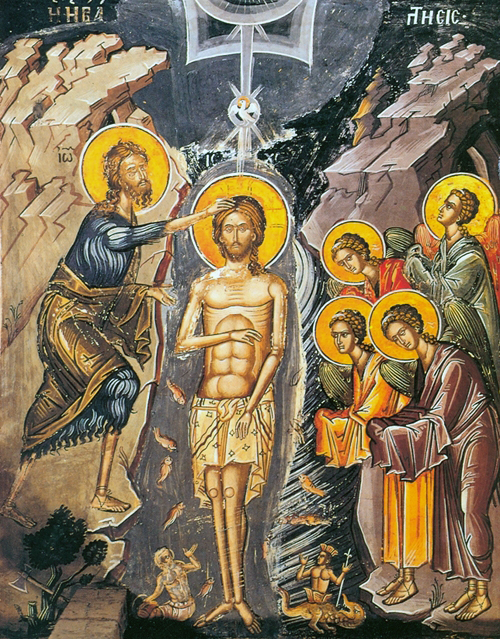
"O ye who are the friends of Christ, and the friends of the stranger, and the friends of the brethren, receive in kindness my speech to-day, and open your ears like the doors of hearing, and admit within them my discourse, and accept from me this saving proclamation of the baptism of Christ, which took place in the river Jordan, in order that your loving desires may be quickened after the Lord, who has done so much for us in the way of condescension. For even though the festival of the Epiphany of the Saviour is past, the grace of the same yet abides with us through all. Let us therefore enjoy it with insatiable minds; for insatiate desire is a good thing in the case of what pertains to salvation—yea, it is a good thing. Come therefore, all of us, from Galilee to Judea, and let us go forth with Christ; for blessed is he who journeys in such company on the way of life. Come, and with the feet of thought let us make for the Jordan, and see John the Baptist as he baptizes One who needs no baptism, and yet submits to the rite in order that He may bestow freely upon us the grace of baptism. Come, let us view the image of our regeneration, as it is emblematically presented in these waters. “Then cometh Jesus from Galilee to Jordan unto John, to be baptized of him.” O how vast is the humility of the Lord! O how vast His condescension! The King of the heavens hastened to John, His own forerunner, without setting in motion the camps of His angels, without despatching beforehand the incorporeal powers as His precursors; but presenting Himself in utmost simplicity, in soldier-like form, He comes up to His own subaltern. And He approached him as one of the multitude, and humbled Himself among the captives though He was the Redeemer, and ranged Himself with those under judgment though He was the Judge, and joined Himself with the lost sheep though He was the Good Shepherd who on account of the straying sheep came down from heaven, and yet did not forsake His heavens, and was mingled with the tares though He was that heavenly grain that springs unsown. And when the Baptist John then saw Him, recognising Him whom before in his mother’s womb he had recognised and worshipped, and discerning clearly that this was He on whose account, in a manner surpassing the natural time, he had leaped in the womb of his mother, in violation of the limits of nature, he drew his right hand within his double cloak, and bowing his head like a servant full of love to his master, addressed Him in these words: I have need to be baptized of Thee, and comest Thou to me? What is this Thou doest, my Lord? Why dost Thou reverse the order of things? Why seekest Thou along with the servants, at the hand of Thy servant, the things that are proper to servants? Why dost Thou desire to receive what Thou requirest not? Why dost Thou burden me, Thy servitor, with Thy mighty condescension? I have need to be baptized of Thee, but Thou hast no need to be baptized of me. The less is blessed by the greater, and the greater is not blessed and sanctified by the less. The light is kindled by the sun, and the sun is not made to shine by the rush-lamp. The clay is wrought by the potter, and the potter is not moulded by the clay. The creature is made anew by the Creator, and the Creator is not restored by the creature. The infirm is healed by the physician, and the physician is not cured by the infirm. The poor man receives contributions from the rich, and the rich borrow not from the poor. I have need to be baptized of Thee, and comest Thou to me? Can I be ignorant who Thou art, and from what source Thou hast Thy light, and whence Thou art come? Or, because Thou hast been born even as I have been, am I, then, to deny the greatness of Thy divinity? Or, because Thou hast condescended so far to me as to have approached my body, and dost bear me wholly in Thyself in order to effect the salvation of the whole man, am I, on account of that body of Thine which is seen, to overlook that divinity of Thine which is only apprehended? Or, because on behalf of my salvation Thou hast taken to Thyself the offering of my first-fruits, am I to ignore the fact that Thou “coverest Thyself with light as with a garment?” Or, because Thou wearest the flesh that is related to me, and dost show Thyself to men as they are able to see Thee, am I to forget the brightness of Thy glorious divinity? Or, because I see my own form in Thee, am I to reason against Thy divine substance, which is invisible and incomprehensible? I know Thee, O Lord; I know Thee clearly. I know Thee, since I have been taught by Thee; for no one can recognise Thee, unless He enjoys Thine illumination. I know Thee, O Lord, clearly; for I saw Thee spiritually before I beheld this light. When Thou wert altogether in the incorporeal bosom of the heavenly Father, Thou wert also altogether in the womb of Thy handmaid and mother; and though held in the womb of Elisabeth by nature as in a prison, and bound with the indissoluble bonds of the children unborn, leaped and celebrated Thy birth with anticipative rejoicings. Shall I then, who gave intimation of Thy sojourn on earth before Thy birth, fail to apprehend Thy coming after Thy birth? Shall I, who in the womb was a teacher of Thy coming, be now a child in understanding in view of perfect knowledge? But I cannot but worship Thee, who art adored by the whole creation; I cannot but proclaim Thee, of whom heaven gave the indication by the star, and for whom earth offered a kind reception by the wise men, while the choirs of angels also praised Thee in joy over Thy condescension to us, and the shepherds who kept watch by night hymned Thee as the Chief Shepherd of the rational sheep. I cannot keep silence while Thou art present, for I am a voice; yea, I am the voice, as it is said, of one crying in the wilderness, Prepare ye the way of the Lord. I have need to be baptized of Thee, and comest Thou to me? I was born, and thereby removed the barrenness of the mother that bore me; and while still a babe I became the healer of my father’s speechlessness, having received of Thee from my childhood the gift of the miraculous. But Thou, being born of the Virgin Mary, as Thou didst will, and as Thou alone dost know, didst not do away with her virginity; but Thou didst keep it, and didst simply gift her with the name of mother: and neither did her virginity preclude Thy birth, nor did Thy birth injure her virginity. But these two things, so utterly opposite—bearing and virginity—harmonized with one intent; for such a thing abides possible with Thee, the Framer of nature. I am but a man, and am a partaker of the divine grace; but Thou art God, and also man to the same effect: for Thou art by nature man’s friend. I have need to be baptized of Thee, and comest Thou to me? Thou who wast in the beginning, and wast with God, and wast God; Thou who art the brightness of the Father’s glory; Thou who art the perfect image of the perfect Father; Thou who art the true light that lighteneth every man that cometh into the world; Thou who wast in the world, and didst come where Thou wast; Thou who wast made flesh, and yet wast not changed into the flesh; Thou who didst dwell among us, and didst manifest Thyself to Thy servants in the form of a servant; Thou who didst bridge earth and heaven together by Thy holy name,—comest Thou to me? One so great to such a one as I am? The King to the forerunner? The Lord to the servant? But though Thou wast not ashamed to be born in the lowly measures of humanity, yet I have no ability to pass the measures of nature. I know how great is the measure of difference between earth and the Creator. I know how great is the distinction between the clay and the potter. I know how vast is the superiority possessed by Thee, who art the Sun of righteousness, over me who am but the torch of Thy grace. Even though Thou art compassed with the pure cloud of the body, I can still recognise Thy lordship. I acknowledge my own servitude, I proclaim Thy glorious greatness, I recognise Thy perfect lordship, I recognise my own perfect insignificance, I am not worthy to unloose the latchets of Thy shoes; and how shall I dare to touch Thy stainless head? How can I stretch out the right hand upon Thee, who didst stretch out the heavens like a curtain, and didst set the earth above the waters? How shall I spread those menial hands of mine upon Thy head? How shall I wash Thee, who art undefiled and sinless? How shall I enlighten the light? What manner of prayer shall I offer up over Thee, who dost receive the prayers even of those who are ignorant of Thee?
When I baptize others, I baptize into Thy name, in order that they may believe on Thee, who comest with glory; but when I baptize Thee, of whom shall I make mention? and into whose name shall I baptize Thee? Into that of the Father? But Thou hast the Father altogether in Thyself, and Thou art altogether in the Father. Or into that of the Son? But beside Thee there is no other Son of God by nature. Or into that of the Holy Spirit? But He is ever together with Thee, as being of one substance, and of one will, and of one judgment, and of one power, and of one honour with Thee; and He receives, along with Thee, the same adoration from all. Wherefore, O Lord, baptize Thou me, if Thou pleasest; baptize me, the Baptist. Regenerate one whom Thou didst cause to be generated. Extend Thy dread right hand, which Thou hast prepared for Thyself, and crown my head by Thy touch, in order that I may run the course before Thy kingdom, crowned like a forerunner, and diligently announce the good tidings to the sinners, addressing them with this earnest call: “Behold the Lamb of God, that taketh away the sin of the world!” O river Jordan, accompany me in the joyous choir, and leap with me, and stir thy waters rhythmically, as in the movements of the dance; for thy Maker stands by thee in the body. Once of old didst thou see Israel pass through thee, and thou didst divide thy floods, and didst wait in expectation of the passage of the people; but now divide thyself more decidedly, and flow more easily, and embrace the stainless limbs of Him who at that ancient time did convey the Jews through thee. Ye mountains and hills, ye valleys and torrents, ye seas and rivers, bless the Lord, who has come upon the river Jordan; for through these streams He transmits sanctification to all streams. And Jesus answered and said to him: Suffer it to be so now, for thus it becometh us to fulfill all righteousness. Suffer it to be so now; grant the favour of silence, O Baptist, to the season of my economy. Learn to will whatever is my will. Learn to minister to me in those things on which I am bent, and do not pry curiously into all that I wish to do. Suffer it to be so now: do not yet proclaim my divinity; do not yet herald my kingdom with thy lips, in order that the tyrant may not learn the fact and give up the counsel he has formed with respect to me. Permit the devil to come upon me, and enter the conflict with me as though I were but a common man, and receive thus his mortal wound. Permit me to fulfill the object for which I have come to earth. It is a mystery that is being gone through this day in the Jordan. My mysteries are for myself and my own. There is a mystery here, not for the fulfilling of my own need, but for the designing of a remedy for those who have been wounded. There is a mystery, which gives in these waters the representation of the heavenly streams of the regeneration of men. Suffer it to be so now: when thou seest me doing what seemeth to me good among the works of my hands, in a manner befitting divinity, then attune thy praises to the acts accomplished. When thou seest me cleansing the lepers, then proclaim me as the framer of nature. When thou seest me make the lame ready runners, then with quickened pace do thou also prepare thy tongue to praise me. When thou seest me cast out demons, then hail my kingdom with adoration. When thou seest me raise the dead from their graves by my word, then, in concert with those thus raised, glorify me as the Prince of Life. When thou seest me on the Father’s right hand, then acknowledge me to be divine, as the equal of the Father and the Holy Spirit, on the throne, and in eternity, and in honour. Suffer it to be so now; for thus it becometh us to fulfill all righteousness. I am the Lawgiver, and the Son of the Lawgiver; and it becometh me first to pass through all that is established, and then to set forth everywhere the intimations of my free gift. It becometh me to fulfill the law, and then to bestow grace. It becometh me to adduce the shadow, and then the reality. It becometh me to finish the old covenant, and then to dictate the new, and to write it on the hearts of men, and to subscribe it with my blood, and to seal it with my Spirit. It becometh me to ascend the cross, and to be pierced with its nails, and to suffer after the manner of that nature which is capable of suffering, and to heal sufferings by my suffering, and by the tree to cure the wound that was inflicted upon men by the medium of a tree. It becometh me to descend even into the very depths of the grave, on behalf of the dead who are detained there. It becometh me, by my three days’ dissolution in the flesh, to destroy the power of the ancient enemy, death. It becometh me to kindle the torch of my body for those who sit in darkness and in the shadow of death. It becometh me to ascend in the flesh to that place where I am in my divinity. It becometh me to introduce to the Father the Adam reigning in me. It becometh me to accomplish these things, for on account of these things I have taken my position with the works of my hands. It becometh me to be baptized with this baptism for the present, and afterwards to bestow the baptism of the consubstantial Trinity upon all men. Lend me, therefore, O Baptist, thy right hand for the present economy, even as Mary lent her womb for my birth. Immerse me in the streams of Jordan, even as she who bore me wrapped me in children’s swaddling-clothes. Grant me thy baptism even as the Virgin granted me her milk. Lay hold of this head of mine, which the seraphim revere. With thy right hand lay hold of this head, that is related to thyself in kinship. Lay hold of this head, which nature has made to be touched. Lay hold of this head, which for this very purpose has been formed by myself and my Father. Lay hold of this head of mine, which, if one does lay hold of it in piety, will save him from ever suffering shipwreck. Baptize me, who am destined to baptize those who believe on me with water, and with the Spirit, and with fire: with water, capable of washing away the defilement of sins; with the Spirit, capable of making the earthly spiritual; with fire, naturally fitted to consume the thorns of transgressions. On hearing these words, the Baptist directed his mind to the object of the salvation, and comprehended the mystery which he had received, and discharged the divine command; for he was at once pious and ready to obey. And stretching forth slowly his right hand, which seemed both to tremble and to rejoice, he baptized the Lord. Then the Jews who were present, with those in the vicinity and those from a distance, reasoned together, and spake thus with themselves and with each other: Was it, then, without cause that we imagined John to be superior to Jesus? Was it without cause that we considered the former to be greater than the latter? Does not this very baptism attest the Baptist’s pre-eminence? Is not he who baptizeth presented as the superior, and he who is baptized as the inferior? But while they, in their ignorance of the mystery of the economy, babbled in such wise with each other, He who alone is Lord, and by nature the Father of the Only-begotten, He who alone knoweth perfectly Him whom He alone in passionless fashion begat, to correct the erroneous imaginations of the Jews, opened the gates of the heavens, and sent down the Holy Spirit in the form of a dove, lighting upon the head of Jesus, pointing out thereby the new Noah, yea the maker of Noah, and the good pilot of the nature which is in shipwreck. And He Himself calls with clear voice out of heaven, and says: “This is my beloved Son,”—the Jesus there, namely, and not the John; the one baptized, and not the one baptizing; He who was begotten of me before all periods of time and not he who was begotten of Zacharias; He who was born of Mary after the flesh, and not he who was brought forth by Elisabeth beyond all expectation; He who was the fruit of the virginity yet preserved intact, and not he who was the shoot from a sterility removed; He who has had His conversation with you, and not he who was brought up in the wilderness. This is my beloved Son, in whom I am well pleased: my Son, of the same substance with myself, and not of a different; of one substance with me according to what is unseen, and of one substance with you according to what is seen, yet without sin. This is He who along with me made man. This is my beloved Son, in whom I am well pleased. This Son of mine and this son of Mary are not two distinct persons; but this is my beloved Son,—this one who is both seen with the eye and apprehended with the mind. This is my beloved Son, in whom I am well pleased; hear Him. If He shall say, I and my Father are one, hear Him. If He shall say, He that hath seen me hath seen the Father, hear Him. If He shall say, He that hath sent me is greater than I, adapt the voice to the economy. If He shall say, Whom do men say that I the Son of man am? answer ye Him thus: Thou art the Christ, the Son of the living God. By these words, as they were sent from the Father out of heaven in thunder-form, the race of men was enlightened: they apprehended the difference between the Creator and the creature, between the King and the soldier (subject), between the Worker and the work; and being strengthened in faith, they drew near through the baptism of John to Christ, our true God, who baptizeth with the Spirit and with fire. To Him be glory, and to the Father, and to the most holy and quickening Spirit, now and ever, and unto the ages of the ages. Amen."

Icon of St. Gregory the Wonderworker of Neo-Caesarea (Icon courtesy of www.eikonografos.com used with permission; for more information on St. Gregory the Wonderworker (November 17th), see: http://full-of-grace-and-truth.blogspot.com/2009/11/st-gregory-wonderworker-bishop-of.html)

Through the prayers of our Holy Fathers, Lord Jesus Christ our God, have mercy on us and save us! Amen!

Tuesday, November 17, 2009

St. Gregory the Wonderworker, Bishop of Neocaesarea

St. Gregory the Wonderworker, Bishop of Neocaesarea - Commemorated on November 17 (icon taken from: http://christopherklitou.com/icon_17_nov_gregory_of_neocaesarea_wonderworker.htm)

"Saint Gregory the Wonderworker, Bishop of Neocaesarea, was born in the city of Neocaesarea (northern Asia Minor) into a pagan family. Having received a fine education, from his youth he strived for Truth, but the thinkers of antiquity were not able to quench his thirst for knowledge. Truth was revealed to him only in the Holy Gospel, and the youth became a Christian.

For the continuation of his studies St Gregory went to Alexandria, known then as a center for pagan and Christian learning. The youth, eager for knowledge, went to the Alexandrian Catechetical School, where the presbyter Origen taught. Origen was a famous teacher, possessing a great strength of mind and profound knowledge. St Gregory became a student of Origen. Afterwards, the saint wrote about his mentor: "This man received from God a sublime gift, to be an interpreter of the Word of God for people, to apprehend the Word of God, as God Himself did use it, and to explain it to people, insofar as they were able to understand it." St Gregory studied for eight years with Origen, and was baptized by him.

The ascetic life of St Gregory, his continence, purity and lack of covetousness aroused envy among his conceited and sin-loving peers, pagans that they were, and they decided to slander St Gregory. Once, when he was conversing with philosophers and teachers in the city square, a notorious harlot came up to him and demanded payment for the sin he had supposedly committed with her. At first St Gregory gently remonstrated with her, saying that she perhaps mistook him for someone else. But the profligate woman would not be quieted. He then asked a friend to give her the money. Just as the woman took the unjust payment, she immediately fell to the ground in a demonic fit, and the fraud became evident. St Gregory said a prayer over her, and the devil left her. This was the beginning of St Gregory's miracles.

Having returned to Neocaesarea, the saint fled from the worldly affairs into which influential townsmen persistently sought to push him. He went into the desert, where by fasting and prayer he attained to high spiritual accomplishment and the gifts of clairvoyance and prophecy. St Gregory loved life in the wilderness and wanted to remain in solitude until the end of his days, but the Lord willed otherwise.

The bishop of the Cappadocian city of Amasea, Thedimos, having learned of St Gregory's ascetic life, decided to have him made Bishop of Neocaesarea. But having foreseen in spirit the intent of Bishop Thedimos, the saint hid himself from the messengers of the bishop who were entrusted to find him. Then Bishop Thedimos ordained the absent saint as Bishop of Neocaesarea, beseeching the Lord that He Himself would sanctify the unusual ordination. St Gregory perceived the extraordinary event as a manifestation of the will of God and he did not dare to protest. This episode in the life of St Gregory was recorded by St Gregory of Nyssa (January 10). He relates that St Gregory of Neocaesarea received the episcopal dignity only after Bishop Thedimos of Amasea performed all the canonical rites over him.

Icon of St. Gregory the Wonderworker, Bishop of Neocaesarea (Icon courtesy of www.eikonografos.com used with permission)

During this time, the heresy of Sabellius and Paul of Samosata began to spread. They taught falsely concerning the Holy Trinity. St Gregory prayed fervently and diligently imploring God and His most pure Mother to reveal to him the true faith. The All-Holy Virgin Mary appeared to him, radiant like the sun, and with Her was the Apostle John the Theologian dressed in archepiscopal vestments.

By the command of the Mother of God, the Apostle John taught the saint how to correctly and properly confess the Mystery of the Most Holy Trinity. St Gregory wrote down everything that St John the Theologian revealed to him. The Mystery of the Symbol of the Faith, written down by St Gregory of Neocaesarea, is a great divine revelation in the history of the Church. The teaching about the Holy Trinity in Orthodox Theology is based on it. Subsequently it was used by the holy Fathers of the Church: Basil the Great, Gregory the Theologian, and Gregory of Nyssa. The Symbol of St Gregory of Neocaesarea was later examined and affirmed in the year 325 by the First Ecumenical Council, showing his enduring significance for Orthodoxy. (***see text below)

Having become a bishop, St Gregory set off to Neocaesarea. Along the way from Amasea he expelled devils from a pagan temple, the priest of which he converted to Christ. The convert was witness to still another miracle of the saint, at his word a large stone shifted from its place.

The preaching of the saint was direct, lively and fruitful. He taught and worked miracles in the name of Christ: he healed the sick, he helped the needy, he settled quarrels and complaints. Two brothers sharing an inheritance were not able to agree over the property of their dead father. There was a large lake over which they argued, for each of the brothers wanted the lake for himself. They both gathered their friends together, and were ready to come to blows. St Gregory persuaded them to delay their fight until the following day, and he himself prayed all night long at the shore of the lake which sparked the quarrel. When dawn broke, everyone saw that the lake had dried up or gone underground. Through the intense prayer of the saint, now there was only a stream, and its course defined the boundary line. Another time, during the construction of a church, he commanded a hill to move and make room at the place of the foundation.

When a persecution against Christians began under the emperor Decius (249-251), St Gregory led his flock to a faraway mountain. A certain pagan, knowing about the hiding place of the Christians, informed the persecutors. Soldiers surrounded the mountain. The saint went out into an open place, raised up his hands to heaven and ordered to his deacon to do the same. The soldiers searched the whole mountain, and they went several times right past those praying, but not seeing them, they gave up and went away. In the city they reported that there was nowhere to hide on the mountain: no one was there, and only two trees stood beside each other. The informer was struck with amazement, he repented of his ways and became a fervent Christian.

St Gregory returned to Neocaesarea after the end of the persecution. By his blessing church Feasts were established in honor of the martyrs who had suffered for Christ.

By his saintly life, his effective preaching, working of miracles and graced guiding of his flock, the saint steadily increased the number of converts to Christ. When St Gregory first ascended his cathedra, there were only seventeen Christians in Neocaesarea. At his death, only seventeen pagans remained in the city."
(taken from: http://ocafs.oca.org/FeastSaintsViewer.asp?SID=4&ID=1&FSID=103315)

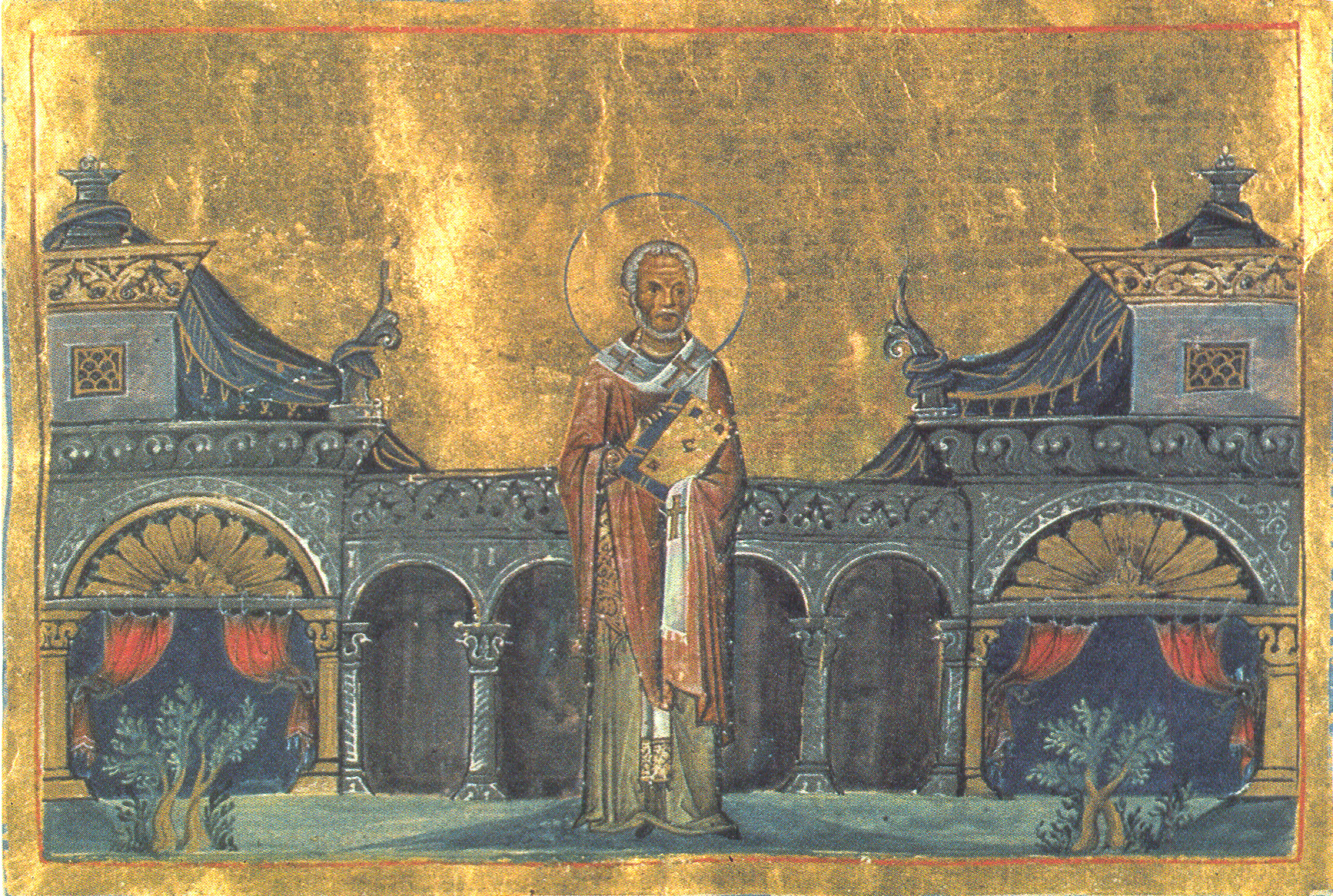
St. Gregory the Wonderworker, Bishop of Neocaesarea (taken from the Menologion of Basileiou, from: http://vatopaidi.files.wordpress.com/2009/11/st-gregory-of-neocaesarea.jpg)

***A DECLARATION OF FAITH
by St. Gregory the Wonderworker, Bishop of Neocaesarea
"There is one God, the Father of the living Word, who is His subsistent Wisdom and Power and Eternal Image: perfect Begetter of the perfect Begotten, Father of the only-begotten Son. There is one Lord, Only of the Only, God of God, Image and Likeness of Deity, Efficient Word, Wisdom comprehensive of the constitution of all things, and Power formative of the whole creation, true Son of true Father, Invisible of Invisible, and Incorruptible of Incorruptible, and Immortal of Immortal and Eternal of Eternal. And there is One Holy Spirit, having His subsistence from God, and being made manifest by the Son, to wit to men: Image of the Son, Perfect Image of the Perfect; Life, the Cause of the living; Holy Fount; Sanctity, the Supplier, or Leader, of Sanctification; in whom is manifested God the Father, who is above all and in all, and God the Son, who is through all. There is a perfect Trinity, in glory and eternity and sovereignty, neither divided nor estranged. Wherefore there is nothing either created or in servitude in the Trinity; nor anything superinduced, as if at some former period it was non-existent, and at some later period it was introduced. And thus neither was the Son ever wanting to the Father, nor the Spirit to the Son; but without variation and without change, the same Trinity abideth ever."
(taken from: http://www.voskrese.info/spl/thaumcreed.html; the following link has the same text with some additional notes and some of the original Greek: http://www.documentacatholicaomnia.eu/04z/z_0213-0270__Gregorius_Thaumaturgus__A_Declaration_of_Faith_[Schaff]__EN.pdf.html)

I beliebe the following document has three homilies of St. Gregory on the Annunciation, and one homily on Theophany: http://www.documentacatholicaomnia.eu/03d/0213-0270,_Gregorius_Thaumaturgus,_Four_Homilies_[Schaff],_EN.pdf, while this site has others: http://www.documentacatholicaomnia.eu/30_20_0213-0270-_Gregorius_Thaumaturgus.html.

May St. Gregory the Wonderworker intercede for us and help us!

Picture of the Pillar of St. Gregory the Wonderworker in Hagia Sophia, Constantinople. This pillar, which contains the Relics of St. Gregory, continues to miraculously weep water that works healings. (taken from: http://www.sacred-destinations.com/turkey/hagia-sophia-photos/hole-cc-khoogheem.jpg.html)

Icon of St. Gregory the Wonderworker, Bishop of Neocaesarea (Icon courtesy of www.eikonografos.com used with permission)

Apolytikion in the Plagal of the Fourth Tone
By vigilance in prayer, and continuance in the working of wonders, thou didst acquire thine achievements as a surname; wherefore, intercede with Christ our God, O Father Gregory, to enlighten our souls, lest we sleep in sin unto death.

Kontakion in the Second Tone
Since thou hadst received the power to work miracles, thou dravest from men diseases, O wise Gregory, and with fearful signs thou madest the demons tremble; hence, thou art called Wonderworker, O man of God; for thou hast received thy surname from thy works.

Through the prayers of our Holy Fathers, Lord Jesus Christ our God, have mercy on us and save us! Amen!