Showing posts with label St. Constantine the Great. Show all posts

Tuesday, May 19, 2020

"We celebrate your memory out of duty, O Constantine, and Equal-to-the-Apostles..."

Christ is risen! Truly He is risen!
St. Constantine the Great (source)
  
We celebrate your memory out of duty, O Constantine, and Equal-to-the-Apostles, the foundation and boast of all rulers, for you were illumined by the rays of the Spirit, and thereby gladden the whole Church of Christ, and the ranks of the faithful, who have gathered from all places to the radiant city of Nicea, in which the insolence of the impious ones was quenched, and the tongues of the heretics were proven foolish, while the ranks of the Orthodox were uplifted, and the faith was revealed. Therefore, you were glorified by them as being most Orthodox, and were proclaimed the father among rulers, as the first to have received the royal robe from God. Therefore, we entreat you, that we who celebrate your memory in faith might be granted forgiveness of sins upon our souls.
-Idiomelon of the Litia in the First Tone.
  
(source)
 
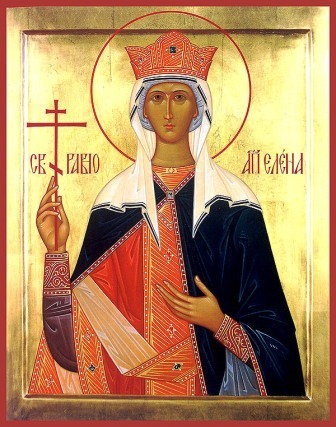
Sts. Constantine and Helen the Equals-to-the-Apostles (source)
   
Christ is risen from the dead, by death, trampling down upon death, and to those in the tombs, He has granted life!
Truly, the Lord is risen!

Wednesday, May 15, 2019

Akathist to Sts. Constantine and Helen the Equals-to-the-Apostles

Christ is risen! Truly He is risen!
Sts. Constantine and Helen the Equals-to-the-Apostles (source)
  
Akathist to Sts. Constantine and Helen the Equals-to-the-Apostles

Kontakion in the Plagal of the Fourth Tone.
O multitude bearing the name of Christ, come let us gather and praise with harmonious hymns the God-crowned Constantine and Helen, who clearly preached the faith of Christ, and uncovered the Precious Cross, and let us cry out to them: Rejoice, O ever-memorable ones.
  
Sts. Constantine and Helen (source)
  
Open my mouth, O Jesus my God, that I might hymn Constantine the Great (3), for he is the joy of all bearing the name of Christ, and a most-radiant proclaimer of the faith. Strengthen also my tongue to cry out to him things such as these:
Rejoice, he who was preordained by God,
Rejoice, he who was sanctified by Him.
Rejoice, he who was descended from royal lineage,
Rejoice, he who was filled with wisdom and counsel.
Rejoice, for in deed you proved God's calling,
Rejoice, for you fled from the darkness of faithlessness.
Rejoice, for you received the call from Heaven in faith,
Rejoice, you who were baptized by Sylvester in Rome.
Rejoice, the chaste joy of the faithful,
Rejoice, the corruption and wailing of the faithless.
Rejoice, through whom the priests take boast,
Rejoice, through whom kings are crowned.
Rejoice, O ever-memorable King.

Beholding Maxentios and Maximian trampling upon the pasture of Christ, you took boldness in God, O Constantine, and having arrayed yourself in the weapon of the Cross, and having overcome tyrants, you cried out to the Lord: Alleluia.
  
Sts. Constantine and Helen (source)
  
Having been enriched with divine blessedness, O Helen, you approached the Lord in faith. And having your son as a sacred fellow worker, the ever-memorable Constantine, you filled the world with incomparable joy, as we cry out to you:
Rejoice, foundation of piety,
Rejoice, glory of the Church.
Rejoice, the boast of all those bearing the name of Christ,
Rejoice, the adornment of all rulers.
Rejoice, for you gave to us the Cross of the Lord,
Rejoice, for from you has the wondrous Weapon shone forth.
Rejoice, you who uncovered the life-giving Tomb [of Christ],
Rejoice, you who revealed it to the whole world.
Rejoice, the joy and famed one of the world,
Rejoice, the corrupting and wailing of the idols.
Rejoice, through whom Christ was glorified,
Rejoice, through whom the divine faith was exalted.
Rejoice, O all-precious Queen.

The power of the Most-high truly descended upon you from on high, O blessed Helen, as you venerated the Holy Lands in reverence, and because of this, you raised up a divine temple that was greatly beautified, crying out to Christ the Savior: Alleluia.
  
Sts. Constantine and Helen (source)
  
Having Christ dwelling within your soul, and having been filled with divine illumination, you gathered the 318 God-bearing Fathers, and you strengthened the faithful, who cry out these things with fervor:
Rejoice, Christ-bearing King,
Rejoice, God-bearing Ruler.
Rejoice, equal in honor to the Apostles of Christ,
Rejoice, equal in number to the divine Fathers.
Rejoice, for you proclaimed the sacred Trinity,
Rejoice, for you drew everyone towards the true faith.
Rejoice, founder of the City that bears your name,
Rejoice, adorner of the Church of Christ.
Rejoice, for the Angels wondered at you,
Rejoice, for men were pleased in you.
Rejoice, protector of your famed Church,
Rejoice, deliverer of us who honor you.
Rejoice, O ever-memorable King.

Breathing forth with godly zeal on behalf of you, O Theotokos, the great King Constantine dedicated his city to you, having you as his sustainer and protector, which may you protect unto the ages, crying out to your Son: Alleluia.
  
Sts. Constantine and Helen (source)
  
All the nations, through you, O all-joyous one, heard the preaching of the Gospel: Armenians, Indians, Iberians and all the rest, O Lady, therefore the tribes and tongues [of the earth] praise you, crying out these things:
Rejoice, she who was ordained by God,
Rejoice, she who was elected by Him.
Rejoice, equal in honor to the former Prophetesses,
Rejoice, equal in station to the Myrrhbearers of Christ.
Rejoice, for you were zealous for Mariam of Moses,
Rejoice, for you were anointed more divinely that Oldas.
Rejoice, you who poured myrrh upon the Tomb of Christ,
Rejoice, another Magdalene and Joanna.
Rejoice, you who conquered the manliness of Judith,
Rejoice, you who surpassed Queen Esther.
Rejoice, you who desired Christ as Salome,
Rejoice, you who loved Him like Susannah.
Rejoice, O all-precious Queen.
 
Performing a God-led journey, O godly-minded one, you returned to the Queen of Cities [Constantinople], and you brought with you the Precious Cross of Christ, and the Nails, bringing them to your son, who was filled with incomparable joy, and cried out to the Lord: Alleluia.
  
Sts. Constantine and Helen (source)
   
All the nations beheld the wondrous Cross of the Lord through you, O Constantine, and were straightaway illumined with light, which drove away the terrible darkness, and you brought people to Christ, who therefore offer to you these things:
Rejoice, Apostle of the Lord,
Rejoice, lamp-lighter of the Gospel.
Rejoice, you who revealed the Precious Cross,
Rejoice, you who multiplied the preaching of Christ.
Rejoice, for you brought all nations to Christ,
Rejoice, for you founded divine temples to Him.
Rejoice, you who built the Church of the All-holy Sepulcher,
Rejoice, divine guide of pilgrimages.
Rejoice, for you are the common boast of cities,
Rejoice, our divine nourishment.
Rejoice, through whom kings are granted wealth,
Rejoice, through whom the faith is preserved.
Rejoice, O ever-memorable King.
  
As one who received the divine calling and the kingdom for your piety, O Constantine, you have boldness before God for the faithful, therefore intercede for those who joyfully cry out to Christ together: Alleluia.
  
Sts. Constantine and Helen (source)
   
You appeared shining forth with the faith as a radiant light, O all-joyous Helen, for the light of your divine works dissolved the darkness of the idols, and illumined all to cry out with fervor these things:
Rejoice, most-radiant light,
Rejoice, most-meek lamp of Christ.
Rejoice, rejoicing of pious Rulers,
Rejoice, adornment of all women.
Rejoice, for you adorned the temples of the Lord,
Rejoice, for you dispersed the altars of the idols.
Rejoice, you who confirmed the true faith in deeds,
Rejoice, you who fought on behalf of all those who are wronged.
Rejoice, common refuge of the poor,
Rejoice, surrounding wall for the naked and strangers.
Rejoice, through whom piety shines forth,
Rejoice, through whom virtue dawns.
Rejoice, O all-precious Queen.
  
Always bearing in mind the commandments of the Lord, you loved Him wholly with all your soul and body, and were arrayed in love for God like porphyry, as the Queen of the Psalms, you were arrayed and crying out: Alleluia.
  
Sts. Constantine and Helen (source)
   
You received the call from God at a young age like Paul, O godly-minded Constantine, and straightaway you imitated him with your whole soul, following Christ. Therefore we magnify you, crying out these things with joy:
Rejoice, chosen one of the Most-high,
Rejoice, creation of the Master.
Rejoice, most-fervent follower of Christ,
Rejoice, he who followed His good laws in practice.
Rejoice, for you served underwritten by virtues,
Rejoice, for you shone forth as meek and humble.
Rejoice, for you were a pillar of continence,
Rejoice, for you were a tower of righteousness.
Rejoice, incomparable help for the poor,
Rejoice, provider for many of the sick.
Rejoice, spring of forgiveness,
Rejoice, lily of sympathy.
Rejoice, O ever-memorable King.

Wholly embracing the dogma of the Holy Trinity that was foreign to you, O Constantine, you correspondingly lived a foreign life that matched these foreign teachings, and you shone like a sun upon the earth, and prayed to the Trinity: Alleluia.
  
Sts. Constantine and Helen (source)
  
Having all your fervor towards God, O blessed one, and love towards for neighbor, you praised God with hymns and prayers, and rejoiced to adorn His temples, and filled all the earth with good works, as we cry out:
Rejoice, fervent worshipper of God,
Rejoice, healer from the Creator.
Rejoice, you who were enriched with ceaseless prayer,
Rejoice, you who ever studied divine hymns.
Rejoice, for you built temples of the Lord,
Rejoice, for you enriched them with your treasures.
Rejoice, for you ever served as a benefactor to men,
Rejoice, for you filled the earth with good deeds.
Rejoice, for the Angels hymned you,
Rejoice, for the demons were afraid of you.
Rejoice, the joyous hymnody of God,
Rejoice, guide of mortals to salvation.
Rejoice, O all-precious Queen.

All the earth truly received the voice of your deeds, and because of this, every breath hymns the name of Helen, and every tongue praises her, crying out to the Creator of all: Alleluia.
  
Sts. Constantine and Helen (source)
   
Many words of rhetors are astonished at the multitude of your deeds, O Constantine, for your voice has reached the end of the earth, as David said. Therefore we magnify you, crying out these things joyfully:
Rejoice, wonder of the Angels,
Rejoice, astonishment of men.
Rejoice, you who did not proceed with pride upon the earth,
Rejoice, you whose name is ceaselessly wondered.
Rejoice, broad giant who measures the heavens,
Rejoice, universal Atlas, who upholds the earth.
Rejoice, the glorious boast of the whole world,
Rejoice, the greatly spoken of flower of every ruler.
Rejoice, most-radiant star of heaven,
Rejoice, greatly-shining light of the world.
Rejoice, through whom creation was illumined,
Rejoice, through whom the Creator was glorified.
Rejoice, O ever-memorable King.

Wishing to save the whole world, the Lord of glory gave the power and the wood of His Cross to you, and He revealed His life-flowing Tomb, which is venerated by all, as we cry out ceaselessly: Alleluia.
  
Sts. Constantine and Helen (source)
   
Ranks of the Angels, Prophets, Apostles, Martyrs and all the Saints received you in joy as you proceeded from earth to Heaven. Intercede along with them, O Helen, that we be saved who cry out to you:
Rejoice, you who proceeded towards the Lord,
Rejoice, you who ever stand beside Him.
Rejoice, you who joined the mansions of the Prophets,
Rejoice, you who dwelt in the dwelling places of the Apostles.
Rejoice, for in your calling, you shine with light among the Saints,
Rejoice, you who entreat the sacred Trinity with joy.
Rejoice, you who were granted the grace of working wonders,
Rejoice, you who stand beside those who call upon you.
Rejoice, for we have been granted you as our protector,
Rejoice, for we have put on you as a surrounding wall.
Rejoice, you who deliver from the danger of death,
Rejoice, you who protect us in creation.
Rejoice, O all-precious Queen.
  
We all are led to offer hymns to the Creator, as you were sent from the earth, O blessed one. Patriarchs, Priests, Judges, together with your God-crowned offspring, O Lady, serve litany with fear, and chant unto the Lord: Alleluia.
  
Sts. Constantine and Helen (source)
   
I behold you as a light-bearing lamp whose light shines throughout the world with the light of piety, as we praise your holy memory, O Christ-bearing Constantine, and do you also remember those who love you and cry out to you:
Rejoice, divine light of the world,
Rejoice, tasteful salt of all things.
Rejoice, you who stand before the unwaning Light,
Rejoice, you who rejoice in the glory of the Trinity.
Rejoice, you who have received unassailable boldness before God,
Rejoice, beloved friend who stands beside Christ.
Rejoice, you who were enriched with the grace of wonders from God,
Rejoice, you whose reliquary was shown to be a spring of graces.
Rejoice, through whom we are made close to God,
Rejoice, through whom we are delivered from dangers.
Rejoice, protector even at the hour of death,
Rejoice, deliverer from the inexorable Judgment.
Rejoice, O ever-memorable King.

You proceeded towards Christ with rejoicing, O Constantine, as you departed this life in peace. And while your body lay in your reliquary, your soul was taken by the divine and all-radiant hand of God, and together with the Angels you sing: Alleluia.
  
Sts. Constantine and Helen (source)
   
The great David chants and tells beforehand of you with joy, O wondrous Helen, as a mother who ever rejoices over her child. And we your servants ever cry out with joy:
Rejoice, you who ever stand before God,
Rejoice, you who are ever nourished by His glory.
Rejoice, you who dwell with the Mother of God,
Rejoice, you who ever rejoice with your son.
Rejoice, you who receive glory and love of Christ,
Rejoice, you who rule together with Him unto the ages.
Rejoice, the common intercession for the whole world,
Rejoice, the fervent protector of those who honor you.
Rejoice, hope and help,
Rejoice, my strength and foundation.
Rejoice, the protector of your famed church,
Rejoice, the deliverer of us who honor you.
Rejoice, O all-precious Queen.
  
O holy pair, Constantine and Helen, the pride of rulers bearing the name of Christ (3), receive our desire to grow closer to God, and intercede that those who share your names might be protected together with all the faithful, who cry out: Alleluia.
  
And again, the Kontakion. 
(source)
  
Sts. Constantine and Helen (source)
  
Christ has risen from the dead, by death he has trampled on death, and to those in the graves given life!
Truly the Lord is risen!
Sunday, April 24, 2011

Additional Quotes of the Fathers on the Resurrection of Christ

Christ is risen! Truly He is risen!
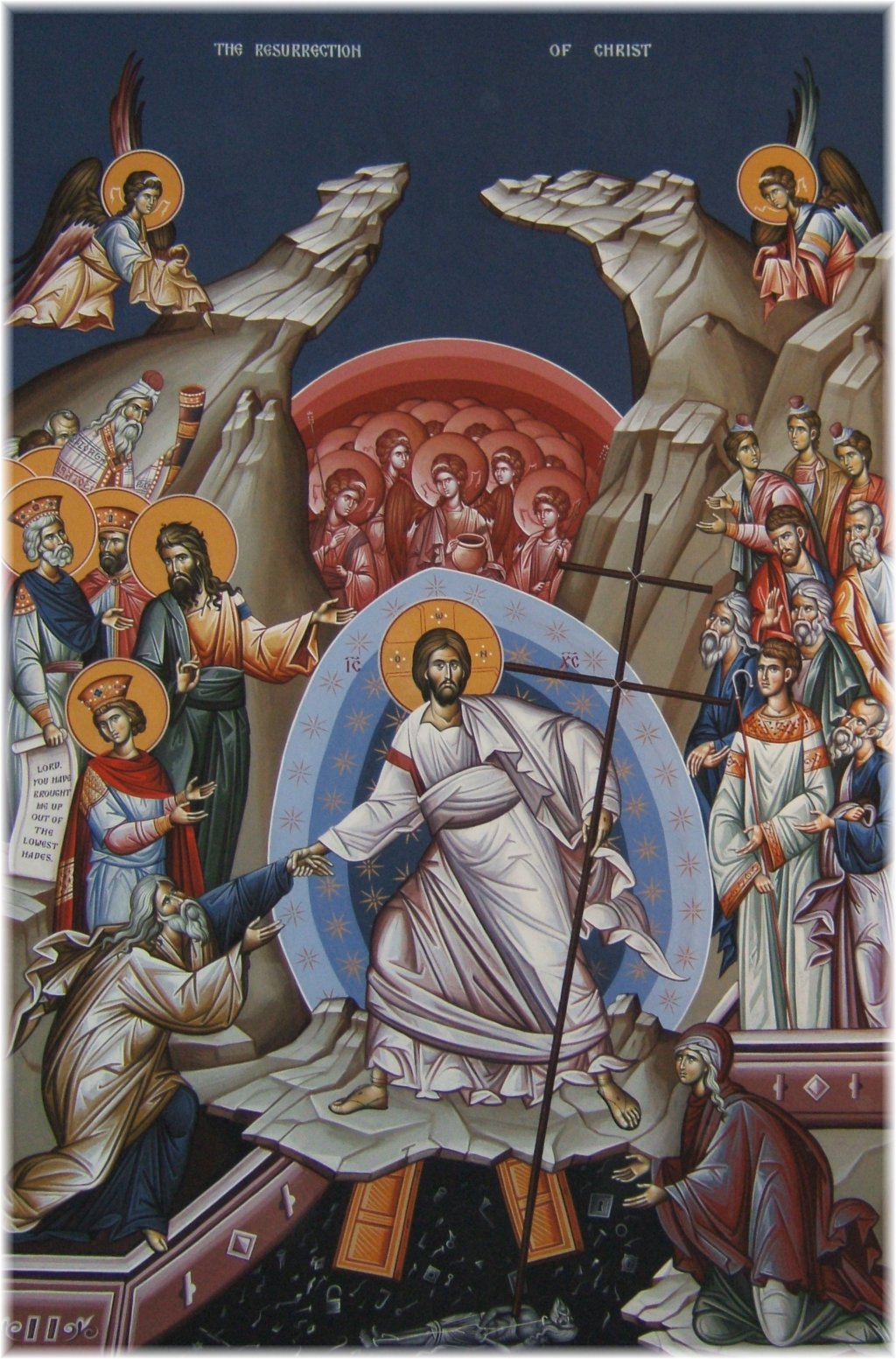
Christ descending to Hades to raise the dead (http://iconreader.files.wordpress.com/2011/01/resurrection2.jpg)
   
Additional Quotes of the Fathers on the Resurrection of Christ
"That light which far outshines the day and sun, first pledge of resurrection, and renovation of bodies long since dissolved, the divine token of promise, the path which leads to everlasting life — in a word, the day of the Passion — is arrived, best beloved doctors; and ye, my friends who are assembled here, ye blessed multitudes who worship Him who is the author of all worship and praise Him continually with heart and voice, according to the precepts of His holy word.

But thou, Nature, parent of all things: what blessing like to this hast thou ever accomplished for mankind? Nay rather, what is in any sense thy workmanship, since He who formed the universe is Himself the author of thy being? For it is He who has arrayed thee in thy beauty; and the beauty of Nature is life according to Nature’s laws.
But principles quite opposed to Nature have mightily prevailed, in that men have agreed in withholding His rightful worship from the Lord of all, believing that the order of the universe depended, not on His providence, but on the blind uncertainty of chance. And this they did, notwithstanding the clearest announcement of the truth by His inspired prophets, whose words should have claimed belief, but were in every way resisted by that impious wickedness which hates the light of truth and loves the obscure mazes of darkness.

Nor was this error unaccompanied by violence and cruelty, especially in that the will of princes encouraged the blind impetuosity of the multitude, or rather itself led the way in the career of reckless folly.

Such principles as these, confirmed by the practice of many generations, became the source of terrible evils in those early times: but no sooner had the radiance of the Saviour’s presence appeared, than justice took the place of wrong, a calm succeeded the confusion of the storm, and the predictions of the prophets were all fulfilled.

For after He had enlightened the world by the glorious discretion and purity of His character, and had ascended to the mansions of His Father’s house, He founded His Church on earth, as a holy temple of virtue, an immortal, imperishable temple, wherein the worship due to the Supreme Father and to Himself should be piously performed."
St. Constantine the Great
"Brethren, how fine a thing it is to move from festival to festival, from prayer to prayer, from holy day to holy day. The time is now at hand when we enter on a new beginning: the proclamation of the blessed Passover, in which the Lord was sacrificed. We feed as on the food of life, we constantly refresh our souls with his precious blood, as from a fountain. Yet we are always thirsting, burning to be satisfied. But he himself is present for those who thirst and in his goodness invites them to the feast day. Our Savior repeats his words:

'If anyone thirsts, let him come to me and drink.'

He quenched the thirst not only of those who came to him then. Whenever anyone seeks him he is freely admitted to the presence of the Saviour. The grace of the feast is not restricted to one occasion. Its rays of glory never set. It is always at hand to enlighten the mind of those who desire it.

Its power is always there for those whose minds have been enlightened and who meditate day and night on the holy Scriptures, like the one who is called blessed in the holy psalm:

'Blessed is the man who has not followed the counsel of the wicked, or stood where sinners stand, or sat in the seat of the scornful, but whose delight is in the law of the Lord, and who meditates on his law day and night.'

Moreover, my friends, the God who first established this feast for us allows us to celebrate it each year. He who gave up his Son to death for our salvation, from the same motive gives us this feast, which is commemorated every year. This feast guides us through the trials that meet us in this world.

God now gives us the joy of salvation that shines out from this feast, as he brings us together to form one assembly, uniting us all in spirit in every place, allowing us to pray together and to offer common thanksgiving, as is our duty on the feast. Such is the wonder of his love: he gathers to this feast those who are far apart, and brings together in unity of faith those who may be physically separated from each other.
St. Athanasios the Great

"The Lord, having put on human nature, and having suffered for him who suffered, having been bound for him who was bound, and having been buried for him who was buried, is risen from the dead, and loudly proclaims this message:
'Who will contend against me? Let him stand before me. It is I who delivered the condemned. It is I who gave life to the dead. It is I who raised up the buried. Who will argue with me? It is I, says Christ, who destroyed death. It is I who triumphed over the enemy, and having trod down Hades, and bound the Strong Man, and have snatched mankind up to the heights of heaven. It is I, says Christ. So then, come here all you families of men, weighed down by your sins and recieve pardon for your misdeeds. For I am your pardon. I am the Passover which brings salvation. I am the Lamb slain for you. I am your lustral bath. I am your life. I am your resurrection. I am your light, I am your salvation, I am your King. It is I who brings you up to the heights of heaven. It is I who will give you the resurrection there. I will show you the Eternal Father. I will raise you up with my own right hand.'"
St. Melito Bishop of Sardis
"Most men believe in the resurrection of Christ, but very few have a clear vision of it. …That most sacred formula which is daily on our lips does not say,
'Having believed in Christ’s resurrection,'
but,
'Having beheld Christ’s resurrection, let us worship the Holy Lord Jesus, who alone is without sin.'
How then does the Holy Spirit urge us to say,
'Having beheld Christ’s resurrection',
which we have not seen as though we had seen it, when Christ has risen once for all a thousand years ago, and even then without anybody’s seeing it? Surely Holy Scripture does not wish us to lie? Far from it! Rather, it urges us to speak the truth, that the resurrection of Christ takes place in each of us who believes, and that not once, but every hour, so to speak, when Christ the Master arises in us, resplendent in array and flashing with the lightnings of incorruption and Deity.

For the light-bringing coming of the Spirit shows forth to us, as in early morning, the Master’s resurrection, or, rather, it grants us to see the Risen One Himself. Therefore we say,
'The Lord is God, and He has given us light' (Ps. 118:27)
and we allude to His second Coming and add these words,
'Blessed is He that cometh in the Name of the Lord' (Ps. 118:26).
Those to whom Christ has given light as He has risen, to them He has appeared spiritually, He has been shown to their spiritual eyes. When this happens to us through the Spirit He raises us up from the dead and gives us life. He grants us to see Him, who is immortal and indestructible. More than that, He grants clearly to know Him who raises us up (Eph. 2:6) and glorifies us (Rom. 8:17) with Himself, as all the divine Scripture testifies.
These, then, are the divine mysteries of Christians. This is the hidden power of our faith, which unbelievers, or those who believe with difficulty, or rather believe in part, do not see nor are able at all to see.
St. Symeon the New Theologian
   
   
Christ is risen from the dead, by death, trampling down upon death, and to those in the tombs, bestowing life!


Truly the Lord is risen!

Thursday, May 20, 2010

Selected hymns from the Feast of Sts. Constantine and Helen

Sts. Constantine and Helen, the God-crowned and Equals-to-the-Apostles - Commemorated on May 21st (http://ia301508.us.archive.org/3/items/Icoane/0521SfImpConstantinSiElena17.jpg)
  
Kathisma I in the Third Tone
You became a new David in manner. * You received the oil of the kingdom, * as an honor from heaven, upon your head. * The Lord and Logos transcending all essences * anointed you with the Spirit, O glorious one. * Therefore you received the scepter to rule, as one most wise. * And you entreat that we obtain the great mercy.

Kathisma II in the Plagal of the Second Tone
The Maker of the sun and all creation was led once to the Cross. And now to himself He leads you, the shining star, by stars from heaven. And to you first He bestowed imperial power. Therefore, O most pious emperor Constantine, we extol you and your mother Helen the godly‐minded.

Idiomelon following the 50th Psalm in the Second Tone
The memorial of Constantine the pious, like perfume that is poured out, has arisen today. He longed for Christ and therefore held the idols in contempt. On earth he erected a temple to the One who was crucified for us; while in heaven he received the crown of hope.

St. Helen (source)
  
Prosomoia of the Praises in the Plagal of the Fourth Tone
Full of wisdom, Constantine, rejoice! * The well of Orthodox Faith, * that has watered in every age * the entire universe * with its waters most sweet, rejoice! * Glorious root, out of which has burgeoned forth * the fruit that feeds the entire Church of Christ, * you are the pride and joy * of the fathers; O rejoice! You are the first * of all Christian emperors. * Rejoice, believersʹ joy!

He who rules over creation all, * O all‐wise Ruler, foresaw * the obedience of your heart, * and through reason captured you * when unreason was ruling you; * and He illumined your thoughts and reasoning * with certain knowledge of Orthodox belief; * glorious Constantine, * to the world He showed you as a shining sun, * radiating brilliant beams * of godly words and deeds.

Full of wisdom, Helen, praised by all, when you accepted the Lordʹs * saving teachings, like chosen earth * you abundantly produced * many fruits of your virtuous deeds. * And by displaying a holy way of life * for imitation, you thereby feed our minds. * Therefore we celebrate * your divine memorial, O royal Saint, * festively observing it today with heightened joy.

Doxastikon of the Praises in the Plagal of the Fourth Tone
Glory to the Father and the Son and the Holy Spirit.
The King of kings and God, who adorns the worthy with abundant gifts, caught you in His net, through the sign of the Cross, like He did to Paul the glorious, O Constantine. He said to you, ʺIn this sign conquer your enemies.ʺ Thus having sought Him, as did your godly‐minded mother, and having found Him for whom you longed, you utterly defeated them. In company with your mother, earnestly pray for Orthodox rulers, and the Christ‐loving armed forces, and all of us who loyally observe your memory, entreating Him who alone loves humanity, to deliver us from all wrath.
Sts. Constantine and Helen the Equals-to-the-Apostles (source)
   
Through the prayers of our Holy Fathers, Lord Jesus Christ our God, have mercy on us and save us! Amen!

Saturday, September 12, 2009

Commemoration of the Founding of the Church of the Resurrection (Holy Sepulchre) at Jerusalem

Picture of the edicule, containing the All-Holy Tomb of Christ, Jerusalem (taken from: http://www.sacred-destinations.com/israel/jerusalem-holy-sepulchre-pictures/edicule-c-damon-lynch.jpg)

Commemoration of the Founding of the Church of the Resurrection (Holy Sepulchre) at Jerusalem - Commemorated on September 13th
"The Dedication of the Temple of the Resurrection of Christ at Jerusalem celebrates the dedication of the Church of the Resurrection, built by St Constantine the Great and his mother, the empress Helen.
After the voluntary Passion and Death on the Cross of our Lord and Savior Jesus Christ, the holy place of His suffering was long trampled on by pagans. When the Roman emperor Titus conquered Jerusalem in the year 70, he razed the city and destroyed the Temple of Solomon on Mount Moriah, leaving there not a stone upon a stone, as even the Savior foretold (Mt.13:1-2).

Later on the zealous pagan emperor Hadrian (117-138) built on the site of the Jerusalem destroyed by Titus a new city named Aelia Capitolina for him (Hadrian Aelius). It was forbidden to call the city by its former name.

He gave orders to cover the Holy Tomb of the Lord with earth and stones, and on that spot to set up an idol. On Golgotha, where the Savior was crucified, he constructed a pagan temple dedicated to the goddess Venus in 119. Before the statues they offered sacrifice to demons and performed pagan rites, accompanied by wanton acts.
 
St. Helen the Equal-to-the-Apostles (source)
 
In Bethlehem, at the place the Savior was born of the All-Pure Virgin, the impious emperor set up an idol of Adonis. He did all this intentionally, so that people would forget completely about Christ the Savior and that they would no loner remember the places where He lived, taught, suffered and arose in glory.

At the beinning of the reign of St Constantine the Great (306-337), the first of the Roman emperors to recognize the Christian religion, he and his pious mother the empress Helen decided to rebuild the city of Jerusalem. They also planned to build a church on the site of the Lord's suffering and Resurrection, in order to reconsecrate and purify the places connected with memory of the Savior from the taint of foul pagan cults.

The empress Helen journeyed to Jerusalem with a large quantity of gold, and St Constantine the Great wrote a letter to Patriarch Macarius I (313-323), requesting him to assist her in every possible way with her task of the renewing the Christian holy places.

After her arrival in Jerusalem, the holy empress Helen destroyed all the pagan temples and reconsecrated the places desecrated by the pagans. She was zealous to find the Cross of our Lord Jesus Christ, and she ordered the excavation of the place where the temple of Venus stood. There they discovered the Sepulchre of the Lord and Golgotha, and they also found three crosses and some nails.


Icon depicting St. Helen and St. Makarios uncovering the Life-giving Cross of Christ (taken from: http://www.ekklisiastikos.com/2009/06/blog-post_1819.html)
  
In order to determine upon which of the three crosses the Savior was crucified, Patriarch Macarius gave orders to place a dead person, who was being carried to a place of burial, upon each cross in turn. When the dead person was placed on the Cross of Christ, he immediately came alive. With the greatest of joy the empress Helen and Patriarch Macarius raised up the Life-Creating Cross and displayed it to all the people standing about.

The holy empress quickly began the construction of a large church which enclosed within its walls Golgotha, the place of the Crucifixion of the Savior, and the Sepulchre of the Lord, located near each other. The holy Apostle and Evangelist John wrote about this: "Now in the place where He was crucified, there was a garden, and in the garden a new tomb, in which no one had yet been laid.

Therefore they laid Jesus there because of the Jewish preparation day, for the tomb was nearby" (John 19:41-42). The Church of the Resurrection was ten years in building, and the holy empress Helen did not survive to see its completion. She returned to Constantinople, and reposed in the year 327. After her arrival in Jerusalem, the holy empress built churches in Bethlehem, on the Mount of Olives, at Gethsemane and in many other places connected with the life of the Savior and events in the New Testament.

The construction of the church of the Resurrection, called "Martyrion" in memory of the sufferings of the Savior, was completed in the same year as the Council of Tyre, and in the thirtieth year of the reign of St Constantine the Great. Therefore, at the assembly of September 13, 335, the consecration of the temple was particularly solemn. Hierarchs of Christian Churches in many lands: Bythnia, Thrace, Cilicia, Cappadocia, Syria, Mesopotamia, Phoenicia, Arabia, Palestine, and Egypt, participated in the consecration of the church. The bishops who participated in the Council of Tyre, and many others, went to the consecration in Jerusalem. On this day all the city of Jerusalem was consecrated. The Fathers of the Church established September 13 as the commemoration of this remarkable event." (taken from: http://ocafs.oca.org/FeastSaintsViewer.asp?SID=4&ID=1&FSID=102593)
  

Picture of the exterior of the Church of the Holy Sepulcher, Jerusalem (taken from: http://www.sacred-destinations.com/israel/jerusalem-holy-sepulchre-pictures/exterior-entrance-cc-waynemclean.jpg)
  
Eusebius on St. Constantine's Church of Holy Sepulchre
The following text is an excerpt from the Life of Constantine (Vita Constantini) written by the emperor's great admirer, the church historian Eusebius of Caesarea (c. 260-341). This is the principle textual source on the original, fourth-century form of the Church of the Holy Sepulchre in Jerusalem, parts of which can still be seen today.

This English translation is from the Nicene and Post Nicene Fathers Series, published in 1890. The notes are from that edition, and appear at the bottom of this page. The excerpt is from Book III of the Life of Constantine.


"XXV. How He Ordered the Erection of a Church at Jerusalem, in the Holy Place of Our Saviour's Resurrection.
After these things, the pious emperor addressed himself to another work truly worthy of record, in the province of Palestine. What then was this work? He judged it incumbent on him to render the blessed locality of our Saviour's resurrection an object of attraction and veneration to all. He issued immediate injunctions, therefore, for the erection in that spot of a house of prayer: and this he did, not on the mere natural impulse of his own mind, but being moved in spirit by the Saviour himself.

XXVI. That the Holy Sepulchre Had Been Covered with Rubbish and with Idols by the Ungodly. For it had been in time past the endeavor of impious men (or rather let me say of the whole race of evil spirits through their means), to consign to the darkness of oblivion that divine monument of immortality to which the radiant angel had descended from heaven, and rolled away the stone for those who still had stony hearts, and who supposed that the living One still lay among the dead; and had declared glad tidings to the women also, and removed their stony-hearted unbelief by the conviction that he whom they sought was alive. This sacred cave, then, certain impious and godless persons had thought to remove entirely from the eyes of men, supposing in their folly that thus they should be able effectually to obscure the truth. Accordingly they brought a quantity of earth from a distance with much labor, and covered the entire spot; then, having raised this to a moderate height, they paved it with stone, concealing the holy cave beneath this massive mound. Then, as though their purpose had been effectually accomplished, they prepare on this foundation a truly dreadful sepulchre of souls, by building a gloomy shrine of lifeless idols to the impure spirit whom they call Venus, and offering detestable oblations therein on profane and accursed altars. For they supposed that their object could not otherwise be fully attained, than by thus burying the sacred cave beneath these foul pollutions. Unhappy men! they were unable to comprehend how impossible it was that their attempt should remain unknown to him who had been crowned with victory over death, any more than the blazing sun, when he rises above the earth, and holds his wonted course through the midst of heaven, is unseen by the whole race of mankind. Indeed, his saving power, shining with still greater brightness, and illumining, not the bodies, but the souls of men, was already filling the world with the effulgence of its own light. Nevertheless, these devices of impious and wicked men against the truth had prevailed for a long time, nor had any one of the governors, or military commanders, or even of the emperors themselves ever yet appeared, with ability to abolish these daring impieties, save only that one who enjoyed the favor of the King of kings. And now, acting as he did under the guidance of the divine Spirit, he could not consent to see the sacred spot of which we have spoken, thus buried, through the devices of the adversaries, under every kind of impurity, and abandoned to forgetfulness and neglect; nor would he yield to the malice of those who had contracted this guilt, but calling on the divine aid, gave orders that the place should be thoroughly purified, thinking that the parts which had been most polluted by the enemy ought to receive special tokens, through his means, of the greatness of the divine favor. As soon, then, as his commands were issued, these engines of deceit were cast down from their proud eminence to the very ground, and the dwelling-places of error, with the statues and the evil spirits which they represented, were overthrown and utterly destroyed.
  
St. Helen the Equal-to-the-Apostles (source)
  
XXVII. How Constantine Commanded the Materials of the Idol Temple, and the Soil Itself, to Be Removed at a Distance.
Nor did the emperor's zeal stop here; but he gave further orders that the materials of what was thus destroyed, both stone and timber, should be removed and thrown as far from the spot as possible; and this command also was speedily executed. The emperor, however, was not satisfied with having proceeded thus far: once more, fired with holy ardor, he directed that the ground itself should be dug up to a considerable depth, and the soil which had been polluted by the foul impurities of demon worship transported to a far distant place.

XXVIII. Discovery of the Most Holy Sepulchre.40
This also was accomplished without delay. But as soon as the original surface of the ground, beneath the covering of earth, appeared, immediately, and contrary to all expectation, the venerable and hollowed monument of our Saviour's resurrection was discovered. Then indeed did this most holy cave present a faithful simili- tude of his return to life, in that, after lying buried in darkness, it again emerged to light, and afforded to all who came to witness the sight, a clear and visible proof of the wonders of which that spot had once been the scene, a testimony to the resurrection of the Saviour clearer than any voice could give.

XXIX. How He Wrote Concerning the Erection of a Church, Both to the Governors of the Provinces, and to the Bishop Macarius.
Immediately after the transactions I have recorded, the emperor sent forth injunctions which breathed a truly pious spirit, at the same time granting ample supplies of money, and commanding that a house of prayer worthy of the worship of God should be erected near the Saviour's tomb on a scale of rich and royal greatness. This object he had indeed for some time kept in view, and had foreseen, as if by the aid of a superior intelligence, that which should afterwards come to pass. He laid his commands, therefore, on the governors of the Eastern provinces, that by an abundant and unsparing expenditure they should secure the completion of the work on a scale of noble and ample magnificence. He also despatched the following letter to the bishop who at that time presided over the church at Jerusalem, in which he clearly asserted the saving doctrine of the faith, writing in these terms.

XXX. Constantine's Letter to Macarius Respecting the Building of the Church of Our Saviour.
"Victor Constantius, Maximus Augustus, to Macarius.
"Such is our Saviour's grace, that no power of language seems adequate to describe the wondrous circumstance to which I am about to refer. For, that the monument of his most holy Passion, so long ago buried beneath the ground, should have remained unknown for so long a series of years, until its reappearance to his servants now set free through the removal of him41 who was the common enemy of all, is a fact which truly surpasses all admiration. For if all who are accounted wise throughout the world were to unite in their endeavors to say somewhat worthy of this event, they would be unable to attain their object in the smallest degree. Indeed, the nature of this miracle as far transcends the capacity of human reason as heavenly things are superior to human affairs. For this cause it is ever my first, and indeed my only object, that, as the authority of the truth is evincing itself daily by fresh wonders, so our souls may all become more zealous, with all sobriety and earnest unanimity, for the honor of the Divine law. I desire, therefore, especially, that you should be persuaded of that which I suppose is evident to all beside, namely, that I have no greater care than how I may best adorn with a splendid structure that sacred spot, which, under Divine direction, I have disencumbered as it were of the heavy weight of foul idol worship; a spot which has been accounted holy from the beginning in God's judgment, but which now appears holier still, since it has brought to light a clear assurance of our Saviour's passion.

XXXI. That the Building Should Surpass All the Churches in the World in the Beauty of Its Walls, Its Columns, and Marbles.
"It will be well, therefore, for your sagacity to make such arrangements and provision of all things needful for the work, that not only the church itself as a whole may surpass all others whatsoever in beauty, but that the details of the building may be of such a kind that the fairest structures in any city of the empire may be excelled by this. And with respect to the erection and decoration of the walls, this is to inform you that our friend Dracilianus, the deputy of the Praetorian Praefects, and the governor of the province, have received a charge from us. For our pious directions to them are to the effect that artificers and laborers, and whatever they shall understand from your sagacity to be needful for the advancement of the work, shall forthwith be furnished by their care. And as to the columns and marbles, whatever you shall judge, after actual inspection of the plan, to be especially precious and serviceable, be diligent to send information to us in writing, in order that whatever quantity or sort of materials we shall esteem from your letter to be needful, may be procured from every quarter, as required, for it is fitting that the most marvelous place in the world should be worthily decorated.
  

Picture of the Great Church of the Resurrection, Jerusalem (taken from: http://www.sacred-destinations.com/israel/jerusalem-holy-sepulchre-pictures/catholicon-looking-east-c-hlp.jpg)
  
XXXII. That He Instructed the Governors Concerning the Beautifying of the Roof; Also Concerning Workmen, and Materials.
"With respect to the ceiling42 of the church, I wish to know from you whether in your judgment it should be panel-ceiled,43 or finished with any other kind of workmanship. If the panel ceiling be adopted, it may also be ornamented with gold. For the rest, your Holiness will give information as early as possible to the before-mentioned magistrates how many laborers and artificers, and what expenditure of money is required. You will also be careful to send us a report without delay, not only respecting the marbles and columns, but the paneled ceiling also, should this appear to you to be the most beautiful form. God preserve you, beloved brother!"

XXXIII. How the Church of Our Saviour, the New Jerusalem Prophesied of in Scripture, Was Built.
This was the emperor's letter; and his directions were at once carried into effect. Accordingly, on the very spot which witnessed the Saviour's sufferings, a new Jerusalem was constructed, over against the one so celebrated of old, which, since the foul stain of guilt brought on it by the murder of the Lord, had experienced the last extremity of desolation, the effect of Divine judgment on its impious people. It was opposite this city that the emperor now began to rear a monument to the Saviour's victory over death, with rich and lavish magnificence. And it may be that this was that second and new Jerusalem spoken of in the predictions of the prophets,44 concerning which such abundant testimony is given in the divinely inspired records.
First of all, then, he adorned the sacred cave itself, as the chief part of the whole work, and the hallowed monument at which the angel radiant with light had once declared to all that regeneration which was first manifested in the Saviour's person." (taken from: http://www.sacred-destinations.com/israel/jerusalem-church-of-holy-sepulchre-eusebius.htm#28)
Icon depicting the Great Church of Christ with various biblical scenes and scenes from the life of Christ (though I'm not totally aware of all that is depicted; it is taken from: http://ocafs.oca.org/FeastSaintsViewer.asp?SID=4&ID=1&FSID=102593)
  
Apolytikion in the Fourth Tone
Thou hast shown the earthly beauty of the holy tabernacle of Thy glory to be like unto the splendour of the heavenly firmament, O Lord. Strengthen it for ever and ever, and accept our prayers which we unceasingly offer therein unto Thee, through the Theotokos, O Thou Who art the Life and Resurrection of all.
Kontakion in the Fourth Tone
The Church is shown to be a many-lighted heaven that doth shine a guiding light upon all them that do believe; wherein while standing we cry aloud: Do Thou Thyself now establish this house, O Lord.
Through the prayers of our Holy Fathers, Lord Jesus Christ our God, have mercy on us and save us! Amen!

Thursday, May 21, 2009

Sts. Constantine and Helen the Equal-to-the-Apostles

Christ is risen! Truly He is risen!
Sts. Constantine and Helen the Equal-to-the-Apostles - Commemorated on May 21st (http://pravicon.com/images/sv/s0767/s0767006.jpg)
  
"The Church calls St Constantine (306-337) "the Equal of the Apostles," and historians call him "the Great." He was the son o the Caesar Constantius Chlorus (305-306), who governed the lands of Gaul and Britain. His mother was St Helen, a Christian of humble birth.

At this time the immense Roman Empire was divided into Western and Eastern halves, governed by two independent emperors and their corulers called "Caesars." Constantius Chlorus was Caesar in the Western Roman Empire. St Constantine was born in 274, possibly at Nish in Serbia. In 294, Constantius divorced Helen in order to further his political ambition by marrying a woman of noble rank. After he became emperor, Constantine showed his mother great honor and respect, granting her the imperial title "Augusta."
  
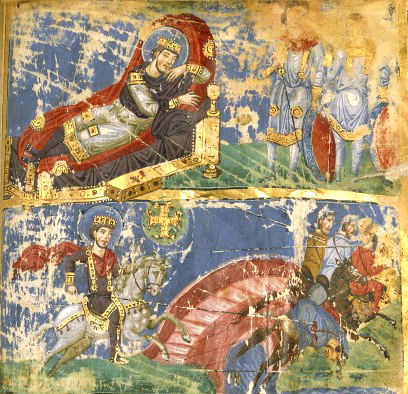
St. Constantine seeing the vision of the Holy Cross of Christ, and receiving his call from the Lord (source)
  
Constantine, the future ruler of all the whole Roman Empire, was raised to respect Christianity. His father did not persecute Christians in the lands he governed. This was at a time when Christians were persecuted throughout the Roman Empire by the emperors Diocletian (284-305) and his corulers Maximian Galerius (305-311) in the East, and the emperor Maximian Hercules (284-305) in the West.

After the death of Constantius Chlorus in 306, Constantine was acclaimed by the army at York as emperor of Gaul and Britain. The first act of the new emperor was to grant the freedom to practice Christianity in the lands subject to him. The pagan Maximian Galerius in the East and the fierce tyrant Maxentius in the West hated Constantine and they plotted to overthrow and kill him, but Constantine bested them in a series of battles, defeating his opponents with the help of God. He prayed to God to give him a sign which would inspire his army to fight valiantly, and the Lord showed him a radiant Sign of the Cross in the heavens with the inscription "In this Sign, conquer."

The vision of St. Constantine of the Precious Cross of Christ, and his victory in battle (http://vatopaidi.files.wordpress.com/2010/06/to-orama-tou-megalou-konstantinou.jpg)
 
[The following night, our Lord Jesus Christ appeared to him in a dream and declared to him the power of the Cross and its significance. When he arose in the morning, he immediately ordered that a labarum be made (which is a banner or standard of victory over the enemy) in the form of a cross, and he inscribed on it the Name of Jesus Christ. On the 28th Of October, he attacked and mightily conquered Maxentius, who drowned in the Tiber River while fleeing. The following day, Constantine entered Rome in triumph and was proclaimed Emperor of the West by the Senate, while Licinius, his brother-in-law, ruled in the East. But out of malice, Licinius later persecuted the Christians. Constantine fought him once and again, and utterly destroyed him in 324, and in this manner he became monarch over the West and the East.]

St. Constantine the Great, the Equal-to-the-Apostles (fresco by Manuel Panselinos, Protaton, Mount Athos) (http://pravicon.com/images/sv/s1199/s1199002.jpg)
 
After Constantine became the sole ruler of the Western Roman Empire, he issued the Edict of Milan in 313 which guaranteed religious tolerance for Christians. St Helen, who was a Christian, may have influenced him in this decision. In 323, when he became the sole ruler of the entire Roman Empire, he extended the provisions of the Edict of Milan to the Eastern half of the Empire. After three hundred years of persecution, Christians could finally practice their faith without fear.

Renouncing paganism, the Emperor did not let his capital remain in ancient Rome, the former center of the pagan realm. He transferred his capital to the East, to the city of Byzantium, which was renamed Constantinople, the city of Constantine (May 11). Constantine was deeply convinced that only Christianity could unify the immense Roman Empire with its diverse peoples. He supported the Church in every way. He recalled Christian confessors from banishment, he built churches, and he showed concern for the clergy.

St. Helen with the Precious Cross of Christ (http://www.pigizois.net/sinaxaristis/05/21_eleni.jpg)
 
The emperor deeply revered the victory-bearing Sign of the Cross of the Lord, and also wanted to find the actual Cross upon which our Lord Jesus Christ was crucified. For this purpose he sent his own mother, the holy Empress Helen, to Jerusalem, granting her both power and money. Patriarch Macarius of Jerusalem and St Helen began the search, and through the will of God, the Life-Creating Cross was miraculously discovered in 326. (The account of the finding of the Cross of the Lord is found under the Feast of the Exaltation of the Cross, September 14). The Orthodox Church commemorates the Uncovering of the Precious Cross and the Precious Nails by the Holy Empress Helen on March 6.

 
While in Palestine, the holy empress did much of benefit for the Church. She ordered that all places connected with the earthly life of the Lord and His All-Pure Mother, should be freed of all traces of paganism, and she commanded that churches should be built at these places [at the sites of the Crucifixion and Resurrection, in Bethlehem at the cave where our Saviour was born, another on the Mount of Olives whence He ascended into Heaven, and many others throughout the Holy Land, Cyprus, and elsewhere.]

The emperor Constantine ordered a magnificent church in honor of Christ's Resurrection to be built over His tomb. St Helen gave the Life-Creating Cross to the Patriarch for safe-keeping, and took part of the Cross with her for the emperor. After distributing generous alms at Jerusalem and feeding the needy (at times she even served them herself), the holy Empress Helen returned to Constantinople, where she died in the year 327.

St. Helen with scenes from her life (http://pravicon.com/images/sv/s0767/s0767015.jpg)
 
Because of her great services to the Church and her efforts in finding the Life-Creating Cross, the empress Helen is called "the Equal of the Apostles." The peaceful state of the Christian Church was disturbed by quarrels, dissensions and heresies which had appeared within the Church. Already at the beginning of St Constantine's reign the heresies of the Donatists and the Novatians had arisen in the West. They demanded a second baptism for those who lapsed during the persecutions against Christians. These heresies, repudiated by two local Church councils, were finally condemned at the Council of Milan in 316.

The Dormition of St. Helen, as she is surrounded by her son, St. Constantine, Angels, and many of the faithful (source)
   
Particularly ruinous for the Church was the rise of the Arian heresy in the East, which denied the Divine Nature of the Son of God, and taught that Jesus Christ was a mere creature. By order of the emperor, the First Ecumenical Council was convened in the city of Nicea in 325.
  
St. Helen holding the Precious Cross, the Crown of Thorns and the Holy Nails of Christ which she found (source)
  
318 bishops attended this Council. Among its participants were confessor-bishops from the period of the persecutions and many other luminaries of the Church, among whom was St Nicholas of Myra in Lycia. (The account about the Council is found under May 29). The emperor was present at the sessions of the Council. The heresy of Arius was condemned and a Symbol of Faith (Creed) composed, in which was included the term "consubstantial with the Father," confirming the truth of the divinity of Jesus Christ, Who assumed human nature for the redemption of all the human race.

One might possibly be surprised by St Constantine's grasp of theological issues during the discussions at the Council. The term "consubstantial" was included in the Symbol of Faith at his insistence.

[Falling ill near Nicomedia, he requested to receive divine Baptism, according to Eusebius (The Life of Constantine. Book IV, 61-62), and also according to Socrates and Sozomen; and when he had been deemed worthy of the Holy Mysteries, he reposed in 337, on May 21 or 22, the day of Pentecost, having lived sixty-five years, of which he ruled for thirty-one years. His remains were transferred to Constantinople and were deposed in the Church of the Holy Apostles, which had been built by him (see Homily XXVI on Second Corinthians by Saint John Chrysostom).]"
(taken from: http://ocafs.oca.org/FeastSaintsViewer.asp?SID=4&ID=1&FSID=101452, and quotes in brackets taken from: http://goarch.org/chapel/saints_view?contentid=62&type=saints&date=5/21/2009&D=TH)
  
Mosaic of St. Constantine the Great, Hagia Sophia, circa 1000 AD (taken from: http://en.wikipedia.org/wiki/Constantine_I)
  
Additional Details about St. Constantine
The following quote about St. Constantine at the First Ecumenical Council is taken from: http://www.orthodoxphotos.com/Holy_Relics/St._John_Iacob_the_Hozevite/index.shtml.

"In the History of the Church by the most-wise hierarch Meletius, it says that when the First Ecumenical Council in Nicaea ended, the Emperor St. Constantine the Great rejoiced greatly at the victory of the the Church against the slanderers. The emperor was present at the Council and honored the Holy Fathers with rich gifts, according to their merit, piously kissing the plucked eyes of the devoted Paphnutius with zeal, as well as the hands maimed by the tyrants. He also devoutly kissed all the other confessors, in order to sanctify himself through their wounds, which they suffered in the time of the persecution.

Some of the Council's fathers handed the emperor some complaints against a number of bishops of bad conduct. But the great Emperor Constantine did not even read their papers, nor was he interested in the identity of the accused clerics, but burned the papers in the presence of all, saying: "If with my own eyes I were to see a cleric sin, I would cover him with my mantle, that is with the mantle of the emperor.""

The Life of St. Nicholas mentions how he appeared to St. Constantine in a dream, telling him to free three generals who were wrongly imprisoned. See: http://full-of-grace-and-truth.blogspot.com/2008/12/life-of-st-nicholas-archbishop-of-myra.html, for an account and an icon.

 
And for one primary source account of the Life of St. Constantine, see that of Eusebius at the following link: http://www.newadvent.org/fathers/2502.htm. This has many details from the life of St. Constantine, many quotes and letters of his. As an example, the following quote is of St. Constantine's request for Baptism, and of the sacrament itself:
"'The time is arrived which I have long hoped for, with an earnest desire and prayer that I might obtain the salvation of God. The hour is come in which I too may have the blessing of that seal which confers immortality; the hour in which I may receive the seal of salvation. I had thought to do this in the waters of the river Jordan, wherein our Saviour, for our example, is recorded to have been baptized: but God, who knows what is expedient for us, is pleased that I should receive this blessing here. Be it so, then, without delay: for should it be his will who is Lord of life and death, that my existence here should be prolonged, and should I be destined henceforth to associate with the people of God, and unite with them in prayer as a member of his Church, I will prescribe to myself from this time such a course of life as befits his service.' After he had thus spoken, the prelates performed the sacred ceremonies in the usual manner, and, having given him the necessary instructions, made him a partaker of the mystic ordinance. Thus was Constantine the first of all sovereigns who was regenerated and perfected in a church dedicated to the martyrs of Christ; thus gifted with the Divine seal of baptism, he rejoiced in spirit, was renewed, and filled with heavenly light: his soul was gladdened by reason of the fervency of his faith, and astonished at the manifestation of the power of God. At the conclusion of the ceremony he arrayed himself in shining imperial vestments, brilliant as the light, and reclined on a couch of the purest white, refusing to clothe himself with the purple any more."
(taken from: http://www.newadvent.org/fathers/25024.htm)

And finally, the life of St. Paisios is recounted a vision he received of St. Constantine the Great, in which he praises the Monastic Life (see the previous post: http://full-of-grace-and-truth.blogspot.com/2008/10/vision-of-st-paisios-of-st-constantine.html)


Icon of St. Helen (taken from: http://www.photosled.com/data/1985/0521_Eleni.jpg)
  
Churches built by St. Helen
Many of the churches built by St. Helen still exist to this day. These include (besides those listed above) the Chapel at the Burning Bush on Mount Sinai (http://www.sinaimonastery.com/en/index.php?lid=65), the Church of Ekatontopyliani (Church of One Hundred Doors) on the Greek island of Paros (http://www.ekatontapyliani.org/), the Church of the Holy Cross in Rome (Santa Croce: http://www.sacred-destinations.com/italy/rome-santa-croce-in-gerusalemme.htm), etc. The Church of the Holy Apostles in Constantinople was also built by Sts. Constantine and Helen, however almost nothing remains of it to this day, and a mosque has been built over it (http://www.sacred-destinations.com/turkey/istanbul-church-of-holy-apostles.htm).
  
"Depiction of the Church of the Holy Apostlesin an illuminated manuscript." (taken from: http://www.sacred-destinations.com/turkey/istanbul-church-of-holy-apostles.htm)
  
A major portion of the Relics of St. Helen are purported to reside in Paris, in the Church of St. Leu - St. Gilles, where they go largely unnoticed by both tourists and the local population. In the following article from Road to Emmaus Journal, "A CITY OF SAINTS: THE FORGOTTEN RELIQUARIES OF PARIS", there is an interview with an Orthodox priest in Paris, Fr. Nicholas Nikichine, who has researched many of the incredible Relics in or near Paris, many of which are generally unknown to the faithful. These include the Crown of Thorns of Christ, the Head of St. John the Baptist, etc., but also the Relics of St. Helen. See the following link for the full interview: http://www.roadtoemmaus.net/back_issue_articles/RTE_25/A_CITY_OF_SAINTS.pdf.
  
May Sts. Constantine and Helen intercede for all of us and help us!
  

Sts. Constantine and Helen the Equal-to-the-Apostles (Icon courtesy of www.eikonografos.com used with permission)
  
Apolytikion in the Plagal of the Fourth Tone
He beheld the image of Your Cross in the Heavens and, as Paul, he too did not receive the call from men. Your Apostle among Kings placed the care of the Royal City in Your hands. Through the intercessions of the Theotokos, O only Loving Lord, keep it ever in peace.
  
Kontakion in the Third Tone
Today, Constantine with his mother Helen present the Cross, the most precious wood. It shames unbelievers. It is a weapon of faithful kings against their adversaries. A great sign has come forth for us which is awesome in battle.


Christ is risen from the dead, by death, trampling down upon death, and to those in the tombs, bestowing life!
Truly the Lord is risen!