Saturday, May 2, 2009

St. Matrona of Moscow

Christ is risen! Truly He is risen!

St. Matrona of Moscow - Commemorated on April 19 (May 2 in the New Calendar) (http://ocafs.oca.org/FeastSaintsViewer.asp?SID=4&ID=1&FSID=205349)
  
"Matrona was born in 1881 into a poor family in the village of Sebino-Epifaniskaya (now Kimovski) in the Tula region of Russia. Blind from birth, she bore her infirmity with humility and patience, and God made her a vessel of grace. At the moment of her baptism, the priest saw a cloud above the child, which shed forth a sweet fragrance as a sign of divine favor.

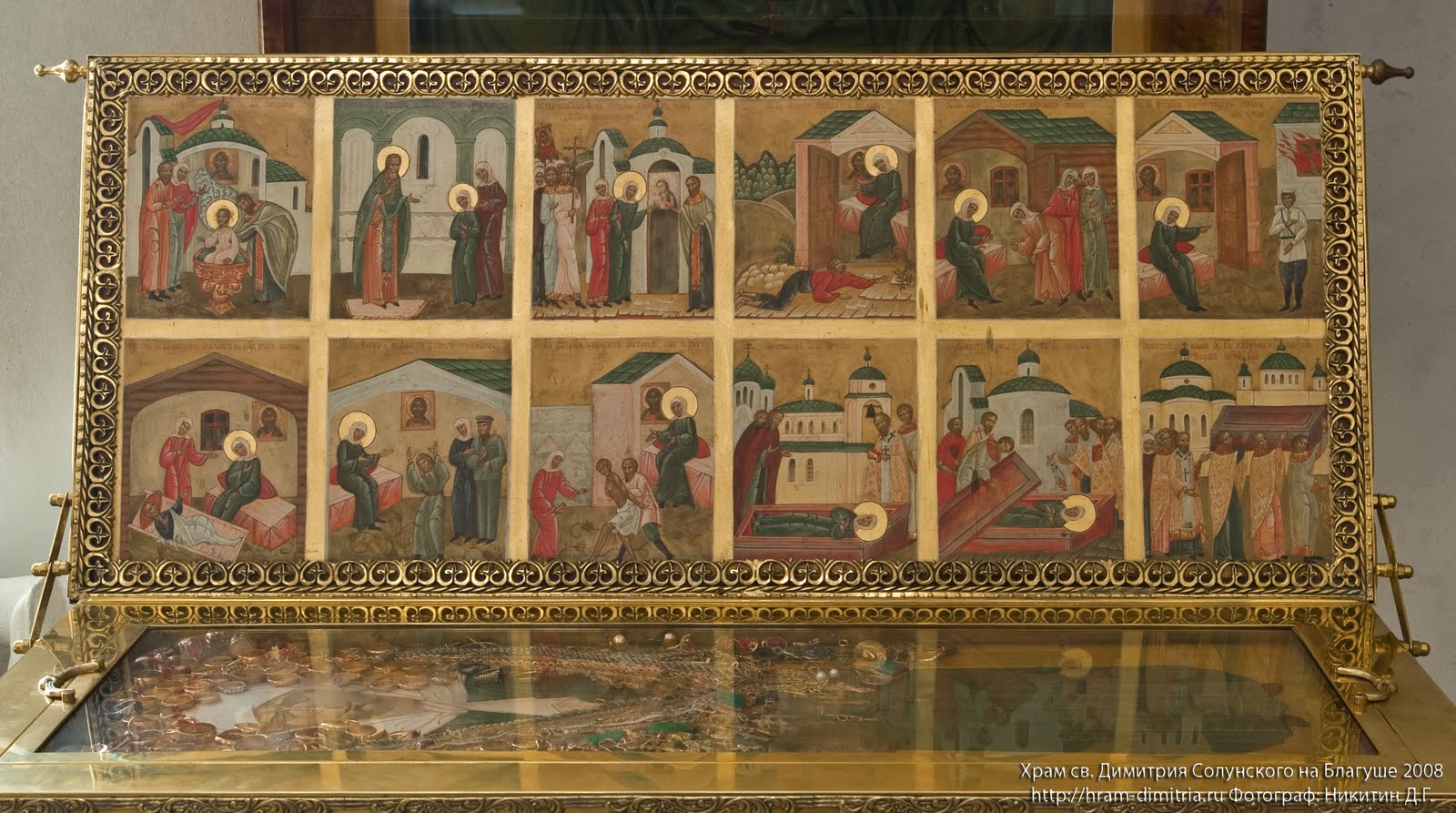
The baptism of St. Matrona of Moscow (http://www.pokrov-monastir.ru/?include=static&page_id=78)
  
From the age of six or seven, she exhibited an extraordinary gift of insight, discerning sicknesses of soul and body in the many people who visited her, revealing to them their secret sins and their problems, and healing them through prayer and wise counsel. Around the age of fourteen, she made a pilgrimage to the great holy places in Russia along with a devout benefactress. When they arrived at Kronstadt to receive the blessing of St. John, they became lost in the crowd. St. John suddenly cried out, “Matrona, come here! She will be my heir, and will become the eighth pillar of Russia.” At that time, no one understood the meaning of this prophecy.

St. Matrona meeting St. John of Kronstadt (http://www.pokrov-monastir.ru/?include=static&page_id=78)
  
When she turned seventeen, Matrona became paralyzed and was unable to walk from then on. Knowing that this was God’s will, she never complained but thanked the Lord. For the rest of her life – over fifty years – she lived in a room filled with icons, sitting cross legged on her bed. With a radiant face and a quiet voice, she received all who came to seek divine consolation through her presence. She foretold the great misfortunes that were to sweep down upon the country after the Bolshevik revolution, placing her gift of insight at the service of the people of God. One day when some visitors commiserated with her about her disablement, she replied: “A day came on which God opened my eyes, and I saw the light of the sun, the stars and all that exists in the world: the rivers, the forests, the sea and the whole of creation.”

The Theotokos "The Searcher for the Lost" (http://www.ruicon.ru/exhibition/1x1.php?page_30=670&)
  
The Theotokos the "Searcher for the Lost"
[Around this same time, Matrona, who was already known throughout the region and whose requests were taken as blessings, asked that a certain icon of the Mother of God be painted for the village Church of the Dormition. This came about one day when the blind girl asked her mother to tell the priest that on a certain shelf in his library lay a book with a picture of the icon, “In Search of the Lost.” The surprised priest found the picture of the icon just as she had described it. When she heard this, Matrona exclaimed, “Mama, I will have such an icon painted.” Her mother was pensive. How could they ever pay for this? Some time later, Matrona again said to her mother, “Mama, I’m dreaming and dreaming about this icon ‘In Search of the Lost.’ The Mother of God is asking to come to our church.” At Matrona’s request local village women began collecting money. Among those who contributed was one man who gave a ruble reluctantly and his brother who gave one small kopeck in fun. When they brought the money to Matrona, she spilled it out and, picking out the very same ruble and kopeck, told her mother, “Mama, give it back, it’s spoiling all the money for me…”

When the necessary amount had been collected, they ordered the icon from an artist from the village of Epiphania. Matrona asked if he was able to paint such an icon, and he replied that for him it was an ordinary commission. She then asked him to go to confession and receive Holy Communion. Later she asked again, “Do you know for sure that you will paint this icon?” The artist answered affirmatively and began his work. After some time, he told Matrona that nothing was coming of the painting. She replied: “Repent of your sins.” With her spiritual vision, she saw that there was one sin that he had not yet confessed. Astounded that she knew this, he returned to the priest, confessed, communed, and asked Matrona’s forgiveness. She replied, “Go. Now you will paint the icon of the Heavenly Queen.” The icon was painted about 1915 and, after the revolution, Matrona kept it with her throughout her life. It is now enshrined in Moscow at the Monastery of the Protection of the Mother of God in Taganskaya, near Matrona’s relics.

The wonderworking icon of the Theotokos, the "Searcher for the Lost", written in 1915 at the direction of St. Matrona of Moscow (http://www.pokrov-monastir.ru/?include=static&page_id=78)
  
With Matrona’s blessing, another collection of money was made in the villages and another icon “In Search of the Lost” was ordered for the village of Bogoroditske. This icon is now in Holy Dormition Monastery in the village of Novo-Moskovsk, in the province of Tula.

When the icon was ready, it was carried in procession with crosses and banners from Bogoroditske to their own church in Sebino. Matrona went four kilometers out of the village to meet it, others leading her by the hands. (This was before she lost the use of her legs.) Suddenly she announced, “Don’t go any further, now very soon they will come, they’re already close.” Blind from birth, she spoke like one with sight, “They will be here in half an hour with the icon.” And indeed, after thirty minutes the procession came in sight. A moleben was served and the procession continued to Sebino, Matrona carrying the icon for much of the way. This icon of the Mother of God became the main object of local veneration and was glorified with many miracles. When there was a drought, they would bring the icon to a meadow near the village and serve a moleben; rarely were the villagers able to return home before it began to rain. (http://manastir-lepavina.org/novosti/index.php/engtext/detaljnije/matrona_of_moscow_saint_and_wonderworker/)]

St. Matrona meeting the icon of the Theotokos the "Searcher for the Lost" in procession (http://www.pokrov-monastir.ru/?include=static&page_id=78)
  
In 1925 she left her village to settle in Moscow and, after her mother’s death in 1945, she moved frequently, welcomed secretly into the houses of the faithful. This was because the Communists, fearing her influence among the people, wanted to arrest her. But, every time, she had advance knowledge, and when the police arrived they learned that she had moved an hour or two earlier. One day, when a policeman arrived to arrest her, she advised him to return home as quickly as possible, promising him that she would not escape. When the man arrived home, he discovered that his wife was on fire, and was just in time to take her to the hospital.


A photograph of St. Matrona the Righteous Wonderworker of Moscow (http://www.ruvr.ru/main.php?lng=eng&q=10744&cid=115&p=11.05.2007)
  
St. Matrona led an ascetic life on her bed of pain. She fasted constantly, slept little, her head resting on her chest, and her forehead was dented by the innumerable signs of the Cross that she made. Not only the Muscovites but also people from afar, of all ages and conditions, thronged around her to ask her advice and her prayers. In this way she truly became the support of afflicted people, especially during World War II. To those who came to ask her for news of their relatives in battle, she reassured some and counseled others to hold memorial services. She spoke to some directly, and to others in parables, having in view their spiritual edification and recommending them to keep the Church’s laws, to marry in the Church and to regularly attend Confession and take Communion. When the sick and possessed were brought to her, she placed her hands on their heads, saying several prayers or driving the demons out with authority, always insisting that she was doing nothing of herself but that God was healing by her mediation. When asked why the Church was undergoing such great persecutions, she replied that it was because of the sins of the Christians and their lack of faith. “All the peoples who have turned away from God have disappeared from off the face of the earth,” she affirmed. “Difficult times are our lot, but we Christians must choose the Cross. Christ has placed us on His sleigh, and he will take us where He will.”

Icon of St. Matrona of Moscow from the Monastery of St. Panteleimon, Penteli (near Athens, Greece), where the Saint is greatly celebrated, and works a great number of miracles (https://vatopaidi.files.wordpress.com/2012/04/agiamatrona004.jpg)
  
The blind Saint's far sight
[In an even more remarkable example of her clairvoyance, Zenaida recalled, “Matushka was completely unlearned, but at the same time knew everything. In 1946, I was to defend my thesis project on an architectural design for the Ministry of the Navy (I was then studying at an architectural institute in Moscow). I did not understand why, but my thesis advisor had taken a dislike to me and my project. For five months he would not consult with me once, and he had already decided to fail my project. Two weeks before the defense he informed me, “The commission will arrive tomorrow and declare the worthlessness of your work! You won’t even defend it.”

I returned home in tears – father was in prison, there was no one to help, mama depended on me. Our only hope was that I would successfully complete my university education and get a job.

That afternoon Matrona listened to me attentively and said, “Don’t worry, don’t worry, you will pass your exam! Tonight, we’ll have tea and talk about it.” I could hardly wait for evening to come and when I joined her, she said, “I will go with you to Italy, to Florence, to Rome and we will see the works of the great masters.” Then she began to enumerate the streets, the buildings! She paused at one point: “Behold, the Plazzio Pitti… and here’s another palace with archways, similar to the one in your work – a building with three lower levels of massive stonework and two arched entryways.” She spoke in detail about the architectural elements of the building, and I was shocked at her knowledge of the subject. In the morning I ran to the institute, put tracing paper over my project and using brown ink I made corrections based on what she had said. The commission came at ten o’clock. They looked over my project and said, “And so, your project came out well, it looks excellent – go ahead and defend it!”...

When she was quite young, Matrona foretold the 1917 Russian Revolution. “There will be pillaging, destruction of churches, and everyone will be persecuted.” She graphically described how the land would be divided up and how parcels of land would be grabbed by people intent on getting something for themselves. “Then, they will throw away the land and run off in every direction. In the end, the land will be useless for anyone.” Thus, Matrona saw beforehand the revolutionary “program” of land redistribution, which dispossessed even the poor.

Before the revolution, Matrona advised Yankov, the landowner of their village of Sebino, to sell everything and go abroad. If he had listened to her, he would not have had to witness the plundering of his estate, he would have avoided his own untimely death, and he would have spared his daughter Lydia a life of homeless wandering.

A fellow villager of Matrona, Evgenia Ivanovna Kalashnikova, related that before the revolution a baroness bought a house in Sebino and told Matrona, “I want to build a bell tower.” “What you plan to do will not come to pass,” Matrona answered. The baroness was surprised: “Why won’t it come true, when I have both money and materials?” But it was so – nothing ever came of her plans; the revolution disrupted everything...

In her memoirs, Zenaida Zhdanova writes: “Who was Matrona, exactly? Matushka was an angel incarnate – a warrior, doing battle with evil powers as if she held a flaming sword in her hands. She healed by her prayers, with holy water…

“She was small, like a child, and often lay on her side, on her clenched fist. She also slept this way, never really lying down completely. When she received people, she sat cross-legged, her legs beneath her. She would put her hands on the head of the person kneeling in front of her, make the sign of the Cross over them, pray, and then say whatever was needful for their soul. “It seems that Matushka knew everything that was going to happen ahead of time. Every day of her life was a stream of grief and sorrow from those who came to her. She would hold the head of a weeping person in both hands, suffering with them, warming them with her holiness. The person would leave as if on wings, and many healings occurred as a result of her prayers. Matrona herself was often exhausted; she sighed heavily and prayed all night long. She had a small depression on her forehead from her fingers because she had crossed herself so very often. She crossed herself slowly, carefully, her fingers searching for this place on her forehead.” (http://manastir-lepavina.org/novosti/index.php/engtext/detaljnije/matrona_of_moscow_saint_and_wonderworker/)]
  
"As an intercessor before the Lord, Matrona helped many with sicknesses and sorrows. Four kilometers from Sebino there lived a man who couldn’t walk. Matrona said, “Let him begin to crawl to me in the morning. He will reach us at about three o’clock.” He crawled the four kilometers, and left her on his own legs, healed." (http://manastir-lepavina.org/novosti/index.php/engtext/detaljnije/matrona_of_moscow_saint_and_wonderworker/, http://www.pokrov-monastir.ru/?include=static&page_id=78)
  
Having foretold the day of her death, she gave instructions for her funeral. Before falling asleep in peace on April 19, 1952, she cried out, “Come close, all of you, and tell me of your troubles as though I were alive! I’ll see you, I’ll hear you, and I’ll come to your aid.” Miracles were multiplied at her tomb and, ever since her translation to the women’s monastery of the Protecting Veil of the Mother of God (March 13, 1998), the faithful who, in their thousands, line up to venerate Moscow’s new protectress, turn to her icon and bring her their various problems as though St. Matrona were alive in front of them."
From Volume Four of the Synaxarion, compiled by the Hieromonk Makarios of Simonos Petra, Mount Athos (taken from: http://www.antiochian.org/node/18294)
  

For an extended account of her life with additional miracles, see: http://www.ruvr.ru/main.php?lng=eng&q=10744&cid=115&p=11.05.2007, http://manastir-lepavina.org/novosti/index.php/engtext/detaljnije/matrona_of_moscow_saint_and_wonderworker/.

For numerous icons of St. Matrona and pictures of her, her Holy Relics, her pilgrimage, etc., see: http://www.rel.gr/photo/thumbnails.php?album=35.


For the Paraklesis and Akathist to St. Matrona of Moscow (in Greek), see: http://www.agiooros.net/forum/viewtopic.php?f=50&t=5031, and http://www.agiooros.net/forum/viewtopic.php?f=50&t=6005.
  
St. Matrona of Moscow, most properly depicted in Orthodox iconography with eyes open (both representing the far-seeing eyes of her soul, and also her physical vision that will be restored in the Resurrection) (http://www.art-sobor.ru/matrkir.jpg)
     
Troparion of St. Matrona of Moscow
Chosen by the Holy Spirit from thy swaddling clothes O blessed eldress Matrona, / Thou didst receive bodily weakness and blindness from God for spiritual cleansing, / Thou wast enriched with the gift of foresight and wonderworking and hast been adorned with an incorruptible crown from the Lord. / Wherefore, we offer thee crowns of praise, in gratitude crying out: / Rejoice O righteous mother Matrona, fervent intercessor before God for us!
  
Ikos 1
An angel in the flesh wast thou revealed to be, O blessed Matrona, fulfilling the will of God. Though thou wast born in bodily blindness yet the Lord who maketh wise the blind and loveth the righteous enlightened thy spiritual eyes that thou mightest serve His people and the things of God were made manifest through thee. Wherefore with love we sing to thee such things as these:
Rejoice, chosen one of God from thy youth; Rejoice, thou who didst shine forth with the grace of the Holy Spirit from thy cradle.
Rejoice, thou who wast enriched with the gift of miracles even as a child; Rejoice, thou who wast filled with wisdom from God most high.
Rejoice, thou who foresawest the will of God with noetic eyes; Rejoice, thou who didst put to shame the wise of this age who are blinded in mind.
Rejoice, thou who ledest deluded souls back toward God; Rejoice, thou who assuagest sorrow and affliction.
Rejoice O righteous mother Matrona, fervent intercessor before God for us.
Christ is Risen from the dead, by death, trampling down upon death, and to those in the tombs, bestowing life!
Truly the Lord is risen!

Friday, May 1, 2009

Sts. Theocharis and Apostolos the Righteous of Arta

Christ is risen! Truly He is risen!
The bell tower of St. Sophia's Church in Arta, Greece (taken from: http://www.imnartis.gr/photo1.html) 


The following is an amateur translation of the life of Sts. Theocharis and Apostolos, two brothers and monastics from Arta, Greece who lived at the end of the 18th to beginning of the 19th century. It is taken from the Metropolis of Arta website at: http://www.imartis.gr/imartis/ntouia.php.


 The feast of Sts. Theocharis and Apostolos was originally celebrated by the people on the Wednesday of Renewal (Bright) Week, but more recently in has been officially moved to the second Sunday after Pascha: the Sunday of the Holy Myrrhbearers. May they intercede for all of us!


The Life of the righteous brothers, Sts. Theocharis and Apostolos of Arta (amateur translation)


In every age God brings forth holy people who, though they live in the same times and ways of life as their fellow people, “fight the good fight of faith”, and enlighten as spiritual lamps everyone, whom they serve in the name of our Lord.


In an era that was difficult for our whole [Greek] nation (the end of the 18th and the beginning of the 19th century), God gave the blessing to our city to have two brothers in the flesh, Sts. Theocharis and Apostolos, be born, live, struggle in asceticism, teach and become holy.

The first years of their lives The righteous brothers Theocharis and Apostolos were the children of the pious priest Fr. George Douia, from the church of St. Sophia in Arta, and the virtuous Presbytera Photini. God graced them with three sons (the third was named Konstantinos), who were raised from childhood in the law of the Lord. They took care first of all that they became men of God and the goal of their earthly lives should be the path towards heaven and of their sanctification. They put great care into forming their children, who ended up becoming some of the finest in their city.

The oldest son Theocharis (born around 1760) paid great attention to learning. He was taught at the school of Manolaki Kastoriote, where the great teacher and chanter Dimitrios Economopoulos Bandrames (from Mesollogi) was. St. Theocharis was taught, but with his holy life also taught his fellow students, many of whom later followed him and became priests and monks. From this age, the power of the Saint’s word was revealed, which came from a heart aflame with the love of God.

And the «simple and pure in soul» St, Apostlos was taken under his father’s wing himself.

The two brothers Sts. Theocharis and Apostolos had a special affinity and love for the ecclesiastical life, and with unique humility and reverence they served their priest/father in his liturgical position. In fact, their whole family was an unending source of love and sacrifice, both physically and spiritually to their fellow men and their parishioners.

The joy of their parents was great for their children’s progress and good works. The heart of this most pious priest danced at the notion and promise of seeing his two sons liturgizing at the super-heavenly altar. Such a holy love of the faith this virtuous priest had! In reality, with great care he advised his two sons to become priests, of which there is nothing more holy or blessed on the earth. He also made requests to the Metropolitan of Arta to ordain his sons in the church of St. Sophia where he liturgized.

The response of the wise youths was: “Don’t rush father. Everything is in God’s hands.” The Saints saw the height and grandeur of the Priesthood of Christ, and did not seek it, but like the great Fathers of our Church, fled with awe and piety from this great honor.


This blessed priest wanted his first son Theocharis to get married and afterwards to become a priest. God had arranged something else for him. St. Theocharis made the decision to follow the angelic commonwealth, in other words, the path of asceticism and the monastic way of life, and he related with great seriousness: “I am thinking that when I finish my studies and reach the legal age, I will go where Divine Providence will enlighten me to go and what to do.”


Along with his parents, the Metropolitan praised him for his foresight and looked forward to enlightening their local church with the decision to ordain them.


When St. Theocharis finished his studies, the family of the holy Priest George Douia, according to the consent of God, was tested. The two parents, Fr. George and Presbytera Photini, fell asleep in the Lord. They left peacefully from the world however, because they did all that they could do to pay back their debt to God and their fellow men by offering back to their children the notable estate and inheritance.


This estate, which they tried to give to their children, was their true and known faith, their holy lives, and their path according to God above the honors of faith and country.

Sts. Theocharis and Apostolos, like good older brothers, took care of their younger brother Konstantinos. When he became a man, they saw to his marriage. From this marriage with Sossani, they had two sons: George and Theocharis. When Sts. Theocharis and Apostolos saw their brother establishing a family, they withdrew to a small house near St. Sophia’s church and fled from worldly things.


St. Sophia's Church in Arta (taken from: http://www.imnartis.gr/photo1.html)


Of the same blood and the same dwelling

The two brothers, far from the things of the world, ceaselessly threw themselves into great ascetical struggles with courage and bravery. Ceaseless prayer, meditation on the word of God, all-night standing, soul-strengthening fasting, silence and perseverance, repentance and all-fervent love towards God were their daily works and life.

The first biographer of their, Archimandrite Konstantinos, Abbot of the Holy Monastery of Kato Panagias, remarked that the bread they placed in an earthenware container with a small opening (such that only one hand could fit in) to limit the amount of their food. But when some pious and merciful Christians brought them food, they would thank them, and received it with good wishes and prayers, not to savor it—not in the least—but to show mercy to their many fellow men who were found in poor and difficult states. When they would take the food to them, they would remark that they had already eaten enough, and that they should take the rest. Naturally, they would tell those they would help not to tell anyone of their actions.

Their food was confined to bread and water until sunset. A few times they ate a little fruit.

The famous Monastery of Kato Panagias, the only Byzantine monastery in Arta still inhabited (taken from: http://www.rodavgi.com/arta/arta.htm)

And though they did not have the monastic schema and were not tonsured monks, they followed the canon of the Great Monastic schema with exactitude. They communed the Holy Mysteries once per week, and followed the life and example of the fathers and ascetics of their day, the spirit of which was also passed to them by the teaching of St. Kosmas Aitolos.

They did not leave their small house unless there was a serious need, or when their love towards those who sought them, dictated service and sacrifice. In this way, St. Theocharis first began to teach letters in Artinopoula in the small and grace-filled chapel of Panagia Kassopitras (Kassiope) until 1818. There he taught not only secular letters and did not impart stale ideas, but chiefly cultivated the soul, watering with the clear waters of faith and of the Gospel, and established in them love of the desert and service to their country. It is not surprising that from this teacher came many excellent students, including the head of the Society of Friends Nicholas Skoufas from Kombotiou. Truly, who can count the heartbeats of the student and the teacher in trasmitting teaching about life? [ποιος μπορεί να μετρήσει τους παλμούς της καρδιάς δασκάλου και μαθητή μέσα στη διαδικασία μετάγγισης ζωής;] Who can outline here in so few words, what occurred in the soul of the youth Skoufas, hearing this fiery teacher?


The work of the Righteous Theocharis was notable, and great was the spiritual profit of the faithful of Arta from his godly homilies in the church of the Agioi Anargyroi (the Holy Unmercenaries).

The Righteous Theocharis offered his untiring services to the Metropolis of Arta without seeking recognition, during the time when the Metropolitan was the Abbot of the Holy Monastery of the Theotokos, Benediktos “the magnificent and merciful”. Benediktos, honoring this great and holy person, called him to work as his secretary. St. Theocharis, due to the weight and the trouble of this work, and the trials of a priest came up with an excuse. He did not allow himself to accept this idea, so he pretended to be sick and returned to his beloved cell, where he found consolation in the prayer of Jesus and in many prostrations.


[This was a particularly difficult portion for me to translate. Here is the original Greek in case I made any errors: Ο Θεοχάρης παρά το φόρτο και τον κόπο της εργασίας αυτής ουδέποτε παραπονέθηκε και αρνήθηκε κάτι, παρά μόνο σε περιπτώσεις διαζυγίου, αφωρισμού και τιμωρίας ιερέα. Η αγία του ψυχή και η συνείδησή του δεν το άντεχε, γι’αυτό προσποιούνταν τον άρρωστο και κατέφευγε στο αγαπητό του κελλί όπου έβρισκε παρηγοριά στην προσευχή του Ιησού και στις πολυάριθμες μετάνοιες.]


Benedict, after entreating the Saint many times, understood that this work wouldn’t suit St. Theocharis, and he excused him from his position to dedicate all time to prayer and the meditation on the word of God and of the holy Fathers. On this ascetical path his fellow traveler and fellow ascetic was St. Apostolos, his brother according to the flesh and the spirit.
The Righteous Brothers loved the solitary life completely. Only St. Apostolos would leave from their small ascetical dwelling in the heart of the city to purchase their necessities and to work their small vineyard.


It is mentioned that the Saints had two jugs for water. During the night they would go to the fountain to refill them where the women would fill theirs during the day. This they did because they were lovers of silence and prayer. With such a station and prayer they strengthened the faithful of the city during the period of the great and fatal plagues which hit Arta, the first on May 2nd of 1816, and the second in 1823.


The two brothers did not distance themselves from the city, but day and night locked themselves up in their cell and prayed for God through the intercessions of St. Bessarion (whose skull the people of Arta brought and proceeded with in litany) to drive away the plague, while the faithful held processions around their houses. With their station, the holy brothers gave strength and courage to the inhabitants of the city who honored them with much reverence.

The dormition of the Righteous Theocharous
A righteous and God-loving life and a righteous and peaceful end comes.

St. Theocharis foresaw the hour of his death and called his brother and fellow athlete St. Apostolo to bring the priest to come and commune him at noon on Holy Friday. The priest, troubled and reverent, came to the small house where the righteous Theocharis, with a special piety communed the Holy Mysteries for the last time. After giving his final instructions and wishes to the «simple and pure in soul St, Apostlos » . He urged him first of all to continue with the same zeal the same God-loving and philanthropic ascetical life. His wish was that the Metropolitan of Arta be at his funeral and that he be buried in the church of the Holy Unmercenaries and that his remains never be unearthed. Their house, in the end, should be given to the holy church of St. Sophia, where their father himself had his first and notable spiritual experiences.

The news of his death on Holy Friday of 1828 summoned pain and sorrow to the faithful of Arta, who with reverence and piety all hastened to the funeral service, which was presided over by the Metropolitan of Arta Neophytos. Neophytos, with a few simple and moving words delivered the eulogy, offered the virtues, the faith and the ascetical life of St. Theocharis and challenged the faithful to imitate his holy life. He himself prayed for himself to be granted these great blessings and to pass away on such a great day. In reality, the following year, 1829, this pious hierarch left for the Lord on Holy Friday.

At the funeral of this Righteous one many “unspeakable and great miracles” occurred. The four lamps of the casket, which because of the funeral procession were extinguished, spontaneously lit up, and an indescribable fragrance enveloped his holy body. This fragrance filled the church of the Holy Unmercenaries and the small house where the Saint lived. Another witness mentions that at the hour of the funeral service, the candles of the polyeleos [the large chandelier in the center of the church] in the church of the Holy Unmercenaries lit on their own, a miracle from God to testify to the Saint’s holy and illuminating life. The Saint was buried in the cemetery of the Holy Unmercenaries, in the place across from the south entrance to the church.


In 1866, when the head of the church Hieromonk Cornelius was restoring the church, in this place hidden underneath a plaque, he found the “grace-filled skull giving off an indescribable fragrance”. He therefore venerated them with piety, and hid them how they had been originally, respecting the wishes of the Saint. Thus, the location of the Saint’s tomb remains untouched to this day.


The interior of St. Sophia's Church, Arta (taken from: http://www.imnartis.gr/photo1.html)


The dormition of St. Apostolos
St. Apostolos continued to live according to the final suggestions of his older brother. Monastically, ascetically, philanthropically, and ecclesiastically. Every day he cared for his fellow men who came to him, and his charity towards all was exemplary. Close to the displaced [κατατρεγμένοι?], the orphans and the poor he found consolation and hope.

Seventeen years he lived after the dormition of his holy brother, St. Theocharis, close to his other brother Konstantinos, who shared a God-loving life.


When he foresaw his death, he asked his brother to bury him in the cemetery of St. Sophia without any honors. In reality, when he surrendered his soul to the Lord in the year 1845, his remains were buried in the cemetery of St. Sophia in a place behind the holy Bema of the church. Three days after the death of the Righteous Apostolos, pious women when to the tomb—as it appears until today— to wash and decorate the tomb. They were astounded to see before them an incredible sight. They found “coming from inside the tomb, an unprecedented wonderful flower giving off an indescribable fragrance”, which revealed the holiness from God of the righteous Apostolos.

The Honor of the Saints
The memory of the righteous brothers was celebrated by the inhabitants of the city of Arta, who from the day of their deaths, honored them as Saints, commemorating them on the Wednesday of Renewal Week.


With the efforts of the ever to be remembered Fr. Stavros Papachristou, the leader of the holy church of St. Sophia, their feast was commemorated.

Their memory is today celebrated magnificently on the Sunday of the Holy Myrrhbearers in the holy church of St. Sophia.


Icon of Sts. Theocharis and Apostolos of Arta (taken from: http://www.imnartis.gr/photo1.html)


ΑΠΟΛΥΤΙΚΙΟ - Ήχος α`. Της ερήμου πολίτης.

Των κλεινών αυταδέλφων την δυάδα τιμήσωμεν, τον θεοειδή Θεοχάρην και τον σύμπνουν Απόστολον` οσίαν γαρ ανύσαντες ζωήν, Αγίων ηριθμήθησαν χοροίς, και πρεσβεύουσιν απαύστως υπέρ ημών, των εκβοώντων πάντοτε` Δόξα τω στεφανώσαντι υμάς, δόξα τω αγιάσαντι, δόξα τω δοξασθέντι δι υμών, εσχάτοις ετεσιν.

Apolytikion of Sts. Theocharis and Apostolos – 1st Tone (amateur translation)

The Dyad of close brothers let us honor, the divine Theocharis and his consonant Apostolos, righteously they persevered in life, and were numbered in the choir of the Saints, and they ceaselessly intercede for us who ever cry out: Glory to Him who crowned you, glory to Him who sanctified you, glory to Him who is glorified by you in this latter days.

ΕΤΕΡΟΝ ΑΠΟΛΥΤΙΚΙΟ - Ήχος γ`. Θείας πίστεως.
Θεία θρέμματα ώφθητε Άρτης, και κειμήλια ηθών οσίων, ώ Θεόχαρες σοφέ και Απόστολε` εν αρεταίς γαρ ενθέοις εμπρέψαντες, της των Αγίων τιμής ηξιώθητε. Αλλ' αιτήσασθε, Αυτάδελφοι παμμακάριστοι, δωρήσασθαι ημίν το μέγα έλεος.

ΜΕΓΑΛΥΝΑΡΙΟΝ

Σύμψυχοι ομότροποι αδελφοί Θεόχαρες μάκαρ και Απόστολε αληθώς, ώφθητε εν Άρτη βιώσαντες οσίως` διο της των Αγίων δόξης ετύχετε.

Megalynarion

Of one soul and the same way, brothers Theocharis the blessed and Apostolos, truly you were seen in Arta living righteously, and were granted the glory of the Saints.
(hymns taken and preliminarily translated from: http://www.imnartis.gr/agiologia.html)

Christ is Risen from the dead, by death, trampling down upon death, and to those in the tombs, bestowing life!
Truly the Lord is risen!

Thursday, April 30, 2009

St. Argyre the New Martyr

Christ is risen! Truly He is risen!

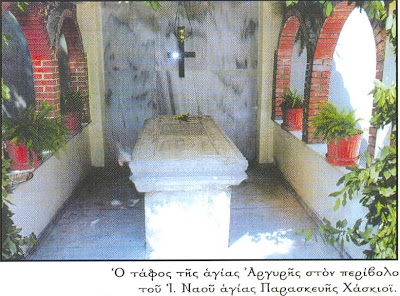
The tomb of St. Argyre the Neomartyr in the garden of the church of St. Paraskevi, Chaskioi (or Haskoy) (taken from: http://www.pigizois.net/agiologio/ag_argiri/tafos_ag_argiris.jpg)
  
The following life of the Saint is taken from: http://www.trueorthodoxy.info/los_stargyre_prusa.shtml.
  
"On the 30th of April, we commemorate the holy New-martyr Argyre of Prusa
ARGYRE, the golden Martyr of Christ, was from Prusa, and the daughter of pious parents. She possessed both a beautiful face and the fear of God. In time the blessed maiden wed. But, the newlywed caught the covetous eyes of a certain Turk in the neighborhood who fell in love with her. He schemed to bring her over to fulfill his wicked intention. Since he was unable to persuade her he slandered her to the judge of Prusa, pretending that she declared a willingness to become a Moslem. The judge immediately imprisoned the Saint. Argyre’s husband considered it more favorable to have the case transferred to the court at Constantinople. However the Saint’s accuser also appeared there and falsely charged her, maintaining the same allegations against the Martyr. Argyre affirmed that she had no knowledge of ever uttering a word denying the Faith, and stated she was a Christian and a Christian she would die. Consequently, by the judge’s order, they beat the Saint and afterwards confined her to prison. Eventually they conducted a second examination, and again they smote, punished, and jailed Argyre. These events occurred repeatedly throughout the next seventeen years. O, her courageousness!
The marble plaque on the tomb of St. Argyre, with the inscription to the right (in Greek) (taken from: http://www.pigizois.net/agiologio/ag_argiri/tafos_ag_argiris2.jpg)
  
Even inside the prison the Saint met with constant troubles and insults from the Turkish women inmates who were in detention because of their criminal actions. The devil incited them to harass Argyre through excessive affliction and torments. Nevertheless, the ever-memorable one withstood everything magnanimously, by the love and yearning she possessed for her Bridegroom Christ.

The interior of the church of St. Paraskevi, Haskoy (taken from: http://www.ec-patr.org/afieroma/churches/show.php?lang=en&id=27)
  
Perhaps you wonder whether this was all? But in addition to this, she herself subjected her body to fasting, bore every trial and underwent hardships just as the other multitudes of Christian women who were also prisoners with the Saint in that very jail. The heart of blessed Argyre was filled with exceeding joy and such thankfulness, since she was imprisoned for Christ that she thought discomforts were conveniences. Such was the case that when the pious Christian, Manolis, the maker of fishing nets, succeeded in having the charge against her withdrawn so she could be at liberty, Argyre did not assent to the reprieve but regarded the prison to be the king’s palace, Thus, incarcerated and in bonds for Christ, she ended her life receiving the imperishable crown of martyrdom in the year 1725.
  
Procession with the holy relics of St. Argyre, April 30th in Chaskioi (taken from: http://www.pigizois.net/agiologio/ag_argiri/licanothiki_ag_argiris02.jpg)
  
Then the Christians took possession of her holy relics and buried her in a place called Haskoy. At the uncovering of her relics after three years her sacred body was discovered whole and intact, emitting an unspeakable fragrance. O, the wonder! The priests and Christians received it with great devotion and placed her within the Church of Saint Paraskevi by permission of the then most holy Patriarch Paisios. To this day, her hallowed relics exist and are venerated by patriarchs, archbishops, notable people, and all Orthodox Christians, to the glory of Father, Son and Holy Spirit. Amen."

The new chapel of St. Argyre the New Martyr in Panagiouda, Lesvos (taken from: http://www.pigizois.net/agiologio/ag_argiri/naos01.jpg)
  
Though April 5th is considered the day she surrendered her soul to God, April 30th, as the date of the removal of her holy relics, is more widely celebrated. Because she refused to defile her sacred marriage, and because she was martyred so young, she is a patron saint and protector of both marriage, and the youth.
  

The holy icon of St. Argyre the Neomartyr with scenes from her life. According to the author of the source site (http://www.pigizois.net/agiologio/ag_argiri/ag_argiri.htm), when the people of Panagiouda were in the process of building the above chapel of the Saint, St. Argyre appeared in a dream to the priest, Fr. Theologos Sakales, and told him: "When you make my icon for my chapel, don't make it like this one here, but depict me holding the two stefana (crowns) of marriage." True to her guidance, the icon above depicts St. Argyre holding both the Holy Cross of a martyr and the marriage crowns as a defender and patron saint of marriage.
Apolytikion of St. Argyre in the Fourth Tone (amateur translation)
You put to shame tyrants in tortures, O pure one, you were shown forth, O much-suffering one, as strong as a diamond, o glorious martyr of Christ, you showed forth in struggles for Christ the Savior, love and zeal and unquenchable longing, Who worthily glorified you, O Argyre.
For the full account of the life, the service and the paraklesis to the Saint (in Greek), see: http://www.pigizois.net/agiologio/ag_argiri/vios_ag_argiris_prostatis_gamou.pdf, http://www.pigizois.net/agiologio/ag_argiri/akolouthia_ag_argiris.pdf, and http://www.pigizois.net/agiologio/ag_argiri/paraklitikos_kanos_ag_argiris.pdf, respectively.
   
St. Argyre the New Martyr (Icon courtesy of www.eikonografos.com used with permission)
  
St. Argyre the New Martyr, the Protector of Marriage (source)  
Christ is Risen from the dead, by death, trampling down upon death, and to those in the tombs, bestowing life!
Truly the Lord is risen!

Wednesday, April 29, 2009

Sts. Jason and Sosipater the Apostles of the Seventy

Christ is risen! Truly He is risen!
Sts. Jason and Sosipater the Apostles - Commemorated on April 29th (or in some places, April 28th); the two icons are from their church in Kerkyra, and are from the 1600's. (Icons taken from: http://www.parembasis.gr/2003/03_04_06.htm)

"The Apostle Jason was from Tarsus (Asia Minor). He was the first Christian in the city. The Apostle Sosipater was a native of Patra, Achaia. He is thought to be the same Sosipater mentioned in Acts 20:4. They both became disciples of St Paul, who even called them his kinsmen (Rom 16:21). St John Chrysostom (Homily 32 on Romans) says that this is the same Jason who is mentioned in Acts 17:5-9. St Jason was made bishop in his native city of Tarsus, and St Sosipater in Iconium. They traveled west preaching the Gospel, and in 63[AD] they reached the island of Kerkyra [Corfu] in the Ionian Sea near Greece.

There they built a church in the name of the Protomartyr Stephen and they baptized many. The governor of the island learned on this and locked them up in prison, where they met seven thieves: Saturninus, Iakischolus, Faustianus, Januarius, Marsalius, Euphrasius and Mammius. The Apostles converted them to Christ. For their confession of Christ, the seven prisoners died as martyrs in a cauldron of molten tar, wax and sulfur.

The prison guard [named Anthony], after witnessing their martyrdom, declared himself a Christian. For this they cut off his left hand, then both feet and finally his head. The governor ordered the Apostles Jason and Sosipater to be whipped and again locked up in prison.


The church of Sts. Jason and Sosipater on Kerkyra (supposedly the sole church of Byzantine architecture on the island). Here are preserved relics of Sts. Jason and Sosipater, and I believe also the tomb of the martyred prison guard, St. Anthony, honored as one of the first martyrs of the island (picture taken from: http://www.corfuvisit.net/default.asp?id=51&ACT=5&mnu=51&content=223&LangID=Greek_Iso)
  
When the daughter of the governor of Kerkyra (Korfu), the maiden Kerkyra, learned how Christians were suffering for Christ, she declared herself a Christian and gave away all her finery to the poor. The infuriated governor attempted to persuade his daughter to deny Christ, but St Kerkyra stood firm against both persuasion and threats. Then the enraged father devised a terrible punishment for his daughter: he gave orders that she be placed in a prison cell with the robber and murderer Murinus, so that he might defile the betrothed of Christ.

But when the robber approached the door of the prison cell, a bear attacked him. St Kerkyra heard the noise and she drove off the beast in the name of Christ. Then, by her prayers, she healed the wounds of Murinus. Then St Kerkyra enlightened him with the faith of Christ, and St. Murinus declared himself a Christian and was executed.

The governor gave orders to burn down the prison, but the holy virgin remained alive. Then on her enraged father's order, she was suspended upon a tree, choked with bitter smoke and shot with arrows. After her death, the governor decided to execute all the Christians on the island of Kerkyra. The Martyrs Zeno, Eusebius, Neon and Vitalis, after being enlightened by Sts Jason and Sosipater, were burned alive.
  
Icon of St. Kerkyra (taken from: http://www.saint.gr/2009/4/29/537/saint.aspx)
  
The inhabitants of Kerkyra, escaping from the persecution, crossed to an adjoining island. The governor set sail with a detachment of soldiers, but was swallowed up by the waves. The governor succeeding him gave orders to throw the Apostles Jason and Sosipater into a cauldron of boiling tar. When he beheld them unharmed, he cried out with tears, "O God of Jason and Sosipater, have mercy on me!"
Having been set free, the Apostles baptized the governor and gave him the name Sebastian. With his help, the Apostles Jason and Sosipater built several churches on the island, and increased the flock of Christ by their fervent preaching. They lived there until they reached old age."
(http://ocafs.oca.org/FeastSaintsViewer.asp?FSID=101215)


The famous Monastery of Osiou Louka in Boiotia, Greece, which treasures the holy skulls of Sts. Jason and Sosipater (picture taken from: http://brummbaer.smugmug.com/gallery/796088_McMjk#35365556_Q9iwn)
  
"In the ancient city of Corfu, a church from the first centuries, built in their honour and bearing inscriptions that mention the Saints by name, verifies the historical account concerning them."
(http://goarch.org/chapel/saints_view?contentid=35&type=saints&date=4/29/2009&D=W)


Icon of Sts. Jason and Sosipater (taken from: http://ocafs.oca.org/FeastSaintsViewer.asp?FSID=101215)
  
Apolytikion for the Holy Apostles in the Third Tone
O Holy Apostles, intercede to our merciful God, that He may grant our souls forgiveness of sins.
  
Kontakion in the Plagal of the Second Tone
Being illuminated with the teachings of Paul, ye became luminaries unto the whole world, O thrice-blessed ones; for ye ever shine upon the world with miracles, O Jason, thou fountain of healings, and Sosipater, thou glory of the Martyrs of Christ. O God-bearing Apostles, ye protectors of them that be in need, entreat God that our souls be saved.
Christ is Risen from the dead, by death, trampling down upon death, and to those in the tombs, bestowing life!
Truly the Lord is risen!