Wednesday, May 13, 2009

The Feast of Mid-Pentecost

Christ is risen! Truly He is risen!
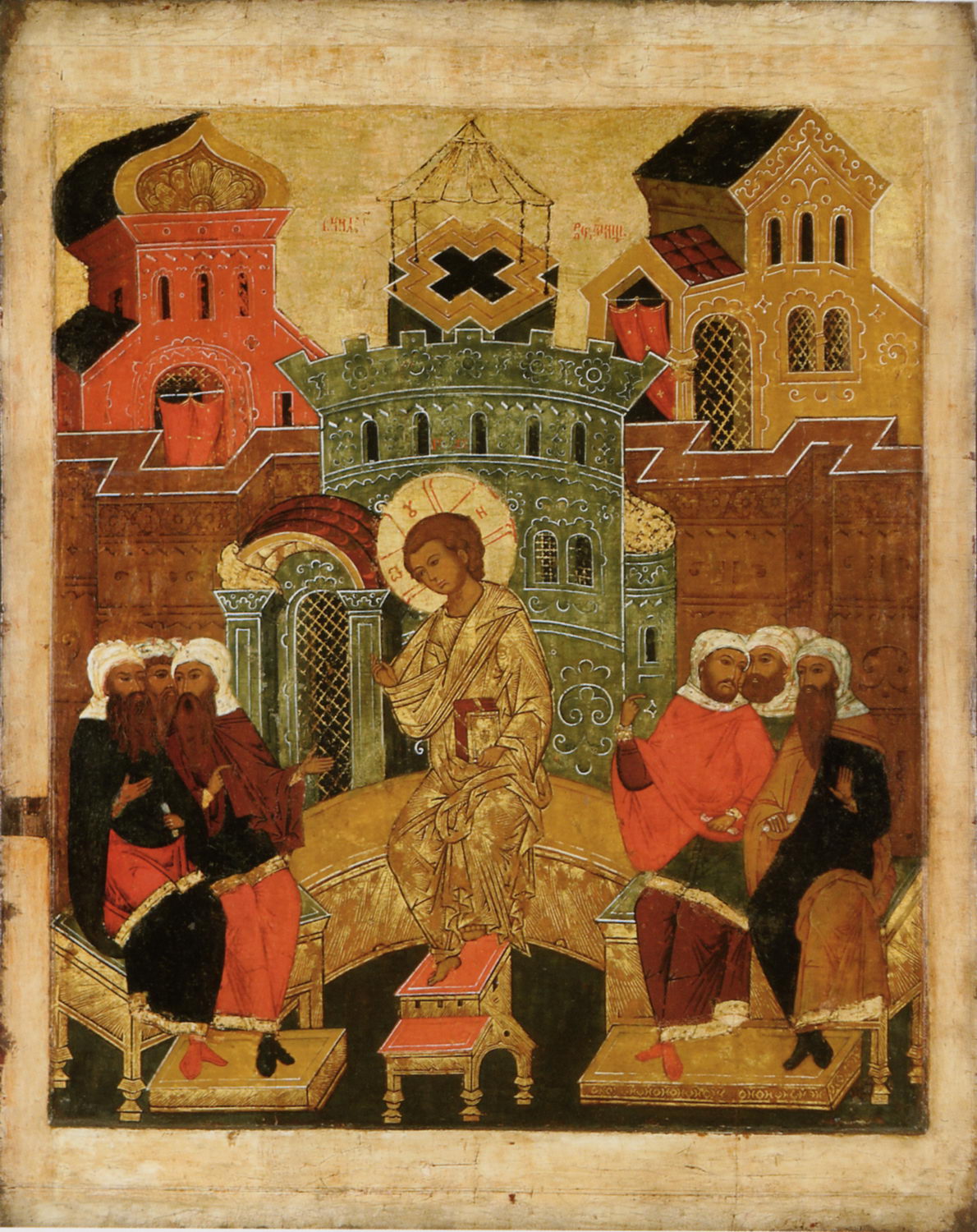
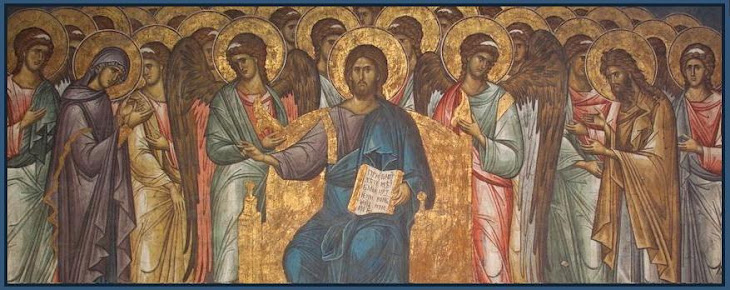
Icon of Christ preaching in the Temple: the Feast of Mid-Pentecost, from Decani Monastery (taken from: http://www.srpskoblago.org/Archives/Decani/exhibits/Collections/PublicMinistry/CX4K3103_l.html)
  
Reading (taken from: http://goarch.org/chapel/saints_view?contentid=893&type=saints)
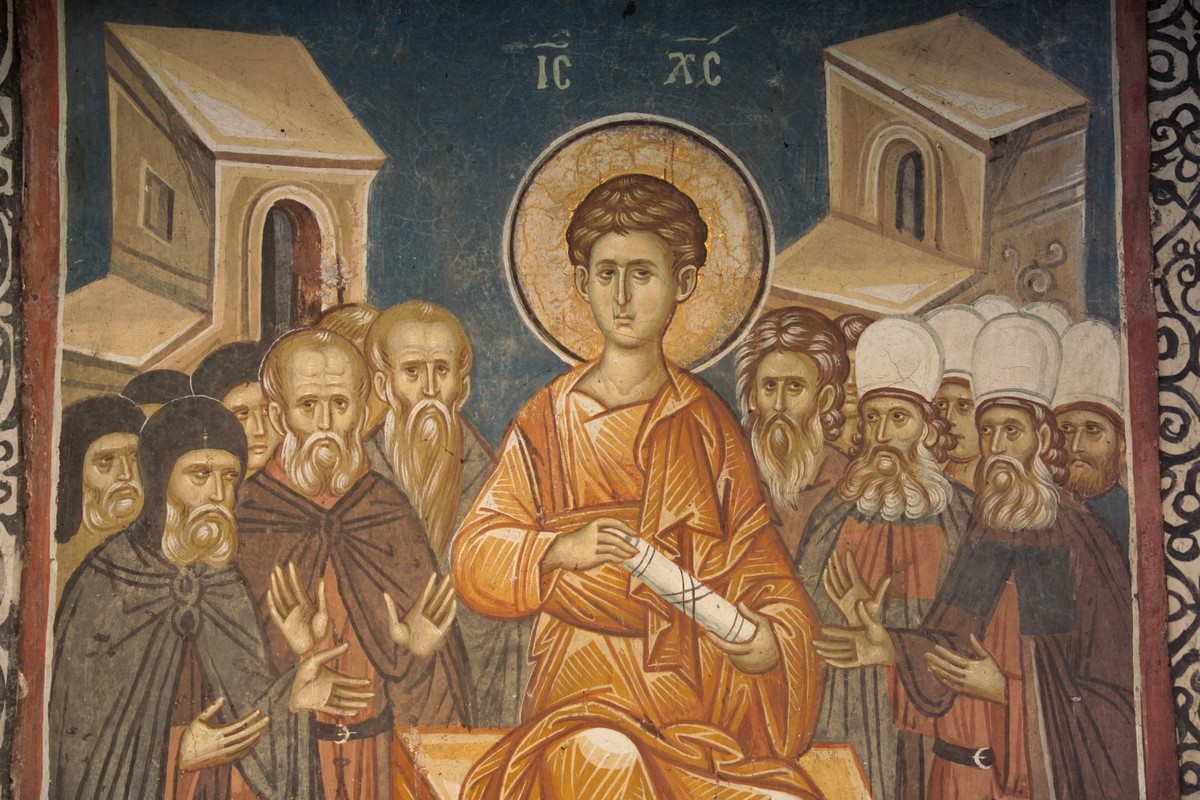
"After the Saviour had miraculously healed the paralytic, the Jews, especially the Pharisees and Scribes, were moved with envy and persecuted Him, and sought to slay Him, using the excuse that He did not keep the Sabbath, since He worked miracles on that day. Jesus then departed to Galilee. About the middle of the Feast of Tabernacles, He went up again to the Temple and taught. The Jews, marvelling at the wisdom of His words, said, "How knoweth this man letters, having never learned?" But Christ first reproached their unbelief and lawlessness, then proved to them by the Law that they sought to slay Him unjustly, supposedly as a despiser of the Law, since He had healed the paralytic on the Sabbath. Therefore, since the things spoken by Christ in the middle of the Feast of Tabernacles are related to the Sunday of the Paralytic that is just passed, and since we have already reached the midpoint of the fifty days between Pascha and Pentecost, the Church has appointed this present feast as a bond between the two great feasts, thereby uniting, as it were, the two into one, and partaking of the grace of them both. Therefore today's feast is called Mid-Pentecost, and the Gospel Reading, "At Mid-feast"--though it refers to the Feast of Tabernacles--is used.

Christ, the Holy Wisdom, teaching in the Temple (http://days.pravoslavie.ru/jpg/ih4527.jpg)
  
It should be noted that there were three great Jewish feasts: the Passover, Pentecost, and the Feast of Tabernacles. Passover was celebrated on the 15th of Nisan, the first month of the Jewish calendar, which coincides roughly with our March. This feast commemorated that day on which the Hebrews were commanded to eat the lamb in the evening and anoint the doors of their houses with its blood. Then, having escaped bondage and death at the hands of the Egyptians, they passed through the Red Sea to come to the Promised Land. It is also called "the Feast of Unleavened Bread," because they ate unleavened bread for seven days. Pentecost was celebrated fifty days after the Passover, first of all, because the Hebrew tribes had reached Mount Sinai after leaving Egypt, and there received the Law from God; secondly, it was celebrated to commemorate their entry into the Promised Land, where also they ate bread, after having been fed with manna forty years in the desert. Therefore, on this day they offered to God a sacrifice of bread prepared with new wheat. Finally, they also celebrated the Feast of Tabernacles from the 15th to the 22nd of "the seventh month," which corresponds roughly to our September. During this time, they live in booths made of branches in commemoration of the forty years they spent in the desert, living in tabernacles, that is, tents (Ex. 12:10-20; Lev. 23)."

Finally, it is worth noting that the Great Church of Hagia Sophia (The Church of the Holy Wisdom) in Constantinople celebrated its feast on the feast of Mid-Pentecost. (http://www.johnsanidopoulos.com/2011/05/mid-pentecost-and-hagia-sophia.html)
  
Christ, the Holy Wisdom, teaching in the Temple (http://www.ruicon.ru/images/iconografy/fresco/Serbia-Dechani/2868.jpg)
  
Apolytikion of Mid-Pentecost in the Plagal of the Fourth Tone
Mid-way in the feast, refresh my thirsty soul with the flowing waters of piety. For You cried out to all, O Savior, "Let him who thirsts come to me and drink." You, O Christ our God, are the Fountain of Life, glory to You.
  
Kontakion. Mode 4. You who were lifted.
The feast according to the Law at its midpoint, O Christ our God, as the Creator and Master of everything, You said to all those who were present there, ʺCome that you might draw from Me the water of immortality. ʺ Hence with faith we cry to You as we prostrate before You. Your tender mercies grant to us, we pray. You are the fountain and source of our life, O Lord.
  
OEkos
With the streams of Your blood water my soul parched by unlawful offences, and show it to be fruitful in virtue. For You have said to all, to approach You, all-holy Word of God, and to draw the water of incorruption, which is alive and washes away the sins of those who extol Your glorious and divine Resurrection. O Good One, You grant those who know You to be God the power of the Spirit that truly came down from on high to Your Disciples. You are the fountain and source of our life, O Lord.
  
  
Christ is risen from the dead, by death, trampling down upon death, and to those in the tombs, bestowing life!
Truly the Lord is risen!

Sunday, May 10, 2009

St. Theodore the Byzantine and the Miraculous Deliverance of Mytilene from the Plague

Christ is risen! Truly He is risen!


Icon of St. Theodore the New Martyr the Byzantine, the Protector of Mytilene (taken from: http://christopherklitou.com/icon_17_feb_theodore_the_byzantine_newmartyr.htm)
 
"In the year 1832, a terrible, deadly disease, the plague, hit the population of Mytilene. Deaths occurred each day and were increasing in number. Residents were forced to abandon their homes and flee to the surrounding hills in the hope that they would not get the disease. And even the city authorities left their offices in the city and took refuge in the mountains. The government had sent for teams of doctors from Constantinople and medicines, none of which had any effect.

But where human efforts failed, the grace of God was successful, by the prayers of Saint Theodore the Byzantine, the Neomartyr.

In these critical days, on the Friday night of the first week of Great Lent, the Saint appeared to the then Chancellor Fr. Kallinikos, (who later became the Metropolitan of Mytilene and Patriarch of Constantinople) and urged him to tell the Metropolitan to gather the Christians from the surrounding areas where they had fled, to have a vigil in the Metropolis church and to remove his relic from the church’s crypt. The Chancellor gave no importance to the dream, but after a week, and again on Friday night, he saw the same dream but more lifelike, and the Saint more austere. This time he immediately ran to inform the Metropolitan of the Saint’s will. The Metropolitan immediately met with the Turkish Governor and requested the permission to call the Christians to come to the church by any means and for everyone to ask God to save them from the disease. The Turkish doctors, who came from Constantinople, objected. They did not want such a gathering to take place for fear of transmitting the disease further. But the Governor, seeing that everyone was dying despite all the measures that were taken by doctors, even when the inhabitants fled from their homes, gave permission to gather and hold vigil.

All the Christians, with faith and hope ran to the temple, which was filled within, outside and around the streets. They cried, beseeched God, and sought the help of the Saint, whom they learned had appeared in a dream to the Chancellor. They rose early and they prayed. In the morning hours, the Metropolitan and the Chancellor descended into the church’s crypt, and removed the Holy Body of St. Theodore with reverence, and had a short procession around the church.

Since that time, no one else, neither Christian nor Turk, died from that plague. The city named St. Theodore their «patron», i.e. the protector of the city and of our island [Lesvos]. Turks and Greeks in every way confessed the miracle and showed their gratitude to God and their guardian Saint.


The Holy Skull of St. Theodore the Byzantine. The Neomartyr's relics are treasured in the Metropolis Cathedral of St. Athanasius in Mytilene (taken from: http://www.immyt.net/diocese/activites/ag_oros_3os_2008/2_3a.JPG)
  
Since then (1832) the venerable relic of the Saint was not returned to the crypt of the church, but was clearly placed (and as a sign to the Turks) in the Metropolis church, where it is found today, and now, as stated in the Apolytikion of the Saint, is a «valuable treasure» for our place.

As the patron saint, St. Theodore protected the island during the last war in 1940, and while the Italians bombed several targets, including the antenna (ασύρματο?) of the city, the factories of Sourlagka in the Gulf of Gera, the ship “Arntena” in the port, no bomb had achieved its objective and many of them hit the ground without exploding.

In remembrance of the miracle of rescuing the population of the city from the plague, since the year 1936, on the initiative of Metropolitan Iakovos of Mytilene from Durrachiou, a new feast day was established in Mytilene on the Fourth Sunday of Pascha [the Sunday of the Paralytic], on which with great splendor and the participation of thousands of the faithful, the procession with the venerable relics of the Saint takes place."
(translated and summarized from: http://www.pigizois.net/agiologio/lesviako_agiologio/20.htm)

See an earlier post for the life and martyrdon of St. Theodore the Byzantine: http://full-of-grace-and-truth.blogspot.com/2009/02/holy-neomartyr-st-theodore-byzantine.html . May St. Theodore intercede for all of us and help us!

Pictures from the Feast of All Saints of Lesvos (the Sunday after All Saints Sunday). The Divine Liturgy is being performed on the Holy Relic of St. Theodore (which forms the Altar table). The tradition of performing the Divine Liturgy on the graves and remains of the Holy Martyrs dates back to the earliest years of Christianity. (http://www.immyt.net/diocese/activites/eorti_ag_lesvou_2009/eorti_ag_lesvou_2009_43.JPG)


Icon of St. Theodore the Neomartyr the Byzantine, with scenes from his life (taken from: http://www.rel.gr/photo/displayimage.php?album=26&pos=272)
  
ΑΠΟΛΥΤΙΚΙON ΤΟΥ ΑΓΙΟΥ ΘΕΟΔΩΡΟΥ (Ο ΒΥΖΑΝΤΙΟΣ) - ΠΟΛΙΟΥΧΟΣ ΜΥΤΙΛΗΝΗΣ - Ήχος δ’ Ταχύ προκατάλαβε
Το πάντιμον λείψανον του Θεοδώρου, πιστοί, ενδόξως τιμήσωμεν ως θησαυρών τιμαλφή, και πάντες βοήσωμεν: Σώσον εκ των κινδύνων τους πιστώς σε υμνούντας, ως πότε σύ ερρύσω εκ πανώλους την πόλιν και πάντας περιφρούρησον ταις ικεσίαις σου.
The Apolytikion for the Translation of the Relics of St. Theodore the Byzantine (4th Sunday of Pascha) – 4th Tone (amateur translation)
The all-precious Relics of St. Theodore, O faithful, let us gloriously honor as a precious treasure, and let all cry out: Save us from the dangers, those who faithfully hymn you, as when you delivered the city from the plague, and preserve all of us through your intercessions.
  
Christ is Risen from the dead, by death, trampling down upon death, and to those in the tombs, bestowing life!
Truly the Lord is risen!

Saturday, May 9, 2009

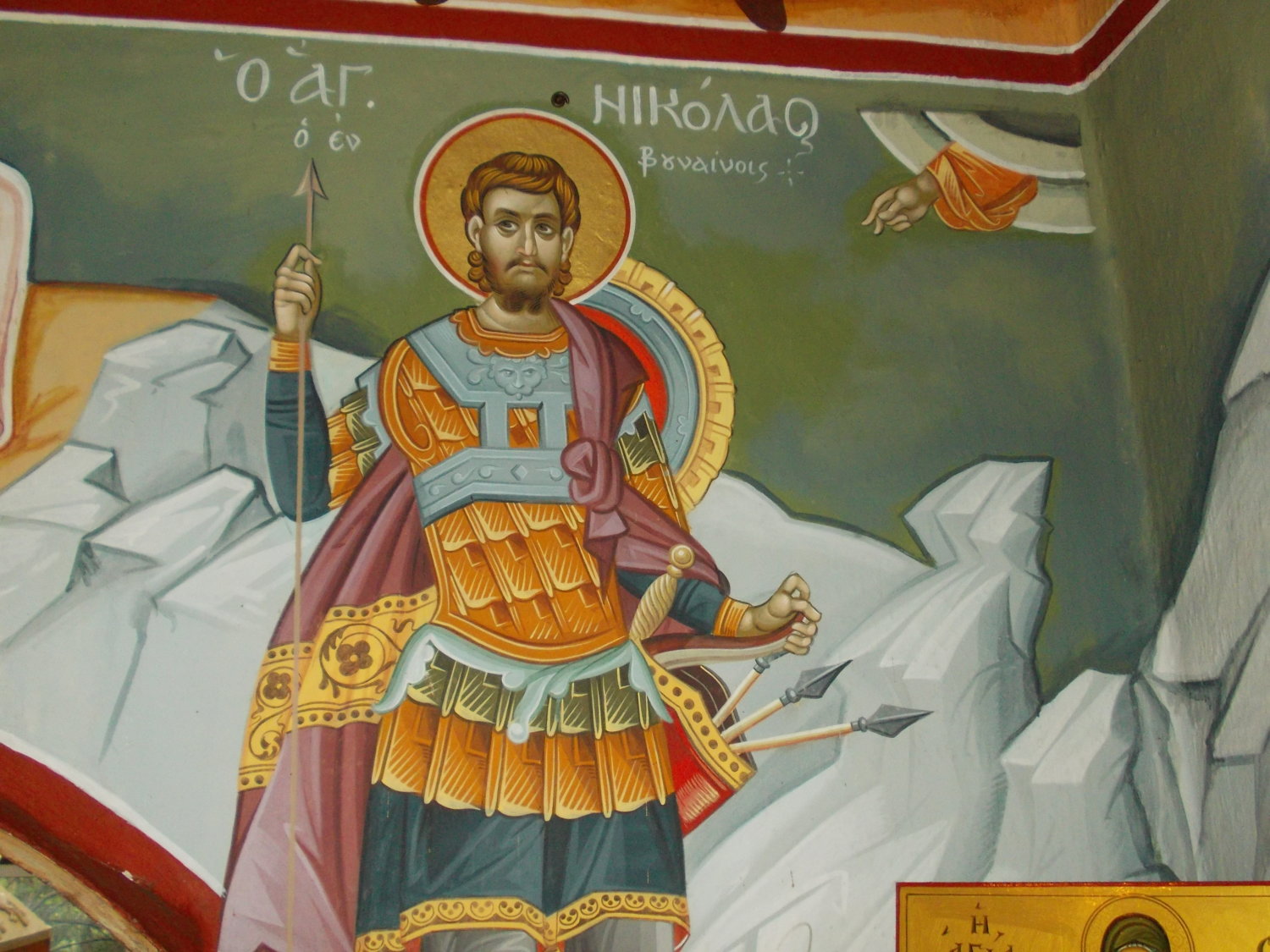
St. Nicholas the New Righteous Martyr of Vounena

Christ is risen! Truly He is risen!

Icon of St. Nicholas the New Righteous Martyr of Vounena (taken from: http://www.synaxaristis.googlepages.com/9μαϊου)

"Life of St. Nicholas of Vounena - May 9th
The Righteous Martyr Nicholas the New was probably born in the land of Asia Minor. From a young age he was noted for his fervent faith, love for God and piety. Nicholas could not hide his virtue and valor. His reputation quickly exceeded the narrow limits of his homeland and spread to the Emperor in Constantinople. The Emperor in that time, Leo the Wise (886-912 AD), therefore requested Nicholas's services. After their first contact, Emperor Leo appointed him head of the imperial province of Larisa, and also appointed him guardian of the city of Thessalonica. Nicholas accepted the position, and over time his spirituality increased and he grew fondly in the hearts of his soldiers and all the inhabitants of Thessaly.

When the Avars invaded Thessaly, they caused much devestation and death. Nicholas with his armed forces tried to halt the enemy. However, because the Avars were in such great numbers, they succeeded to invade the land and conducted many massacres and much looting. Several of the residents fled to the city or the mountains. Nicholas and his soldiers retreated to the village called Vounena, where there existed several hermitages in the steep hills. He settled there with his soldiers, and they assumed a life of chastity and prayer. He and his soldiers lived the angelic life of monasticism.

  
Another icon of St. Nicholas with his fellow soldiers (source)
 
One evening, while in prayer, the Angel of the Lord appeared and announced to Nicholas that his disciples would soon be martyred for Christ. Indeed, the enemies captured them, and submitted them to a multitude of torments. They urged them to abandon the faith and worship the Avar "gods," as well as swear their allegiance to the Avar chief. But they remained faithful to Christ and their names have thus been written in the Book of Life. The holy martyrs are known to be the monks Gregory, Demetrius, Evodius, Theodore, John, Michael, Pancratius, Panteleon, Christopher and Emilian, and the nuns Irene and Pelagia.


Another depiction of the Saint's Martyrdom for Christ (source)
  
Nicholas has himself escaped and continued his ascetic life, lodging in a cave which was covered by an oak tree. But soon he too was also captured and martyred for Christ. The barbarian invaders captured him and tortured him, attempting to convince him to deny the Faith. But he bravely resisted. He was tortured for ten days, until he received the crown of glory and entered into the choir of martyrs.


The Bishop of Larisa transferred his relics to the city of Tyrnabus. Years later, the Euphemian, the Duke of Thessalonica, discovered the relics. Euphemian suffered from the illness of leprosy. He searched for the treatments of doctors, but in vain. However, when he was visiting Larisa, he was advised to go to the place called Vounena for the feastday of St. Nicholas the New, and to witness the miracle of the blood that comes out of his cave of dwelling, out of the oak tree, and out of his grave, each year on his feastday.

  
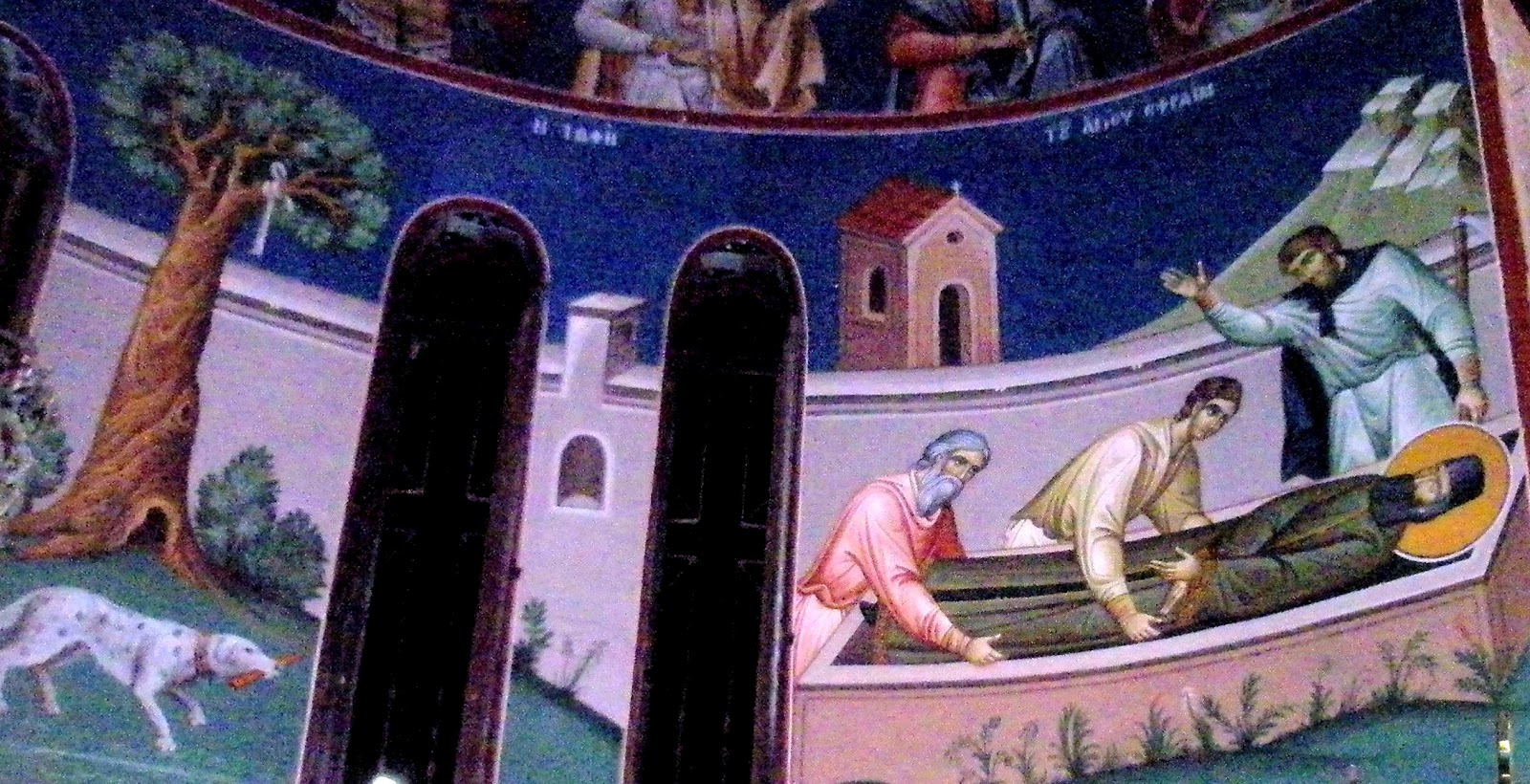
Another depiction of the Saint's burial (source)
 
Duke Euphemian went to Vounena, and anointed his body with the miraculously-appearing red liquid. He was immediately healed from leprosy, and glorified God who worked wonders through this holy saint. To thank the saint, he built a chapel dedicated to St. Nicholas, and placed the holy relics of St. Nicholas therein." The Holy Skull of St. Nicholas the New of Vounena is also treasured at the Monastery of St. Nicholas on Andros. (taken from: http://www.genuineorthodoxchurch.net/miraclevounena.html)

The Sacred Skull of St. Nicholas the New of Vounena, treasured by the Monastery of St. Nicholas, Andros (http://www.in-agiounikolaoutouneou.gr/assets/mymedia/1262799758_nfile2.pdf)
   

Top: Church at the Place of Martyrdom of St. Nicholas the New, Vounena, Thessaly; bottom left: the Tomb of the Saint; bottom right: agiasmo of the Saint (http://www.in-agiounikolaoutouneou.gr/assets/mymedia/1262799758_nfile2.pdf)
   
12th Century fresco of St. Nicholas of Vounena (http://www.in-agiounikolaoutouneou.gr/assets/mymedia/1262799758_nfile2.pdf)

Every year on the Saint's feast day (May 9th) in Vounena, Thessaly, at the Church dedicated to him, at the Saint's grave and his place of martyrdom, a red-colored "blood" miraculously flows and is gathered by the faithful, causing many healings by the grace of Christ. I disagree with the source quoted above, however, as I've heard from numerous sources (e.g. http://www.agiooros.net/modules.php?name=Forums&file=viewtopic&t=5825) that this miracle (like many other miracles) occurs on both the New and the Old Calendar celebrations of St. Nicholas the New.
 
A picture of the tree pouring forth the wondrous "blood" on the feast of St. Nicholas the New at the place of his martyrdom (source)
 
For another account of the Saint, see: http://www.agiosnikolaosneos.gr/index.php?option=com_content&view=article&id=4&Itemid=4.

May St. Nicholas the New intercede for all of us and help us!

Icon of St. Nicholas the New Osiomartyr of Vounena (Icon courtesy of www.eikonografos.com used with permission)
Apolytikion of St. Nicholas the New - 4th Tone (amateur translation)
As the free physician of the sick, and the impregnable help of those in dangers, the fervent protector of those in troubles, and the defender of those with all needs, O Righteous-martyr from the east Nicholas, intercede with Christ God to save our souls.

St. Nicholas the New Martyr of Vounena (source)
   
ΜΕΓΑΛΥΝΑΡΙΟΝ
Χαίροις των Βουνένων λύχνος λαμπρός και της Θεσσαλίας λαμπαδούχος ο φαεινός, χαίροις το της Άνδρου, Οσιομάρτυς κλέος, και προς Χριστόν μεσίτης θερμός Νικόλαε.

Megalynarion (amateur translation)
Hail O bright lamp of Vounena, and radiant lamp-bearer of Thessaly, hail the Righteous-martyr boast of Andros, and fervent intercessor to Christ, Nicholas.

For the full life, miracles, full service, Paraklesis, Akathist, and engomia of St. Nicholas the New Righteous Martyr of Vounena (in Greek), see: http://www.in-agiounikolaoutouneou.gr/assets/mymedia/1262799758_nfile2.pdf.
Christ is Risen from the dead, by death, trampling down upon death, and to those in the tombs, bestowing life!
Truly the Lord is risen!

Wednesday, May 6, 2009

St. John the Theologian, and the Miraculous Manna of his tomb

Christ is risen! Truly He is risen!

Icon of St. John being buried and his tomb in Ephesus found empty, from Decani Monastery (taken from: http://www.srpskoblago.org/Archives/Decani/exhibits/Menologion/September/CX4K3481_l.html)
  
"The feast day of this great apostle and evangelist is celebrated on September 26. This day (May 8) commemorates the miracle which appeared at his grave. When John was over one hundred years old, he took seven of his disciples, went outside the town of Ephesus and ordered them to dig a grave in the form of a cross. After that, the elder went down into this grave and was buried. Later on, when the faithful opened John's grave, they did not find his body. On May 8 of every year, dust [also called "manna"] is raised from his grave from which the sick are healed of various diseases." (taken from the Prologue of St. Nikolai from: http://www.westsrbdio.org/prolog/prolog.cgi)
  
An artistic reconstruction of how St. John's Basilica (built by the Holy Emperor Justinian) over his Tomb in Ephesus might have looked (taken from: http://www.sacred-destinations.com/turkey/images/ephesus/basilica-st-john/model-cc-slimnastics.jpg)
  
The following is from an interesting study of the various pilgrimage sites throughout Asia Minor:
"The most elaborate description of the miracle [of the Manna from St. John the Theologian's Tomb] dates from the very end of the Byzantine period, written by the Catalan Muntaner who arrived in a mercenary force in 1304:
On Saint Stephen’s day, every year, at the hour of vespers, there comes out of the tomb (which is four-cornered and stands at the foot of the altar and has a beautiful marble slab on the top, full twelve palms long and five broad) and in the middle of the slab there are nine very small holes, and out of these holes, as vespers are being sung on St. Stephen’s day (on which day the vespers are of St. John), manna like sand comes out of each hole and rises a full palm high from the slab, as a jet of water rises up. And this manna issues out . . . and it lasts all night and then all Saint John’s day until sunset. There is so much of this manna, by the time the sun has set and it has ceased to issue out, that, altogether, there are of it full three cuarteras of Barcelona [about 120 quarts]. And this manna is marvelously good for many things; for instance he who drinks it when he feels fever coming on will never have fever again. Also, if a lady is in travail and cannot bring forth, if she drinks it with water or with wine, she will be delivered at once. And again, if there is a storm at sea and some of the manna is thrown in the sea three times in the name of the holy Trinity and Our Lady Saint Mary and the Blessed Saint John the Evangelist, at once the storm ceases. And again, he who suffers from gall stones, and drinks it in the said names, recovers at once. And some of this manna is given to all pilgrims who come there; but it only appears once a year."
(taken from "Pilgrimage in Medieval Asia Minor" by Foss, taken from: http://www.doaks.org/publications/doaks_online_publications/DOP56/DP56ch09.pdf)


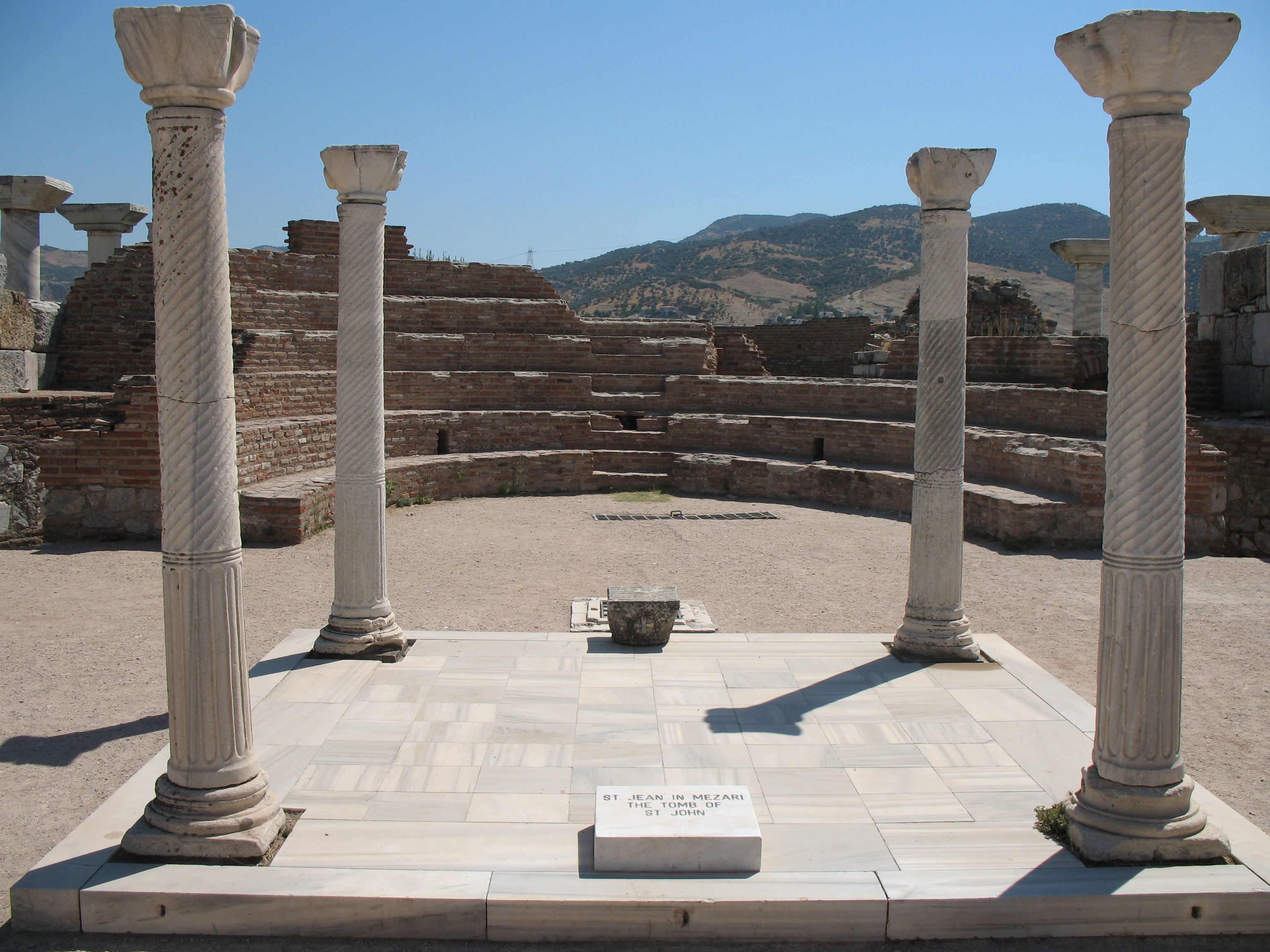
Picture of the Tomb of St. John the Theologian as it appears today, in the ruins of his Basilica in Ephesus (taken from: http://upload.wikimedia.org/wikipedia/commons/7/74/Tomb_of_Saint_John_the_Apostle.jpg)
  
And a Russian Abbot Daniel from the early 12th century, who recorded his pilgrimage to the Holy Land, also visited St. John's Tomb, and mentions the various other holy places near St. John's Basilica:
"It is 60 versts from the isle of Chios to Ephesus; and at this latter place is seen the tomb of St. John the Evangelist. On the anniversary of his death, holy dust rises from this tomb, which believers gather as a remedy against every kind of disease; the garment which John wore is also here. Quite near is the cave in which rest the bodies of the Seven Sleepers who slept for 360 years, having fallen asleep in the reign of the Emperor Decius, and awakened in the time of the Emperor Theodosius. In this same cavern are the (remains of the) three hundred holy fathers and of St. Alexander; the tomb of Mary Magdalene is also here, as well as her head; and the holy Apostle Timothy, the disciple of St. Paul, reposes in his ancient coffin. In the old church the picture of the Holy Virgin is preserved; it was with this that the holy (fathers) refuted the heretic Nestorius. Here, too, one sees the Bath of Dioscorides, where St. John the Evangelist laboured with Prochorus in the house of Romana. We saw, also, the harbour, named the 'Marble Port,' where St. John the Evangelist was cast up by the sea." (taken from: http://chass.colostate-pueblo.edu/history/seminar/daniel/daniel2.htm)
  
Note that the Synaxarion also mentions that the tomb of St. Hermione (September 4th), and the relics of Sts. Audaktos and his daughter St. Kallisthenis (October 4th), and those of other martyrs and bishops, Sts. Aristonos, Tyrannou, Aristoboulos and Paul the Desert-dweller were all found near St. John's Tomb (taken from: http://www.snhell.gr/references/synaxaristis/search.asp). Thus, Ephesus was considered truly a sacred place, but most of all because of the presence St. John the Theologian, the one who reclined on Christ's bosom, and His Beloved Disciple. May he intercede for all of us and help us!


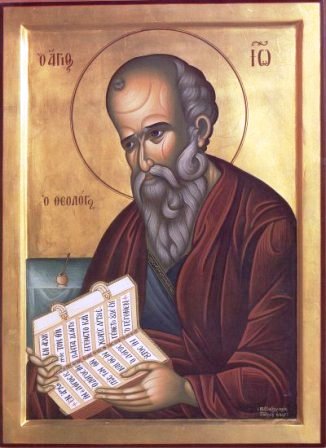
Icon of St. John the Theologian, the Beloved Disciple of Christ (taken from: http://www.photosled.com/data/1985/0508_Ioannis_Theologos.jpg)
  
Apolytikion of St. John the Theologian in the Second Tone
Beloved Apostle of Christ our God, hasten to deliver a people without defense. He who permitted you to recline upon His bosom, accepts you on bended knee before Him. Beseech Him, O Theologian, to dispel the persistent cloud of nations, asking for us peace and great mercy.
  
Kontakion in the Second Tone
Who can recount your greatness, O virgin, for miracles flow and healing springs forth from you. You intercede for our souls, as the Theologian and friend of Christ. (hymns taken from: http://goarch.org/chapel/saints_view?contentid=44)
  
Christ is Risen from the dead, by death, trampling down upon death, and to those in the tombs, bestowing life!
Truly the Lord is risen!

Monday, May 4, 2009

St. Ephraim the Great Martyr of Nea Makri

Christ is risen! Truly He is risen!

Icon of St. Ephraim the Great-Martyr, Wonderworker and Newly-revealed of Nea Makri (Icon courtesy of www.eikonografos.com used with permission)

  
"ST. EPHRAIM THE GREAT MARTYR AND WONDERWORKER - May 5th
The holy New Martyr and wonderworker Ephraim was born in Greece on September 14, 1384. His father died when the saint was young, and his pious mother was left to care for seven children by herself.

When Ephraim reached the age of fourteen, the all-good God directed his steps to a monastery on the mountain of Amoman near Nea Makri in Attica. The monastery was dedicated to the Annunciation and also to St Paraskeva. Here he took on his shoulders the Cross of Christ, which all His followers must bear (Matt. 16:24). Being enflamed with love for God, St Ephraim eagerly placed himself under the monastic discipline. For nearly twenty-seven years he imitated the life of the great Fathers and ascetics of the desert. With divine zeal, he followed Christ and turned away from the attractions of this world. By the grace of God, he purified himself from soul-destroying passions and became an abode of the All-Holy Spirit. He was also found worthy to receive the grace of the priesthood, and served at the altar with great reverence and compunction.
  
The Monastery of the Evangelismos and St. Ephraim, Amomos Mountain, Attica, Greece, as it appears today. This has become one of the greatest pilgrimages in Greece due to all of the healings of St. Ephraim (taken from: http://stnectarioschurch.org/Archives/May/050504_EphraimMegalomartyros/StEphraimMoni_index.htm)
  
On September 14, 1425, the barbarous Turks launched an invasion by sea, destroying the monastery and and looting the surrounding area. St Ephraim was one of the victims of their frenzied hatred. Many of the monks had been tortured and beheaded, but St Ephraim remained calm. This infuriated the Turks, so they imprisoned him in order to torture him and force him to deny Christ.
 
St. Ephraim of Nea Makri, with scenes from his life and martyrdom (source)
 
They locked him in a small cell without food or water, and they beat him every day, hoping to convince him to become a Moslem. For several months, he endured horrible torments. When the Turks realized that the saint remained faithful to Christ, they decided to put him to death. On Tuesday May 5, 1426, they led him from his cell. They turned him upside down and tied him to a mulberry tree, then they beat him and mocked him. "Where is your God," they asked, "and why doesn't he help you?" The saint did not lose courage, but prayed, "O God, do not listen to the words of these men, but may Thy will be done as Thou hast ordained."
  

The mulberry tree on which St. Ephraim was martyred on (taken from: http://agiosefraim.netfirms.com/bio1.html)
     
The barbarians pulled the saint's beard and tortured him until his strength ebbed. His blood flowed, and his clothes were in tatters. His body was almost naked and covered with many wounds. Still the Hagarenes were not satisfied, but wished to torture him even more. One of them took a flaming stick and plunged it violently into the saint's navel.

  
His screams were heart-rending, so great was his pain. The blood flowed from his stomach, but the Turks did not stop. They repeated the same painful torments many times. His body writhed, and all his limbs were convulsed. Soon, the saint grew too weak to speak, so he prayed silently asking God to forgive his sins. Blood and saliva ran from his mouth, and the ground was soaked with his blood. Then he lapsed into unconsciousness.
  
A close-up of the icon of the martyrdom of St. Ephraim (http://www.romiosini.org.gr/DA9A0DD2.el.aspx)
   
Thinking that he had died, the Turks cut the ropes which bound him to the tree, and the saint's body fell to the ground. Their rage was still not diminished, so they continued to kick and beat him. After a while, the saint opened his eyes and prayed, "Lord, I give up my spirit to Thee." About nine o'clock in the morning, the martyr's soul was separated from his body. These things remained forgotten for nearly 500 years, hidden in the depths of silence and oblivion until January 3, 1950."
(taken from: http://www.stirene.org/archives/may/0505_stefraim.html)
  
  
The Burial of St. Ephraim of Nea Makri (source)


Gerontissa Makaria was told by St. Ephraim: “I will work many miracles, and I will help many people, before the evils come".


St. Ephraim heals the sick and helps those in need (source)
   
For the account of the miraculous finding of his Holy Relics, see the above link to continue reading, or a previous post (which also includes a moving miracle of the Saint): http://full-of-grace-and-truth.blogspot.com/2009/01/uncovering-of-holy-relics-of-st-ephraim.html.
  
For more miracles of the Saint, see: http://full-of-grace-and-truth.blogspot.com/2010/05/selected-miracles-of-st-ephraim-of-nea.html.
  
The following is the address and information regarding the monastery of St. Ephraim:
ΙΕΡΑ ΜΟΝΗ ΕΥΑΓΓΕΛΙΣΜΟΥ ΤΗΣ ΘΕΟΤΟΚΟΥ
[The Holy Monastery of the Annunciation of the Theotokos (St. Ephraim)]
190 05 ΝΕΑ ΜΑΚΡΗ
Τηλέφωνο:   22940-91202
FAX:   22940-50128
The Monastery is open to pilgrims 7AM-12noon, and 4-6PM.
(i.e. It is CLOSED daily from 12-4pm, but please contact the monastery for the most up to date information, and know that the schedule is subject to change)
  
May St. Ephraim intercede for all of us and help us!
  
This icon of St. Ephraim was the last painted by the famous iconographer, Photi Kontouglou (who is also buried at Evangelismos Monastery of St. Ephraim). He had prayed to the Saint to reveal himself so that he could properly depict him. This has become the prototype of all the icons of St. Ephraim. (taken from: http://greecepilgrimage.blogspot.com/2008/06/day-4-st-ephraim-and-island-of-tinos.html, http://www.romiosini.org.gr/DA9A0DD2.el.aspx)
     
ΑΠΟΛΥΤΙΚΙΟN Ἦχος α’ Τῆς ἐρήμου πολίτης
Ἐν ὄρει τῶν Ἀμῶμων ὥσπερ ἥλιος ἐλάμψας καί μαρτυρικῶς, Θεοφόρε, πρός Θεόν ἐξεδήμησας, βαρβάρων ὑποστάς ἐπιδρομάς, Ἐφραίμ Μεγαλομάρτυς τοῦ Χριστοῦ , διά τοῦτο ἀναβλύζεις χάριν ἀεί, τοῖς εὐλαβῶς βοῶσι σοι, δόξα τῷ δεδωκότι σοι ἰσχύν, δόξα τῷ σέ θαυμαστώσαντι, δόξα τῷ ἐνεργοῦντι διά Σοῦ, πᾶσιν ἰάματα.
  
For the Full Service, Paraklesis, Akathist and Engomia to St. Ephraim in Greek, written by Fr. Gerasimos of Little St. Anne's Skete: http://analogion.gr/glt/texts/May/05c.uni.htm.
  
Apolytikion of St. Ephraim the Great-martyr of Nea Makri in the First Tone (amateur translation)
On Amomon Mountain, you shown forth like the sun, and O God-bearer, you left for God by martyrdom, you endured barbarians’ attacks, Ephraim O Great-martyr of Christ, because of this you ever pour forth grace, to those who piously cry out to you, glory to Him who gave you strength, glory to Him you made you wondrous, glory to Him who grants through you, healings for all!
          
For amateur translations of selected hymns to St. Ephraim, and his Akathist, see the following links, respectively: http://full-of-grace-and-truth.blogspot.com/2011/05/selected-hymns-for-st-ephraim-of-nea.html, http://full-of-grace-and-truth.blogspot.com/2012/05/akathist-to-st-ephraim-righteous-martyr.html.
  
St. Ephraim of Nea Makri, the Great Righteous Hieromartyr and Wonderworker (http://3.bp.blogspot.com/_KBtBBuRAt7w/S0CPUe7LZ4I/AAAAAAAAADw/Vdd1drbUeoY/s1600/Scan20009-792797.JPG)
  
Christ is Risen from the dead, by death, trampling down upon death, and to those in the tombs, bestowing life!
Truly the Lord is risen!

St. Irene the Great Martyr

Christ is risen! Truly He is risen!

Icon of St. Irene the Great-Martyr (Icon courtesy of www.eikonografos.com used with permission)
  
"IRENE, THE GREAT MARTYR OF THESSALONIKA - May 5th
The holy Great Martyr Irene was born in the city of Magedon in Persia during the fourth century. She was the daughter of the pagan king Licinius, and her parents named her Penelope.

Penelope was very beautiful, and her father kept her isolated in a high tower from the time she was six so that she would not be exposed to Christianity. He also placed thirteen young maidens in the tower with her. An old tutor by the name of Apellian was assigned to give her the best possible education. Apellian was a Christian, and during her lessons, he told the girl about Christ the Savior and taught her the Christian Faith and the Christian virtues.

When Penelope reached adolescence, her parents began to think about her marriage. One day, a dove flew through the window carrying an olive branch in its beak, depositing it upon a table. Then an eagle swooped in with a wreath of flowers in its beak, and also placed it upon the table. Finally, a raven flew in carrying a snake, which it dropped on the table. Penelope was puzzled by these events and wondered what they meant.

Apellian explained that the dove signified her education, and the olive branch stood for the grace of God which is received in Baptism. The eagle with the wreath of flowers represented success in her future life. The raven and the snake foretold her future suffering and sorrow.
  
St. Irene seeing the vision of the dove, the olive branch, the eagle and wreath (source)
  
At the end of the conversation Apellianus said that the Lord wished to betroth her to Himself and that Penelope would undergo much suffering for her heavenly Bridegroom. After this Penelope refused marriage, was baptized by the priest Timothy, and she was named Irene (peace). She even urged her own parents to become Christians. Shortly after this, she destroyed all her father's idols.

Since St. Irene had dedicated herself to Christ, she refused to marry any of the suitors her father had chosen for her. When Licinius learned that his daughter refused to worship the pagan gods, he was furious. He attempted to turn her from Christ by having her tortured. She was tied up and thrown beneath the hooves of wild horses so that they might trample her to death, but he horses remained motionless. Instead of harming the saint, one of the horses charged Licinius, seized his right hand and tore it from his arm. Then it knocked Licinius down and began to trample him. They untied the holy virgin, and through her prayers Licinius rose unharmed in the presence of eyewitnesses with his hand intact.

Seeing such a miracle, Licinius and his wife, and many of the people, (about 3000 men) believed in Christ and turned from the pagan gods. Resigning his administrative duties, Licinius devoted himself to the service of the Lord Jesus Christ. St. Irene lived in the house of her teacher Apellian, and she began to preach Christ among the pagans, converting them to the path of salvation.

When Sedecius, the new governor of the city, heard of this miracle he summoned Apellian and questioned him about Irene's manner of life. Apellian replied that Irene, like other Christians, lived in strict temperance, devoting herself to constant prayer and reading holy books. Sedecius summoned the saint to him and urged her to stop preaching about Christ. He also attempted to force her to sacrifice to the idols. St. Irene staunchly confessed her faith before the governor, not fearing his wrath, and prepared to undergo suffering for Christ. By order of Sedecius she was thrown into a pit filled with vipers and serpents. The saint spent ten days in the pit and remained unharmed, for an angel of the Lord protected her and brought her food. Sedecius ascribed this miracle to sorcery, and he subjected St. Irene to many other tortures, but she remained unharmed.

["King Sedechias then wanted to saw her in half but the saw rebounded from her body as from stone. After that, the same king tied her to a wheel under a water mill and released the flow of water hoping, in this manner, to kill her. But the water refused to flow, rather stood still and the virgin remained alive and well. King Sapor, the son of King Sedechias, shod her feet with nails, loaded a sack of sand on her, harnessed her and ordered that she be led like an animal far outside the town. "Truly, I am a beast before You, O Lord!" said the holy martyr, running bridled behind her torturers. However, an angel of God shook the earth and the earth opened up and swallowed her torturers." (taken from: http://www.westsrbdio.org/prolog/May5.htm)]

Under the influence of her preaching and miracles even more people were converted to Christ, and turned away from the worship of inanimate idols.

Sedecius was deposed by his son Savorus, who persecuted Christians with an even greater zeal than his father had done. St. Irene went to her home town of Magedon in Persia to meet Savorus and his army, and ask him to end the persecution. When he refused, St. Irene prayed and his entire army was blinded. She prayed again and they received their sight once more. In spite of this, Savorus refused to recognize the power of God. Because of his insolence, he was struck and killed by a bolt of lightning.

After this, St. Irene walked into the city and performed many miracles. She returned to the tower built by her father, accompanied by the priest Timothy. Through her teaching, she converted five thousand people to Christ.

  
Next, the saint went to the city of Callinicus, or Callinicum (possibly on the Euphrates River in Syria). The ruler of that place was King Numerian, the son of Sebastian. When she began to teach about Christ, she was arrested and tortured by the pagan authorities. She was placed into three bronze oxen which were heated by fire. She was transferred from one to another, but miraculously she remained uninjured. Thousands of idolaters embraced Christianity as a result of this wondrous event.

Sensing the approach of death, Numerian instructed his eparch Babdonus to continue torturing the saint in order to force her to sacrifice to idols. Once again, the tortures were ineffective, and many people turned to Christ.

Christ's holy martyr then traveled to the city of Constantina, forty miles northeast of Edessa. By 330, the Persian king Sapor II (309-379) had heard of St. Irene's great miracles. To prevent her from winning more people to Christ, she was arrested, beheaded, and then buried. However, God sent an angel to raise her up again, and she went into the city of Mesembria. After seeing her alive and hearing her preach, the local king was baptized with many of his subjects.

Wishing to convert even more pagans to Christianity, St. Irene went to Ephesus, where she taught the people and performed many miracles. The Lord revealed to her that the end of her life was approaching. Then St. Irene left the city accompanied by six people, including her former teacher Apellian. On the outskirts of the town, she found a new tomb in which no one had ever been buried. After making the Sign of the Cross, she went inside, directing her companions to close the entrance to the cave with a large stone, which they did. When Christians visited the cave four days later, they did not find the body of the saint.

Apellian returned after only two days, and found the stone rolled away and the tomb empty.*** Thus did God glorify St. Irene, who loved Him and devoted her life to serving Him. Although many of these miracles may seem improbable to those who are skeptical, nothing is impossible with God.

St. Irene the Great Martyr (Icon courtesy of www.eikonografos.com used with permission)
  
[***Note: Other accounts hold that Holy Relics of St. Irene were found, and were later transferred to Constantinople and the Church of St. Irene Riganokampo, Patras (http://users.uoa.gr/~nektar/orthodoxy/agiologion/agia_megalomartys_eirhnh_riganokampos_patrwn.htm). Some of her Relics today are purported to be treasured in the Monastery of Bronta on Samos, the Monastery of St. John the Theologian on Patmos, St. Basil the Great Orthodox Church in St. Louis Missouri (http://stbasilthegreat.org/about/relics/the-relics-of-st-irene/), and the aforementioned church of the Saint in Patras (http://www.i-m-patron.gr/enories/ag_eirini_riganokampos/index.html) for the help and healing of the faithful.]

St. Irene led thousands of people to Christ through her preaching, and by her example. The Church continues to honor her memory and to seek her heavenly intercession.

The holy, glorious Great Martyr Irene is invoked by those wishing to effect a swift and happy marriage. In Greece, she is also the patron saint of policemen. St. Irene is also one of the twelve Virgin Martyrs who appeared to St. Seraphim of Sarov (January 2) and the Diveyevo nun Eupraxia on the Feast of the Annunciation in 1831. By her holy prayers, may the Lord have mercy upon us and save us."
(taken from: http://www.stirene.org/archives/may/0505_stirene.html)
  
And as St. Nikolai says in the Prologue:
"Thus, St. Irene, by her suffering and miracles converted over one-hundred thousand pagans to the Faith of Christ."
(taken from: http://www.westsrbdio.org/prolog/May5.htm)
  
May St. Irene intercede for all of us and help us!


Icon of St. Irene the Great-Martyr with two scenes from her life (Icon courtesy of www.eikonografos.com used with permission)
  
Apolytikion of St. Irene the Great-Martyr - 4th Tone
Following in the steps of the Prince of Peace, O pious one, you were shown to be named after peace by divine inspiration; for fleeing from the snares of the warring enemy, as a wise virgin you supernaturally endured the contest. Therefore, Great-Martyr Irene, pray for peace for us.
  

Kontakion in the Third Tone
Being fair adorned before with pure and virginal beauty, thou becamest fairer still in thy brave contest, O virgin; for when thou, in thine own spilt blood, wast stained and reddened, O Irene, thou overthrewest ungodly error. Hence, thou hast received the prizes of thy good vict'ry from thy Creator's right hand.
  
Two separate Parakleses to the Saint in Greek can be found here: http://voutsinasilias.blogspot.com/2009/05/5-1.html and http://voutsinasilias.blogspot.com/2009/05/5-2.html.
  
   
Christ is Risen from the dead, by death, trampling down upon death, and to those in the tombs, bestowing life!
Truly the Lord is risen!