Sunday, August 14, 2011

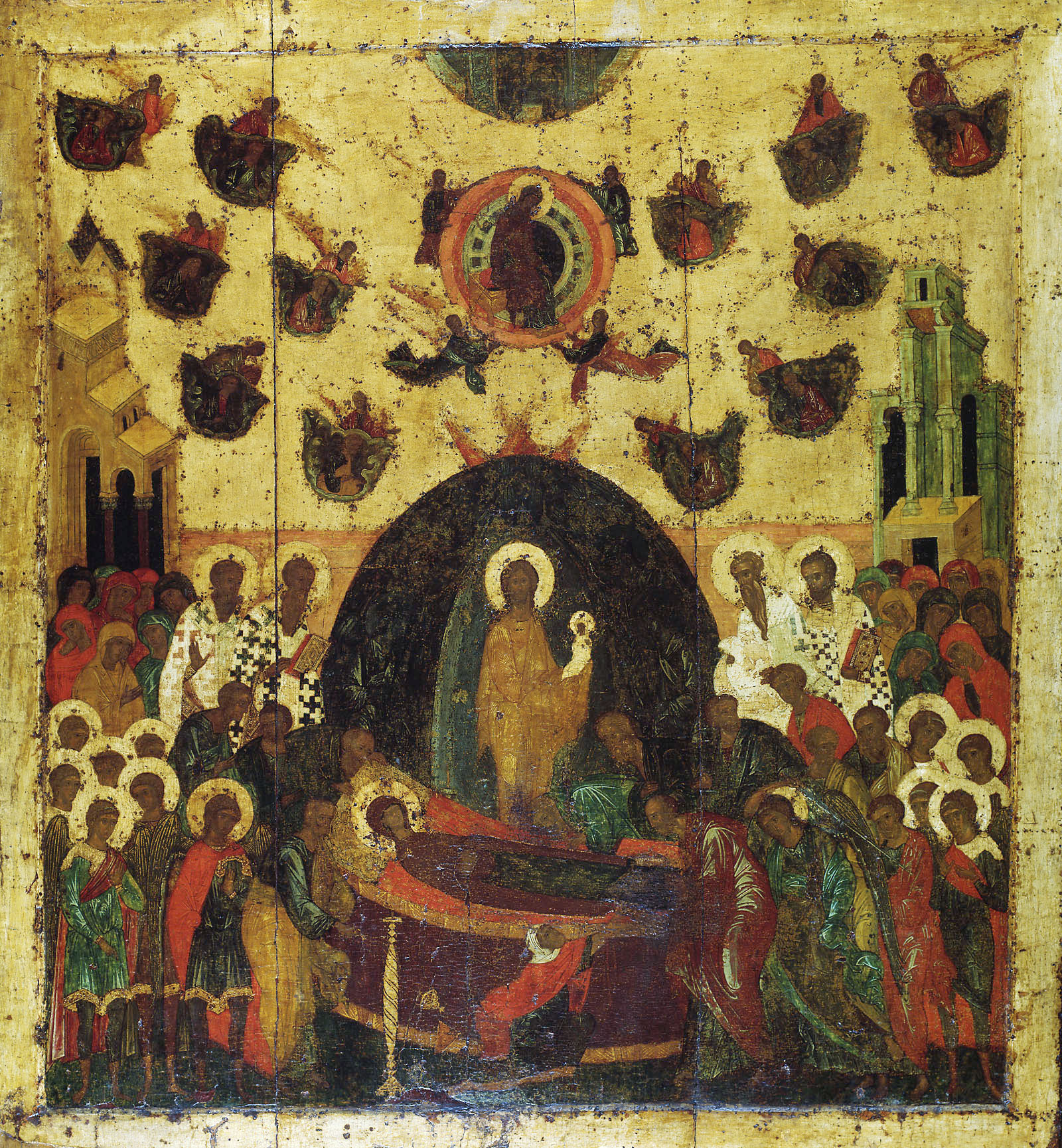
Homily of St. Cyril of Jerusalem on the Feast of the Dormition of the Theotokos


Homily of St. Cyril of Jerusalem on the Feast of the Dormition of the Theotokos
When a rich man of high position wisheth to invite his friends to a breakfast or to a dinner, doth he not first of all sit down before those who are to be bidden are invited, and set out in array the various kinds of food wherewith he may stir up the appetite of those who see them, and make them to taste (i.e. partake) of them? And doth he not then cause his slaves to be summoned, and send them forth to his friends [inviting them] to the feast? And when they have come in, and have laid themselves down [on the cushions], doth not he who hath invited them give unto them first of all fine wine which hath a rich perfume, and which gratifieth the palate? [And after this doth he not make his slaves] bring in all the meats, one after the other, and each one different and the less dainty than the last? Now he who inviteth [p. 627] his friends doeth this so that those who are sitting at meat may not day, 'We have already tasted this [dish].' Even thus is [my] invitation unto you this day, although ye may say concerning the things which I shall declare unto you, 'We have heard this already,' even as Paul saith concerning the Athenians, 'The Athenians wish to hear nothing except some new thing' (Acts 17.21). And although David saith, 'Sing unto the Lord a new song, his blessing is in the church of the saints' (Ps 149.1), yet the Gospel also saith, 'The kingdom of heaven is like unto a rich man' (Cf. Matt 13.45, 52; 22.2). And ye have also heard of the honourableness of the Cross, and of its discovery, and of how the Gentiles and the Jews are coming into the knowledge of Jesus the Christ, and of how Gastor, the Jewish nobleman, hath believed with his whole house. And I Cyril, the least of all men, instructed him in the elements of the Faith, and I baptized him into the great Resurrection of the Christ, and he became a great and righteous and chosen vessel, loving the Faith of the Son of God. And I also baptized a large number of Samaritans, one of whom was Isaac, the handicraftsman (?), and he became a chosen Christian of Christ.

I mention all these, O my beloved, because I have already in times past directed your love to them. But the words of God can never become rusty, and they are sweeter than honey, and [more savory] than salt, according to what our father David said, 'Thy words are sweeter in my throat than honey' (Ps 19.10). Now, therefore, let us remember the pressing liability which is upon us, and let us see that we pay back some small part thereof. And if we are not able to pay back the whole of it, let us give two mites at least, even as did that poor woman who was blessed (Mark 12.42; Luke 21.2), or a denarius, that is to say, a stater, the like of that which Peter found in the [p. 628] mouth of the fish, and which he paid as tribute on behalf of himself and his Lord (Matt 17.27). For if we give only a very little of that which we have we shall be upbraided like him that giveth nothing at all. Let us understand accurately in whose Name we have been invited into this place to-day, and Who it is Who hath invited us: it is Jesus, the God of truth, Who hath invited us, in remembrance of His mother, who became to Him a throne and a place of abode. Since He hath invited us it would be most unseemly for us to shew ourselves sluggish, and not fulfill that which we have promised you in the argument of this commentary. This is the day of the Holy Offering, which is wholly pure in soul and spirit. This is the day wherein the Queen, the mother of the King of Life, tasted death like every other human being, because she was flesh and blood. And, moreover, she was begotten by a human father, and brought forth by a human mother, like every other man. Let Ebion now be ashamed, and Harpocratius, these godless heretics who say in their madness that 'she was a force (or, abstract power) of God which took the form of a woman, and came upon the earth, and was called "Mary," and this force gave birth to Emmanuel for us.' Doth it not follow from thy imaginative words, which are wholly incongruous, that Christ did not take flech upon Himself? Without flesh and without body 'forces' would be beings without bodies, and they could not die like mortal men. Notwithstanding [this], come hither ye deaf and blind and foolish, O Bion and Harpocration, and I will question you. If ye say that Mary is a 'force,' a 'force' will die. Who is it then whose falling asleep the whole of the inhabited world commemorateth by keeping a festival this day? Is it not Saint Mary, the mother of our Lord Jesus Christ? But pay attention to me with [p. 629] a tranquil mind and listening ears, and I will entreat the Paraclete, the Holy Spirit, to illumine my heart with the knowledge of all the Scriptures of God, so that I may explain clearly to you, in gladness, the life of the holy Virgin Mary, and what her race was, and what were the names of her parents according to the first genealogy which is written in the Scriptures. For we are wholly unable to follow the fictitious statements which are found in the fabulous lives of her, and which resemble the writings of the Greek poets, who in their works on theology relate mere myths about their gods; neither will we invent lives of her in order to gratify her. Now every gift of grace is of God. Of what kind is the gift of grace which came to man or to woman from Adam until this day? Understand what happened unto her, O wise virgin, since thou art in heaven, and art [near] the throne of Him who fashioned us. This gift of grace was not given unto the Patriarchs, who enjoyed friendly intercourse with God, and who ate with Him, and they never expected in the smallest degree that He would come in their time. This gift of grace was not given unto the Prophets, but they continued to prophesy the advent of the Word of God until He came and dwelt in the womb of Mary the Virgin, who became the mother of the King Christ. Shew me, [O Paraclete], who their kinsfolk were, and the house of their father, so that I may inform every one concerning the exalted position of their family.

And behold, the Virgin stretcheth out her hand to me, saying, 'O Cyril, if thou wishest to know concerning my family, and concerning the house of my fathers, hearken. I was a child promised to God, and my parents dedicated me [to Him] before I came into the world. My parents who produced me were of the tribe of Judah and of the House of [p. 630] David. My father was Joakim, which is, being interpreted, "Keopa." My mother was Anna, who brought me forth, and who was usually called "Mariham." I am Mary Magdalene*, because the name of the village wherein I was born was "Magdalia." My name is "Mary, who belongeth to Kleopa." I am Mary who belongeth to Iakkobos (James), the son of Joseph the carpenter, into whose charge they committed me. Enquire in the Scriptures, and thou shalt find abundant information concerning these things about which thou art asking questions. In ancient days when Joshua, the son of Nun, divided up the land [which he had taken] among the children of Israel, the tribe of Judah obtained for its inheritance Jebuselia, that is to say, Jerusalem and the region about it. From that time each of the Twelve Tribes hath remained in the region of its inheritance. No tribe hath been in the habit of entering into the country of another tribe and of acquiring an inheritance therein. or property therein, and no man hath married a wife, and no woman hath taken a husband, from any tribe except their own, until the time when the Word of the Father was graciously pleased to come and to rescue us from the slavery of sin. And besides this He put on our flesh in a woman according to what He wished, [for] there was none to deliver us.'

[*Note: St. Cyril is not denying St. Mary Magdalene's existence, as he mentions her later in the homily.]

Now I have made an examination of the ancient histories of Ioseppos (Josephus) and Eierennaios (Irenaeus), [and] those of the Hebrews which I have searched out for myself, and I am convinced of the correctness of that which I am now going to say. Mary was descended from the Jews, through the tribe of David, according to the blessing which the Lord spake, I mean to Abraham, saying, 'In thy seed all the peoples of the earth shall receive a blessing' (Gen 12.3). Abraham [p. 631] begat Isaac, Isaac begat Jacob, and Jacob begat Judah and his brethren. Our Lord was descended from the tribe of Judah, according to the blessing of Abraham, [which was] then and there fulfilled. Inasmuch as each one of you is anxious to know what I am going to say, [I will tell you] what our fathers have taught us, according to what the Psalmist David saith, 'The things which our fathers have declared shall not be hidden from their children of the generation which is to come' (Ps 78.3-4).

At the time when the Virgin was born there was a certain district of Jerusalem which was commonly called 'Magdalia,' and there was situated upon it a small village which people called by this name, and in this village were a few people who were Jews. And among these people was a man who was commonly called 'David,' and he was rich in possessions of every kind. He observed with great diligence the Law of Moses and the Prophets, which was sweeter to him than honey, and he performed manifold acts of charity to those who were in want; and he was awaiting the Redeemer of Israel, Who was to come shortly. And this man was lying on his bed one evening, and he was caught in an ecstasy, and it seemed to him as if some one said unto him, 'O Aaron, the Redeemer of Israel shall spring forth from thy family, for the time hath come when the root shall put forth fruit.' And he said within himself, 'What now is the meaning of this vision which I have seen? But, whatever it may be, whatsoever God wisheth let that happen.' And he had living there with him a woman who was a believer, and her name was Sara; and she bore unto him a man child, and his father called him Kleopa. And his father David gave unto him to wife Anna, the daughter of his brother Aminadab, and the two of them were pleasing before God. And it came to pass that after a time they gave all [p. 632] their possessions to Joakim their son, and to Anna his wife, together with all the village of Magdalia. Now Anna was barren, and she had never borne a son, and the matter was one of anxiety to them. And they said, 'Who then is there to inherit our possessions?'

And it came to pass that after certain days (or, many days) Joakim said unto Anna, 'Let us go to the Temple of the Lord, and let us make supplication unto the Lord, that He may shew mercy unto us, and may grant us our petition which we shall ask of Him.' And they rose up and went into the Temple of the Lord, and they made supplication unto Him, and they paid their vows to the priest, and they prayed unto the Lord with their faces flat upon the earth. And Joakim prayed, saying, 'Lord God Almighty, Who didst hear our father Abraham in his old age, and didst graciously give to him Isaac, his child of promise, hearken Thou unto me also this day, and do Thou give me the seed of men. If this come to pass, and Thou dost give unto us either a man child I or a woman child, we will dedicate him to Thy Temple all his days, and he shall minister unto Thee.' And straightway a voice came to them out of the place of the altar, saying, 'Joakim Kleopa, the prayer which thou hast made to God hath been heard, and thy petition hath been fulfilled. Now therefore arise, and get thee into thy house, for the grace that hath come to thee hath never been [bestowed upon] any of the people of old.' And Joakim thought that it was the priest who was talking to him in the place of the altar, and he answered and said unto him, 'May it be according to thy word, O my lord!' And Joakim and Anna rose up and parted to their house.

And after certain days Joakim visited Anna, and she conceived, and all those who were acquainted with her rejoiced with her. And when the days were fulfilled for her to bring forth she gave birth to a woman child, according to the Providence of God; and the grace of God was upon her face. [633] And her parents called her '...Mary,’ and she increased in beauty (?) every day, and all those who saw her marvelled at her because of the glory of God that surrounded her at all times. And when three years were fulfilled the child was weaned from her mother's milk. And Joakim said unto Anna his wife, 'Let us give unto the Lord what we have vowed to Him, lest He be angry with us.' And they made themselves ready, together with their offerings of first-fruits, and they took them into the Temple with Mary their daughter, and they gave their offerings of first-fruits to the priests who were ruling at that time, that is to say, to Simeon and Zacharias. And they took their daughter Mary and gave her into the hands of the priests, Saying unto them, 'Behold the child whom God hath graciously given unto us. We give her as a votive offering in the Temple of the Lord, so that she may minister unto Him all her days.' And the priests blessed Joakim and Anna, saying, 'According as ye have vowed so have ye paid unto the Lord, Who will bestow His good gifts upon you in such wise that ye shall have a son in the place of this daughter Mary whom ye have given to the Lord, and whose name shall be known throughout the world.' And they said, 'Amen. So be it!' And they returned to their house. And they were in the habit of visiting their daughter once each month, when they carried to her whatsoever things of which she had need. And their little virgin daughter ministered in the Temple with the other women, who were aged virgins, and they taught her to work with her hands. And when she had become somewhat master of herself she used to go alone into the court of the Temple, but no man whatsoever saw her with the exception of the priest and her father. Her food consisted of bread and water and a few green herbs, and she did not fast for long periods at a time; in short, it is [impossible to describe] her beauty of body, and soul, and spirit.

And when she had completed the fifteenth year of her age [p. 634] the Shepherd was pleased to come and visit His sheep, and to snatch them away from the claws of the wolf, and the King was pleased to redeem those who belonged to Him and were in captivity in the hands of the Tyrant. And Gabriel the Archangel was sent from God to the holy Virgin Mary, and he announced to her the glad tidings that the Saviour was coming to her. But peradventure thou wilt say unto me, 'At what time, or in what manner(?), did these things take place? [Tell us] so that we may be certain about the words which thou sayest.' I will answer thy questions according to the Scriptures. God sent Gabriel on the seventh day of the month Xanthikos (April), which is the new moon Parmoute, in the year five thousand five hundred; on this [day] was conceived the Life of all of us, and He was born on the twenty-ninth day of the month Khasileue (November), which is Khoiak, in the fourth year of Augustus, the Emperor of the Romans, in the fifteenth year of the life of Mary. The place wherein He was born was Khabratha, which is Bethlehem, in the land of Judah, in the second year of Herod, the Governor all Judea. When Christ was brought to Egypt he was two years and four months old. But thou wilt in any case say unto me, 'Why did Joseph and Mary depart from Palestine and go so far away as Egypt by themselves, for it is said that there were twenty halting places before they came into Egypt? And how was it that they were able to perform such a wearisome journey which necessitated so many days of difficult travelling? And where could they find food to eat?' I will tell thee, O thou unbelieving and feeble person, the things which thou shalt set in thy remembrance, and I will speak unto thee from out of the Scriptures.

Peradventure thou wilt say unto me, 'The angel took Habakkuk to Babylon from Jerusalem, a road on which [p. 635] there were seventy halting places, and which required a very long time to travel over.' Habakkuk, the Scripture saith, placed the leaves of bread in a basket, and he took them with the wine and the [other] food, and went to the field to carry them to his reapers. And the angel of the Lord lifted him up by the hair of his head under the impulse of his spirit, that is to say, by the strength of his flight, and he carried him straightway to the place that was above the den of lions in Babylon, and he gave food to Daniel, and he and the reapers ate of this food on the same day. If now the power of the angel was great enough to do this, then the Lord of the angels could come to Egypt riding upon a light cloud, and, indeed, it was by means of the light cloud that God came to Egypt. And when the young Child came into Egypt He recalled to mind the works of Egypt, [for] He rode upon the light cloud which transporteth those who are without sin. The spotless Lamb and the old man Joseph came into Egypt under the guidance (or, direction) of that whereupon they rode. And the mountains and the rocks levelled themselves before them, and smooth roads whereon they could walk easily made themselves ready for their feet, and they crossed rivers and streams without the help of ship or sailor. In short, our Saviour came into Egypt by the power of His Father, and He passed three years there, and He proclaimed to the Egyptians what they ought to do whilst He was at the breast of His mother Mary. And when Herod had received the punishment which he deserved for the slaughter of the innocent children whom he had put to death, the words which are written in the prophet, saying; 'I called My Son out of Egypt' (Hos 11.1) were fulfilled. And God sent a message unto His beloved Son, and His mother Mary and Joseph by a...guard, and He brought them out of Egypt, and settled them in Nazareth. All these things have I related [p. 636] to you, beloved ones, because of the godless heretics, who say that Mary is a 'force' (or, abstract power). Behold, I have already pointed out to you in the words which I have addressed to you, saying that Mary was flesh like all other folk, and that the Lamb of God, Who took away the sins of the world, took flesh in her.

And now I wish to relate to you an incident that happened to me. There was a certain monk who lived in the neighbourhood of Maioma of Gaza, who had received instruction in the heresy of Bion and of Harpocratius his master, of whose books he obtained possession, and he expounded them publicly, and he became filled with blasphemies and with falsehoods, and he masqueraded with great pride and arrogance, and he deceived all the people who were in that neighbourhood by his pretensions, through those who used to come to the holy places there to pray. And the things which he proclaimed in his corrupt heterodoxy were repeated to me, and I sent two ministers to the Bishop of Gaza, and I said unto him, 'I beseech thee to seek out on my behalf a certain monk who is in the neighborhood of Maioma, and do thou send him to me, together with his books.'

And when the bishop had received the letter and read it, he caused search to be made for that monk everywhere. And when they had brought him to the bishop he said unto him, 'My son, rise up and go to Jerusalem to the archbishop. If thou dost not go he will send for thee and thy books. He knoweth about thy doctrine, and about thy preaching, and whose it is.' And the monk replied, 'I will take my books and I will go to him in Jerusalem.' And the ministers took him to Jerusalem to the archbishop, who said unto him, 'We have heard, O brother, that thou art teaching a strange doctrine, and that thou art changing the voices of the Holy Gospels.' The monk, [who was called Annarikhus, said unto him, 'My teaching (or, doctrine) is not a strange doctrine, but is that of our Fathers the [p. 637] Apostles, and our own Fathers taught it everywhere as sound doctrine.' And Apa Cyril said unto him, 'Who mere thy Fathers?' And the monk said, 'Sator, and Ebion, who succeeded him.' And the archbishop said unto him, 'Thou hast become a disciple and hast made thyself a mule-like beast under the stupid yoke of the chariot of the Devil.' And the monk said unto him, ' Harpocratius used to cast out devils.' And the archbishop said unto him,' Shew me by what meands thou dost cast out devils, and in what way thou dost preach the Gospel, and what thou dost say concerning Christ and His Birth according to the flesh, and concerning His mother who brought Him forth, and concerning His death which was full of salvation, and His resurrection from the dead after the third day.'

And that monk replied, 'It is written in the [Gospel] to the Hebrews that when Christ wished to come upon the earth to men the Good Father called a mighty "power" in the havens which was called "Michael'', and committed Christ to the care thereof. And the "power" came down into the world, and it was called Mary and [Christ] was in her womb for seven months. Afterwards she gave birth to Him, and he increased in stature, and He chose the Apostles, who preached Him in every place. He fulfilled the appointed time that was decreed for Him. And the Jews became envious of Him, they hated Him, they changed the custom of their Law, and they rose lip against Him and laid a trap and caught Him, and they delivered Him to the governor, and he gave Him to them to crucify Him. And after they had raised Him up on the Cross the Father took Him up into heaven unto Himself.' And the Patriarch Cyril said unto the monk, 'Who sent thee about to teach these things?' And that monk said unto him, 'The Christ said, 'Go ye forth into all the world, and teach ye all the nations in My Name in every place. (Matt 28.19-20)' And Apa Cyril said unto him, 'Dost [p. 638] thou take the Gospels literally?' And the monk said, 'Yea, absolutely, my lord Father.' And the archbishop answered and said, 'Where in the Four Gospels is it said that the holy Virgin Mary, the mother of God, is a " force "?' And the monk answered and said, 'In the [Gospel] to the Hebrews.' And Apa Cyril answered and said, 'Then, according to thy words, there are Five Gospels?' And that monk replied, 'Yea, there are.' And Apa Cyril answered and said, 'What is the name of the fifth Gospel? for I should like to from whence this doctrine concerning Christ is derived, and to understand it. The Four Gospels have written above them: "[The Gospel] according to Matthew"; "[The Gospel] according to Mark"; "[The Gospel according to Luke"; "[The Gospel] according to John." Whose is the fifth Gospel?' And that monk said unto him, 'It is [the Gospel] that was written to the Hebrews.' And Saint Cyril answered and said, 'If thou speakest the truth, O brother, must we not then reject the teaching of the Christ, and follow the misleading doctrine of the Hebrews? God forbid! The Hebrews wish for doctrine of this kind greatly, so that they may cast a blemish upon our purity and honour, even as it was said by the Christ in times of old, "Thou castest out devils by Berzeboul." (Matt 12.24 par.) And is it not written, "He who doth not confess that Jesus the Christ hath come in the flesh is a deceiver and an Antichrist, like thyself"? (2 John 7) And again, "Whosoever shall come unto thee, and bring a doctrine that is different from thine, receive him not into thy house, neither say unto him, Hail!" (2John 10) And again, "If they were of us they would have been like unto us; they came forth from us, but they are not of us." (1 John 2.19) Which meaneth that they utter the Name of Christ with their mouths only and that they make a pretence in their hearts. They heap up wrath for themselves in the day of the Judgement of Truth and the wrath that is from Jesus the Christ. The doctrine of [p. 639] the Jews cannot be joined unto the doctrine of Christ. What connection can there be between the agreement of the [Gospel to the] Hebrews and the agreement of the Holy Gospels? But those heresies must spring up which Epiphanius describes in his work AgkurwtV , saying, "The error in each one of them is different, but evil is implanted in them all.''' And Annarikhus the monk said unto Apa Cyril, 'The night cannot contend against the day, neither can darkness stand before the light. I am vanquished by thy great wisdom, and I know that I have made a mistake. Let thy fatherhood grant repentance unto me! And all these things which I have overthrown I will build up again. But take my books, and burn them in the fire, and my possessions do thou give to the poor. My heart followeth thy words and [those of] the Holy Gospel.'

And when I (i.e. Cyril) had burned his books, I said unto him 'Who...[One leaf wanting]...He to Whom no form can be assigned was born [in the form of] a son. He was the Beginning, and He Who had no beginning was brought forth. Now there was a beginning to that humanity, but the Godhead had no beginning, and was without form. And no addition took place to the Trinity in such wise that the Trinity, which consisteth of Three [Persons], became Four [Persons]. One sunodoV entered one who was of two natures, and one son was brought forth, a unity of the flesh without any diminution. For He was neither changed in His nature, nor reduced in His strength, nor was He separated from His Ancient Begetter, that is to say, the Beginning. But the oneness of the flesh of God received one Nature. As for the coming to us of the Blessed Offspring God the Word, it is the miracle that was hidden in God from eternity, I mean the miracle of God Who made Himself man. An impenetrable mystery is the Nature that abolished the curse and destroyed the sentence of death, [p. 640] and taught us concerning the foundation, which had no beginning, of the Only-begotten One, Jesus the Christ, our Lord, the production, according to the flesh, of the womb of Saint Mary, the perpetual Virgin, in whose holy house we are I gathered together this day to commemorate the day of her death. If thou wilt confess these things with a true and sincere belief then we will prepare to receive thee into the fold of all the sheep of the loving Shepherd Christ. Have no doubt about the matter; thou must either follow the words which I have taught thee or thou must get outside this place.' And Annarikhus opened his mouth and anathematized the heresy of Ebion and Harpocratius, saying, 'Anathema be every heresy; the things which thou [Ebion] hast said unto me are not to be believed. And now, O my father, receive thou me into good fellowship with thyself.' And when I knew that his mind had received the light I baptized him in the name of the Lady of us all, Saint Mary, whose day is this day. Finally he went to a monastery in the Mount of Olives, and he builded upon the foundation of the Apostles until the day of his death.

I have now described unto you the whole of the story concerning the heresy of Ebion who said, 'Mary, the mother of the Lord, is a " force ".' Let us now return to I that which we promised to you in the introduction to our explanation, that is to say, the [narrative of] the end of the life of the holy Virgin Mary. And I wish also to go back to what I promised from the beginning, and to declare it. Tell me, O Gabriel, thou mediator between God and men, what is the history of the kinswoman of Mary, this Elisabeth? I am listening to thee, and I hear thee preaching about her saying, 'Behold, Elisabeth the kinswoman [of Mary] conceived a son in her old age, according to the prophecy in the Gospel. The parents of the Virgin were descended from the tribe of Judah, and Elisabeth was descended from the daughters of Aaron, and Aaron was descended from the tribe [p. 641] of Levi. Thus this matter is twofold, and it reduceth itself to two persons. Judah and Levi were brethren, each of the other, and one father, that is to say, Jacob, and one mother produced them both. Since Elisabeth was a daughter of Levi, and Mary was descended from Judah, they are then daughters of two brethren; are they not then kinswomen, each of the other? I have also stated that the little Virgin Mary was in the Temple, and that she remained by herself before the archangel Gabriel came to her with a sweet odour, and Zacharias, the husband of Elisabeth, spake unto her words of praise concerning the Virgin. I have said that she was in the Temple before the gift of the Lord was given unto her, and that there was no limit to her beauty, and the Temple was wont to be filled with angels because of her sweet odour, and they used to come to visit her for the sake of her conversation. And when Elisabeth heard these things she set out from Dorine and departed to Jerusalem, and she went into the Temple of the Lord. And when she saw Mary she marvelled at the grace of God which was on her face, and they saluted each other and sat down. And Elisabeth said unto Mary, 'Thy soul and body have been joined unto the Lord from thy childhood, and thou hast followed Him with thy whole heart so truly that the redeemer of Israel shall proceed from thee.' And Mary said, 'Blessed be the God of Israel, Who hath appointed me for Himself from my childhood to minister unto Him with perfect service.' And the two women comforted each other from the Law and the Prophets for many days. And afterwards Elisabeth returned to Dorine to her ordinary life, and she made it a habit to visit the Virgin several times that year, and she ministered unto her every need until the day when Gabriel came unto Mary and said unto her, 'Behold, Elisabeth thy kinswoman hat conceived.' (Luke 1.36) Behold, moreover, the matter is plain that Mary and Elisabeth were kinswomen, each of the other, [p. 642] from what is written in the Gospel, the which. I have already declared to you.

Behold now, let us return to the previous subject which we left [for a short time], because there is no trouble whatsoever in discussing the queen, who became the mother of the King, and he who listeneth is not wearied by her history. It is like unto one who goeth to draw mater from a spring; as soon as he stretcheth forth his hand to draw therefrom the spring sendeth forth water in great abundance. And this is my own case when I begin [to describe] the life of the Virgin, for the fountain of my speech bubbleth up abundantly, and I cry out with the Prophet, David, and I lift up my voice, saying, 'Thou hast made me wiser than all my teachers,' (Ps 119.99) and again, 'The manifestation of Thy words is what illumineth us.' (Ps 119.130) For I looked round about me, saying, 'Where shall I begin my discourse?' Then I remembered the words which the Saviour spake unto His mother when He was hanging upon the Cross, 'Then woman, behold thy son!' referring to John. Then He turned to John, and said unto him, 'Behold thy mother!' (John 19.26) and from that day the disciple took her into his house and ministered unto her with service of every kind, even as doth a slave who serveth his lord. And she loved him even as a mother loveth her son. And she used to do many mighty works, and perform healings among the people, which were like unto those that were wrought by Jesus our God, but she never permitted the Apostles to know [about them], for she fled from the praise of men. And the Apostles were closely associated with her at all times when they were preaching. She gathered round about her a multitude of virgins, she assisted them, and she made them to rejoice in the benefits of virginity--she who had drawn nigh unto her God, Who at length came and took up His abode in her womb for nine months--and she [p. 643] shewed the way, and that the entrance into heaven, to her beloved Son, was good and without obstacle.

And it came to pass that for ten years after our Lord rose from the dead, according to what the Ancient History of Josephus and Irenaeus and the Hebrew authorities say, John and Mary lived in the same house in Jerusalem. And it came to pass on a certain day, for so he saith, that the holy Virgin Mary called John and said unto him, 'Go and summon to me Peter and James, and let them come to me here in this place.' And John went in haste and summoned them, and they came, and the three [Apostles] sat down before her. And she said unto them, 'Hearken unto me, O ye whom God hath chosen to preach the Gospel throughout the world. Ye have seen with your own eyes the mighty deeds and wonders which God performed in the time when He was in the world with you, and ye have no need of any to bear testimony to you. Ye three did He take up to the Mount of Olives; and your ears did hear the Voice of the Father bearing witness concerning Him, saying, "This is My beloved Son, in Whom is My desire." Ye saw the sufferings which the Jews inflicted upon Him when He was raised upon the Cross, and that they put Him to death, and that His Father raised Him up from the dead on the third day. And I went to the tomb, and He appeared unto me, and He spake unto me, saying, "Go and inform My brethren what things ye have seen. Let those whom My Father hath loved come to Galilee." And He came in to you, the door being closed, and He spake unto you concerning the Kingdom which is in the heavens. And at the end of forty days ye were all gathered together in one place on the Mount of Olives, and he was there with you. And the Lord came again to you, [p. 644] and he said unto you, "I have fulfilled the dispensation which was laid down for Me in the world, and I am now going up to my Father." And ye replied, "Wilt thou depart and leave us I orphans? " And he said, "When I go I will send unto you the Paraclete, the Holy Spirit, in My place, after many days, even until Pentecost. But behold, to her who was unto Me a dwelling-place I was a Son in the flesh, and she is under your care now. But I will be with you until the end of the world." And when He had said these things unto us He separated Himself from us a little, and ascended the mountain on the east, and mounted upon the Cherubim, and departed into the heights in the flesh; the which He had received from me. And thousands of thousands, and tens of thousands of tens of thousands [of angels] sang hymns to Him, and they followed Him with their eyes until He entered heaven. And we saw two men who were standing close to him, and they said, "Ye men, why are ye looking up into heaven? This is Jesus Whom they crucified, and Who is being carried up into heaven, and He it is Who shall come to judge the quick and the dead." And after the end of ten days He sent upon you the Holy Spirit, Who gave you power to do mighty works, according to your ability. Put not behind you the commandments of the Son of God; fear ye not the destruction of the kings and governors of the earth in such wise that ye shall put behind you the instructions of our Lord and Master. Now therefore, be not grieved in your hearts at what I shall say unto you.

'The time of my visitation hath drawn nigh, and I must lay down my body so that my soul and my spirit may depart to the Lord, in order that He may give unto me the things which He hath promised to me. For my Lord came unto me on the evening of the Sabbath (?), as I was standing in prayer, and He said unto me, "Dost thou know Me?" And I said unto Him, "Thou art my Lord and my beloved Son; [p. 645] what is it that Thou commandest me to do?" And He said unto me, "Inform Peter and John concerning these things, for it is they who shall lay their hands upon thine eyes. Now three more days have yet to pass before I shall come for thee and take thy soul and thy body into My city of the Jerusalem of heaven. And all My saints shall marvel at the glory which I shall give unto thee in that place, for it is thou who shalt make God and His angels to be reconciled with man. And thou shalt be more exalted than all the saints, and I will make My angels to hymn thee at all times, for thou resemblest them in thy purity and thy virginity. All the angels and all the hosts of heaven shall rejoice when thou comest to meet them. The Patriarchs and the prophets shall come forth to meet thee, and they shall exult because the mother of the Lord hath come to them, for they were not able to see her in the flesh. Behold, when they see her they shall praise her through God the Father. All the virgins who are in the heavens shall rejoice with thee when thou shalt meet them, and those who have preserved their virginity shall come forth to thee, and shall bow in homage before thee, saying, Well hast thou come (i.e. Welcome)! O mother of all virgins! It was time for thee to come unto us, O thou mother! Grieve thou not, O mother, about thy holy body, neither about what shall happen unto it, nor about where they shall lay it. What man is there who hath been begotten by the flesh who shall not taste death, and whose body shall not return to the earth wherefrom I took him? I tasted death, but I rose from the dead on the third day, I destroyed him that held the power of death. I will hide thy body in the earth and I will make My angels to keep it in the earth always, and no man whatsoever shall find thy body in the earth in the place wherein I shall place it, until the day wherein I shall raise it up incorruptible. And a sweet odours shall arise from out of thy body until the day wherein it shall rise up. They shall build a great and glorious church over [p. 646] thy body, and it shall be more splendid than a palace of kings. Haste thee [to do] the commandment; of the Apostles, and give an ordinance to the virgins. I will come with My angels, and I will hide thy body and thy soul; so then thou shalt not be afraid of Death when he shall come to thee." Now therefore call unto us all the virgins, and I will give them an ordinance.

And the Apostles did according to what she told them; and when the virgins had come unto her they saluted her and she said unto them, 'I declare unto you that I am about to depart to the Jerusalem of heaven'; and they paid no attention to the words. And Mary took hold of the hand of one of them who had waxed exceedingly old, that is to say, Mary Magdalene, out of whom the Christ had cast several devils, and she said unto the virgins, 'Behold your mother from this time onwards. Give rest to her spirit, even as she hath given rest to me in my days. Observe the customs which ye arranged to keep with the Christ when ye were with Him.' These things did she say unto the virgins, but she did not inform them about her death. And she turned to the Apostles, and she said unto Simon Peter, 'Simon Peter, whom the Lord loved, and preserved for the kingdom that is in the heavens, be merciful, even as your Father Who Is in the heavens is merciful. James and John, watch over your holy Catholicus, and be kind and gracious to every man. And thou, O Peter, go thou into the house of thy disciple Bibros, and take the pieces of fine linen which thou didst commit to his care, and bring them hither to me.' And Peter did according as she told him, and he brought the pieces of fine linen which had been committed to the care of Bifros (sic). And she said unto James, 'Rise up, take a stater, and go to the sellers of sweet perfumes, and bring its value in spices to me hither'; and he did according as she told him.

And when the day wherein she was to be taken arrived, the Virgin Mary said unto John, 'Rise up, light a great [p. 647] number of lamps, both large and small, for the evening hath come.' And she took the pieces of fine linen, and spread them out upon the ground, and she poured out upon them her sweet spices, and she stood up on them, and said unto the Apostles, 'Lee us pray to I the Lord, so that He may have mercy upon us.' And she spread out her hands towards the east, and she made supplication to the Lord, saying, 'I give thanks unto Thee, O Lord God Almighty, and to Thine Only-begotten Son Jesus Christ, the Word of the Father, because He came to us, and built for Himself a fleshly tabernacle in my womb, according as He wished. I brought Him forth without pollution, without blemish. I nursed Him (or, reared Him) with anxious care, and it was He Who nourished me. I give thanks unto Him because Thy Holy Spirit came into me. And now, my Lord, the time hath come when Thou shalt draw nigh unto me, and shalt be gracious unto me. Scatter all the stones of stumbling that are before me and [all] obstacles, and let all those that are in my path, both on the left hand and on the right hand, flee before me. Stand Thou near me with gladness. Let the powers of darkness be ashamed, for nothing of theirs hath been found in me; Open unto me the gates of righteousness, and let me go in through them, and I will make manifest Thy holy name, O my God. Let the Dragon flee before me, for have freedom of speech before Thee. May the river of fire be tranquil when I come unto Thee, and may it allow me cross over it, for I unto Thee belongs the power and the glory forever and ever. Amen.'

And when she had said these things she lay down upon the pieces of fine linen and the sweet spices, and her face was towards the east. And behold, the Lord Jesus Christ came unto her upon the Cherubim, with the angels before Him, and He came and stood at His mother's head, and He said unto her, 'Be not afraid of Death, for the Life of the whole world is with thee, but it is necessary that at least [p. 648] thou shouldst Glance at him with thine eyes, and he will not come except he be commanded to do so.' And Jesus said unto Death, 'Come, O thou who art in the chambers of the south.' And when Mary saw him she cast her soul into the bosom of her Son, and He wrapped it up in a napkin(?) of delight. And the Apostles laid their hands upon her eyes, and she fell asleep with a good falling asleep on the night of the twentieth day of Tobe, in the peace of God! Amen.

And the Lord said unto the Apostles, 'Take up her bed carefully, and take it to the Valley of Jehosaphat, which is opposite the Mount of Olives, the place where I broke bread in days of old. Set down there the bier whereon is the body, and withdraw yourselves because of the threatening of the Jews, for they will pursue you wishing to slay you. And I will hide the body according as it pleaseth Me.' Thereupon the Apostles took up the body and placed it upon a bier.

And when the morning had come a great multitude was gathered together in the city, and the virgins cried out. And straightway Peter and John lifted up the body to carry out to the place of which the Saviour had told them, and a great multitude of people sang psalms and hymns before it, saying, 'The Lord .......,' and a multitude of angels sang hymns before her. And when they arrived at the Temple of the Jews all the members of the Sanhedrin were gathered together in the Temple on that day, and they heard the singing of the hymns over her holy body. And they said, 'Who is this who hath died in the city this day?' And [the people] said unto them, 'It is the mother of the Nazarene, that is, Jesus, who hath died, and they are taking her out to bury her.' And they passed a decree unanimously, saying, 'We must not let her be buried in the city; lest mighty deeds be worked [at her tomb] similar to those which her Son performed, and lest the people believe in her, and they [p. 649] change our Law.' And the high priests and the scribes said, let us go and burn her body with fire, so that no man will ever be able to find it.' And the Jews lighted a fire, and they pursued [the Apostles] with the bier whereon was the body of the Virgin. And when the Apostles had arrived at the Valley of Jehosaphat they looked behind them, I and they saw the Jews pursuing them, and they dropped the bier upon the ground, for they were afraid that the godless Jews would kill them. And whilst the Jews were rushing on to overtake them the Apostles betook themselves to flight and escaped. Now the body of the holy Virgin they could not find, and all that they found was the wooden bier, and they lighted a fire and threw the bier into it. And they went into every place, saying, 'Perhaps her body hath been carried away secretly,' but they could not find it. And a very strong sweet smell emanated from the place whereon the body of the Virgin had been laid, and a mighty voice came from heaven, saying unto them, 'Let no man give himself the trouble of seeking after the body of the Virgin until the great day of the appearing the Saviour.' And the Jews fled greatly ashamed; and they came to the city and told their neighbours what had happened, and they commended them, saying, 'Tell no man whomsoever what hath happened.'**

[**Note: Though St. Cyril's account differs slightly from others regarding the Dormition of the Theotokos and her Translation to Heaven, they are by no means incompatible.]

Now, therefore, O my beloved, these are the things which we were able to discover for our discourse on the life of the holy Virgin Mary. The whole time of her life was sixty years. She gave birth to our Lord when she was fifteen years; she followed the Saviour when He was preaching for three and a half years after she gave Him birth, and after the Saviour rose from the dead she lived eleven years and a half more. She ended her life on the twentieth day of the month Tobe. Our Lord Jesus, the Christ, reigneth over us. And after the righteous Emperors, Constantine and his [p. 650] son, rose up we built a holy church in the name of the holy Virgin Mary, the mother of the Lord, on the day of her holy commemoration. And let us send up to her thanksgiving, saying, 'Remember us, O true Queen, and do thou plead on our behalf before God, so that He may shew mercy unto us and so that me may celebrate a festival to Him at all times.' Let us give alms to the poor in the name of the Virgin, [so that] she may not forsake us in the place to which we are going. Let us ascribe glory unto her by the utterances of our lips, and let us say, 'Through thee honours have been bestowed upon the city by our God.' And again, 'The death of the saints is precious in the sight of the Lord.' (Ps 116.15) And again, 'The sound of rejoicing and salvation is in the habitation of the righteous.' (Ps 118.15) And now the time hath arrived for us to offer up the Holy Offering, the Body and Blood of Jesus the Christ, our Lord, and moderation in everything is good. By the Will of God we will give the remainder of the exegesis in the holy shrine. Let us then bring to an end our discourse at this place, and let us ascribe glory to the Holy Trinity, the Father, and the Son, and the Holy Spirit, lifegiving and consubstantial, now and always, and for ever and ever. Amen.
(http://pages.uoregon.edu/sshoemak/texts/coptic/Cyril.htm)


Most-Holy Theotokos, save us!

Homily of St. Luke of Simferopol on the Dormition of the Theotokos

  
Homily of St. Luke of Simferopol on the Dormition of the Theotokos (amateur translation)
Each of us is tormented with the question: what will happen to us and what awaits us after death? A sure answer to this question we cannot find by ourselves. But the Holy Scripture, and first of all the word of our Lord Jesus Christ reveals the secret to us. It is also revealed by the apolytikion and kontakion of this great feast of the Dormition of the Most-Holy Theotokos, along with the church hymns that we chant at this feast.

I want all of you to understand why the death of the Most-Holy Theotokos and Virgin Mary is called “Dormition”. The great apostle John the Theologian, in the 20th chapter of the Revelation speaks of the first and second death. The first death, which alone is inescapable to all men, also awaits the saints and righteous ones. But the second, the fearsome and eternal death, awaits the great and unrepentant sinners, who denied the love and the righteousness of God and are condemned to eternity in communion with the devil and his angels.

In the Gospel of the same great apostle and evangelist John the Theologian, we read the words of Christ, which are very closely associated with those written in the Revelation: “Truly, truly, I say to you, whoever hears my word and believes him who sent me has eternal life. He does not come into judgment, but has passed from death to life.” (John 5:24).

Do you hear this, do you understand this? I think that this probably strikes you as strange, that all those who are obedient to the word of Christ and believe in the Heavenly Father Who sent Him passes immediately after death to eternal life. There is no reason to judge those who have living faith in God and who follow his commandments.

And to the great twelve apostles, our Lord Jesus Christ said: “Amen, I say to you that you who follow me, in the age to come, when the Son of man sits upon his throne of glory, will also sit upon twelve thrones judging the twelve tribes of Israel” (Matthew 19:28). Judges and condemners the Apostles of Christ will be during the Terrible Judgment of God, and of course, we are totally unable to imagine the Most-Holy Theotokos and Ever-Virgin Mary being judged*, along with the Baptist of the Lord John, the great Prophets of God, Elias and Enoch whom God took to Heaven alive, all the countless mass of martyrs of Christ, the holy hierarchs and wonderworkers who were glorified by God, foremost being St. Nicholas, archbishop of Myra of Lycia.

[*Note: St. Luke is in no way denying Christ's Awesome Judgment of all mankind at His Second Coming, but is saying that all the righteous made worthy of Paradise will join Christ and the Theotokos with body and soul in the New Heaven and New Earth of His eternal Kingdom.]

We are unable to pass the thought from our minds that they would be judged, they who heard from the mouth of Christ: “The kingdom of God is within you” (Luke 17:21). In those great strugglers of Christ, as if in precious temples, dwelt the Holy Spirit. And while they were alive on earth, they were in close communion with God, for thus Christ said: “If anyone loves me, he will keep my word, and my Father will love him, and we will come to him and make our home with him.” (John 14:23)

The Most-Holy Virgin Mary was the spotless temple of the Savior in which dwelt the Holy Spirit, and from her most-holy womb the Son of God received his human body, He Who descended from the Heavens. Because of this, the bodily death is not death, but Dormition, in other words, an immediate passage from the Kingdom of God within to the Kingdom of the Heavens and to eternal life.

Something new just came to mind. In one of the previous sermons, I told you that we have every reason to believe that the body of the Most-Holy Theotokos, through the power of God, remained incorrupt and ascended to the heavens. The kontakion of the great feast of the Dormition of the Theotokos tells us this: “Neither the grave nor death could contain the Theotokos, the unshakable hope, ever vigilant in intercession and protection. As Mother of life, He who dwelt in the ever-virginal womb transposed her to life.”

Note that it says: “neither the grave nor death could contain her”. Think that, as we remember the Holy Scripture writes regarding the death of the greatest prophet of the Old Testement, Moses, in the 34th chaper of the book of Deuteronomy, that he died according to the word of God on Mount Nebo, and was buried in the land of Moab. They grave of this great prophet must have been a place of pilgrimage for the whole people of Israel. However in the Bible we read that: “no one knows of his tomb until the current day” (Deuteronomy 34:6). However, at the Transfiguration of the Lord on Mount Tabor, Moses appeared to his Lord and Master, Jesus, together with the prophet Elias, who was seized alive into heaven.

I think that it would not be a sin to say that the body of the great Moses, as the body of the Most-Holy Theotokos, remained incorrupt.** Because of this his tomb is unknown.

[**Note: As is clear above, St. Luke acknowledges the distinction that the Theotokos (in accordance with Tradition) ascended bodily to Heaven following her Dormition, as opposed to the incorrupt bodies of the Saints, which await the general Resurrection.]

Let us think, brothers and sisters, about the blessed Dormition of the Most-Holy Virgin Mary and remember the words of our Lord Jesus Christ: “Truly, truly, I say to you, whoever hears my word and believes him who sent me has eternal life. He does not come into judgment, but has passed from death to life.” (John 5:24). May God also make us sinners worthy to experience this great joy, through the joy and love for man of our Lord Jesus Christ, to Whom belong all glory and dominion with His beginningless Father and His All-Holy Spirit, unto the ages. Amen.
(source)

The Dormition of the Theotokos (source)
 
Most-Holy Theotokos, save us!

Friday, August 5, 2011

Selected hymns from the Great Feast of the Transfiguration of Christ

The Holy Transfiguration of Christ - Celebrated on August 6 

Selected hymns from the Great Feast of the Transfiguration of Christ


Apolytikion
You were transfigured upon the mountain, O Christ our God, showing to Your disciples Your glory as much as they could bear. Do also in us, sinners though we be, shine Your everlasting light, at the intercession of the Theotokos, O Giver of light. Glory to You.

Kathisma I. Mode 4. Joseph marveled.
You were transfigured on the Mount* Tabor, and demonstrated thus* the transformation mortal men* shall with Your glory undergo* at the fearful Second Coming of You our Savior.* Moses and Elias were conversing with You.* And You called together three of Your disciples there,* who gazed upon Your glory, O Master,* and were astounded by Your fulgurant light.* O Lord who then shined Your light upon them,* do also illuminate our souls.

Kontakion. Grave Mode.
Upon the mountain were You transfigured, and Your disciples beheld Your glory as far as they were able, O Christ our God; so that when they would see You crucified they might understand that Your Passion was deliberate, and declare to the world that in truth You are the Father’s radiance.

Å’kos
Awake you dull thoughts, be not always groveling and bending my soul towards the earth; arise and go up to the height of divine ascent. Let us run to join Peter and Zebedeeʹs sons, and with them go directly to Mount Tabor; that with them we may see the glory of our God, and may also hear the voice that they heard from heaven; and they proclaimed the Father’s radiance.

Excerpt from the Ninth Ode of the Second Canon of the Feast, in the Plagal of the Fourth Tone
Glory to You, our God, glory to You.
That You might manifestly show * Your unutterable second descent to come, * how You the Most High God * will then be seen standing in the midst of gods, * You did ineffably shine forth * on Moses and Elias and * on the Apostles, O Lord, * on Mount Tabor. Hence we magnify You, O Christ

Glory.
People, come listen to me. * Let us climb that mountain, holy and heavenly, and immaterially * stand in the city of the living God. * Let us noetically see * the immaterial Divinity * of the Father and the Spirit, * shining forth in the Only‐begotten Son.

Both now.
You have enraptured me, O Christ, * with Your longing and transformed me with love divine. * I pray, completely consume * with immaterial fire all my sins. * And count me worthy to be filled * fully with the delight in You, * that I may magnify * both Your Comings, O good Master, exultantly.

Exaposteilarion. Mode 3. Original Melody.
O Logos, light unaltered* of light, unbegotten Father,* we have beheld light, the Father,* and light the all‐holy Spirit* today in Your light appearing* upon Mount Tabor,* guiding with light all creation.

Prosomoia of the Praises in the Fourth Tone
Before You went to Your precious Cross and Passion,* taking those holy Disciples You had specially* chosen, O Lord, You went up with them* into Mount Tabor,* wishing to show them Your glory as You did.* And when they beheld You thus transfigured and they saw* that You were shining more brightly than* the sun, they fell down* and were astounded by Your authority.* They cried aloud: You are the timeless light,* and the Father’s bright radiance, even though* as You willed You became flesh* without changing and were thus beheld.

O God the Word who exist before the ages,* who cover yourself with light as with a garment, O Lord,* You were transfigured before the eyes* of Your Disciples* and shined, O Logos, more brightly than the sun.* Moses and Elias stood by You betokening* that You are truly the Lord of both* the dead and living,* And they doxologized Your ineffable* mercy and dispensation and Your great* condescension by which You have saved the world* which was lost in transgressions* and was perishing because of sins.

When Your Disciples were there with You together,* the voice of the Father then explicitly declared* that You are His own beloved Son,* the same in essence,* sharing the same throne, in whom He is well pleased,* You who from a virgin cloud were born becoming flesh,* and were transfigured, O sovereign Lord,* upon Mount Tabor,* and were encompassed with a bright shining cloud.* Wherefore did Peter in astonishment* say, “O Master, it is well that we are here,”* not knowing what he was saying,* O Benefactor rich in mercy.

Doxastikon of the Praises in the Plagal of the Fourth Tone
Glory; both now.
Christ took Peter, James, and John,and led them up on a high mountain apart by themselves; and He was transfigured before them; and His face shone like the sun, and His clothes became as white as the light. Moses and Elijah appeared to them, talking with Him. Then a bright cloud overshadowed them; and suddenly a voice came out of the cloud, saying, ʺThis is My beloved Son, in whom I am well pleased. Listen to Him!ʺ


Through the prayers of our Holy Fathers, Lord Jesus Christ our God, have mercy on us and save us! Amen!

Thursday, August 4, 2011

Homily of St. John Chrysostom on the Transfiguration of Christ

The Holy Transfiguration of Christ (http://pravicon.com/images/icon/0413/0413012.jpg)

Homily of St. John Chrysostom on the Transfiguration of Christ (Matthew 17:28-36)
“Verily, verily, I say unto you, There are some of them that stand here, which shall not taste of death, until they see the Son of Man coming in His kingdom.”

Thus, inasmuch as He had discoursed much of dangers and death, and of His own passion, and of the slaughter of the disciples, and had laid on them those severe injunctions; and these were in the present life and at hand, but the good things in hope and expectation:—for example, “They save their life who lose it;” “He is coming in the glory of His Father;” “He renders His rewards: “—He willing to assure their very sight, and to show what kind of glory that is wherewith He is to come, so far as it was possible for them to learn it; even in their present life He shows and reveals this; that they should not grieve any more, either over their own death, or over that of their Lord, and especially Peter in His sorrow.

And see what He doth. Having discoursed of hell, and of the kingdom (for as well by saying, “He that findeth his life shall lose it, and whosoever will lose it for my sake, shall find it; “ as by saying, “He shall reward every man according to his works,” He had manifested both of these): having, I say, spoken of both, the kingdom indeed He shows in the vision, but hell not yet.

Why so? Because had they been another kind of people, of a grosser sort, this too would have been necessary; but since they are approved and considerate, He leads them on the gentler way. But not therefore only doth He make this disclosure, but because to Himself also it was far more suitable.

Not however that He passes over this subject either, but in some places He almost brings even before our eyes the very realities of hell; as when He introduces the picture of Lazarus, and mentions him that exacted the hundred pence, and him that was clad in the filthy garments, and others not a few.

2. “And after six days He taketh with Him Peter and James and John.

Now another says, “after eight,” not contradicting this writer, but most fully agreeing with him. For the one expressed both the very day on which He spake, and that on which He led them up; but the other, the days between them only.

But mark thou, I pray thee, the severe goodness of Matthew, not concealing those who were preferred to himself. This John also often doth, recording the peculiar praises of Peter with great sincerity. For the choir of these holy men was everywhere pure from envy and vainglory.

Having taken therefore the leaders, “He bringeth them up into a high mountain apart, and was transfigured before them: and His face did shine as the sun, and His raiment was white as the light. And there appeared unto them Moses and Elias talking with Him.

Wherefore doth He take with Him these only? Because these were superior to the rest. And Peter indeed showed his superiority by exceedingly loving Him; but John by being exceedingly loved of Him; and James again by his answer which he answered with his brother, saying, “We are able to drink the cup; nor yet by his answer only, but also by his works; both by the rest of them, and by fulfilling, what he said. For so earnest was he, and grievous to the Jews, that Herod himself supposed that he had bestowed herein a very great favor on the Jews, I mean in slaying him.

But wherefore doth He not lead them up straightway? To spare the other disciples any feeling of human weakness: for which cause He omits also the names of them that are to go up. And this, because the rest would have desired exceedingly to have followed, being to see a pattern of that glory; and would have been pained, as overlooked. For though it was somewhat in a corporeal way that He made the disclosure, yet nevertheless the thing had much in it to be desired.

Wherefore then doth He at all foretell it? That they might be readier to seize the high meaning, by His foretelling it; and being filled with the more vehement desire in that that round of days, might so be present with their mind quite awake and full of care.

3. But wherefore doth He also bring forward Moses and Elias? One might mention many reasons. And first of all this: because the multitudes said He was, some Elias, some Jeremias, some one of the old prophets, He brings the leaders of His choir, that they might see the difference even hereby between the servants and the Lord; and that Peter was rightly commended for confessing Him Son of God.

But besides that, one may mention another reason also: that because men were continually accusing Him of transgressing the law, and accounting Him to be a blasphemer, as appropriating to Himself a glory which belonged not to Him, even the Father’s, and were saying, “This Man is not of God, because He keepeth not the Sabbath day;” and again, “For a good work we stone Thee not, but for blasphemy, and because that Thou, being a man, makest Thyself God:” that both the charges might be shown to spring from envy, and He be proved not liable to either; and that neither is His conduct a transgression of the law, nor His calling Himself equal to the Father an appropriation of glory not His own; He brings forward them who had shone out in each of these respects: Moses, because he gave the law, and the Jews might infer that he would not have overlooked its being trampled on, as they supposed, nor have shown respect to the transgressor of it, and the enemy of its founder: Elias too for his part was jealous for the glory of God, and were any man an adversary of God, and calling himself God, making himself equal to the Father, while he was not what he said, and had no right to do so; he was not the person to stand by, and hearken unto him.

And one may mention another reason also, with those which have been spoken of. Of what kind then is it? To inform them that He hath power both of death and life, is ruler both above and beneath. For this cause He brings forward both him that had died, and him that never yet suffered this.

But the fifth motive, (for it is a fifth, besides those that have been mentioned), even the evangelist himself hath revealed. Now what was this? To show the glory of the cross, and to console Peter and the others in their dread of the passion, and to raise up their minds. Since having come, they by no means held their peace, but “spake,” it is said, “of the glory which He was to accomplish at Jerusalem; “ that is, of the passion, and the cross; for so they call it always.

And not thus only did He cheer them, but also by the excellency itself of the men, being such as He was especially requiring from themselves. I mean, that having said, “If any man will come after me, let him take up his cross, and follow me;” them that had died ten thousand times for God’s decrees, and the people entrusted to them, these persons He sets before them. Because each of these, having lost his life, found it. For each of them both spake boldly unto tyrants, the one to the Egyptian, the other to Ahab; and in behalf of heartless and disobedient men; and by the very persons who were saved by them, they were brought into extreme danger; and each of them wishing to withdraw men from idolatry; and each being unlearned; for the one was of a “slow tongue,” and dull of speech, and the other for his part also somewhat of the rudest in his bearing: and of voluntary poverty both were very strict observers; for neither had Moses made any gain, nor had Elias aught more than his sheepskin; and this under the old law, and when they had not received so great a gift of miracles. For what if Moses clave a sea? yet Peter walked on the water, and was able to remove mountains, and used to work cures of all manner of bodily diseases, and to drive away savage demons, and by the shadow of his body to work those wonderful and great prodigies; and changed the whole world. And if Elias too raised a dead man, yet these raised ten thousand; and this before the spirit was as yet vouchsafed to them. He brings them forward accordingly for this cause also. For He would have them emulate their winning ways toward the people, and their presence of mind and inflexibility; and that they should be meek like Moses, and jealous for God like Elias, and full of tender care, as they were. For the one endured a famine of three years for the Jewish people; and the other said, “If thou wilt forgive them their sin, forgive; else blot me too out of the book, which thou hast written.” Now of all this He was reminding them by the vision.

For He brought those in glory too, not that these should stay where they were, but that they might even surpass their limitary lines. For example, when they said, “Should we command fire to come down from heaven,” and made mention of Elias as having done so, He saith, “Ye know not what manner of spirit ye are of;” training them to forbearance by the superiority in their gift.

And let none suppose us to condemn Elias as imperfect; we say not this; for indeed he was exceedingly perfect, but in his own times, when the mind of men was in some degree childish, and they needed this kind of schooling. Since Moses too was in this respect perfect; nevertheless these have more required of them than he. For “except your righteousness shall exceed the righteousness of the Scribes and Pharisees, ye shall in no ease enter into the kingdom of Heaven.” For not into Egypt did they enter, but into the whole world, worse disposed than the Egyptians; neither were they to speak with Pharaoh, but to fight hand to hand with the devil, the very prince of wickedness. Yea, and their appointed struggle was, both to bind him, and to spoil all his goods; and this they did cleaving not the sea, but an abyss of ungodliness, through the rod of Jesse,—an abyss having waves far more grievous. See at any rate how many things there were to put the men in fear; death, poverty, dishonor, their innumerable sufferings; and at these things they trembled more than the Jews of old at that sea. But nevertheless against all these things He persuaded them boldly to venture, and to pass as along dry ground with all security.

To train them therefore for all this, He brought forward those who shone forth under the old law.

4. What then saith the ardent Peter? “It is good for us to be here.” For because he had heard that Christ was to go to Jerusalem and to suffer, being in fear still and trembling for Him, even after His reproof, he durst not indeed approach and say the same thing again, “Be it far from thee; but from that fear obscurely intimates the same again in other words. That is, when he saw a mountain, and so great retirement and solitude, his thought was, “He hath great security here, even from the place; and not only from the place, but also from His going away no more unto Jerusalem.” For he would have Him be there continually: wherefore also he speaks of “tabernacles.” For “if this may be,” saith he, “we shall not go up to Jerusalem; and if we go not up, He will not die, for there He said the scribes would set upon Him.”

But thus indeed he durst not speak; but desiring however to order things so, he said undoubtingly, “It is good for us to be here,” where Moses also is present, and Elias; Elias who brought down fire on the mountain, and Moses who entered into the thick darkness, and talked with God; and no one will even know where we are.”

Seest thou the ardent lover of Christ? For look not now at this, that the manner of his exhortation was not well weighed, but see how ardent he was, how burning his affection to Christ. For in proof that not so much out of fear for himself he said these things, hear what he saith, when Christ was declaring beforehand His future death, and the assault upon Him: “I will lay down my life for Thy sake. Though I should die with Thee, yet will I not deny Thee.

And see how even in the very midst of the actual dangers he counselled amiss for himself. We know that when so great a multitude encompassed them, so far from flying, he even drew the sword, and cut off the ear of the high priest’s servant. To such a degree did he disregard his own interest, and fear for his Master. Then because he had spoken as affirming a fact, he checks himself, and thinking, what if he should be again reproved, he saith, “If Thou wilt, let us make here three tabernacles, one for Thee and one for Moses, and one for Elias.”

What sayest thou, O Peter? didst thou not a little while since distinguish Him from the servants? Art thou again numbering Him with the servants? Seest thou how exceedingly imperfect they were before the crucifixion? For although the Father had revealed it to him, yet he did not always retain the revelation, but was troubled by his alarm; not this only, which I have mentioned, but another also, arising from that sight. In fact, the other evangelists, to declare this, and to indicate that the confusion of his mind, with which he spake these things, arose from that alarm, said as follows; mark, “He wist not what to say, for they were sore afraid;” but Luke after his saying, “Let us make three tabernacles,” added, “not knowing what he said.” Then to show that he was holden with great fear, both he and the rest, he saith, “They were heavy with sleep, and when they were awake they saw His glory;” meaning by deep sleep here, the deep stupor engendered in them by that vision. For as eyes are darkened by an excessive splendor, so at that time also did they feel. For it was not, I suppose, night, but day; and the exceeding greatness of the light weighed down the infirmity of their eyes.

5. What then? He Himself speaks nothing, nor Moses, nor Elias, but He that is greater than all, and more worthy of belief, the Father, uttereth a voice out of the cloud.

Wherefore out of the cloud? Thus doth God ever appear. “For a cloud and darkness are round about Him;” and, “He sitteth on a light cloud;” and again, “Who maketh clouds His chariot;” and, “A cloud received Him out of their sight;” and, “As the Son of Man coming in the clouds.”

In order then that they might believe that the voice proceeds from God, it comes from thence.

And the cloud was bright. For “while he yet spake, behold, a bright cloud overshadowed them; and, behold, a voice out of the cloud, which said, This is My beloved Son, in whom I am well pleased; hear ye Him.”

For as, when He threatens, He shows a dark cloud;—as on Mount Sinai; for “Moses,” it is said, “entered into the cloud, and into the thick darkness; and as a vapor, so went up the smoke;” and the prophet said, when speaking of His threatening, “Dark water in clouds of the air;” —so here, because it was His desire not to alarm, but to teach, it is a bright cloud.

And whereas Peter had said “Let us make three tabernacles,” He showed a tabernacle not made with hands. Wherefore in that case it was smoke, and vapor of a furnace; but in this, light unspeakable and a voice.

Then, to signify that not merely concerning some one of the three was it spoken, but; concerning Christ only; when the voice was uttered, they were taken away. For by no means, had it been spoken merely concerning any one of them, would this man have remained alone, the two being severed from Him.

Why then did not the cloud likewise receive Christ alone, but all of them together? If it had received Christ alone, He would have been thought to have Himself uttered the voice. Wherefore also the evangelist, making sure this same point, saith, that the voice was from the cloud, that is, from God.

And what saith the voice? “This is my beloved Son.” Now if He is beloved, fear not thou, O Peter. For thou oughtest indeed to know His power already, and to be fully assured touching His resurrection; but since; thou knowest not, at least from the voice of the Father take courage. For if God be mighty, as surely He is mighty, very evidently the Son is so likewise. Be not afraid then of those fearful things.

But if as yet thou receive it not, consider at least that other fact, that He is both a Son, and is beloved. For “This,” it is said, “is My beloved Son.” Now if He is beloved, fear not. For no one gives up one whom he loves. Be not thou therefore confounded; though thou lovest Him beyond measure, thou lovest Him not as much as He that begat Him.

“In whom I am well pleased.” For not because He begat Him only, doth He love Him, but because He is also equal to Him in all respects, and of one mind with Him. So that the charm of love is twofold, or rather even threefold, because He is the Son, because He is beloved, because in Him He is well pleased.

But what means, “In whom I am well pleased ?” As though He had said, "In whom I am refreshed, in whom I take delight;” because He is in all respects perfectly equal with Himself, and there is but one will in Him and in the Father, and though He continue a Son, He is in all respects one with the Father.

“Hear ye Him.” So that although He choose to be crucified, you are not to oppose Him.

6. “And when they heard it, they fell on their face, and were sore afraid. And Jesus came and touched them, and said, Arise, and be not afraid. And when they lifted up their eyes, they saw no man, save Jesus only.”

How was it that, when they heard these words, they were dismayed? And yet before this also a like voice was uttered at Jordan, and a multitude was present, and no one felt anything of the kind; and afterwards again, when also they said, “It thundered, …yet neither at that time did they experience anything like this. How then did they fall down in the mount? Because there was solitude, and height, and great quietness, and a transfiguration full of awe, and a pure light, and a cloud stretched out; all which things put them in great alarm. And the amazement came thick on every side, and they fell down both in fear at once and in adoration.

But that the fear abiding so long might not drive out their recollection, presently He puts an end to their alarm, and is seen Himself alone, and commands them to tell no man this, until He is risen from the dead.

For “as they came down from the mount, He charged them to tell the vision to no man, until He were risen from the dead.” For the greater the things spoken of Him, the harder to be received by the generality at that time; and the offense also from the cross was the more increased thereby.

Therefore He bids them hold their peace; and not merely so, but He again reminds them of the passion, and all but tells them also the cause, for which indeed He requires them to keep silence. For He did not, you see, command them never to tell any man, but “until He were risen from the dead.” And saying nothing of the painful part, He expresses the good only.

What then? Would they not afterwards be offended? By no means. For the point required was the time before the crucifixion. Since afterwards they both had the spirit vouchsafed them, and the voice that proceeded from the miracles pleading with them, and whatsoever they said was thenceforth easy to be received, the course of events proclaiming His might more clearly than a trumpet, and no offense of that sort interrupting what they were about.

7. Nothing then is more blessed than the apostles, and especially the three, who even in the cloud were counted worthy to be under the same roof with the Lord. But if we will, we also shall behold Christ, not as they then on the mount, but in far greater brightness. For not thus shall He come hereafter. For whereas then, to spare His disciples, He discovered so much only of His brightness as they were able to bear; hereafter He shall come in the very glory of the Father, not with Moses and Elias only, but with the infinite host of the angels, with the archangels, with the cherubim, with those infinite tribes, not having a cloud over His head, but even heaven itself being folded up. For as it is with the judges; when they judge publicly, the attendants drawing back the curtains show them to all; even so then likewise all men shall see Him sitting, and all the human race shall stand by, and He will make answers to them by Himself; and to some He will say, “Come, ye blessed of my Father; for I was an hungered, and ye gave me meat; “ to others, "Well done, thou good and faithful servant, thou hast been faithful over a few things, I will set thee over many things. And again passing an opposite sentence, to some He will answer, “Depart into the everlasting fire, that is prepared for the devil and his angels,” and to others, “O thou wicked and slothful servants.” And some He will “cut asunder,” and “deliver to the tormentors;” but others He will command to “be bound hand and foot, and cast into outer darkness? And after the axe the furnace will follow; and all out of the net, that is east away, will fall therein. “Then shall the righteous shine forth as the sun;" or rather more than the sun. But so much is said, not because their light is to be so much and no more, but since we know no other star brighter than this, He chose by the known example to set forth the future brightness of the saints.

Since on the mount too, when He says, “He did shine as the sun,” for the same cause did He so speak. For that the comparison did not come up to His light, the apostles showed by falling down. For had the brightness not been unalloyed, but comparable to the sun; they would not have fallen, but would easily have borne it.

The righteous therefore will shine as the sun, and more than the sun in that time; but the sinners shall suffer all extremities. Then will there be no need of records, proofs, witnesses. For He who judges is Himself all, both witness, and proof, and judge. For He knows all things exactly; “For all things are naked and opened unto His eyes.”

No man will there appear rich or poor, mighty or weak, wise or unwise, bond or free; but these masks will be dashed in pieces, and the inquiry will be into their works only. For if in our courts, when any one is tried for usurpation, or murder, whatever he may be, whether governor, or consul, or what you will, all these dignities fleet away, and he that is convicted suffers the utmost penalty; much more will it be so there.

8. Therefore that this may not be so, let us lay aside our filthy garments, let us put on the armor of light, and the glory of God will wrap us around. For what is even grievous in the injunctions? or what is there not easy? Hear, for instance, the prophet speaking, and then thou shalt know the easiness thereof. “Neither though thou bow as a collar thy neck, and strew beneath thee sackcloth and ashes, not even so shalt thou call a fast acceptable; but loose every bond of iniquity, unloose the twisted knots of oppressive bargains.”

See a prophet’s wisdom, how stating first whatever was irksome, and removing it, he exhorts them to obtain salvation by the duties that are easy; signifying, that God needs not toils, but obedience.

Then implying that virtue is easy, but vice grievous and galling, he makes it out by the bare names; “For,” saith he, “vice is a bond,” and “a twisted knot,” but virtue is a disengagement and release from all these.

“Tear in sunder every unjust compact;” thus calling men’s bills about the interest due to them, and the sums they have lent.

“Set at liberty them that are bruised;’ them that are afflicted. For such a being is the debtor; when he sees his creditor, his mind is broken, and he fears him more than a wild beast.

“Bring in the poor that are cast out to thy house; if thou seest one naked, clothe him, and them that belong to thy seed thou shalt not overlook.”

Now in our late discourse which we made unto you when declaring the rewards, we showed the wealth arising from these acts; but now let us see if any of the injunctions be grievous, and transcending our nature. Nay, nothing of the kind shall we discover, but quite the contrary; that while these courses are very easy, those of vice are full of labor. For what is more vexatious than to be lending, and taking thought about usuries and bargains, and demanding sureties, and fearing and trembling about securities, about the principal, about the writings, about the interest, about the bondsmen ?

Nor such is the nature of worldly things; yea, nothing is so unsound and suspicious as that which is accounted security, and contrived for that purpose; but to show mercy is easy, and delivers from all anxiety.

Let us not then traffic in other men’s calamities, nor make a trade of our benevolence. And I know indeed that many hear these words with displeasure; but what is the profit of silence? For though I should hold my peace, and give no trouble by my words, I could not by this silence deliver you from your punishment; rather it has altogether the opposite result; the penalty is enhanced, and not to you only, but to me also, doth such a silence procure punishment. What then signify our gracious words, when in our works they help us not, but rather do harm? What is the good of delighting men in word, while we vex them in deed, bringing pleasure to the ears, and punishment to the soul? Wherefore I must needs make you sorry here, that we may not suffer punishment there.

9. For indeed a dreadful disease, beloved, dreadful and needing much attendance, hath fallen on the church. Those, namely, who are enjoined not even by honest labors to lay up treasures, but to open their houses to the needy, make a profit of other men’s poverty, devising a specious robbery, a plausible covetousness.

For tell me not of the laws that are without; since even the publican fulfills the law that is without, but nevertheless is punished: which will be the case with us also, unless we refrain from oppressing the poor, and from using their need and necessity as an occasion for shameless trafficking.

For to this intent thou hast wealth, to relieve poverty, not to make a gain of poverty; but thou with show of relief makest the calamity greater, and sellest benevolence for money. Sell it, I forbid thee not, but for a heavenly kingdom. Receive not a small price for so good a deed, thy monthly one in the hundred, but that immortal life. Why art thou beggarly, and poor, and mean, selling thy great things for a little, even for goods that perish. when it should be for an everlasting kingdom? Why dost thou leave God, and get human gains? Why dost thou pass by the wealthy one, and trouble him that hath not? and leaving the sure paymaster make thy bargain with the unthankful? The other longs to repay, but this even grudges in the act of repaying. This hardly repays a hundredth part, but the other “an hundredfold and eternal life.” This with insults and revilings, but the other with praises and auspicious words. This stirs up envy against thee, but the other even weaves for thee crowns. This hardly here, but the other both there and here.

Surely then is it not the utmost senselessness, not so much as to know how to gain? How many have lost their very principal for the interest’s sake? How many have fallen into perils for usurious gains. How many have involved both themselves and others in extreme poverty through their unspeakable covetousness !

For tell me not this, that he is pleased to receive, and is thankful for the loan. Why, this is a result of thy cruelty. Since Abraham too, contriving how his plan might take with the barbarians, did himself give up his wife to them; not however willingly, but through fear of Pharaoh. So also the poor man, because thou countest him not even worth so. much money, is actually compelled to be thankful for cruelty.

And it seems to me as though, shouldest thou deliver him from dangers, thou wouldest exact of him a payment for this deliverance. “Away,” saith he; “let it not be.” What sayest thou? Delivering him from the greater evil, thou art unwilling to exact money, and for the lesser dost thou display so much inhumanity?

Seest thou not how great a punishment is appointed for the deed? hearest thou not that even in the old law this is forbidden? But what is the plea of the many? “When I have received the interest, I give to the poor;” one tells me. Speak reverently, O man; God desires not such sacrifices. Deal not subtilly with the law. Better not give to a poor man, than give from that source; for the money that hath been collected by honest labors, thou often makest to become unlawful because of that wicked increase; as if one should compel a fair womb to give birth to scorpions.

And why do I speak of God’s law? Do not even ye call it “filth”? But if ye, the gainers, give your voice so, consider what suffrage God will pass upon you.

And if thou wilt ask the Gentile lawgivers too, thou wilt be told that even by them this thing is deemed a proof of the most utter shamelessness. Those, for example, who are in offices of honor, and belong to the great council, which they call the senate, may not legally disgrace themselves with such gains; there being a law among them which prohibits the same.

How then is it not a horrible thing, if thou ascribe not even so much honor to the polity of Heaven, as the legislators to the council of the Romans; but Heaven is to obtain less than earth, and thou art not ashamed even of the very folly of the thing? For what could be more foolish than this, unless one without! land, rain, or plough, were to insist upon sowing? Tares therefore, to be committed to the fire, do they reap, who have devised this evil husbandry.

Why, are there not many honest trades? in the fields, the flocks, the herds, the breeding of cattle, in handicrafts, in care of property? Why rave and be frantic, cultivating thorns for no good? What if the fruits of the earth are subject to mischance; hail, and blight, and excessive rain? yet not to such an extent as are money dealings. For in whatsoever cases of that sort occur, the damage of course concerns the produce, but the principal remains, I mean, the land. But herein many often have suffered shipwreck in their principal; and before the loss too they are in continual dejection. For never cloth the money-lender enjoy his possessions, nor find pleasure in them; but when the interest is brought, he rejoices not that he hath received gain, but is grieved that the interest hath not yet come up to the principal. And before this evil offspring is brought forth complete, he compels it also to bring forth, making the interest principal, and forcing it to bring forth its untimely and abortive brood of vipers. For of this nature are the gains of usury; more than those wild creatures do they devour and tear the souls of the wretched. This “is the bond of iniquity:” this “the twisted knot of oppressive bargains.”

Yea, “I give,” he seems to say, “not for thee to receive, but that thou mayest repay more.” And whereas God commands not even to receive what is given (for “give,” saith He, “to them from whom ye look not to receive”), thou requirest even more than is given, and what thou gavest not, this as a debt, thou constrainest the receiver to pay.

And thou indeed supposest thy substance to be increased hereby, but instead of substance thou art kindling the unquenchable fire.

That this therefore may not be, let us cut out the evil womb of usurious gains, let us deaden these lawless travailings, let us dry up this place of pernicious teeming, and let us pursue the true and great gains only. “But what are these?” Hear Paul saying “Godliness with contentment is great gain.”

Therefore in this wealth alone let us be rich, that we may both here enjoy security, and attain unto the good things to come, by the grace and love towards man of our Lord Jesus Christ, to whom be glory and might with the Father and the Holy Spirit, now and always, and world without end. Amen.
(Note: hosted by non-Orthodox source: http://thedivinelamp.stblogs.com/2010/02/27/st-john-chrysostom-on-the-transfiguration-feb-28-second-sunday-of-lent/)

The Holy Transfiguration of Christ (http://pravicon.com/images/icon/0413/0413007.jpg)

Through the prayers of our Holy Fathers, Lord Jesus Christ our God, have mercy on us and save us! Amen!

The Holy Seven Youths of Ephesus

The Holy Seven Youths and Martyrs of Ephesus - Commemorated on August 4 and October 22 (http://www.korners.com.ua/russian/painters/912)


"The Seven Youths of Ephesus: Maximilian, Iamblicus, Martinian, John, Dionysius, Exacustodianus (Constantine) and Antoninus, lived in the third century. St Maximilian was the son of the Ephesus city administrator, and the other six youths were sons of illustrious citizens of Ephesus. The youths were friends from childhood, and all were in military service together.

When the emperor Decius (249-251) arrived in Ephesus, he commanded all the citizens to offer sacrifice to the pagan gods. Torture and death awaited anyone who disobeyed. The seven youths were denounced by informants, and were summoned to reply to the charges. Appearing before the emperor, the young men confessed their faith in Christ.

Their military belts and insignia were quickly taken from them. Decius permitted them to go free, however, hoping that they would change their minds while he was off on a military campaign. The youths fled from the city and hid in a cave on Mount Ochlon, where they passed their time in prayer, preparing for martyrdom.

The youngest of them, St Iamblicus, dressed as a beggar and went into the city to buy bread. On one of his excursions into the city, he heard that the emperor had returned and was looking for them. St Maximilian urged his companions to come out of the cave and present themselves for trial.

Learning where the young men were hidden, the emperor ordered that the entrance of the cave be sealed with stones so that the saints would perish from hunger and thirst. Two of the dignitaries at the blocked entrance to the cave were secret Christians. Desiring to preserve the memory of the saints, they placed in the cave a sealed container containing two metal plaques. On them were inscribed the names of the seven youths and the details of their suffering and death.

The Lord placed the youths into a miraculous sleep lasting almost two centuries. In the meantime, the persecutions against Christians had ceased. During the reign of the holy emperor Theodosius the Younger (408-450) there were heretics who denied that there would be a general resurrection of the dead at the Second Coming of our Lord Jesus Christ. Some of them said, "How can there be a resurrection of the dead when there will be neither soul nor body, since they are disintegrated?" Others affirmed, "The souls alone will have a restoration, since it would be impossible for bodies to arise and live after a thousand years, when even their dust would not remain." Therefore, the Lord revealed the mystery of the Resurrection of the Dead and of the future life through His seven saints.

The owner of the land on which Mount Ochlon was situated, discovered the stone construction, and his workers opened up the entrance to the cave. The Lord had kept the youths alive, and they awoke from their sleep, unaware that almost two hundred years had passed. Their bodies and clothing were completely undecayed.

Preparing to accept torture, the youths once again asked St Iamblicus to buy bread for them in the city. Going toward the city, the youth was astonished to see a cross on the gates. Hearing the name of Jesus Christ freely spoken, he began to doubt that he was approaching his own city.

When he paid for the bread, Iamblicus gave the merchant coins with the image of the emperor Decius on it. He was detained, as someone who might be concealing a horde of old money. They took St Iamblicus to the city administrator, who also happened to be the Bishop of Ephesus. Hearing the bewildering answers of the young man, the bishop perceived that God was revealing some sort of mystery through him, and went with other people to the cave.

At the entrance to the cave the bishop found the sealed container and opened it. He read upon the metal plaques the names of the seven youths and the details of the sealing of the cave on the orders of the emperor Decius. Going into the cave and seeing the saints alive, everyone rejoiced and perceived that the Lord, by waking them from their long sleep, was demonstrating to the Church the mystery of the Resurrection of the Dead.

Soon the emperor himself arrived in Ephesus and spoke with the young men in the cave. Then the holy youths, in sight of everyone, lay their heads upon the ground and fell asleep again, this time until the General Resurrection.

The emperor wanted to place each of the youths into a jeweled coffin, but they appeared to him in a dream and said that their bodies were to be left upon the ground in the cave. In the twelfth century the Russian pilgrim Igumen Daniel saw the holy relics of the seven youths in the cave.

There is a second commemoration of the seven youths on October 22. According to one tradition, which entered into the Russian PROLOGUE (of Saints' Lives), the youths fell asleep for the second time on this day. The Greek MENAION of 1870 says that they first fell asleep on August 4, and woke up on October 22.

There is a prayer of the Seven Sleepers of Ephesus in the GREAT BOOK OF NEEDS (Trebnik) for those who are ill and cannot sleep. The Seven Sleepers are also mentioned in the service for the Church New Year, September 1."
(http://ocafs.oca.org/FeastSaintsViewer.asp?SID=4&ID=1&FSID=102195)


HYMN OF PRAISE: THE SEVEN HOLY YOUTHS OF EPHESUS
by St. Nikolai Velimirovich
When the last rays of the sun turned the west bloody red,
Seven Youths, to God prayed,
That, on the morrow again find themselves alive and healthy,
Before Emperor Decius, brought forth to torture.
And lay down to sleep a long dream, a deep dream,
Time walked by a wide step.
One morning, from the east, the sun dawned
And the Seven from their deep sleep awakened.
And Jamblichus the youngest, to Ephesus hurried
To see, to hear, about everything he inquired,
Does Decius, even them, seek to slaughter,
And bread to buy for the Seven of them.
But behold, what kind of miracle: this is not the gate!
And even the town is totally different!
Everywhere, beautiful churches, domes, crosses,
Jamblichus asks himself: are those not dreams?
Nowhere a familiar face, nowhere kinsmen,
There are no persecutions; there are no martyrs.
"Tell me brethren, the name of this town,
And tell me the name of the emperor, who now reigns?"
Thus Jamblichus inquires. The people, at him, look,
And about him, everyone judges differently.
"This town is Ephesus, now and before,
In Christ, reigns Emperor Theodosius."
This Antipater [The Consul] heard and [Martin] the graying bishop,
The entire town was perplexed,
Everyone, to the cave hurries.
And saw the miracle, glorified God,
And the resurrected servants of Christ the Resurrected One.


Prayer from the Great Euchologion "For One Who Is Ill And Cannot Sleep"

Priest: Let us pray to the Lord.

People: Lord, have mercy.
Priest: O God, Great, Praised, Incomprehensible and Ineffable, Who didst fashion man with Thy hands, taking dust from the earth, and Who didst honor him with Thine Image, O Jesus Christ, Most-desired Name, together with Thy Father Who is without beginning, and Thy Most-Holy, Good, and Lifegiving Spirit: Do Thou manifest unto Thy servant, N., and visit him (her) in soul and body, being entreated by our most-glorious Sovereign Lady, the Theotokos and Ever-Virgin Mary; by the holy Bodiless Powers of Heaven; by the honorable and glorious Prophet, Forerunner and Baptist John; by the holy, glorious and all-praised Apostles; by the holy, glorious and right-victorious Martyrs; by our Fathers among the Saints and ecumenical Teachers: Basil the Great, Gregory the Theologian, and John Chrysostom; by Athanasius and Cyril, Nicholas of Myra in Lycia, Cyril and Methodius, Teachers of the Slavs, Spyridon the Wonderworker, and all the holy Hierarchs; by the holy Apostle, Protomartyr and Archdeacon Stephen; by the holy, glorious Greatmartyrs: George the Trophy-bearer, Demetrius the Myrrgusher, Theodore Stratelates, and all the holy Martyrs; by our Venerable and Godbearing Fathers: Anthony, Euthymius, Savvas the Sanctified, Theodosius (Founder of the Common Life), Onouphrius, Arsenius, Athanasius the Athonite, and all the Venerable Ones; by the holy Unmercenary Physicians: Cosmas and Damian, Cyrus and John, Panteleimon and Hermalaeus, Samson and Diomedes, Thalelaeus and Tryphon, and all the rest; by Saint(s), N. (of the Day); and by all Thy Saints; and grant unto him (her) a peaceful sleep, the sleep of bodily health and salvation, and life and strength of soul and body, as once Thou didst visit Abimelech, Thy favorite, in the house of Agrippa, and gavest him the consolation of sleep, that he not see the Fall of Jerusalem, and having nourished him with sleep, didst raise him up again in the twinkling of an eye, to the glory of Thy goodness; and as Thou didst make manifest Thy holy glorious Seven Youths, confessors and witnesses of Thine Appearance in the days of the Emperor Decius and the Apostate, having sustained them in the cave for 372 years[1], as infants kept warm in their own mother's womb, none having endured corruption, to the praise and glory of Thy love for mankind, and for a testimony and confession of our regeneration and the resurrection of all. Do Thou Thyself, therefore, O Lover of Mankind and King, be present now also with the infusion of Thy Holy Spirit, and visit Thy servant, N., and grant unto him (her) health, strength and power, by Thy grace, for with Thee every action is good, and every gift is perfect. For Thou art the Physician of our souls and bodies, and unto Thee do we send up glory, thanksgiving and worship, together with Thy Father Who is without beginning, and Thy Most-Holy, Good, and Lifegiving Spirit, now and ever, and unto the ages of ages. Amen.
1. It was actually about 184 years.
From The Great Book of Needs (vol. III), St. Tikhon's Seminary Press, 2002, pp. 4-5.
(http://www.johnsanidopoulos.com/2011/08/prayer-of-holy-seven-youths-for-one-who.html)


Holy Seven Youths of Ephesus, Troparion, in Tone IV
In their sufferings, O Lord,/ Thy martyrs received imperishable crowns from Thee, our God;/ for, possessed of Thy might,/ they set at nought the tormentors and crushed the feeble audacity of the demons.// Through their supplications save Thou our souls.

Or this troparion, in the same tone
Great is the wonder of faith!/ The seven holy youths abode in the cave/ as in a royal chamber,/ and died without falling into corruption;/ and after much time they arose as from sleep,/ as an assurance of the resurrection of all men.// Through their supplications, O Christ God, have mercy on us.

Kontakion, in Tone IV, "Having been lifted up..."
Spurning the corrupt things of this world and accepting gifts of incorruption,/ though they died yet did they remain untouched by corruption./ Wherefore, they arose after many years,/ burying all the unbelief of the wicked.// O ye faithful, praising them today in laudation, let us hymn Christ!

Through the prayers of our Holy Fathers, Lord Jesus Christ our God, have mercy on us and save us! Amen!