Friday, September 23, 2011

Miraculous appearance of St. Paraskevi to Elder Damaskenos

  
Miraculous appearance of St. Paraskevi to Elder Damaskenos (amateur translation)
Elder Damaskenos (+2001) (Spiritual Father of the Monastery of St. John the Forerunner, Megara)writes: “We have the Saints and all the heavenly world dancing with us and celebrating with us. The Saints, with their love, capture our minds, so to speak... Every instant they communicate with us, because they are found amidst the light of God, and they are no longer burdened by material things. Therefore, they closely follow us continuously, and when we call upon them, immediately they visit us and save us from from many temptations, and the nous rejoices...”

“You see that the Saints leap to come to us, and they want us to leap towards them, that we might be friends. We should return this visitation, for they desire it unbelievably. And what if the visible world is separated from the invisible? We must embrace the love of Christ, and make the leap!”

In the spring of 1988 (March 17th), the Elder, together with three sisters of the Monastery set off by car to work on the then dirt road, which had become impassible due to the rains. At the same time they would cut grass for the Monastery's cows. A short distance before the outdoor icon-stand of St. Paraskevi, at Stampola's field that was filled with wild flowers, they saw a woman wearing a kerchief, and dressed in dark clothing, moving slowly and bending down. She looked as if she were searching for something. She suddenly lifted her head and gazed intensely on the Elder, as if she wanted to talk with him. Her wholly-radiant and white face, along with her large almond eyes made a great impression on everyone. They passed her, however, without speaking with her.

After about an hour, as they were returning, they again met this strange sight, as she moved in the same way at the same place. The sisters were curious and asked:
“Papou*, what a strange thing! What is this woman doing by herself for so long here? She doesn't look like she is gathering plants.”
[*Papou: Greek word for "Grandfather", used as a term of endearment by the nuns towards their spiritual father]

“Thus the Saints appear”, Papou replied in simplicity.

At that instant, the woman turned around and gazed at the Elder with great emphasis, however, this time the sisters asked:
“Papou, stop so we can ask her who she is.”

But he, without stopping, repeated the words: “Thus the Saints appear—suddenly!”

Then the sisters thought that may this appearance was supernatural, and lamented that they didn't stop to investigate this unusual presence.

After a few days, at the end of the Divine Liturgy of Holy Saturday, one sister saw this same strange woman in church going to get antidoron from Papou. Astonished, she thought with joy: “Now you won't escape. I'll ask you who you are.” And she tried to catch her. As soon as she got closer, however, she disappeared before her eyes. She looked for her inside and outside of the Church, but she was gone! It was certain, furthermore, that her presence was supernatural.

Later Papou confessed that the sight of her and her appearance had filled his soul with a Divine exultation and informed him that she was St. Paraskevi. Besides this, for a while, he refused to accept this event as the Saint's appearance, as he feared being deluded. Because of this he tried to convince himself that this must have been an ordinary woman gathering plants. Of course, Papou would not accept all supernatural things as Divine, untested. For a long time, therefore, he repelled the spiritual sweetness that he sensed while remembering this meeting, thus protecting himself. However as he said, his soul did not find rest in this state of denial, and in the end, he lost peace in prayer. Thus he understood his mistake to not accept this blessing of God.

Later he confirmed to us: “As I stare into the eyes of St. Paraskevi, I greatly sense a river of Grace within me. I see that it raises me to a greater fire of Divine love. If I left my nous to work out the issue of the appearance of the Saint, I would have been wounded greatly! But I maintain that: “Who am I [to be worthy of such a vision]?” For there is always the danger of delusion.”

Later a spiritual child of his from Megara revealed: “I saw in a dream a woman who said: Go tell Damaskenos: Three times I appeared to you. What else do you want?”

“And who are you?” I asked her.

“I am she whom your mother honors and fasts for since she was a small child. I Am Paraskevi!”

Biography of Fr. Damaskenos Katrakoules (+2001). Published by the Holy Monastery of St. John the Forerunner, Makrynou, Megara 2006. (http://apantaortodoxias.blogspot.com/2011/06/blog-post_9635.html)

Through the prayers of our Holy Fathers, Lord Jesus Christ our God, have mercy on us and save us! Amen!

Excerpt from St. John Chrysostom's Homily on the Conception of St. John the Forerunner

The Theotokos bearing Christ in her womb, greeting the Righteous Elizabeth, bearing the Precious Forerunner in her womb (http://pravicon.com/images/sv/s0772/s0772008.jpg)

Excerpt from St. John Chrysostom's Homily on the Conception of St. John the Forerunner (amateur translation)
None of the Lord’s laws disobey, but are all present to serve the divine command. He made an ordinance, therefore, and it shall not pass away. For by His word all things came into being, and instantly he is able to change them by the works of his word. He once said to the dry rock, “become a spring”, and a river of water came forth. He struck the rock, and poured forth water, and it became rivers. And the rock that was once dry and not quenching, became a spring of rivers and mother of waters. For God brings forth childbearing, not barrenness. The up till then barren rock was transformed into a lake, and the up till then barren Elizabeth was commanded to bear a child, and shown forth a mother, and showed her barrenness fruitful, and the old, burdened woman as a newly-wedded girl. For she who was heading towards the grave, now rejoiced in childbirth. For she whose body had wilted, God renewed her womb. And she whom youth abandoned, is divorced from old age. She who became neighbor to death, is called mother by a child. And this “mommy” transcends time, calling to motherly care, and the child she holds in her arms, she who once needed a cane due to her age. And the cry of the first-born child rings out, and the barren womb paradoxically gives birth, that the Virgin who gives birth beyond nature might be believed. How much greater and paradoxical are these new things! For a barren one and a Virgin have unexpectedly become mothers.
(Note: hosted by a non-Orthodox site: http://www.documentacatholicaomnia.eu/04z/z_0345-0407__Iohannes_Chrysostomus__In_oraculum_Zacharia__MGR.pdf.html)

Through the prayers of our Holy Fathers, Lord Jesus Christ our God, have mercy on us and save us! Amen!

Thursday, September 22, 2011

Excerpt from St. John Chrysostom's Homily: "On St. Phocas"

St. Phocas the Hieromartyr, Bishop of Sinope - Commemorated September 22nd (http://uncutmountainsupply.com/proddetail.asp?prod=1PH15)

Excerpt from St. John Chrysostom's Homily: "On St. Phocas"
Note: This is taken from a homily of St. John delivered on the feast of the transferral of the relics of St. Phocas to Constantinople. The translation is taken from "The Cult of the Saints", which includes translations of multiple homilies of the Saint on the Holy Martyrs. Though he is referring specifically to St. Phocas (purportedly the Hieromartyr, Bishop of Sinope), he is also describing the grace of all of the Martyrs of Christ, and the sanctification we receive by honoring them.

Let no one keep away from this holy festival. Let no virgin remain at home, let no married woman stick to the house. Let's empty the city, and set course for the martyr's tomb. After all, the imperial couple, too, are joining with us in the festivities. What excuse, then, does the private person have, when the imperial couple are quitting the palace and taking a seat at the martyr's tomb? For the nature of the martyr's power is such that it catches in its net not just private persons, but those who wear diadems. This [power is] a source of shame for the Greeks, this [power is] the censure of their error, this [power is] the total annihilation of demons. This [power is] our nobility, and the Church's crown. I celebrate with martyrs and instead of at [the sight of] meadows skip at the sight of their trophy, because instead of springs [of water] they poured forth blood. Their bones were consumed and yet their memory becomes fresher with every day. My point is that just as the sun cannot in any way be extinguished, so too the martyrs' memory. For Christ himself revealed: “The heaven and the earth will pass away, but my words will not pass away” (Mt 24.35). But let's put off our praises of the martyr until the appropriate moment. For truly what's been said is enough for the benefit of those who ought to assemble and make the day of the festival renowned. For what I said yesterday, I say again today, too, namely that while no glory will attach to the martyr from the attendance of large numbers, the blessing to you from being in the martyr's presence will be substantial. For just as the person who looks towards the sun doesn't make that star more brilliant, but floods their own eyes with light; so, too, then, the person who honors a martyr doesn't make him more radiant, but draws from him the light's blessing.

Through the prayers of our Holy Fathers, Lord Jesus Christ our God, have mercy on us and save us! Amen!

Wednesday, September 21, 2011

The Holy Prophet Jonah

The Holy Prophet Jonah - Commemorated on September 21 (Greek) / 22 (Russian) (http://pravicon.com/images/sv/s1018/s1018006.jpg)

The Holy Prophet Jonah lived in the eighth century before the birth of Christ and was a successor of the Prophet Elisha.

[It is said that he was that son of the widow of Zarephath in Sidon whom the Prophet Elias had raised from the dead. (http://www.westsrbdio.org/prolog/prolog.htm)]

The Book of the Prophet Jonah contains prophecies about the judgments on the Israelite nation, the sufferings of the Savior, the downfall of Jerusalem, and the end of the world. Besides the prophecies, the Book of Jonah relates how he was sent to the Ninevites to preach repentance (Jon. 3: 3-10).

Icon depicting Jonah fleeing from the Lord on the ship, being thrown overboard, being disgorged by the sea beast, and preaching repentance to the people of Ninevah. Note that the full story is read annually in the Vespers of Holy Saturday (http://anastasis.org.uk/HWSat-V.htm) (http://pravicon.com/images/sv/s1018/s1018009.jpg)

Our Lord Jesus Christ, addressing the Scribes and the Pharisees who demanded a sign from Him, said that no sign would be given except for the sign of the Prophet Jonah, "As Jonah was in the belly of the whale three days and three nights, so also shall the Son of Man be in the heart of the earth three days and three nights (Mt. 12: 40). From these words the Lord shows clearly the symbolic meaning of the Book of the Prophet Jonah in relation to Christ's death on the Cross, descent into Hell, and the Resurrection.

Reproaching the lack of penitence and recalcitrance of the Jews, the Lord said, "The Ninevites shall rise in the judgment with this generation and will condemn it, because they repented at the preaching of Jonah; and one greater than Jonah is here" (Mt. 12: 41).
(http://ocafs.oca.org/FeastSaintsViewer.asp?SID=4&ID=1&FSID=102696)

Prophet Jonah being disgorged by the sea beast, prefiguring Christ's Third-Day Resurrection (http://pravicon.com/images/sv/s1018/s1018007.jpg)

HYMN OF PRAISE
by St. Nikolai Velimirovitch

The Holy Prophet Jonah
Nineveh! Nineveh resounds with sin,
And God sends Jonah to heal Nineveh.
Jonah does not want to, and flees from God!
Oh, where will you go, Jonah, to hide from the Most High?
Jonah sleeps; he sleeps and the tempest rises.
God moves slowly, but He will find you in time.
Hurled into the waves, swallowed by the whale,
``From whom did I flee?'' Jonah asks himself.
``I fled from Him, from Whom one cannot hide!''
God chastises Jonah and yet delivers him,
And, by His providence, glorifies him forever.
Jonah, you do not want to speak to the Ninevites,
But through your punishment you will prophesy the immortal Christ.
You do not want to by words? Then you must, by deeds,
Prophesy Christ and the death and resurrection of the body!
Your deeds, Jonah, will not fade away,
And Christ the Lord will speak of you to men,
That, through you, the mercy of the Living God might be revealed,
By which you will be saved, as well as Nineveh.
Through you, the power of repentance shall be revealed-
The power of repentance and God's forgiveness.
You pitied the gourd, and God pitied men.
Help us to repent, O God, and save us from condemnation.

Prophet Jonah being spit up by the sea beast, and being protected by the shade of the plant.
"And God said to Jonas: Are you then so very grieved over the gourd [which withered in the sun]? And he said: I am very grieved, even to death. And the Lord said: You had pity for the gourd, for which you had suffered no evil, nor did you rear it; it came into being before night, and perished before night. And I, shall I not have pity for Nineve the great city..." (Fourth Reading of the Vespers of Holy Saturday (http://anastasis.org.uk/HWSat-V.htm)) (http://pravicon.com/images/sv/s1018/s1018003.jpg)

Troparion - Tone 2
The memory of your Prophet Jonah, we celebrate today, O Lord. By his prayers we entreat you: O Christ God, save our souls!


Through the prayers of our Holy Fathers, Lord Jesus Christ our God, have mercy on us and save us! Amen!

Thursday, September 15, 2011

St. Niketas the Great Martyr, the Goth

St. Niketas the Great Martyr, the Goth - Commemorated on September 15 (http://pravicon.com/images/sv/s1523/s1523006.jpg)

"The Holy Great Martyr Nicetas was a Goth (a Germanic tribe). He was born and lived on the banks of the Danube River, and suffered for Christ in the year 372. The Christian Faith was then already widely spread throughout the territory of the Goths. St Nicetas believed in Christ and accepted Baptism from the Gothic bishop Theophilus, a participant in the First Ecumenical Council. Pagan Goths began to oppose the spread of Christianity, which resulted in internecine strife.

After the victory of Fritigern, heading a Christian army and inflicting defeat on the pagan Athanaric, the Christian Faith began to spread increasingly among the Goths. The Arian bishop Ulfilas, the successor to Bishop Theophilus, created a Gothic alphabet and translated into the Gothic language many priestly books. St Nicetas worked intensely among his fellow Goths at spreading Christianity. By his personal example and inspired words he brought many pagans to the Christian Faith.

However, after his defeat Athanaric again contrived to gather his own forces, return to his own country and regain his former power. Since he remained a pagan, he continued to hate Christians and persecute them.


[When the Gothic prince Athenarik began to torture Christians, St. Nicetas stood before the prince and denounced him for his paganism and inhumanity. Subsequently harshly tortured, Nicetas confessed his faith in Christ even more strongly, and prayed to God with thanksgiving. His mind was unceasingly raised up to God, and on his breast under his robe he bore an icon of the Most-holy Theotokos with the Pre-eternal Christ Child standing and holding the Cross in His hands. St. Nicetas carried this icon because the Holy Theotokos had appeared to him and comforted him. (http://www.westsrbdio.org/prolog/prolog.htm)]

St Nicetas endured many tortures, and died after being thrown into a fire. His body remained unharmed by the fire and was illumined by a miraculous light. By night, a friend of the martyr, a Christian named Marianus, retrieved the body of St Nicetas,and buried it in Cilicia. Afterwards, it was transferred to Constantinople. Part of the relics of the Great Martyr Nicetas were later transferred to the monastery of Vysokie Dechani in Serbia. St Nicetas received an unfading crown of glory from Christ in the year 372.

We pray to St Nicetas for the preservation of children from birth defects."
(http://ocafs.oca.org/FeastSaintsViewer.asp?SID=4&ID=1&FSID=102615)

The Martyrdom of St. Niketas the Great Martyr (http://pravicon.com/images/sv/s1523/s1523003.jpg)

HYMN OF PRAISE
The Holy Martyr Nicetas
by St. Nikolai Velimirovitch
He is a true patriot who, among his own people,
Erects a true altar to the Living Lord.
Athenarik the Goth ruled by force,
And offered sacrifices to lifeless idols.
But holy Nicetas, the soldier of Christ God,
Was a preacher of eternal salvation.
He cast rays of the Eternal Light throughout the night,
Dispersing the idolatrous darkness that shrouded souls.
Holy Nicetas opposed the prince,
And his brave endurance amazed his people.
By the power of the Honorable Cross, he confounded the darkness
And filled all the people with the fear of God.
His blood was the rosy hue of the new dawn,
And his spirit was raised up to the heavenly courts.
In the terrible fire, Nicetas burned,
But, not even today, has he been consumed.
With the truth of Christ the Goths were baptized,
And they glorified Nicetas, their wonderful one.
O Saint Nicetas, voice of God's trumpet,
Courageous martyr, true patriot;
From the tents of the earth you have departed,
And you stand in the royal courts with the angels.
Pray for us, for the King listens to you,
That He grant our souls mercy.


Troparion - Tone 3
You defeated error and triumphed in martyrdom, Nicetas, namesake of victory; for you conquered the ranks of the enemy and ended your contest by fire. Pray to Christ our God to grant us His great mercy.

Kontakion - Tone 2
You stood firm and defeated delusion and have received your martyr's crown, Nicetas, namesake of victory; you are rejoicing with the angels, together with them you are praying unceasingly to Christ God for us all.


Through the prayers of our Holy Fathers, Lord Jesus Christ our God, have mercy on us and save us! Amen!


Wednesday, September 14, 2011

On the Holy Cross, by St. John Chrysostom

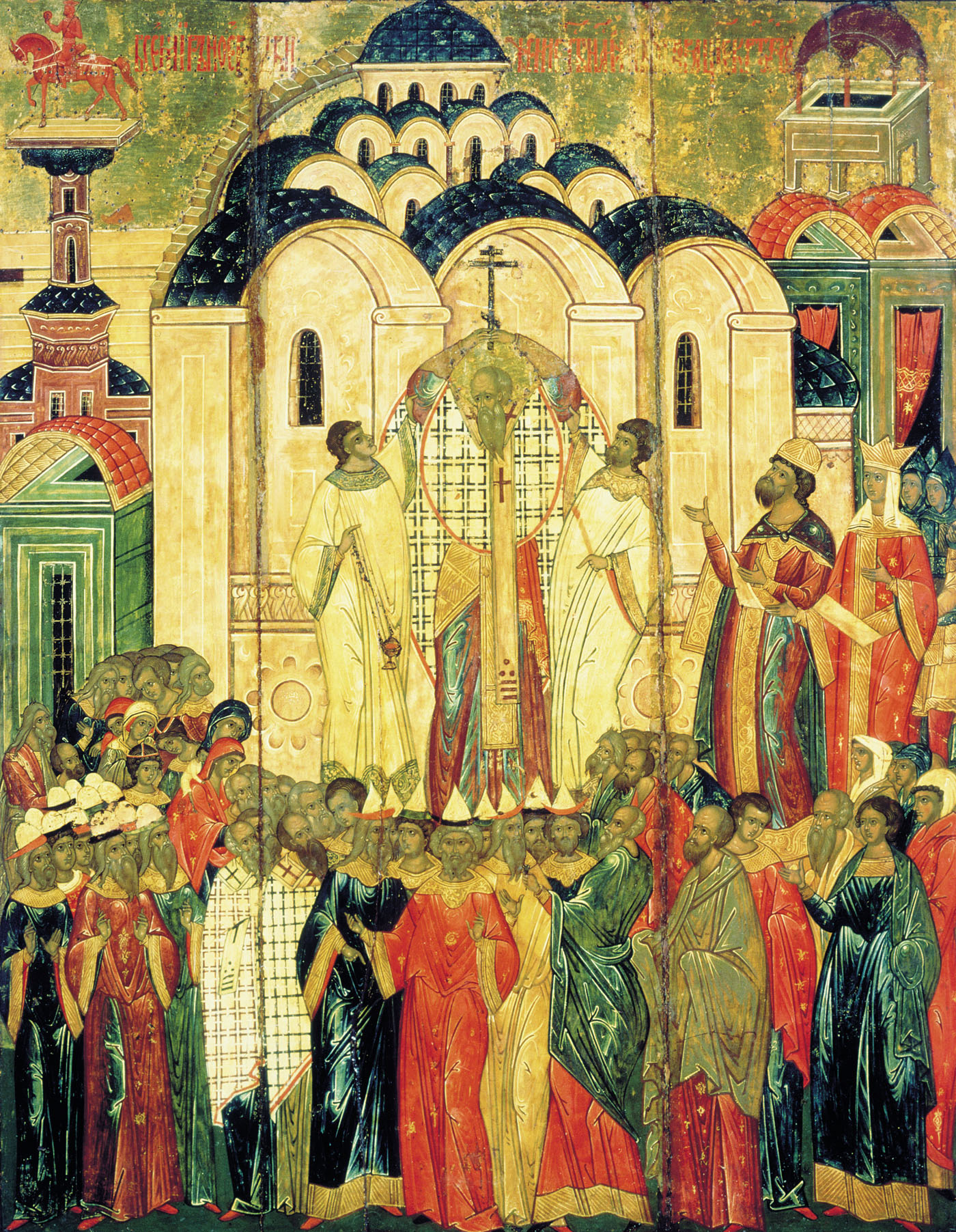
The Elevation of the Precious Cross of Christ (http://www.belygorod.ru/img2/Ikona/Used/232Vozdvijenie_krestaXVIGTG.jpg)

On the Holy Cross, attributed to St. John Chrysostom
Let us consider of what great blessings for us Christ's Cross has become the cause. For though the Lord's Cross sounds sad and bitter, it is in reality full of joy and radiance. For the Cross is the salvation of the Church; the Cross is the boast of those who hope in it; the Cross is reconciliation of enemies to God and conversion of sinners to Christ. For through the Cross we have been delivered from enmity, and through the Cross we have been joined in friendship to God. Through the Cross we have been freed from the tyranny of the devil, and through the Cross we have been delivered from death and destruction. 'When the Cross was not proclaimed, we were held fast by death; now the, Cross is proclaimed, and we have. come to despise death, as though it did not exist, while we have come to long for everlasting life. 'When the Cross was not proclaimed, we were strangers to paradise; but when the Cross appeared, at once a thief was found worthy of paradise. From such darkness the human race has crossed over to infinite light; from death it has been called to everlasting life, from corruption it has been renewed for incorruption. For the eyes of the heart are no longer covered by the darkness that comes through ignorance, but through the Cross they are flooded with the light of knowledge. The ears of the deaf are no longer shut by unbelief, for the deaf have heard the word of the Lord, and the blind have recovered their sight to see the glory of God. These are the gifts we are given through the Cross. What blessing has not been achieved for us through the Cross?
The Cross is proclaimed, and faith in God is confessed and truth prevails in the whole inhabited world. The Cross is proclaimed, and martyrs are revealed and confession of Christ prevails. The Cross is proclaimed, and the resurrection is revealed, life is made manifest, the kingdom of heaven is assured. The Cross has become the cause of all these things, and through the Cross we have been taught to sing. What then is more precious than the Cross? What more profitable for our souls? So let us not be ashamed to name the Cross, but let us confess it with total confidence.
Christ is hung upon the Cross, and the devil has become a corpse. Christ has been stretched on the Cross, and a standard of salvation has been given to the world. Christ has been nailed to the Cross, and every soul has been released from bonds. Christ has been fixed to the Cross, and all creation has been set free from the slavery of corruption. Christ has breathed his last on the Cross, and a new marvel has been shown to the world; for the sun's light is darkened. This what a prophetic saying cries out, "And it shall come to pass in that day, says the Lord, that the sun will set at midday, and the light will become dark in the daytime, and I will change all your feasts into grief and all your songs into laments" [Amos 8:9]. Do you see, beloved, how great a mystery the prophetic saying holds? For here the deeds of both are intimated: I mean of the Jews, who are under the law, and of the nations, who are outside the law, who both practice iniquity. For those who feast according to the law will grieve as they celebrate their feasts, and instead of songs, they make lamentations over Jerusalem. For Jerusalem will no longer hold solemn rites, and no feast will be celebrated in it. While pagan nations will mourn, making confession for their sins, and mourning is cause of blessedness. For scripture says, "Blessed are those who mourn, for they will be comforted" [Matthew 5:4]. They will mourn, then, over their empty feasts and lawless songs that they performed for the unclean demons. Take note then today how a pagan, repenting for the evil things he has done, laments and says with the prophet, "We have erred and strayed in our shame, and our sins have covered us, for we have been filled with our impiety. We have acknowledged the iniquities of our fathers". So then let us too lament and mourn for the evils that have been laid to our charge; let us cling to the Cross, placing all our hopes on the Cross, so that taught through the Cross, fixing our thought on heaven, being brought close to Christ our Saviour, we may be found worthy to be near God in the kingdom of heaven, in Christ our Lord himself, to whom be glory and might to the ages of ages. Amen.
Translation of text by permission of copyright © of the Very Rev. Archimandrite of the Oecumenical Throne Ephrem Lash. www.anastasis.org.uk. This appeared originally in Light of Christ, Newsletter of the Orthodox Church of St. John the Baptist and St. Anthony, London. (http://www.orthodox-christian-comment.co.uk/properofseason-exaltation_of_the_holy_cross.htm)

Through the prayers of our Holy Fathers, Lord Jesus Christ our God, have mercy on us and save us! Amen!

Sunday, September 11, 2011

Greek philosophers foreshadowing Christ

Jesus Christ: "This is the King of Glory", along with St. Paul the Apostle, and St. Justin the Martyr and Philosopher (https://picasaweb.google.com/118177000525429425765/IIcpoB?authkey=Gv1sRgCNLM1Jm-noCQtwE#5647155839515995266)

As outlined by numerous Fathers of the Church, Christ was the expectation of all the nations, and as such, many of the writings from disperate cultures throughout the world tell of and indicate the great Redeemer of the whole world Who was to come: Jesus Christ.

Many of the philosophers of ancient Greece seem to point towards Christ in their writings, and thus many Greeks were primed, in a certain sense, to accept the teachings of Christ's apostles. The picture above is part of a series of icons from the Great Meteora Monastery that depict St. Paul and St. Justin the Philosopher leading Greeks to Christ while citing Greek Philosophy. On either side are depicted many ancient Greek philosophers, and quotes from their writings that seem to point to Christ. (It is worth noting that they put a small fence around these icons, most likely that they might not be venerated like icons of the Saints.)

These are newly-painted icons, but they are by no means out of tradition. The "Hermenia" or Painter's Manual by Monk Dionysios of Fourna mentions the names, descriptions and quotes of such philosophers. The Monasteries of Megiste Lavra and Vatopedi on Mount Athos (as examples) also have depictions of such philosophers.

We can see vividly how God works to lead all nations to the Truth. Though their examples pale in comparison to the love, grace and sacrifice of Christ and His Saints, these philosophers help us understand the human condition, and how our longing can only be satiated by Christ.

The following Greek quotes from the depicted philosophers are from http://enaskitis.blogspot.com/2011/09/blog-post.html, along with my own amateur translations. If you have any suggestions for better translations, or can provide a documented translation or a citation from the philosophers' original writings, please share.

,

“Η Έλληνίς Σίβυλλα η φιλόσοφος” : “Ήξει ουρανόθεν βασιλεύς αιώνων ο μέλλων κρίναι πάσαν σάρκα και κόσμον άπαντα”.
The Greek Sybil, the Philosopher: "The eternal king has come from heaven, who will judge all flesh and the whole world."

For more on the Sybil of Erythrae foreshadowing Christ, see: http://full-of-grace-and-truth.blogspot.com/2010/01/sibyl-of-erythrae-and-prophetic.html.

“Ο Έλλην Σόλων ο σοφός και νομοθέτης” : “Ήν δ’ αυτός τώι αυτοπάτορι απάτωρ τρισόλβιος ός [sic: ως] τι φως τριλαμπές ο δε παθών Θεός εστι και ου θεότης πάθεν όστις φως γαρ, βροτόσωμος αυτός Θεός ήδη και ανήρ πάντως φέρων εν θνητοίς”.
The Greek Solon, the Wise and Law-giver: "Being himself the fatherless father, thrice-praised and thrice-radiant as the light, it is God who suffers and not godhead which suffers, who therefore is light, this mortal-body is God, and man always bringing among mortals.

“Ο Έλλην Πυθαγόρας ο φιλόσοφος και μαθηματικός” : “Ο Θεός εστιν νους και λόγος και πνεύμα και λόγος [bis] σαρκωθείς εκ Πατρός”.
The Greek Pythagoras, the Philosopher and Mathematician: "God is nous and word and spirit and word incarnate from the Father."

“O Έλλην Σωκράτης ο φιλόσοφος” : “Και το όνομα αυτού αυξηθήσεται και τιμηθήσεται υπό πάντων εφ’ όλην την οικουμένην”.
The Greek Socrates the Philosopher: "And his name will be increased and honored by all throughout the world."


“Ο Έλλην Απολλώνιος ο φιλόσοφος” : “Ένα Θεόν ύψιστον εν τρισίν λέγω, ός ουρανόν έρξεν άμα και χθόνα, Θεός ήν μεν αεί και εστίν και έσται ούτε αρξάμενος, ούτε παυσόμενος”.
The Greek Apollon, the Philosopher: "I speak of one God exalted in three, who created heaven and earth, God ever was and is and will be, neither changed, nor ceasing."

“Ο Έλλην Όμηρος ο ποιητής” : “Ήξει προς ημάς οψέ γης άναξ απλούς και σάρκα φανείται δίχα τινός σφάλματος”.
The Greek Homer, the Poet: "He came towards us, later on earth, simple in beginning, and appears in flesh without any error."

“Ο Έλλην Θουκυδίδης ο ιστορικός” : “Ου Θεός έτερος ουκ άγγελος ου δαίμων ου σοφία ουκ ουσία αλλ’ ή μόνος Κύριός εστι δημιουργός τού παντός τών απάντων παντέλειος Λόγος”
The Greek Thucydides, the Historian: "Not another God, nor angel, nor demon, nor wisom, nor any thing else in essence, but the Lord alone is creator of all, the all-perfect Word of all things."

“Ο Έλλην Αριστοτέλης ο φιλόσοφος” : “Οψέποτέ τις επί την πολυσχεδή ταύτην ελάσειεν επί [bis] γην δίχα σφάλματος γενήσεται σαρξ ακάματος φύσει Θεός γέννησις εξ αυτού γαρ ο αυτός ουσιούται Λόγος”.
The Greek Aristotle, the Philosopher: "Never before among the many on earth was seen one without error, he will be born flesh from the ceaseless nature of God, and from him is born the essential Word."
“Ο Έλλην Πλάτων ο φιλόσοφος” : “Εκ μητρονύμφου παναμώμου παρθένου μέλλει σπαρήναι του Θεού μόνος γόνος. Άσαρκον, σαρκικόν και γεννητόν εν γήι τέτοκεν τον ουρανού και γης ποιητήν”.
The Greek Plato, the Philosopher: "From the all-pure virgin mother-bride will be born the sole child of God. The fleshless one becomes flesh and is born on earth, he who is the creator of heaven and earth."

“Ο Έλλην Πλούταρχος, ο πατήρ της ιστορίας”: “Καταγγέλλω εν τρισίν ένα μόνον υψιμέδοντα Θεόν, ού λόγος άφθιτος εν αδαεί κόρηι έγκυμος έσεται [sic]. Ούτος γαρ ως τόξον πυρφόρον ίσος διαδραμείται και κόσμον άπαντα ζωγρήσει και τώι Πατρί προσάξει δώρον”.
The Greek Plutarch, the father of histories: "I proclaim in three one sole exalted-ruler God, the endless word within an innocent pregnant girl. For as a fire-bearing bow he spans, and gives life to all the world, and is offered as a gift to the Father."

St. Justin the Martyr and Philosopher, along with Homer the Historian (http://enaskitis.blogspot.com/2011/09/blog-post.html)

Through the prayers of our Holy Fathers, Lord Jesus Christ our God, have mercy on us and save us! Amen!