Tuesday, November 22, 2011

St. Sophia the Righteous, the "Ascetic of the Panagia"

St. Sophia the Righteous, the "Ascetic of the Panagia" - Commemorated on May 6th (http://anavaseis.blogspot.com/2011/11/blog-post_9443.html)
  
Elder Sophia to be officially numbered among the Saints
The Holy Metropolis of Kastorias is deeply moved to inform the fulness of our Holy Metropolis that bears the name of Christ, along with all the inhabitants of Western Macedonia, that the Ecumenical Patriarchate, led by our Ecumenical Patriarch Bartholomew, along with the Holy Synod, has recorded and numbered among the Saints of our Orthodox Church, the Ascetic of the Holy Monastery of Panagia Kleisouras, the Eldress Sophia.

Thus from now and to all the ages, she who "fought the good fight" invisibly in the Monastery of Panagia, Sophia the Ascetic, will be honored as a Saint and will be praised in hymns and spiritual odes from the faithful, especially on the 6th of May, the day of her dormition.

For this reason, on November 27th 2011, in the Holy Monastery of Panagia Kleisouras, during the Orthros before the Divine Liturgy, will the relics of the Righteous Sophia be put forth for the veneration and blessing of all. The Metropolitans Paul of Drama and Seraphim of Kastoria will take part.
(amateur translation of text from: http://anavaseis.blogspot.com/2011/11/blog-post_9443.html)
  
Bishops and other clergy celebrating a memorial service for the Righteous Sophia before her holy relics earlier this year (http://www.imkastorias.gr/newsflashes/ekdeloseis/to-mnemosuno-tes-asketrias-sophias-sten-kleisoura-maiou-2011.html)
  
Life of the Saint
Sophia Saoulidi, the "ascetic of the Panagia", was born of Amanatiou and Maria Saoulidi in a village of Trebizond in Pontus of Asia Minor in 1883. She was also married there years later in 1907 to Jordan Hortokoridou, but after seven years her husband disappeared (likely not of his own will) in 1914 and she was left with a newborn son who soon thereafter died. These tragedies helped shape her piety and repentant spirit, making her rely solely upon God. Her asceticism began in Pontus on a mountain away from her relatives. It was there that one day Saint George appeared to her and warned her to notify the villagers of a coming persecution and to flee, and in this way she saved the village.

Her soul breathed Christ and the Panagia with her simple and humble love. "One is the Lord and one is the Lady", she would say of Christ and the Panagia, "the rest of us are all siblings."

She was a teacher of the simple, especially of women, and every word that came from her lips was spoken with humility and love. As with many "fools for Christ" of the past, the proud and the educated didn't recognize her worth as much as those who possessed simple and humble hearts.

She came to Greece in 1919 as an exile. The name of the ship that carried her was Saint Nicholas, so when they arrived in Greece the Panagia appeared to her and said: "Come to my house." Sophia asked: "Where are you and where is your house?" The Panagia responded: "I am in Kleisoura." Therefore she went and settled at the Monastery of the Birth of the Theotokos in Kleisoura of Kastoria when she was 44 years old. There the abbot of the Monastery was Gregorios Magdalis, an Athonite of great virtue. Sophia learned much from him and always spoke his name with the highest respect.

By the command of the Panagia, Sophia lived within the fireplace of the Monastery in the kitchen, which was also used to cook the food. She would sleep there two hours a night and the rest of the night pray on her knees. In the winter it was especially cold there, while during the rain water would drip on her. At times she would light a little fire, but this did not help much. At the window she would always have a candle lit before the fresco of the Panagia. This is where she ate and spent her time, and when visitors came to see her she would say their names before they even introduced themselves to her. People came from Thessaloniki and the surrounding areas, even as far as from Athens, just to see her. She would tell people their names and their family problems without being told beforehand. Among those who came was Fr. Leonidas Paraskevopoulos, who later became Metropolitan, and he would say: "You have a great treasure up there".

She dressed poorly and had a blanket with holes. Her sandals had holes also. Visitors would see how she suffered in the cold and humidity and give her clothes, but she would take them with one hand and give them away to the poor with the other. She also always wore a black scarf, and since her days in Pontus never bathed. Her fasting was constant and only allowed herself oil on the weekends. She cared little for what she ate, eating only to survive, and cared less about cleanliness so that she would even eat food without washing them. And despite the germs and the worms, she always remained healthy.

Visitors would often give her money, which she would hide anywhere she could. And when someone had need, she would go and give the money immediately.

She saw many scandalous things done by priests and lay people, but never criticized anyone. "Cover things, so that God will cover you", she would say.

Her popularity arose rapidly, so that people came not only from all over Greece, but even places like France and Israel to see her. Some villagers made fun of her however, calling her "Crazy-Sophia". To many she looked like Saint Mary of Egypt, as thin as a bone and all dried up. Within however she contained the same beauty of Saint Mary.

  
Wondrous Events
Her love for God and humanity was powerful and she had impressive experiences with the Panagia and various Saints.

As the ship carried the passengers from Asia Minor to Greece in 1919 a storm hit that put the passengers at great risk. Eventually the storm ceased and everyone survived, but the captain said after making the sign of the cross: "You must have a righteous person among you that saved you", and everyone looked at Sophia who was standing at the corner of the ship the entire journey praying. This incident actually exists on videotape, where she herself recounts what happened:

"The waves were filled with angels and the Panagia appeared, saying, 'Humanity will be lost, because they are very sinful.' And I said: 'Panagia, let me be lost because I am a sinner, so let the world be saved.'"

In 1967 Sophia became very sick and was in great pain. Her stomach had open sores that smelled. She took the pain courageously, saying: "The Panagia will come to take away my pain. She promised me." Some Athenians have her on videotape explaining what happened soon thereafter:

"The Panagia came with the Archangel Gabriel and Saint George, as well as other Saints. The Archangel said: 'We will cut you now'. I said: 'I am a sinner, I must confess, receive communion, then you can cut me'. 'You will not die', he said, 'we are doing a surgery on you', and he cut me open."

As with many Saints, she had a special relationship with wild animals, especially with bears in the forest, but also with snakes and birds.
   
St. Sophia of Kleisoura (source)
   
New and Old Calendar
From the time when the Ecclesiastical Calendar changed in Greece, Sophia would keep the fasts of both the Old and New Calendar so as not to be an offense to anyone.

Unfortunately there is a tendency among Old Calendarists to distort facts and consider her one of their own, but this does not conform to reality as she was always in communion with the Church.

Spiritual Sayings
"The fear of God makes a person wise. What is the fear of God? Not that one should be afraid of God, but to be afraid to sadden someone, to harm someone, to do them no wrong, and to not make accusations. This is wisdom. After all this, God will illumine you as to what to do in your life."

"Look for and find the poor and gather them and help them. This is what God wants, and not to go to church as if to pray."

"Almsgiving should be in secret, for God alone to know."

"Oh, if you only knew what happened to the Lord on Wednesday and Friday, you would put nothing in your mouth. Neither bread, nor oil. Do not break the fast of Wednesday and Friday."

"The angels speak every day. God sends the angels to see if people are repenting."

"The Panagia weeps, she weeps every day. She says to her Son: 'My Son and my God, grant the world wisdom, forgive the world.'"

"Let the mouth become basil and a rose."
 
The official document of the canonization of St. Sophia, signed by Patriarch Bartholomew and the members of the Holy Synod of the Patriarchate at that time (source)
 
Views Of Her Sainthood
In 2009 the Metropolis of Kastoria organized the discussion of the topic "The Saints Honored In Kastoria". Much was discussed of the Eldress' life, and Metropolitan Seraphim of Kastoria gave his own opinion which reflected the opinions of those in the local church of Kastoria, that she was a saint, that hymns had been written and an icon painted of her, and the necessary official requirements for Glorification would be submitted to the Ecumenical Patriarchate.

The Monastery of the Nativity of the Theotokos, Kleisoura (http://www.panoramio.com/photo/33060508)
  
The Holy Monastery of Kleisouras
The Monastery of the Birth of the Theotokos is 35 kilometers from Kastoria and 70 kilometers from Florina. It was founded around 1314 by the Hieromonk Neophytos of Kleisoura and once again established in 1813 by Hieromonk Isaiah Pista of Kleisoura who came from Iveron Monastery on Mount Athos after a vision of the Panagia.

During the Liberation War of Macedonia the Monastery gave hospitality to many of the Macedonian fighters, among whom was Pavlos Melas. When the Turks burned down the neighboring village of Variko in 1903 the residents fled to this Monastery for safety. Until 1993 the Monastery was not an organized coenobitic community, and it was during these years that Eldress Sophia lived here in asceticism from the time she left Pontus until she died in her old age. Since 1993 the Monastery serves as a female coenobitic convent and has an aim to "resurrect" it as a center of worship in Western Macedonia.

Eldress Sophia fell asleep in the Lord on May 6, 1974 and was buried on the grounds of the Monastery. She was well-known in Western Macedonia, and many who knew her come to pray at her tomb. Her relics are kept in the Monastery, and upon request to the nuns can be venerated by the faithful.

The current abbess is Anisia Egglezou and the Monastery has six nuns and one novice. The address is Κλεισούρα, Τ.Κ. 52054 and the telephone number is 24670 - 94330.
(http://www.johnsanidopoulos.com/2010/06/eldress-sophia-ascetic-of-panagia.html)
  

Apolytikion in the Third Tone (amateur translations below)
O blessed mother Sophia, you became wise, and the adornment of the Mother of God, and you lived your life in the Monastery ascetically, from which have spread the praise of your struggles, striking the ranks of the demons. And as you stand as an intercessor before Christ, do not neglect those who honor you with fervor.

Kontakion in the Fourth Tone
You became a treasury of Divine wisdom and all-consuming fear [of God], O mother Sophia, through your motherly intercessions, O blessed one, you offer to all the richness of grace.

Megalynarion
Being made spiritually wise, O mother, you passed the whole of your life in utter patience, and now you are made to dwell in the beauty of your Bridegroom, in His bridal chamber.
  
St. Sophia of Kleisoura (source)
  
Through the prayers of our Holy Fathers, Lord Jesus Christ our God, have mercy on us and save us! Amen!

Saturday, November 19, 2011

St. Ambrose of Milan on the Virtues of the Theotokos

The Entrance of the Most-Holy Theotokos to the Temple (http://pravicon.com/images/icon/0051/0051006.jpg)
  
St. Ambrose of Milan on the Virtues of the Theotokos
6. Let, then, the life of Mary be as it were virginity itself, set forth in a likeness, from which, as from a mirror, the appearance of chastity and the form of virtue is reflected. From this you may take your pattern of life, showing, as an example, the clear rules of virtue: what you have to correct, to effect, and to hold fast.

7. The first thing which kindles ardour in learning is the greatness of the teacher. What is greater than the Mother of God? What more glorious than she whom Glory Itself chose? What more chaste than she who bore a body without contact with another body? For why should I speak of her other virtues? She was a virgin not only in body but also in mind, who stained the sincerity of its disposition by no guile, who was humble in heart, grave in speech, prudent in mind, sparing of words, studious in reading, resting her hope not on uncertain riches, but on the prayer of the poor, intent on work, modest in discourse; wont to seek not man but God as the judge of her thoughts, to injure no one, to have goodwill towards all, to rise up before her elders, not to envy her equals, to avoid boastfulness, to follow reason, to love virtue. When did she pain her parents even by a look? When did she disagree with her neighbours? When did she despise the lowly? When did she avoid the needy? Being wont only to go to such gatherings of men as mercy would not blush at, nor modesty pass by. There was nothing gloomy in her eyes, nothing forward in her words, nothing unseemly in her acts, there was not a silly movement, nor unrestrained step, nor was her voice petulant, that the very appearance of her outward being might be the image of her soul, the representation of what is approved. For a well-ordered house ought to be recognized on the very threshold, and should show at the very first entrance that no darkness is hidden within, as our soul hindered by no restraints of the body may shine abroad like a lamp placed within.

8. Why should I detail her spareness of food, her abundance of services—the one abounding beyond nature, the other almost insufficient for nature? And there were no seasons of slackness, but days of fasting, one upon the other. And if ever the desire for refreshment came, her food was generally what came to hand, taken to keep off death, not to minister to comfort. Necessity before inclination caused her to sleep, and yet when her body was sleeping her soul was awake, and often in sleep either went again through what had been read, or went on with what had been interrupted by sleep, or carried out what had been designed, or foresaw what was to be carried out.

9. She was unaccustomed to go from home, except for divine service, and this with parents or kinsfolk. Busy in private at home, accompanied by others abroad, yet with no better guardian than herself, as she, inspiring respect by her gait and address, progressed not so much by the motion of her feet as by step upon step of virtue. But though the Virgin had other persons who were protectors of her body, she alone guarded her character; she can learn many points if she be her own teacher, who possesses the perfection of all virtues, for whatever she did is a lesson. Mary attended to everything as though she were warned by many, and fulfilled every obligation of virtue as though she were teaching rather than learning.

10. Such has the Evangelist shown her, such did the angel find her, such did the Holy Spirit choose her. Why delay about details? How her parents loved her, strangers praised her, how worthy she was that the Son of God should be born of her. She, when the angel entered, was found at home in privacy, without a companion, that no one might interrupt her attention or disturb her; and she did not desire any women as companions, who had the companionship of good thoughts. Moreover, she seemed to herself to be less alone when she was alone. For how should she be alone, who had with her so many books, so many archangels, so many prophets?

11. And so, too, when Gabriel visited her, (Luke i. 28.) did he find her, and Mary trembled, being disturbed, as though at the form of a man, but on hearing his name recognized him as one not unknown to her. And so she was a stranger as to men, but not as to the angel; that we might know that her ears were modest and her eyes bashful. Then when saluted she kept silence, and when addressed she answered, and she whose feelings were first troubled afterwards promised obedience.

12. And holy Scripture points out how modest she was towards her neighbours. For she became more humble when she knew herself to be chosen of God, and went forthwith to her kinswoman in the hill country, not in order to gain belief by anything external, for she had believed the word of God. “Blessed,” she said, “art thou who didst believe.” (Luke i. 56). And she abode with her three months. Now in such an interval of time it is not that faith is being sought for, but kindness which is being shown. And this was after that the child, leaping in his mother’s womb, had saluted the mother of the Lord, attaining to reason before birth.

13. And then, in the many subsequent wonders, when the barren bore a son, the virgin conceived, the dumb spake, the wise men worshipped, Simeon waited, the stars gave notice. Mary, who was moved by the angel’s entrance, was unmoved by the miracles. “Mary,” it is said, “kept all these things in her heart.” (Luke ii. 19). Though she was the mother of the Lord, yet she desired to learn the precepts of the Lord, and she who brought forth God, yet desired to know God.

14. And then, how she also went every year to Jerusalem at the solemn day of the passover, and went with Joseph. Everywhere is modesty the companion of her singular virtues in the Virgin. This, without which virginity cannot exist, must be the inseparable companion of virginity. And so Mary did not go even to the temple without the guardianship of her modesty.

15. This is the likeness of virginity. For Mary was such that her example alone is a lesson for all. If, then, the author displeases us not, let us make trial of the production, that whoever desires its reward for herself may imitate the pattern. How many kinds of virtues shine forth in one Virgin! The secret of modesty, the banner of faith, the service of devotion, the Virgin within the house, the companion for the ministry, the mother at the temple.

16. Oh! how many virgins shall she meet, how many shall she embrace and bring to the Lord, and say: “She has been faithful to her espousal, to my Son; she has kept her bridal couch with spotless modesty.” How shall the Lord Himself commend them to His Father, repeating again those words of His: “Holy Father, these are they whom I have kept for Thee, on whom the Son of Man leant His head and rested; I ask that where I am there they may be with Me.” (John xvii. 24). And if they ought to benefit not themselves only, who lived not for themselves alone, one virgin may redeem her parents, another her brothers. “Holy Father, the world hath not known Me, but these have known Me, and have willed not to know the world.” (John xvii. 25).

17. What a procession shall that be, what joy of applauding angels when she is found worthy of dwelling in heaven who lived on earth a heavenly life! Then too Mary, taking her timbrel, shall stir up the choirs of virgins, singing to the Lord because they have passed through the sea of this world without suffering from the waves of this world. (Ex. xv. 20). Then each shall rejoice, saying: “I will go to the altar of God; to God Who maketh my youth glad;” (Ps. xliii. [xlii.] 4). and, “I will offer unto God thanksgiving, and pay my vows unto the Most High.” (Ps. l. [xlix.] 14).

18. Nor would I hesitate to admit you to the altars of God, whose souls I would without hesitation call altars, on which Christ is daily offered for the redemption of the body. For if the virgin’s body be a temple of God, what is her soul, which, the ashes, as it were, of the body being shaken off, once more uncovered by the hand of the Eternal Priest, exhales the vapour of the divine fire. Blessed virgins, who emit a fragrance through divine grace as gardens do through flowers, temples through religion, altars through the priest.
(Note: hosted by a non-Orthodox site: http://www.ccel.org/ccel/schaff/npnf210.iv.vii.iii.ii.html)
  
The Most-Holy Theotokos: "All creation rejoices in thee..." (http://pravicon.com/images/icon/0219/0219001.jpg)
  
Through the prayers of our Holy Fathers, Lord Jesus Christ our God, have mercy on us and save us! Amen!

Sunday, November 13, 2011

"Concerning Lowliness of Mind" by St. John Chrysostom


"Concerning Lowliness of Mind" by St. John Chrysostom
1. When lately we made mention of the Pharisee and the publican, and hypothetically yoked two chariots out of virtue and vice; we pointed out each truth, how great is the gain of humbleness of mind, and how great the damage of pride. For this, even when conjoined with righteousness and fastings and tithes, fell behind; while that, even when yoked with sin, out-stripped the Pharisee's pair, even although the charioteer it had was a poor one. For what was worse than the publican? But all the same since he made his soul contrite, and called himself a sinner; which indeed he was; he surpassed the Pharisee, who had both fastings to tell of and tithes; and was removed from any vice. On account of what, and through what? Because even if he was removed from greed of gain and robbery, he had rooted over his soul the mother of all evils— vain-glory and pride. On this account Paul also exhorts and says “Let each one prove his own work; and then he will have his ground of boasting for himself, and not for the other.” Whereas he publicly came forward as an accuser of the whole world; and said that he himself was better than all living men. And yet even if he had set himself before ten only, or if five, or if two, or if one, not even was this endurable; but as it was, he not only set himself before the whole world, but also accused all men. On this account he fell behind in the running. And just as a ship, after having run through innumerable surges, and having escaped many storms, then in the very mouth of the harbour having been dashed against some rock, loses the whole treasure which is stowed away in her— so truly did this Pharisee, after having undergone the labours of the fasting, and of all the rest of his virtue, since he did not master his tongue, in the very harbour underwent shipwreck of his cargo. For the going home from prayer, whence he ought to have derived gain, having rather been so greatly damaged, is nothing else than undergoing shipwreck in harbour.

2. Knowing therefore these things, beloved even if we should have mounted to the very pinnacle of virtue, let us consider ourselves last of all; having learned that pride is able to cast down even from the heavens themselves him who takes not heed, and humbleness of mind to bear up on high from the very abyss of sins him who knows how to be sober. For this it was that placed the publican before the Pharisee; whereas that, pride I mean and an overweening spirit, surpassed even an incorporeal power, that of the devil; while humbleness of mind and the acknowledgment of his own sins committed brought the robber into Paradise before the Apostles. Now if the confidence which they who confess their own sins effect for themselves is so great, they who are conscious to themselves of many good qualities, yet humble their own souls, how great crowns will they not win. For when sinfulness be put together with humbleness of mind it runs with such ease as to pass and out-strip righteousness combined with pride. If therefore thou have put it to with righteousness, whither will it not reach? Through how many heavens will it not pass? By the throne of God itself surely it will stay its course; in the midst of the angels, with much confidence. On the other hand if pride, having been yoked with righteousness, by the excess and weight of its own wickedness had strength enough to drag down its confidence; if it be put together with sinfulness, into how deep a hell will it not be able to precipitate him who has it? These things I say, not in order that we should be careless of righteousness, but that we should avoid pride; not that we should sin, but that we should be sober-minded. For humbleness of mind is the foundation of the love of wisdom which pertains to us. Even if you should have built a superstructure of things innumerable; even if almsgiving, even if prayers, even if fastings, even if all virtue; unless this have first been laid as a foundation, all will be built upon it to no purpose and in vain; and it will fall down easily, like that building which had been placed on the sand. For there is no one, no one of our good deeds, which does not need this; there is no one which separate from this will be able to stand. But even if you should mention temperance, even if virginity, even if despising of money, even if anything whatever, all are unclean and accursed and loathsome, humbleness of mind being absent. Everywhere therefore let us take her with us, in words, in deeds, in thoughts, and with this let us build these (graces).

3. But the things belonging to humbleness of mind have been sufficiently spoken of; not for the value of the virtue; for no one will be able to celebrate it in accordance with its value; but for the intelligence of your love. For well do I know that even from the few things that have been said you will embrace it with much zeal. But since it is also necessary to make clear and manifest the apostolic saying which has been today read; seeming as it does to many to afford a pretext for indolence; so that some may not, providing for themselves hence a certain frigid defence, neglect their own salvation— to this let us direct our discourse. What then is this saying? “Whether in pretence,” it says, “or in sincerity, Christ is preached.” (Philippians 1:18) This many wrest absolutely and just as happens, without reading what precedes and what comes after it; but having cut it off from the sequence of the remaining members, to the destruction of their own soul they put it forward to the more indolent. For attempting to seduce them from the sound faith; then seeing them afraid and trembling; on the ground of its not being without danger to do this, and desiring to relieve their fears, they bring forward this apostolic declaration, saying, Paul conceded this, by saying, “Whether in pretence or in sincerity, let Christ be proclaimed.” But these things are not (true), they are not. For in the first place he did not say “let him be proclaimed,” but “he is proclaimed,” and the difference between this and that is wide. For the saying “let him be proclaimed” belongs to a lawgiver; but the saying “he is proclaimed” to one announcing the event. For that Paul does not ordain a law that there should be heresies, but draws away all who attended to him, hear what he says, “If any one preaches to you a gospel besides what you have received, let him be anathema, were it even I, were it even an angel from the heavens.” (Galatians 1:8-9) Now he would not have anathematized both himself and an angel, if he had known the act to be without danger. And again— “I am jealous of you with a jealousy of God,” he says; “for I have betrothed you to one husband a chaste virgin: and fear lest at some time, as the serpent beguiled Eve by his wiliness, so your thoughts should be corrupted from the singleness that is towards Christ.” See, he both set down singleness, and granted no allowance. For if there were allowance, there was no danger: and if there was no danger Paul would not have feared: and Christ would not also have commanded that the tares should be burned up, if it were a thing indifferent to attend to this one or that or another: or to all indiscriminately.

4. What ever then is what is meant? I wish to narrate to you the whole history from a point a little earlier; for it is needful to know in what circumstances Paul was when he was writing these things by letter. In what circumstances therefore was he? In prison and chains and intolerable perils. Whence is this manifest? From the epistle itself. For earlier than this he says, “Now I wish you to know, brethren, that the circumstances in which I am have come rather to the furtherance of the Gospel; so that my bonds have become manifest in Christ in the whole Court, and to all the others; and a good many of the brethren, trusting to my bonds, the more exceedingly dare fearlessly to speak the word.” (Philippians 1:12-14) Now Nero had then cast him into prison. For just as some robber having set foot in the house, while all are sleeping, when stealing every thing, if he see any one having lit a lamp, both extinguishes the light and slays him who holds the lamp, in order that he may be allowed in security to steal and rob the property of others; so truly also the Cæsar Nero then, just as any robber and burglar while all were sleeping a deep and unconscious slumber; robbing the property of all, breaking into marriage chambers, subverting houses, displaying every form of wickedness; when he saw Paul having lighted a lamp throughout the world; (the word of his teaching;) and reproving his wickedness, exerted himself both to extinguish what was preached, and to put the teachers out of the way; in order that he might be allowed with authority to do anything he pleased; and after binding that holy man, cast him into prison. It was at that time then that the blessed Paul wrote these things. Who would not have been astounded? Who would not have marvelled? Or rather who could adequately have been astounded at and admired that noble and heaven-reaching soul; in that, while bound in Rome and imprisoned, at so great a distance as that, he wrote a letter to the Philippians? For you know how great is the distance between Macedonia and Rome. But neither did the length of the way, nor the amount of time (required), nor the press of business, nor the peril and the dangers coming one upon another, nor anything else, drive out his love for and remembrance of the disciples; but he retained them all in his mind; and not so strongly were his hands bound with the chains as his soul was bound together and rivetted by his longing for the disciples: which very thing itself indeed also declaring, in the preface of the Epistle he said, “On account of my having you in my heart, both in my bonds, and in the defence and confirmation of the Gospel.” (Philippians 1:7) And just as a King, having ascended upon his throne at morning-tide and taken his seat in the royal courts, immediately receives from all quarters innumerable letters; so truly he also, just as in royal courts, seated in the dungeon, both received and sent his letters in far greater number; the nations from all quarters referring to his wisdom everything about what had taken place among themselves; and he administered more business than the reigning monarch in proportion to his having had a larger dominion entrusted to him. For in truth God had brought and put into his hands not those who inhabited the country of the Romans only, but also all the barbarians, both land and sea. And by way of showing this he said to the Romans, “Now I would not that you should be ignorant, brethren, that ofttimes I have purposed to come to you, and have been hindered until the present; in order that I might have some fruit also among you, as among the rest of the Gentiles too. Both to Greeks and barbarians, both to wise and those without understanding I am a debtor.” (Romans 1:13-14) Every day therefore he was in anxious thought at one moment for Corinthians, at another for Macedonians; how Philippians, how Cappadocians, how Galatians, how Athenians, how they who inhabited Pontus, how all together were. But all the same, having had the whole world put into his hands, he continually cared not for entire nations only, but also for each single man; and now indeed he dispatched a letter on behalf of Onesimus, and now on behalf of him who among the Corinthians had committed fornication. For neither used he to regard this— that it was the individual who had sinned and needed advocacy; but that it was a human being; a human being, the living thing most precious to God; and for whose sake the Father had not spared even the Only-begotten.

5. For do not tell me that this or that man is a runaway slave, or a robber or thief, or laden with countless faults, or that he is a mendicant and abject, or of low value and worthy of no account; but consider that for his sake the Christ died; and this suffices you for a ground for all solicitude. Consider what sort of person he must be, whom Christ valued at so high a price as not to have spared even his own blood. For neither, if a king had chosen to sacrifice himself on any one's behalf, should we have sought out another demonstration of his being some one great and of deep interest to the King— I fancy not— for his death would suffice to show the love of him who had died towards him. But as it is not man, not angel, not archangel; but the Lord of the heavens himself, the only-begotten Son of God himself having clothed himself with flesh, freely gave himself on our behalf. Shall we not do everything, and take every trouble, so that the men who have been thus valued may enjoy every solicitude at our hands? And what kind of defence shall we have? What allowance? This at least is the very thing by way of declaring which Paul also said, “Do not by your meat destroy him for whose sake Christ died.” (Romans 14:15) For desiring to shame, and to bring to solicitude, and to persuade to care for their neighbours, those who despise their brethren, and look down upon them as being weak, instead of all else he set down the Master's death.


Sitting then in the prison he wrote the letter to the Philippians from that so great distance. For such as this is the love that is according to God: it is interrupted by no one of human things, since it has its roots from above in the heavens and its recompense. And what says he? “Now I desire that you should know, brethren.” (Philippians 1:12) Do you see solicitude for his scholars? Do you see a teacher's carefulness? Hear too of loving affection of scholars towards their teacher, that you may know that this was what made them strong and unconquerable— the being bound together with one another. For if “Brother helped by brother is as a strong city;” far more so many bound together by the bonds of love would have entirely repulsed the plotting of the wicked demon. That indeed then Paul was bound up with the disciples, requires not even any demonstration further nor argument for us, since in truth even when in bonds he anxiously cared for them, and each day, he was also dying for them, burning with his longing.

6. And that the disciples too were bound up with Paul with all perfectness; and that not men only, but women also, hear what he says about Phœbe. “Now I commend to you Phœbe the sister, being a deaconess of the Church which is in Cenchreæ; that you may receive her in the Lord worthily of the saints, and stand by her, in whatever matter she may require you, since she has proved a helper of many; and of me myself.” (Romans 16:1-2) But in this instance he bore witness to her of her zeal so far as help went (only:) but Priscilla and Aquilla went as far even as death for Paul's sake; and about them he thus writes, saying, “Aquila and Priscilla salute you, who for my life's sake laid down their own neck;” (Romans 16:3-4) for death clearly. And about another again writing to these very persons he says, “Because he went as far as death; having counselled ill for his life, in order that he might supply your deficiency in your service towards me.” (Philippians 2:30) Do you see how they loved their teacher? How they regarded his rest before their own life? On this account no one surpassed them then. Now this I say, not that we may hear only, but that we may also imitate; and not to the ruled only, but also to those who rule is what we say addressed; in order that both scholars may display much solicitude about their teachers, and the teachers may have the same loving affection as Paul about those placed under them; not those present only, but also those who are far off. For also Paul, dwelling in the whole world just as in one house, thus continually took thought for the salvation of all; and having dismissed every thing of his own; bonds and troubles and stripes and straits, watched over and inquired into each day, in what state the affairs of the disciples were; and often for this very purpose alone sent, now Timothy, and now Tychicus; and about him he says, “That he may know your circumstances, and encourage your hearts:” (Ephesians 6:22) and about Timothy; “I have sent him, being no longer able to contain myself; lest in some way the tempter have tempted you.” (1 Thessalonians 3:5) And Titus again elsewhere, and another to another place. For since he himself, by the compulsion of his bonds being often detained in one place, was unable to meet those who were his vitals, he met them through the disciples.

7. And then therefore being in bonds he writes to the Philippians, saying, “Now I desire that you should know, brethren,” (Philippians 1:12) calling the disciples brethren. For such a thing as this is love; it casts out all inequality, and knows not superiority and dignity; but even if one be higher than all, he descends to the lowlier position of all; just what Paul also used to do. But let us hear what it is that he desires they should know. “That the things which happened unto me,” he says, “have fallen out rather to the furtherance of the gospel.” (Philippians 1:12) Tell me, how and in what way? Have you then been released from your bonds? Have you then put off your chain? And do you with free permission preach in the city? Have you then, having gone into an assembly, drawn out many long discourses about the faith, and departed after gaining many disciples? Have you then raised the dead and been made an object of wonder? Have you then cleansed lepers, and all were astounded? Have you driven away demons, and been exalted? No one of these things, he says. How then did the furtherance of the gospel take place? Tell me. “So that my bonds,” he says, “have become openly known in the whole Court, and to all the rest.” (Philippians 1:13) What do you say? This then, this was the furtherance, this the advance, this the increase of the proclamation— that all knew that you were bound. Yes, he says: Hear at least what comes next, that you may learn that the bonds not only proved no hindrance, but also a ground of greater freedom of speech. “So that several of the brethren in the Lord, in reliance on my bonds, more abundantly dare fearlessly to speak the word.” (Philippians 1:14) What do you say, O Paul? Have your bonds inspired not anxiety but confidence? Not fear but earnest longing? The things mentioned have no consistency. I too know it. For neither did these things take place according to the consistency of human affairs, he means, but what came about was above nature, and the successes were of divine grace. On this account what used to cause anxiety to all others, that to him afforded confidence. For also if any one having taken the leader of an army and confined him, have made this publicly known, he throws the whole camp into flight; and if any one have carried a shepherd away from the flock, the security with which he drives off the sheep is great. But not in Paul's case was it thus, but the contrary entirely. For the leader of the army was bound, and the soldiers became more forward in the spirit; and the confidence with which they sprung upon their adversaries was greater: the shepherd was in confinement, and the sheep were not consumed, nor even scattered.

8. Who ever saw, who ever heard of, the scholars taking greater encouragement in the dangers of their teachers? How was it that they feared not? How was it that they were not terrified? How was it that they did not say to Paul, “Physician, heal yourself,” (Luke 4:23) deliver yourself from your manifold perils, and then thou will be able to procure for us those countless good things? How was it they did not say these things? How! It was because they had been schooled, from the grace of the Spirit, that these things took place not out of weakness, but out of the permission of the Christ; in order that the truth might shine abroad more largely; through bonds and imprisonments and tribulations and straits increasing and rising, to a greater volume. Thus is the power of Christ in weakness perfected. For indeed if his bonds had crippled Paul and made him cowardly; either himself or those belonging to him; one could not but feel difficulty; but if rather they prepared him into greater renown, one must be astounded and marvel, how through a thing involving dishonour glory was procured for the disciple— through a thing inspiring cowardice confidence and encouragement resulted to them all. For who was not astounded at him then, seeing him encircled with a chain? Then demons took to flight all the more, when they saw him spending his time in a prison. For not so splendid does the diadem make a royal head, as the chain his hands; not owing to their proper nature, but owing to the grace that darted brightness on them. On this account it was that great encouragement resulted to the disciples. For also they saw his body indeed bound, but his tongue not bound, his hands indeed tightly manacled, but his voice unshackled, and transversing the whole world more swiftly than the solar ray. And this became to them an encouragement; learning as they did from the facts that no one of present things is to be dreaded. For when the soul has been genuinely imbued by divine longing and love, it pays regard to no one of things present; but just as those who are mad venture themselves against fire and sword and wild beasts and sea and all else, so these too, maddened with a most noble and most spiritual frenzy, a frenzy arising from sanity, used to laugh at all things that are seen. On this account, seeing their teachers bound, they the more exulted, the more prided themselves; by facts giving to their adversaries a demonstration that on all sides they were impregnable and indomitable.

9. Then therefore, when matters were in this state, some of the enemies of Paul, desiring to fan up the war to greater vehemence, and to make the hatred of the tyrant, which was felt towards him greater, pretended that they themselves also preached; (and they did preach the right and sound faith,) for the sake of the doctrine advancing more rapidly: and this they did, not with the desire to disseminate the faith; but in order that Nero, having learned that the preaching was increasing and the doctrine advancing, might the sooner have Paul led away to execution. There were therefore two schools; that of Paul's scholars and that of Paul's enemies; the one preaching out of sincerity, and the others out of love of contention and the hatred they felt towards Paul. And by way of declaring this he said, “Some indeed through envy and strife are preaching Christ,” (pointing out those his enemies) “but some also through good pleasure;” saying this about his own scholars. (Philippians 1:15) Then next about those; “Some indeed out of contentiousness,” (his enemies,) not purely, not soundly, but, “thinking that they are thereby bringing pressure upon my bonds; for the defence of the gospel.” For what? Nevertheless, in any way; whether in pretence or in sincerity, Christ is being announced. (Philippians 1:16-18) So that vainly and to no purpose is this saying taken in reference to heresies. For those who then were preaching were not preaching corrupt doctrine; but sound and right belief. For if they were preaching corrupt doctrine, and were teaching other things contrary to Paul, what they desired was certain not to succeed to them. Now what did they desire? That the faith having grown, and the disciples of Paul having become numerous, it should rouse Nero to greater hostility. And if they were preaching different doctrines, they would not have made the disciples of Paul numerous; and by not doing so, they would not have exasperated the tyrant. He does not therefore say this— that they were bringing in corrupt doctrines— but that the motive from which they were preaching, this was corrupt. For it is one thing to state the pretext of their preaching itself was not sound. For the preaching does not become sound when the doctrine is laden with deception; and the pretext does not become sound when the preaching indeed is sound, but they who preach do not preach for the sake of God, but either with a view of enmity, or with a view to the favour of others.

10. He therefore does not say this— that they were bringing in heresies; but that it was not from a right motive, nor through piety that they were preaching what they did preach. For it was not they might increase the gospel that they were doing this; but that they might wage war against him, and throw him into greater danger— on this account he accuses them. And see how with exactitude he laid it. “Thinking,” he says, “that they were putting pressure upon my bonds.” (Philippians 1:17) He did not say, putting, but “thinking they were putting upon,” that is supposing, by way of pointing out that even if they so supposed, still he himself was not in such a position; but that he even rejoiced on account of the advance of the preaching. He added therefore saying, “But in this I both rejoice and will rejoice:” doctrines deception, and they were bringing in heresies, Paul could not possibly rejoice. But since the doctrine was sound and of genuine parentage, on this account he says, “I rejoice and will rejoice.” For what if they are destroying themselves by doing this out of contentiousness? Still, even unwillingly, they are strengthening my cause. Do you see how great is Paul's power? How he is caught by not one of the devil's machinations? And not only is he not caught; but also by these themselves he subdues him. For great indeed is both the devil's craftiness, and the wickedness of those who minister to him; for under pretence of being of the same mind, they desired to extinguish the proclamation. But “he who seizes the cunning in their craftiness” did not permit that this should take place then. By way of declaring this very thing at least Paul said, “But the continuing in the flesh is the more necessary for your sake; and this I confidently know, that I shall continue and remain in company with you all.” (Philippians 1:24-25) For those men indeed set their mind on casting me out of the present life, and are ready to endure anything for this object: but God does not permit it on your account.

11. These things therefore, all of them, remember with exactness in order that you may be able with all wisdom to correct those who use the Scriptures without reference to circumstances and at hap-hazard, and for the destruction of their neighbours. And we shall be able both to remember what has been said, and to correct others, if we always betake ourselves to prayers as a refuge, and beseech the God who gives the word of wisdom to grant both intelligence in hearing, and a careful and unconquerable guardianship of this spiritual deposit in our hands. For things which often we have not strength to perform successfully from our own exertions, these we shall have power to accomplish easily through prayers which are persevering. For always and without intermission it is a duty to pray, both for him who is in affliction, and him who is in dangers, and him who is in prosperity— for him who is in relief and much prosperity, that these may remain unmoved and without vicissitude, and may never change; and for him who is in affliction and his many dangers, that he may see some favourable change brought about to him, and be transported into a calm of consolation. Are you in a calm? Then beseech God that this calm may continue settled to you. Have you seen a storm risen up against you? Beseech God earnestly to cause the billow to pass, and to make a calm out of the storm. Have you been heard? Be heartily thankful for this; because you have been heard. Have you not been heard? Persevere, in order that you may be heard. For even if God at any time delay the giving, it is not in hatred and aversion; but from the desire by the deferring of the giving perpetually to retain you with himself; just in the way also that affectionate fathers do; for they also adroitly manage the perpetual and assiduous attendance of children who are rather indolent by the delay of the giving. There is to you no need of mediators in audience with God; nor of that much canvassing; nor of the fawning upon others; but even if you be destitute, even if bereft of advocacy, alone, by yourself, having called on God for help, you will in any case succeed. He is not so wont to assent when entreated by others on our behalf, as by ourselves who are in need; even if we be laden with ten thousand evil deeds. For if in the case of men, even if we have come into countless collisions with them, when both at dawn and at mid-day and in the evening we show ourselves to those who are aggrieved against us, by the unbroken continuance and the persistent meeting and interview we easily demolish their enmity— far more in the case of God would this be effected.

12. But you are unworthy. Become worthy by your assiduity. For that it both is possible that the unworthy should become worthy from his assiduity; and that God assents more when called on by ourselves than by others; and that he often delays the giving, not from the wish that we should be utterly perplexed, nor to send us out with empty hands; but in order that he may become the author of greater good things to us— these three points I will endeavour to make evident by the parable which has today been read to you. The woman of Chanaan had come to Christ praying on behalf of a daughter possessed by a demon, and crying out with much earnestness (it says, “Have pity on me, Lord, my daughter is badly possessed by a demon.”) See, the woman of a strange nation, and a barbarian, and outside of the Jewish commonwealth. For indeed what else (was she) than a dog, and unworthy of the receiving her request? For “it is not,” he says, “good to take the children's bread, and to give it to the dogs.” But, all the same, from her assiduity, she became worthy. For not only did he admit her into the nobility of children, dog as she was; but also he sent her off with that high encomium saying, “O woman great is your faith; be it done to you as you will.” Now when the Christ says, “great is your faith,” seek thou no other demonstration of the greatness of soul which was in the woman. Do you see how, from her assiduity the woman, being unworthy, became worthy? Desirest thou also to learn that we accomplish (our wish) by calling on him by ourselves more than by others? She cried out, and the disciples having come to him say, “Let her go away, for she is crying after us:” (Matthew 5:23) and to them he says, “I am not sent, unless to the lost sheep of the house of Israel.” (Matthew 5:24) But when she had come to him by herself and continued crying, and saying, “Yes, Lord, for even the dogs eat from the table of their masters,” then he granted the favour and says, “Be it done unto you as you will.” Do you see how, when they were entreating him, he repelled; but when she who needed the gift herself cried out, he assented? For to them he says, “I am not sent, unless to the lost sheep of the house of Israel;” but to her he said, “Great is your faith; be it done unto you as you will.” Again, at the beginning and in the prelude of her request he answered nothing; but when both once and twice and thrice she had come to him, then he granted the boon; by the issue making us believe that he had delayed the giving, not that he might repel her but that he might display to us all the woman's endurance. For if he had delayed in order that he might repel her, he would have not granted it even at the end; but since he was waiting to display to all her spiritual wisdom, on this account he was silent. For if he had granted it immediately and at the beginning, we should not have known the woman's virtue. “Let her go” it says, “because she is clamouring behind us.” But what (says) the Christ? You hear a voice, but I see the mind: I know what she is going to say. I choose not to permit the treasure hidden in her mind to escape notice; but I am waiting and keeping silence; in order that having discovered it I may lay it down in publicity, and make it manifest to all.

13. Having therefore learned all these things, even if we be in sins, and unworthy of receiving, let us not despair; knowing, that by assiduity of soul we shall be able to become worthy of the request. Even if we be unaided by advocate and destitute, let us not faint; knowing that it is a strong advocacy— the coming to God one's self by one's self with much eagerness. Even if he delay and defer with respect to the giving, let us not be dispirited; having learned that the putting it off and delay is a sure proof of caring and love for mankind. If we have thus persuaded ourselves; and with a soul deeply pained and fervent, and thoroughly roused purpose; and such as that with which the woman of Chanaan approached, we too come to him, even if we be dogs; even if we have done anything whatever dreadful; we shall both rebut our own crimes, and obtain so great liberty of speech as also to be advocates for others; in the way in which also this woman of Chanaan not only herself enjoyed liberty of speech and ten thousand encomiums but had power to snatch her dear daughter out of her intolerable sufferings. For nothing— nothing is more powerful than prayer when fervent and genuine. This both disperses present dangers, and rescues from the penalties which take place at that hour. That therefore we may both complete our passage through the present life with ease, and depart there with confidence, with much zeal and eagerness let us perform this perpetually. For thus shall we be able both to attain the good things which are laid up, and to enjoy those excellent hopes; which God grant that we may all attain; by the grace and loving kindness and compassion of our Lord Jesus Christ— with whom to the Father together with the Holy Spirit be glory, honour, dominion, to the ages of the ages. Amen.
(Hosted by a non-Orthodox site: http://www.newadvent.org/fathers/1907.htm)


Through the prayers of our Holy Fathers, Lord Jesus Christ our God, have mercy on us and save us! Amen!
Saturday, November 12, 2011

Selected hymns to St. John Chrysostom

St. John Chrysostom, Patriarch of Constantinople (with scenes from his life) (http://pravicon.com/images/sv/s0942/s0942005.jpg)
  
Selected hymns to St. John Chrysostom - Commemorated November 13th

Prosomoia of the Stichera in Tone 4. As noble among Martyrs.
Let us praise in song the golden trumpet, the instrument inspired by God, the inexhaustible ocean of doctrines, the support of the Church, the heavenly mind, the depth of wisdom, the mixing bowl of solid gold which pours out rivers of teachings that flow with honey and which waters creation.

Let us fittingly honour John of golden speech, the unsetting star which lights with the rays of its teachings the whole wide earth; the herald of repentance, the all-golden sponge that takes away the sweat of dread despair and moistens hearts wasted by sins.

The Angel of earth and man of heaven, the sweet singing swallow of many notes, the treasury of the virtues, the unbreakable rock, pattern for the faithful, rival of the Martyrs, in rank the equal of the holy Angels, in living one with the Apostles, let Chrysostom be magnified in hymns.


Doxastikon of the Stichera in the Plagal of the Second Tone

Thrice-blessed, holiest, venerable Father, the good shepherd and Disciple of Christ the Chief Shepherd, you lay down your life for the sheep. Now too, all-praised John Chrysostom, by your prayers ask that we may be granted his great mercy.


At the Aposticha, Prosomia in the Plagal of the First Tone. Hail of Ascetics.
Hail instrument of the Church, lovely and gleaming like gold; the tongue which with love for mankind traced out for us the many-sided ways of repentance; mind formed of gold; golden-mouthed swallow; dove, whose pinions, as the Psalmist says, are shining like gold with the golden pallor of virtues; stream like gold, pouring out waters; godlike mouth and entrusted with love for mankind: entreat Christ to send down to our souls his great mercy.

Hail Father of orphans; sure help of the wronged; provision for the poor; righting of sinners; most skilled and revered physician of souls; lofty precision of theology; clarity of the Scriptures of the Spirit; most effective law; straightest rule; contemplation and action, the summits of wisdom. entreat Christ to send down to our souls his great mercy.

You made yourself into a consecrated house of the sacred virtues; for in you, Father, as in a holy and most pure temple, they made their dwelling; for you governed wisely the body’s senses and guarded your mind, purified of the passions, as in a secure treasure-house; therefore you became most godlike, All-blessed, and presided over the Church, adorned with the priesthood, implore Christ to grant the world his great mercy.

Doxastikon of the Aposticha in the Plagal of the Second Tone.
You were revealed as golden-voiced trumpet, O Golden Mouthed of golden words, making the hearts of the faithful golden by your teachings worked in gold. For the sound of your doctrines went out, Venerable Father, and enlightened the ends of all the world.

  
Apolytikion. Tone 8. Model Melody.
The grace which shone from your mouth like a torch of flame enlightened the whole earth; it laid up for the world the treasures of freedom from avarice; it showed us the height of humility. But as you train us by your words, Father John Chrysostom, intercede with Christ God, the Word, that our souls may be saved.

Kontakion. Tone 6.
You received divine grace from heaven, and through your lips you teach us all to worship one God in Trinity, venerable John Chrysostom, wholly blessed. Fittingly we praise you, for you are a teacher who makes clear things divine.

Oikos
I bow the knee to the Maker of all things, I stretch out my hands to the eternal Word seeking the gift of words that I may sing the praise of the Saint whom he magnified. For he who lives to the ages said to the Prophet: I glorify those who glorify me with faith. He then, who among those of old exalted Samuel, has now glorified his Hierarch. For having traded well he brought the talent with which he had been entrusted to the King. Therefore the One above all being also exalted him. For this reason I the unworthy ask that words be given me that I may have strength to sing his praise. For he is the instructor of the of the world who makes clear things divine.

Synaxarion.
On the 13th of the month, Commemoration of our Father among the Saints, John Chrysostom, Archbishop of Constantinople.

Verses.
Closing his mouth in death, the golden John
Another mouth has left to us: his books.
On the thirteenth of the month the lips that were golden fell silent.

Prosomoia of the Praises in Tone 4. You have given as a sign.
Pouring forth your sacred teachings more brightly than gold, all-wise Chrysostom, you enrich minds that are poor, and you dispel the fog of the passions and the bitter winter of the love of money. And so, as is fitting, we call you blessed and honour the dust of your relics as a source of sanctification.
   
Let the fiery pillar, the river that flows with waters of doctrines, the heavenly mind of theology, the mouth of solid gold, guarantor for sinners, inspired herald of repentance, brightly shining beacon, heavenly mortal, the blessed Chrysostom be praise today.
   
You have become a sun with many lights, irradiating the inhabited world by your words, dazzling star, brightly shining lamp, torch that ever summons those who are storm-tossed by the worldly sea to the calm haven of salvation by grace, O Golden-worded, Golden-mouthed, intercessor for our souls.
   
Unjustly driven from flock, venerable Father, you became familiar with afflictions and bitter exiles, by which you were counted worthy of a blessed end as a noble Athlete, throwing down the one of many wiles, and Christ crowned you with a diadem of victory, John Chrysostom, intercessor for our souls.
   
Doxastikon of the Praises in the Plagal of the Fourth Tone. By Anatolios.
With golden words and teachings inspired by God you adorned the Church of God, storing up in it spiritual riches, your words received from God, and so, having woven for you with songs a crown of unfading flowers, she offers it to your sacred memory, O John, wise in God, all golden of soul and tongue. But as you freedom to speak, venerable Father, intercede on behalf of our souls.
(All texts and translations on this page are copyright to
Archimandrite Ephrem ©
http://www.anastasis.org.uk/13%20nov.htm
)
     
St. John Chrysostom, before Christ on the Holy Altar (http://pravicon.com/images/sv/s0942/s0942011.jpg)
  
Through the prayers of our Holy Fathers, Lord Jesus Christ our God, have mercy on us and save us! Amen!

Sunday, November 6, 2011

Excerpt from the Homily of St. John Chrysostom on the Synaxis of the Archangels

Synaxis of the Holy Archangels (http://pravicon.com/images/icon/0455/0455001.jpg)
  
Excerpt from the Homily of St. John Chrysostom on the Synaxis of the Archangels (amateur translation)
There is need to praise the Angels, for they hymn the Creator, and entreat Him to impart goodness to men. The Angels are honored, for they are our allies against the opposing foes that war against us.

For it was the archangel Michael who fought back [ἀντιταττόμενος] the devil for the body of Moses (Jude 1:9), and the leader of the Persians that freedom might blossom for the people (Daniel 10:13). It was he himself who held back [καταστρέφων] the donkey, and stopped the inappropriate madness of Balaam, for the sorcerer did not reflect on his speaking, where the mute [animal] was made wise to speak (Numbers 22). It was he himself who bore the sword, and urged Jesus of Navi to fight [συμπλέκεσθαι τοῖς πολεμίοις προτρεπόμενος] (Joshua 5-6). It was he who slaughtered the 185,000 Assyrians in one night, and put the barbarians to death during sleep (Isaiah 37:36). It was he who moved the prophet Habakkuk swiftly through the air, that the prophet Daniel might eat amidst the non-feeding lions, for they in reality were not fighting enemies, but ruled over the passions (Daniel 14:32-42).

There also is the wondrous and awesome [Archangel] Raphael (Tobit 12:15), who through a fish healed the possessed girl, and gave light to the blind old man.

But this silence is not worthy of the New Testement, in which a great portion is for the Archangel Gabriel, who ministered to Zacharias, and censured his doubt by making him silent, for he did not believe the dispensation that the barren womb would bear a child (Luke 1:19). It was he who gave good tidings to the pure and unwedded Mariam (Luke 1:26-38). It was he who lead the shepherds to the cave, where they beheld the Uncontainable One in the manger, wrapped in swaddling clothes, and together with them they offered odes in doxology: “Glory to God in the highest, and on earth peace, good will among men.” (Luke 2:8-18) He also urged the Magi to flee the tyrant [Herod], who persecuted the Creator upon the earth (Matthew 2:12). He also told the betrothed of the Virgin not to disdain the spotless one as soiled (Matthew 1:20). He also told them to flee the child-killing of Herod (Matthew 2:13). Even those in the flesh perceived the uncreated, and served as servants. They therefore were amazed by His strength, through which he troubled [the idols] which fell, according to the voice of David: “He will lift them up with his hands, and break them to pieces by throwing stones” [Ἐπὶ χειρῶν ἄραντες αὐτὸν, ἔξω τῆς βολῆς τῶν λίθων ἐκόμιζον.] Therefore, the Judeans looked for stones to throw upon him. He also hastened to [His] Passion, and also after the Resurrection, gathered at the empty tomb, saying to the faithful women: “Why do you seek the Living One among the dead?” (Luke 24:5) After the Ascension, he escorted the disciples, dissolving the bonds of Peter [when he was in prison] (Acts 12), accompanying Paul through his dangers on land and sea (2 Corinthians 11:26), interceding for the faith of Cornelius [the Centurion] (Acts 10), trampling upon Herod, the killer of the righteous (Acts 12:23).

But besides being worthy these great honors, don't [the Angels] also help our lives? For not only are angels placed to protect each nation, as the word cries: “When the Most-high divided the nations, he placed among the nations a number of Angels of God” (Deuteronomy 32:8). But also each man was granted an angel. This is not our word, but that of the Divine Scripture. The child Rhoda, who recognized the apostle Peter before the gates as he was fleeing from Herod's prison, was disbelieved, and they thought that it was his Angel (Acts 12:15). And the Savior Himself bears witness to this, as he says of the life of the small ones of this life: “Do not look down on one of these little ones. I tell you that their angels always behold the face of my Father in the heavens.” (Matthew 18:10) In each Church also, Christ has placed a guardian Angel, as John reveals: “Say to the angel of the Church of Smyrna: I see your poverty and your sorrow, but you are rich...” (Revelation 2:8).

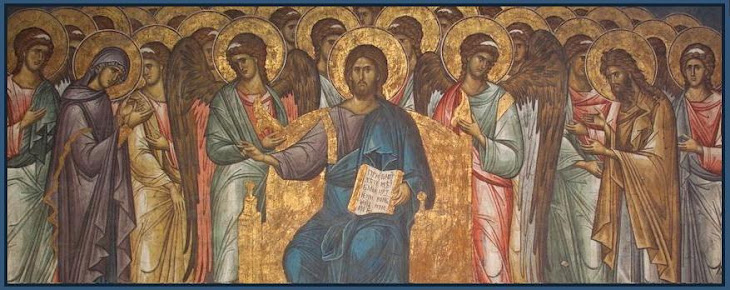
Christ surrounded by the hosts of the Angels (http://pravicon.com/images/icon/0455/0455004.jpg)
  
Through the prayers of our Holy Fathers, Lord Jesus Christ our God, have mercy on us and save us! Amen!

Saturday, November 5, 2011

St. John Vatatze the Merciful, Emperor of Nicea


Brief life of the Saint
He was born in Adrianople of Thrace from a great family. He married the daughter of Theodore Laskareos [the writer of the Great Paraklesis to the Theotokos], Irene, and accepted the throne of Nicea (1222-1255AD).

John was a pious and merciful king, and the people loved him greatly for his Christian ways, his meekness, his humility, his good ethics and his commitment to divine things.

Having ruled with Christ-like ethics, he fell asleep in peace on October 30th, 1255. He was buried with great honor in the Holy Monastery of the Savior Christ, which he himself had built, known as Sosandron.
(http://synaxarion.gr/gr/sid/1092/sxsaintinfo.aspx)
  
  
The wondrous Relic of the Saint
The precious body of the most-pious, righteous, brave and merciful king was buried in a Monastery that he had previously built named Sosandra, though later, through the wondrous revelation of John himself, he sought to have the relic transferred to Magnesia [Asia Minor]. When they went, however, to open the tomb to transfer his relic, instead of an odor, there was a sweet fragrance like a garden of flowers. But this is not all. The dead appeared as if he were sitting upon a royal throne, without any darkening, without any odor, without any signs that he was dead! Seven years he was in the tomb, and his color was the same as a live human being. He appeared in reality as if he were alive, but a marble king. And in addition, his clothes appeared incorrupt as if he had just put them on. Thus God glorified those who glorify Him on earth!

The precious relic of the Holy king John Douka Vatatze the Merciful worked a great many miracles, healing wondrously the sick through the Grace of God, casting out demons and healing a multitude of passions, through the indwelling of the Grace of the Holy Spirit.

St. John Vatatze the Merciful King (source)
 
In 2001, the Holy Metropolis of Didymoteichou, Orestiados and Soufliou mentioned in their annual calendar: "until 1992, the memory of the emperor John the Merciful was honored every year in the church of Magnesia which he built, and where he found his final repose, and also in Nymphaion, his beloved home" (Ostrogorsky).

But what happened to that Church? What happened to the incorrupt relic of the "Marble King"? What does this have to do with the "legend", or with prophecies of the rebuilding of the City [Constantinople], for which he had suffered so much?
(http://noiazomai.tripod.com/vatatzis.html)


The Imperial Flag of the Vatatze Family (http://protostrator.blogspot.com/2011/05/byzantine-heraldry.html)

A couple of personal thoughts that come to mind when discussing this righteous man:
One, God ultimately judges our hearts. As a result, almost no career or way of life can serve as an impediment to holiness. We have Saints that were kings, beggars, patriarchs, readers, soliders, actors, physicians, lawyers, teachers, fishermen, artists, farmers, etc. Christ of course acknowledges how difficult it is for those with riches to be saved. Nevertheless, He said: "With man this is impossible, but with God all things are possible." (Matthew 19:24-26). So, by denying ourselves and following Christ through His holy Orthodox Church, we are all called to become Saints and imitators of Christ.

  
Also, I should mention that some traditions and prophecies (though this is by no means dogma), hold that St. John Vatatze is either a prototype of a future Orthodox king who will rule Constantinople, or that he is the so-called "Sleeping King", who will himself one day be raised to life again to lead the Orthodox Greek people in the coming difficult times. Again, this is by no means central to Orthodoxy. It is clear however, that though dark and trying days are ahead for the whole world before the Second Coming of Christ, we know that Christ will always preserve His flock, and "the gates of hell will never prevail against it" (Matthew 16:18).

I am unsure how official or widespread St. John Vatatze's veneration is, but there was recently a church built in his honor in Didymoteichos (I believe where he was born), and a service for him has been written (I believe by St. Nikodemos). Part of this is translated below.

May Christ continue to preserve and protect all the Orthodox everywhere, through the prayers of our Holy Fathers!

Coin depicting the Theotokos crowning St. John Vatatzes as King (http://upload.wikimedia.org/wikipedia/el/4/49/Johannes_III_Vatatzes_coin.jpg)

Apolytikion in the First Tone (amateur translations below)
The radiant king and great boast of the faithful, the pride of Didymoteichou, let us honor John in hymns and spiritual odes, as we celebrate his memory, that we might richly be rewarded, crying out together: glory to Christ Who glorified you, glory to Him Who crowned you, glory to Him Who grants to us through you healing for all.
   
Kontakion in the Fourth Tone
Today, John, the divine ruler, flees his earthly kingdom for the Kingdom of Heaven, leaving for eternity merrily.
   
Oikos
The Lord, Who foresaw before his birth the good nature of his soul, the uprightness of his heart, and his proclivity to choosing the good path, chose John Vatatze to be ruler of the faithful, having the name of mercy, and being arrayed with many graces, he now is alive in heaven, and after his death has been shown forth a spring of wonders and a stream of healings, and he drives away the spirits of error. Therefore, having rightly and manfully completed his path in God, and having kept the faith, he flees for the Kingdom of Heaven, leaving for eternity merrily.
   
Synaxarion
On the 4th of the month of November, the memory of the holy, glorious, Godly-crowned king John Vatatze the Merciful, born in Didymotheicho in the year 1193, and departed for the Lord in Nymphaio, Magnesia in the year of salvation 1254.
   
Verses
Having, O John, heaven as a dwelling place,
Meeting Constantine, the great the former [king].
John meets his end and [hastens towards] the perfect [One] on the fourth.


Through the prayers of our Holy Fathers, Lord Jesus Christ our God, have mercy on us and save us! Amen!