Wednesday, December 21, 2011

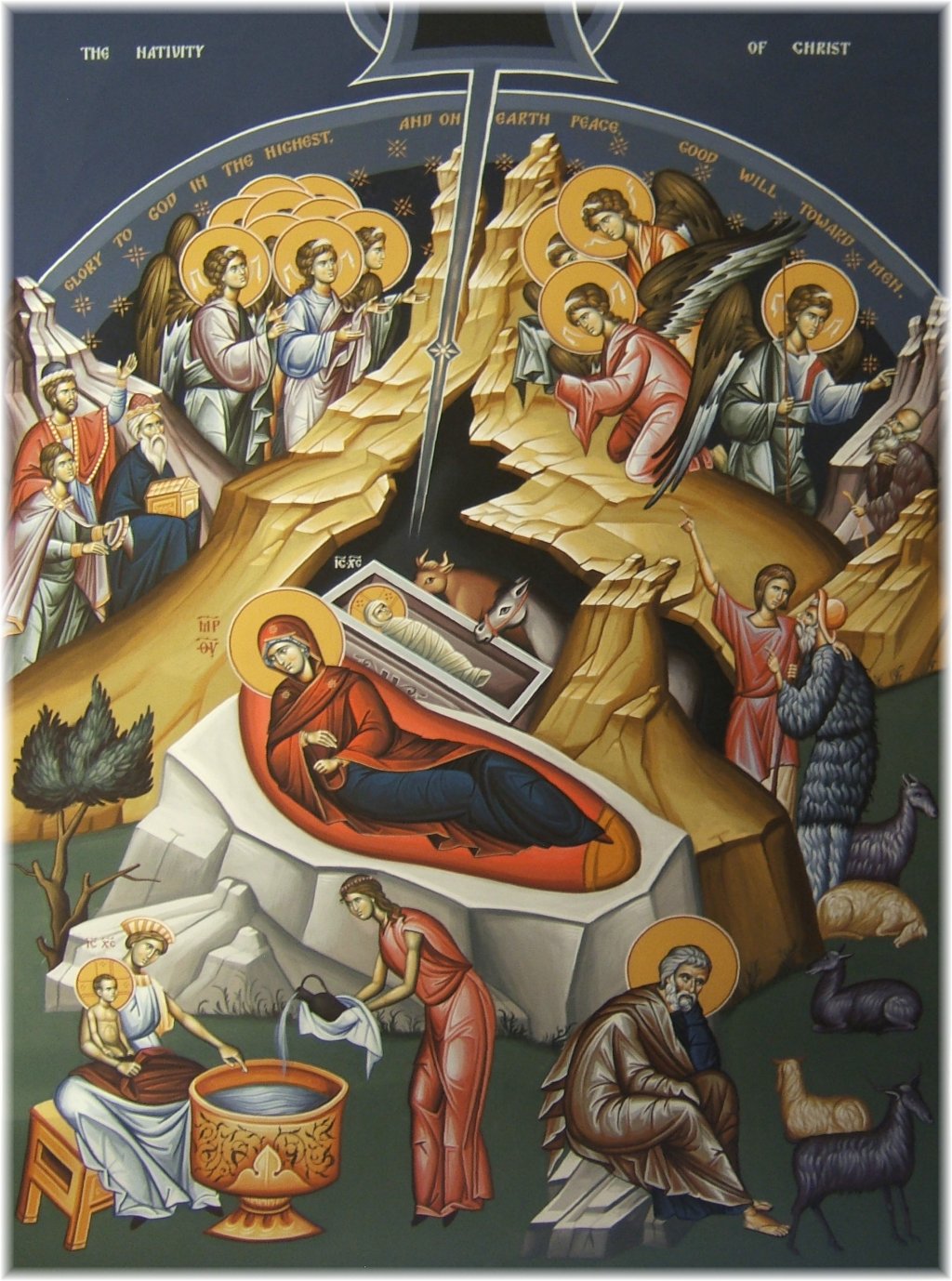
Homily on the Nativity of Christ, by St. John Chrysostom

Christ is born! Glorify Him!
  

Homily on the Nativity of Christ, by St. John Chrysostom
The following is one of several sermons by the great Hierarch and Teacher of the world, St. John Chrysostom, on the Nativity of Christ. It is a beautiful and deep work in which the Saint praises the newborn Christ, discusses the deep theology of Christ's incarnation, and tries to urge us all to deeper faith in Him and to follow His commandments. The first portion has been translated and posted numerous places online, while I have yet to find the rest of this moving homily translated. Thus the remainder is also posted below, as an amateur translation of mine.
  
It should be noted that some mistakenly interpret some of the Blessed Chrysostom's words as "anti-semitic". This is not the time for a full examination of this error, but I will say the following: St. John, having been purified of his passions through love of God and his fellow man, and following the Lord's commandments, truly became a great vessel of the Holy Spirit. As such, the Saint did not bear any hate towards anyone in his life, neither does he after his death. He did not rejoice in hate or persecution of anyone, but ever preached love and forgiveness. He does not judge any person, but is only critical of false beliefs and of sin against God. The admonishments that he uses (whether addressed towards Jews, Gentiles, idolaters, sinners, or the faithful) are dispassionate, loving urgings to come to understand the Truth that is Christ. He urges all on this great feast of Christmas, both believers and unbelievers throughout the world: "Come, let us rejoice together! Come, let us celebrate!" Let us all worship Christ: God Who became man for our salvation! May He be born also within our cold and unbelieving hearts! Amen!
  
I behold a new and wondrous mystery! My ears resound to the Shepherd's song, piping no soft melody, but chanting full forth a heavenly hymn.
The Angels sing!
The Archangels blend their voices in harmony!
The Cherubim hymn their joyful praise!
The Seraphim exalt His glory!
  
All join to praise this holy feast, beholding the Godhead here on earth, and man in heaven. He who is above, now for our redemption dwells here below; and he that was lowly is by divine mercy raised.
  
Bethlehem this day resembles heaven; hearing from the stars the singing of angelic voices; and in place of the sun, enfolds within itself on every side the Sun of Justice.
  
And ask not how: for where God wills, the order of nature yields. For He willed, he had the power, He descended, He redeemed; all things move in obedience to God.
  
This day He Who Is, is Born; and He Who Is becomes what He was not. For when He was God, He became man; yet not departing from the Godhead that is His. Nor yet by any loss of divinity became He man, nor through increase became he God from man; but being the Word He became flesh, His nature, because of impassibility, remaining unchanged.
  
And so the kings have come, and they have seen the heavenly King that has come upon the earth, not bringing with Him Angels, nor Archangels, nor Thrones, nor Dominations, nor Powers, nor Principalities, but, treading a new and solitary path, He has come forth from a spotless womb.
  
Yet He has not forsaken His angels, nor left them deprived of His care, nor because of His Incarnation has he departed from the Godhead.
  
And behold,
Kings have come, that they might adore the heavenly King of glory;
Soldiers, that they might serve the Leader of the Hosts of Heaven;
Women, that they might adore Him Who was born of a woman so that He might change the pains of child-birth into joy;
Virgins, to the Son of the Virgin, beholding with joy, that He Who is the Giver of milk, Who has decreed that the fountains of the breast pour forth in ready streams, receives from a Virgin Mother the food of infancy;
Infants, that they may adore Him Who became a little child, so that out of the mouth of infants and sucklings, He might perfect praise;
Children, to the Child Who raised up martyrs through the rage of Herod;
Men, to Him Who became man, that He might heal the miseries of His servants;
Shepherds, to the Good Shepherd Who has laid down His life for His sheep;
Priests, to Him Who has become a High Priest according to the order of Melchisedech;
Servants, to Him Who took upon Himself the form of a servant that He might bless our servitude with the reward of freedom;
Fishermen, to Him Who from amongst fishermen chose catchers of men;
Publicans, to Him Who from amongst them named a chosen Evangelist;
Sinful women, to Him Who exposed His feet to the tears of the repentant;
  
And that I may embrace them all together, all sinners have come, that they may look upon the Lamb of God Who taketh away the sins of the world.
[The Magi to worship Him.
The Shepherds to glorify Him.
The tax collectors to preach Him.
The harlots to offer myrrh to Him.
The Samaritan Woman to quench His thirst.
The Canaanite Woman to be benefited by Him.]
(amateur translation of missing portion)
          
Since therefore all rejoice, I too desire to rejoice. I too wish to share the choral dance, to celebrate the festival. But I take my part, not plucking the harp, not shaking the Thyrsian staff, not with the music of pipes, nor holding a torch, but holding in my arms the cradle of Christ. For this is all my hope, this my life, this my salvation, this my pipe, my harp. And bearing it I come, and having from its power received the gift of speech, I too, with the angels, sing: Glory to God in the Highest;
and with the shepherds: and on earth peace to men of good will.
  
We only can say this: that as His heavenly birth is true, thus also His earthly birth is irrefutable. It is true that God was begotten from God, it is true that He was born a man from a virgin. In heaven, He alone was born from the Father, His only-begotten Son. And on earth, He alone was born from the Virgin, her only Son.
  
As with His heavenly birth, it is impious to think of a mother, thus in His earthly birth, it is blasphemy to propose a father.
   
God gave birth to Him in a divine manner; the Virgin have birth to Him in a supernatural manner. Thus neither His heavenly birth can be fully explained, nor can His incarnation be studied.
   
I know that the Virgin today gave birth to Him. I believe that He was begotten of God the Father before the ages.
  
And I have learned to silently honor His birth, without curious investigations and unnecessary discussions. Because, whatever relates to God cannot be held to the natural course of events, but it is belief in His power that orders all things.
   
What is more natural than for a married woman to give birth? However, what is more paradoxical than for a virgin to give birth to a child, without a man, and to remain a virgin?
   
What can we study, therefore? That which occurrs according to the natural laws. However, whatever occurs supernaturally, we must honor silently. Not because it is dangerous, but because it is inscrutable.
  
I ponder in fear before the divine mystery.
  
What can I say, and what shall I speak? I see her who gave birth. I see Him Who was born. But the manner of birth, I cannot understand.
  
Do you see how, where God wills, the laws of nature are overcome? The same occurred here: the natural order is put aside, and the divine will works.
  
How inexplicable is the compassion of God!
  
The Son of God before the ages, the incorruptible and invisible and bodiless, came to inhabit our corruptible and visible body. For what reason? That, as you know, we men might believe beyond that which we see, beyond that which we hear. We [sinners] believe in the visible, but not the invisible. Thus we do not believe in the true God, but we worship visible idols in the form of men. Therefore, God appeared before us in the visible form of man, to dissolve in this manner every doubt as to His existence. And later, having taught the certainty of His presence through the senses, in order to easily lead us to the true faith, to the invisible and supernatural.
  
The wonder fills me with astonishment!
  
I see God before the ages as a child!
He rests in the manger, He Whose throne is heaven!
Human hands hold Him Who is unapproachable and bodiless!
He is wrapped in swaddling clothes, He Who breaks apart the bonds of sin!
  
However, this is His will: to transform dishonor into honor, to array worthlessness in glory, to recreate assault into virtue.
  
He took my body, He offers me His Spirit. He grants me the treasure of eternal life, taking but also giving me. He takes my flesh to sanctify me, He give me His Spirit to save me.
   
“Behold, a virgin shall conceive.” (Isaiah 7:14).
The words are from the synagogue, but has been acquired by the Church.
The synagogue buried the thread; the Church wears the royal robe.
Judea gave birth to Him; the world received Him.
The synagogue nursed Him and raised Him; the Church received Him and was benefited by Him.
In the synagogue the root sprouted; we however partake of the grapes of truth.
The synagogue trampled upon the grapes; the idolaters, however, drink of the mystical drink.
He offered the seed to Judea; the idolaters, however, reaped the sheaves with the sickle of faith. They cut the rose with honor, and left the Judeans with the thorn of faithlessness.
The little bird has flown away, and they still senselessly wait and guard the nest.
The Judeans struggle to study the scriptures, and the idolaters eat of the fruit of the Spirit.
  
“Behold, a virgin shall conceive.” (Isaiah 7:14).
Tell me, O Judaean, tell me, who was born?
I entreat you, show boldness as that which you showed before Herod. But you do not have boldness. And I know why. Because you are insidious. You spoke to Herod to cast Him out, and to me you do not speak that I might not worship Him.
  
Who, therefore, was born? Who? The Creator of creation. And if you are silent, nature will cry out like thunder. He was born, therefore, in the manner in which He willed to be born. In nature, there is no possibility for a birth like this. He, however, as the Lord of creation, created a paradoxical way of birth. And He thus showed that, though He became man, He was not born like other men, but in a way that suits God.
  
Adam, therefore, without a woman, acquired a woman. The Virgin now, without a man, gave birth to a man.
   
And why did this occur? Behold why:
Women had an ancient debt towards men, because Adam had sprouted a woman without the intervention of another woman. For this reason, today the Virgin fulfills the debt of Eve towards men, and gives birth without a man, showing thus the equal honor of nature.
  
Adam remained whole after parting with his rib; the Virgin remained incorrupt after giving birth to her Child.
  
But note something further:
The Lord did not create another body to be seen on earth. He took the body of man, that He not appear to disdain the matter with which he created Adam. He came thus, God and man, in a mystical union. And the devil, who had enslaved man, ran to flee.
  
God becomes man, but is born as God. If He came like I did, from a common marriage, many would doubt His birth. This is why He was born from a virgin. For this reason he kept her womb untouched. For this reason he preserves her virginity unspotted: that the manner of His birth might be paradoxical, a cause of unshakable faith.
  
Therefore, to those who doubt the seedless birth of the Word of God, I call upon the spotless seal of virginity as a witness.
  
Tell me, therefore, O Judean, did the Virgin give birth or not?
And if she gave birth, why do you not confess the supernatural birth?
And again if she did not give birth, why did you deceive Herod?
  
For he sought to learn where the Christ would be born, and you told him: “In Bethlehem of Judea” (Matthew 2:4).
Perhaps I knew the city or the place?
Perhaps I knew the worth of the Child Who had come into the world?
Did not Isaiah and the Prophets speak to you of Him?
And you thankless enemies, did you not study the truth? You, the scribes and Pharisees, the strict keepers of the law, why don't you teach us about Christ?
Haven't you searched the Scriptures? Perhaps, do you not understand your own language?
And when the Virgin gave birth, did you not present the witness of the Prophet Michah to Herod: “But you, O Bethlehem of the land of Ephratha, though you are among the least of the cities of Judea, you will receive the leader of Israel” (Michah 5:1)?
  
Very well did the Prophet say: “from you”. From you He came, and appeared to the whole world. He appeared as a man, to lead men. He appeared as God to save the world.
  
O how beneficial enemies you are! What philanthropic condemners!
You by mistake showed how the newborn of Bethlehem is God.
You preached Him without wishing it.
You revealed Him, while trying to hide Him.
You were good to Him, while you wished to harm Him.
Truly, what illiterate teachers you are.
You hunger, and you run to others to be fed.
You thirst, and you are watered by others. You are utterly poor, and enrich others.
   
Come, let us rejoice together! Come, let us celebrate! The manner of the feast is strange—as is also the word on the birth of Christ.
Today are dissolved the ancient bonds.
The devil is disgraced.
The demons flee.
Death is dispoiled.
Paradise is opened.
The curse disappears.
Sin is cast out.
Error is driven away.
Truth is revealed.
The message of piety is poured forth and is given everywhere.
The kingdom of the heavens is transplanted to earth.
Angels speak with men.
All have been united.
Why?
Because God has descended to earth, and man has ascended to the heavens.
  
God descended to earth, and again is found in heaven. He is wholly in heaven and wholly on earth. He became man and is God. He is God and took on flesh. He is held in virginal arms, and with His hands holds the world.
  
The Magi hasten to Him; let us also hasten.
The star hastens to reveal the Lord of heaven, and He Himself hastens.
   
He hastens towards Egypt. And of course it appears that he is going to flee the command of Herod. However, this came about to fulfill the prophetic words: “On that day, the people of Israel will take third, along with the Assyrians and the Egyptians, of the blessing of God upon the earth” (Isaiah 19:24).
  
What do you say, O Judean? You who were first have become third? The Egyptians have moved ahead, and the first-born of Israel has moved behind? Yes, this occurred. The Assyrians will be first, because through the Magi, they were the first to worship the Lord. Behind them, the Egyptians received Him, when they fled to their lands to flee the command of Herod. Third and last is the Israelite people, who knew the Lord through the apostles, after His baptism in the Jordan.
  
What else remains for me to say?
  
I behold the Creator and the manger, Child and swaddling clothes, Virgin and Mother arrayed in much poverty. You see, however, what riches there are in great poverty. The Rich One became poor as a gift to us. He does not have even a bed nor mattress. He is placed in His humble crib.
  
O poverty, spring of riches!
O uncountable riches, hid amidst poverty!
  
In the manger He is laid, and the world he preserves.
In swaddling clothes He is wrapped, and He breaks the bonds of sin.
You have not spoken a word yet, and you teach the Magi about God.
  
What can I say, and what should I speak?
There the Child is wrapped!
There is Mary, His Mother and Virgin, with Him!
There is Joseph, the supposed father of the Child!
She is the wife, he is the husband. The names are legal, but without meaning. Joseph only betrothed Mary, when the Holy Spirit came upon her. Thus, full of wonder, he did not know what to think about this Child:
He would not dare to say that He was the fruit of adultery.
He could not offer a blasphemous word against the Virgin.
He also could not receive the Child as his, because it was unknown to him who He was born from.
But above his confusion, he receives an answer from heaven, with the voice of the angel: “Joseph, do not hesitate to take Mary into your house, for the child which will come from her is from the Holy Spirit” (Matthew 1:20).
  
And he revealed the same to us, that the Holy Spirit came upon the Virgin.
  
Why, however, did Christ wish to be born from a virgin, leaving her virginity intact?
  
Behold the reason:
Once, the devil deceived the virgin Eve. Now, the angel brings the saving message to the Virgin Mary.
Once, Eve poured forth a word, which became the cause of death. Now, Mary gives birth to the Word, Who became the cause of eternal life.
  
The word of Eve revealed the tree which took Adam from Paradise. The Word of Mary revealed the Cross, which placed Adam again in Paradise.
  
To Him, therefore, the Word of God and Son of the Virgin, Who opened the road in an impassible manner, let us offer glory, together with the Father and the Holy Spirit unto the ages of ages. Amen.
(Bibliography, Voice of the Fathers. Holy Monastery of the Paraclete. Amateur translation of the later portion (http://oparadeisos.wordpress.com/2011/01/01/%CE%B1%CE%B3%CE%AF%CE%BF%CF%85-%CE%B9%CF%89%CE%AC%CE%BD%CE%BD%CE%BF%CF%85-%CF%84%CE%BF%CF%8D-%CF%87%CF%81%CF%85%CF%83%CE%BF%CF%83%CF%84%CF%8C%CE%BC%CE%BF%CF%85-%CF%87%CF%81%CE%B9%CF%83%CF%84%CF%8C/))
  
  
Through the prayers of our Holy Fathers, Lord Jesus Christ our God, have mercy on us and save us! Amen!

Monday, December 19, 2011

Homily on St. Ignatios the God-bearer, by St. John Chrysostom

St. Ignatios the God-bearer of Antioch - Commemorated December 20, January 29 (http://pravicon.com/images/sv/s0868/s0868004.jpg)
  
Homily on St. Ignatios the God-bearer, by St. John Chrysostom
1. Sumptuous and splendid entertainers give frequent and constant entertainments, alike to display their own wealth, and to show good-will to their acquaintance. So also the grace of the Spirit, affording us a proof of his own power, and displaying much good-will towards the friends of God, sets before us successively and constantly the tables of the martyrs. Lately, for instance, a maiden quite young, and unmarried, the blessed martyr Pelagia, entertained us, with much joy. Today again, this blessed and noble martyr Ignatius has succeeded to her feast. The persons are different: The table is one. The wrestlings are varied: The crown is one. The contests are manifold: The prize is the same. For in the case of the heathen contests, since the tasks are bodily, men alone are, with reason, admitted. But here, since the contest is wholly concerning the soul, the lists are open to each sex, for each kind the theatre is arranged. Neither do men alone disrobe, in order that the women may not take refuge in the weakness of their nature, and seem to have a plausible excuse, nor have women only quitted themselves like men, lest the race of men be put to shame; but on this side and on that many are proclaimed conquerors, and are crowned, in order that you may learn by means of the exploits themselves that in Christ Jesus neither male nor female, (Galatians 3:28) neither sex, nor weakness of body, nor age, nor any such thing could be a hindrance to those who run in the course of religion; if there be a noble readiness, and an eager mind, and a fear of God, fervent and kindling, be established in our souls. On this account both maidens and women, and men, both young and old, and slaves, and freemen, and every rank, and every age, and each sex, disrobe for those contests, and in no respect suffer harm, since they have brought a noble purpose to these wrestlings. The season then already calls us to discourse of the mighty works of this saint. But our reckoning is disturbed and confused, not knowing what to say first, what second, what third, so great a multitude of things calling for eulogy surrounds us, on every side; and we experience the same thing as if any one went into a meadow, and seeing many a rosebush and many a violet, and an abundance of lilies, and other spring flowers manifold and varied, should be in doubt what he should look at first, what second, since each of those he saw invites him to bestow his glances on itself. For we too, coming to this spiritual meadow of the mighty works of Ignatius, and beholding not the flowers of spring, but the manifold and varied fruit of the spirit in the soul of this man, are confused and in perplexity, not knowing to which we are first to give our consideration, as each of the things we see draws us away from its neighbours, and entices the eye of the soul to the sight of its own beauty. For see, he presided over the Church among us nobly, and with such carefulness as Christ desires. For that which Christ declared to be the highest standard and rule of the Episcopal office, did this man display by his deeds. For having heard Christ saying, the good shepherd lays down his life for the sheep, (John 10:11) with all courage he did lay it down for the sheep.
  
He held true converse with the apostles and drank of spiritual fountains. What kind of person then is it likely that he was who had been reared, and who had everywhere held converse with them, and had shared with them truths both lawful and unlawful to utter, and who seemed to them worthy of so great a dignity? The time again came on, which demanded courage; and a soul which despised all things present, glowed with Divine love, and valued things unseen before the things which are seen; and he lay aside the flesh with as much ease as one would put off a garment. What then shall we speak of first? The teaching of the apostles which he gave proof of throughout, or his indifference to this present life, or the strictness of his virtue, with which he administered his rule over the Church; which shall we first call to mind? The martyr or the bishop or the apostle. For the grace of the spirit having woven a threefold crown, thus bound it on his holy head, yea rather a manifold crown. For if any one will consider them carefully, he will find each of the crowns, blossoming with other crowns for us.
  
2. And if you will, let us come first to the praise of his episcopate. Does this seem to be one crown alone? Come, then, let us unfold it in speech, and you will see both two, and three, and more produced from it. For I do not wonder at the man alone that he seemed to be worthy of so great an office, but that he obtained this office from those saints, and that the hands of the blessed apostles touched his sacred head. For not even is this a slight thing to be said in his praise, nor because he won greater grace from above, nor only because they caused more abundant energy of the Spirit to come upon him, but because they bore witness that every virtue possessed by man was in him. Now how this is, I tell you. Paul writing to Titus once on a time— and when I say Paul, I do not speak of him alone, but also of Peter and James and John, and the whole band of them; for as in one lyre, the strings are different strings, but the harmony is one, so also in the band of the apostles the persons are different, but the teaching is one, since the artificer is one, I mean the Holy Spirit, who moves their souls, and Paul showing this said, “Whether therefore they, or I, so we preach.” (1 Corinthians 15:11) This man, then, writing to Titus, and showing what kind of man the bishop ought to be, says, “For the bishop must be blameless as God's steward; not self-willed, not soon angry, no brawler, no striker, not greedy of filthy lucre; but given to hospitality, a lover of good, sober-minded, just, holy, temperate, holding to the faithful word, which is according to the teaching, that he may be able both to exhort in the sound doctrine, and to convict the gainsayers;” Titus 1:7-9 and to Timothy again, when writing upon this subject, he says somewhat like this: If a man seeks the office of a bishop, he desires a good work. The bishop, therefore, must be without reproach, the husband of one wife, temperate, sober-minded, orderly, given to hospitality, apt to teach, no brawler, no striker, but gentle, not contentious, no lover of money. Do you see what strictness of virtue he demands from the bishop? For as some most excellent painter from life, having mixed many colors, if he be about to furnish an original likeness of the royal form, works with all accuracy, so that all who are copying it, and painting from it, may have a likeness accurately drawn, so accordingly the blessed Paul, as though painting some royal likeness, and furnishing an original sketch of it, having mixed the different colors of virtue, has painted in the features of the office of bishop complete, in order that each of those who mount to that dignity, looking thereupon, may administer their own affairs with just such strictness.
  
Boldly, therefore, would I say that Ignatius took an accurate impression of the whole of this, in his own soul; and was blameless and without reproach, and neither self-willed, nor soon angry, nor given to wine, nor a striker, but gentle, not contentious, no lover of money, just, holy, temperate, holding to the faithful word which is according to the teaching, sober, sober-minded, orderly, and all the rest which Paul demanded. “And what is the proof of this?” says one. They who said these things ordained him, and they who suggest to others with so great strictness to make proof of those who are about to mount to the throne of this office, would not themselves have done this negligently. But had they not seen all this virtue planted in the soul of this martyr would not have entrusted him with this office. For they knew accurately how great danger besets those who bring about such ordinations, carelessly and hap-hazard. And Paul again, when showing this very thing to the same Timothy wrote and says, “Lay hands suddenly on no man, neither be partaker of other men's sins.” (1 Timothy 5:22) What do you say? Has another sinned, and do I share his blame and his punishment? Yes, says he, the man who authorizes evil; and just as in the case of any one entrusting into the hands of a raging and insane person a sharply pointed sword, with which the madman commits murder, that man who gave the sword incurs the blame; so any one who gives the authority which arises from this office to a man living in evil, draws down on his own head all the fire of that man's sins and audacity. For he who provides the root, this man is the cause of all that springs from it on every side. Do you see how in the meanwhile a double crown of the episcopate has appeared, and how the dignity of those who ordained him has made the office more illustrious, bearing witness to every exhibition of virtue in him?
  
3. Do you wish that I should also reveal to you another crown springing from this very matter? Let us consider the time at which he obtained this dignity. For it is not the same thing to administer the Church now as then, just as it is not the same thing to travel along a road well trodden, and prepared, after many wayfarers; and along one about to be cut for the first time, and containing ruts, and stones, and full of wild beasts, and which has never yet, received any traveller. For now, by the grace of God, there is no danger for bishops, but deep peace on all sides, and we all enjoy a calm, since the Word of piety has been extended to the ends of the world, and our rulers keep the faith with strictness. But then there was nothing of this, but wherever any one might look, precipices and pitfalls, and wars, and fightings, and dangers; both rulers, and kings, and people and cities and nations, and men at home and abroad, laid snares for the faithful. And this was not the only serious thing, but also the fact that many of the believers themselves, inasmuch as they tasted for the first time strange doctrines, stood in need of great indulgence, and were still in a somewhat feeble condition and were often upset. And this was a thing which used to grieve the teachers, no less than the fightings without, nay rather much more. For the fightings without, and the plottings, afforded much pleasure to them on account of the hope of the rewards awaiting them. On this account the apostles returned from the presence of the Sanhedrin rejoicing because they had been beaten; (Acts 5:41) and Paul cries out, saying: “I rejoice in my sufferings,” (Colossians 1:24) and he glories in his afflictions everywhere. But the wounds of those at home, and the falls of the brethren, do not suffer them to breathe again, but always, like some most heavy yoke, continually oppress and afflict the neck of their soul. Hear at least how Paul, thus rejoicing in sufferings, is bitterly pained about these. “For who, says he, is weak, and I am not weak? Who is offended, and I burn not?” (2 Corinthians 11:29) and again, “I fear lest when I come I shall find you not such as I would, and I be found of you such as you would not,” (2 Corinthians 12:20) and a little afterwards, “Lest when I come again to you, God humble me, and I shall mourn many of those who have sinned before, and have not repented of their uncleanness, and wantonness, and fornication which they have committed.” (2 Corinthians 12:21) And throughout you see that he is in tears and lamentations on account of members of the household, and evermore fearing and trembling for the believers. Just as then we admire the pilot, not when he is able to bring those who are on board safe to shore when the sea is calm, and the ship is borne along by favourable winds, but when the deep is raging and the waves contending, and the passengers themselves within in revolt, and a great storm within and without besets those who are on board, and he is able to steer the ship with all security; so we ought to wonder at, and admire those who then had the Church committed to their hands, much more than those who now have the management of it; when there was a great war without and within, when the plant of the faith was more tender, and needed much care, when, as a newly-born babe, the multitude in the church required much forethought, and the greatest wisdom in any soul destined to nurse it; and in order that you may more clearly learn, how great crowns they were worthy of, who then had the Church entrusted to them, and how great work and danger there was in undertaking the matter on the threshold and at the beginning, and in being the first to enter upon it, I bring forward for you the testimony of Christ, who pronounces a verdict on these things, and confirms the opinion which has been expressed by me. For when he saw many coming to him, and was wishing to show the apostles that the prophets toiled more than they, he says: “Others have laboured, and you have entered into their labour.” (John 4:38) And yet the apostles toiled much more than the prophets. But since they first sowed the word of piety, and won over the untaught souls of men to the truth, the greater part of the work is credited to them. For it is by no means the same thing for one to come and teach after many teachers, and himself to be the first to sow seeds. For that which has been already practised, and has become customary with many, would be easily accepted; but that which is now for the first time heard, agitates the mind of the hearers, and gives the teacher a great deal to do. This at least it was which disturbed the audience at Athens, and on this account they turned away from Paul, reproaching him with, “You bring certain strange things to our ears.” (Acts 17:20) For if the oversight of the Church now furnishes much weariness and work to those who govern it, consider how double and treble and manifold was the work then, when there were dangers and fighting and snares, and fear continually. It is not possible to set forth in words the difficulty which those saints then encountered, but he alone will know it who comes to it by experience.
  
4. And I will speak of a fourth crown, arising for us out of this episcopate. What then is this? The fact that he was entrusted with our own native city. For it is a laborious thing indeed to have the oversight of a hundred men, and of fifty alone. But to have on one's hands so great a city, and a population extending to two hundred thousand, of how great virtue and wisdom do you think there is a proof? For as in the care of armies, the wiser of the generals have on their hands the more leading and more numerous regiments, so, accordingly, in the care of cities. The more able of the rulers are entrusted with the larger and more populous. And at any rate this city was of much account to God, as indeed He manifested by the very deeds which He did. At all events the master of the whole world, Peter, to whose hands He committed the keys of heaven, whom He commanded to do and to bear all, He bade tarry here for a long period. Thus in His sight our city was equivalent to the whole world. But since I have mentioned Peter, I have perceived a fifth crown woven from him, and this is that this man succeeded to the office after him. For just as any one taking a great stone from a foundation hastens by all means to introduce an equivalent to it, lest he should shake the whole building, and make it more unsound, so, accordingly, when Peter was about to depart from here, the grace of the Spirit introduced another teacher equivalent to Peter, so that the building already completed should not be made more unsound by the insignificance of the successor. We have reckoned up then five crowns, from the importance of the office, from the dignity of those who ordained to it, from the difficulty of the time, from the size of the city, from the virtue of him who transmitted the episcopate to him. Having woven all these, it was lawful to speak of a sixth, and seventh, and more than these; but in order that we may not, by spending the whole time on the consideration of the episcopate, miss the details about the martyr, come from this point, let us pass to that conflict. At one time a grievous warfare was rekindled against the Church, and as though a most grievous tyranny overspread the earth, all were carried off from the midst of the market-place. Not indeed charged with anything monstrous, but because being freed from error, they hastened to piety; because they abstained from the service of demons, because they recognized the true God, and worshipped his only begotten Son, and for things for which they ought to have been crowned, and admired and honoured, for these they were punished and encountered countless tortures, all who embraced the faith, and much more they who had the oversight of the churches. For the devil, being crafty, and apt to contrive plots of this kind, expected that if he took away the shepherds, he would easily be able to scatter the flocks. But He who takes the wise in their craftiness, wishing to show him that men do not govern His church, but that it is He himself who everywhere tends those who believe in Him, agreed that this should be, that he might see, when they were taken away, that the cause of piety was not defeated, nor the word of preaching quenched, but rather increased; that by these very works he might learn both himself, and all those who minister to him, that our affairs are not of men, but that the subject of our teaching has its root on high, from the heavens; and that it is God who everywhere leads the Church, and that it is not possible for him who fights against God, ever to win the day. But the Devil did not only work this evil, but another also not less than this. For not only in the cities over which they presided, did he suffer the Bishops to be slaughtered; but he took them into foreign territory and slew them; and he did this, in anxiety at once to take them when destitute of friends, and hoping to render them weaker with the toil of their journey, which accordingly he did with this saint. For he called him away from our city to Rome, making the course twice as long, expecting to depress his mind both by the length of the way and the number of the days, and not knowing that having Jesus with him, as a fellow traveller, and fellow exile on so long a journey, he rather became the stronger, and afforded more proof of the power that was with him, and to a greater degree knit the Churches together. For the cities which were on the road running together from all sides, encouraged the athlete, and sped him on his way with many supplies, sharing in his conflict by their prayers, and intercessions. And they derived no little comfort when they saw the martyr hastening to death with so much readiness, as is consistent in one called to the realms which are in the heaven, and by means of the works themselves, by the readiness and by the joyousness of that noble man, that it was not death to which he was hastening, but a kind of long journey and migration from this world, and ascension to heaven; and he departed teaching these things in every city, both by his words, and by his deeds, and as happened in the case of the Jews, when they bound Paul, and sent him to Rome, and thought that they were sending him to death, they were sending a teacher to the Jews who dwelt there. This indeed accordingly happened in the case of Ignatius in larger measure. For not to those alone who dwell in Rome, but to all the cities lying in the intervening space, he went forth as a wonderful teacher, persuading them to despise the present life, and to think naught of the things which are seen, and to love those which are to come, to look towards heaven, and to pay no regard to any of the terrors of this present life. For on this and on more than this, by means of his works, he went on his way instructing them, as a sun rising from the east, and hastening to the west. But rather more brilliant than this, for this is wont to run on high, bringing material light, but Ignatius shone below, imparting to men's souls the intellectual light of doctrine. And that light on departing into the regions of the west, is hidden and straightway causes the night to come on. But this on departing to the regions of the west, shone there more brilliantly, conferring the greatest benefits to all along the road. And when he arrived at the city, even that he instructed in Christian wisdom. For on this account God permitted him there to end his life, so that this man's death might be instructive to all who dwell in Rome. For we by the grace of God need henceforward no evidence, being rooted in the faith. But they who dwelt in Rome, inasmuch as there was great impiety there, required more help. On this account both Peter and Paul, and this man after them, were all slain there, partly, indeed, in order that they might purify with their own blood, the city which had been defiled with blood of idols, and partly in order that they might by their works afford a proof of the resurrection of the crucified Christ, persuading those who dwell in Rome, that they would not with so much pleasure disdain this present life, did they not firmly persuade themselves that they were about to ascend to the crucified Jesus, and to see him in the heavens. For in reality it is the greatest proof of the resurrection that the slain Christ should show forth so great power after death, as to persuade living men to despise both country and home and friends, and acquaintance and life itself, for the sake of confessing him, and to choose in place of present pleasures, both stripes and dangers and death. For these are not the achievements of any dead man, nor of one remaining in the tomb but of one risen and living. Since how couldest thou account, when he was alive, for all the Apostles who companied with him becoming weaker through fear to betray their teachers and to flee and depart; but when he died, for not only Peter and Paul, but even Ignatius, who had not even seen him, nor enjoyed his companionship, showing such earnestness as to lay down life itself for his sake?
  
5. In order then that all who dwell in Rome might learn that these things are a reality, God allowed that there the saint should be perfected, and that this was the reason I will guarantee from the very manner of his death. For not outside the walls, in a dungeon, nor even in a court of justice, nor in some corner, did he receive the sentence which condemned him, but in the midst of the theatre, while the whole city was seated above him, he underwent this form of martyrdom, wild beasts being let loose upon him, in order that he might plant his trophy against the Devil, beneath the eyes of all, and make all spectators emulous of his own conflicts. Not dying thus nobly only, but dying even with pleasure. For not as though about to be severed from life, but as called to a better and more spiritual life, so he beheld the wild beasts gladly. Whence is this manifest? From the words which he uttered when about to die, for when he heard that this manner of punishment awaited him, “may I have joy,” said he, “of these wild beasts.” For such are the loving. For they receive with pleasure whatever they may suffer for the sake of those who are beloved, and they seem to have their desire satisfied when what happens to them is more than usually grievous. Which happened, therefore, in this man's case. For not by his death alone, but also by his readiness he studied to emulate the apostles, and hearing that they, after they had been scourged retired with joy, himself too wished to imitate his teachers, not only by his death, but by his joy. On this account he said, “may I have joy of your wild beasts,” and much milder than the tongue of the tyrant did he consider the mouths of these; and very reasonably. For while that invited him to Gehenna, their mouths escorted him to a kingdom. When, therefore, he made an end of life there, yea rather, when he ascended to heaven, he departed henceforward crowned. For this also happened through the dispensation of God, that he restored him again to us, and distributed the martyr to the cities. For that city received his blood as it dropped, but you were honoured with his remains, you enjoyed his episcopate, they enjoyed his martyrdom. They saw him in conflict, and victorious, and crowned, but you have him continually. For a little time God removed him from you, and with greater glory granted him again to you. And as those who borrow money, return with interest what they receive, so also God, using this valued treasure of yours, for a little while, and having shown it to that city, with greater brilliancy gave it back to you. You sent forth a Bishop, and received a martyr; ye sent him forth with prayers, and you received him with crowns; and not only ye, but all the cities which intervene. For how do ye think that they behaved when they saw his remains being brought back? What pleasure was produced! How they rejoiced! With what applause on all sides they beset the crowned one! For as with a noble athlete, who has wrestled down all his antagonists, and who comes forth with radiant glory from the arena, the spectators receive him, and do not suffer him to tread the earth, bringing him home on their shoulders, and besetting him with countless praises: so also the cities in order receiving this saint then from Rome, and bearing him upon their shoulders as far as this city, escorted the crowned one with praises, celebrating the champion, in song; laughing the Devil to scorn, because his artifice was turned against him, and what he thought to do against the martyr, this turned out for his behoof. Then, indeed, he profited, and encouraged all the cities; and from that time to this day he enriches this city, and as some perpetual treasure, drawn upon every day, yet not failing, makes all who partake of it more prosperous, so also this blessed Ignatius fills those who come to him with blessings, with boldness, nobleness of spirit, and much courage, and so sends them home.
  
Not only today, therefore, but every day let us go forth to him, plucking spiritual fruits from him. For it is, it is possible for him who comes hither with faith to gather the fruit of many good things. For not the bodies only, but the very sepulchres of the saints have been filled with spiritual grace. For if in the case of Elisha this happened, and a corpse when it touched the sepulchre, burst the bands of death and returned to life again, (2 Kings 13:21) much rather now, when grace is more abundant, when the energy of the spirit is greater, is it possible that one touching a sepulchre, with faith, should win great power; thence on this account God allowed us the remains of the saints, wishing to lead by them us to the same emulation, and to afford us a kind of haven, and a secure consolation for the evils which are ever overtaking us. Wherefore I beseech you all, if any is in despondency, if in disease, if under insult, if in any other circumstance of this life, if in the depth of sins, let him come hither with faith, and he will lay aside all those things, and will return with much joy, having procured a lighter conscience from the sight alone. But more, it is not only necessary that those who are in affliction should come hither, but if any one be in cheerfulness, in glory, in power, in much assurance towards God, let not this man despise the benefit. For coming hither and beholding this saint, he will keep these noble possessions unmoved, persuading his own soul to be moderate by the recollection of this man's mighty deeds, and not suffering his conscience by the mighty deeds to be lifted up to any self conceit. And it is no slight thing for those in prosperity not to be puffed up at their good fortune, but to know how to bear their prosperity with moderation, so that the treasure is serviceable to all, the resting place is suitable, for the fallen, in order that they may escape from their temptations, for the fortunate, that their success may remain secure, for those in weakness indeed, that they may return to health, and for the healthy, that they may not fall into weakness. Considering all which things, let us prefer this way of spending our time, to all delight, all pleasure, in order that rejoicing at once, and profiting, we may be able to become partakers with these saints, both of their dwelling and of their home, through the prayers of the saints themselves, through the grace and lovingkindness of our Lord Jesus Christ, with whom be glory to the Father with the Holy Spirit, now and always forever and ever amen.
(Note: hosted by a non-Orthodox site: http://www.newadvent.org/fathers/1905.htm)
  
St. Ignatios the God-bearer of Antioch (http://pravicon.com/images/sv/s0868/s0868013.jpg)
  
Through the prayers of our Holy Fathers, Lord Jesus Christ our God, have mercy on us and save us! Amen!

Sunday, December 18, 2011

The angel and the unworthy priest

  
The angel and the unworthy priest (amateur translation)
This icon is from the cemetary church of All Saints in the town of Perama, Rethymna, the seat of the municipality of Mylopotamou, by the iconographer Emmanuel Sephake.
  
The prototype is from the historic church of the Holy Trinity in the same town, near the monastery of Arkadiou, Rethymna...and is found in the Holy Alter, roughly next to the holy table of Prothesis, and the priest sees it across from him, though it is not visible from outside the Altar. It is directed, therefore, to the priest, and is aimed at his constant moral diligence.
  
This icon, I assume, is based on an old story which says that once there was a priest who got drunk one Saturday night, and went the next day to serve Divine Liturgy. However, as his wife was going to church, she saw him outside, tied to a tree. When she went inside, she saw him again, serving Divine Liturgy! She was surprised. After the Liturgy, her husband revealed how an angel prevented him from liturgizing, and served Divine Liturgy in his stead and with his appearance.
  
The meaning of the story is that, no matter how unworthy a priest may be, this does not hinder the validity of the holy mysteries, for it is the grace of God which completes them, not the priest himself. But priests should be worthy of their work, otherwise they will face consequences, now and to eternity...
(http://proskynitis.blogspot.com/2011/12/blog-post_6716.html)
  
Through the prayers of our Holy Fathers, Lord Jesus Christ our God, have mercy on us and save us! Amen!

Three moving miracles of St. John the Russian

St. John the Russian, the Confessor of Prokopi, Evia - Commemorate May 27 (http://pravicon.com/images/sv/s0971/s0971005.jpg)
  
An unbelieving physician is miraculously healed (amateur translation)
At Limne of Evia lived and worked a physician named Mantzoros. As a physician he was very good, but he did not believe in Christ, and of course did not wish to hear questions about religion and the soul. He was against religion, and his opinions were harsh on the subject of Christianity.
  
One day, he however became very sick. This illness had struck this unbelieving doctor with terrible pains as soon as it arrived. Amidst unbearable pains, he was taken to the Hospital of Chalkida. There, due to his illness, they were unable to help him, so they sent him to the Athens clinic “Pantocrator”, which is on September 3rd road. There they took x-rays and and ran blood tests, which showed that he had a problem with his large intestine...The physicians of the Hospital, therefore, said that if he agreed, he would be operated on the next day. He agreed, based on the medical knowledge that he had. But the words of his brethren: “Take hope in the Almighty, O brother”, led him to a spontaneous prayer from his soul the night before his surgery. He entreated God, not only to make him well, but to forgive him for the disbelief which he had shown for so many years.
  
During his prayer, someone knocked on his door and entered. It was a beautiful young man, who opened his door and entered the doctor's room.
   
“What do you have?” he asked.
  
“I am very sick” the doctor answered.
  
“But you don't have anything wrong with you” he replied.
  
“What are you saying, my Christian? I have colon cancer of the final stage, and tomorrow I am going to surgery. Do you understand what is going on?”
  
The young man replied “You don't have anything wrong with you anymore. I made you well.”
  
“Don't you have any shame talking like this to a sick man?” the doctor said, “Are you just trying to calm me down?”
  
“I am Saint John the Russian. If you insist, have the surgery tomorrow, and you will be convinced that nothing is wrong with you.” The young man disappeared.
  
The doctor was full of agony, and he rang the bell in his room to ask the nurses who the young man was who came to his room. However, not one of the nurses had seen anything. The next day, the sick physician went to the operating room for the surgery. The doctors were ready for the operation when they heard the doctor tell them that he didn't need the surgery, and that his health was good: “Saint John the Russian healed me”.
  
“What are you talking about?” they asked him, “We're in the 20th century, what are you talking about brother? Our brother must be out of it.”
  
Though the sick man had improved, they continued with the surgery. He went under anesthesia, and when they opened him up, they did not find any cancer. The Saint had done his miracle, and the doctors were astonished, and were looking at each other. The doctor was totally well. He relates this himself, wherever he goes.
(from the book: “Lives of Orthodox Saints 9: Saint John the Russian”, published by Entheos Vios (http://1myblog.pblogs.gr/2011/04/o-apistos-giatros-ena-thayma-toy-ai-giannh-toy-rwsoy.html))
  
 "The Saint Was Helping Me To Pray"
Aikaterina M. from Athens related the following miracle of St. John the Russian in 1995, about her first visit to the Church of Saint John the Russian in Evia:
The first time I came here with my friends, I barely knew who St. John was, nor did I know what to expect, as I had never seen incorrupt relics before. At first I was shocked - the saint's body was certainly there, as it should not have been if it had been subject to the normal processes of nature, but his skin looked dark and a little withered, and I was fearful of coming any closer to the glass coffin. I finally gathered my courage and went up to look. His face was covered with a gold cloth, out of reverence, but I could clearly see his hands and wrists. I knelt down beside the coffin to pray, feeling that even if it seemed strange to me, I should still try to be respectful. I asked the saint to help me understand what I was seeing, and to know him. When I finished praying, I went to sit in a chair off to the side while I waited for my friends. I thought that I should pray some more, but I didn't know any prayers to St. John so I took out my Akathist Hymn to the Panagia, which I always carry with me, and told St. John that it was for him also. I begged him to forgive me for not having a special prayer for him alone.
  
Probably like most people, I often don't pray very deeply unless someone I love is ill or in danger, and this time I began read the Akathist to the Panagia in my usual way, although I tried hard to concentrate on the words. Suddenly, I felt that someone had come up and was standing next to me. I looked around quickly, but the nearest person was kneeling at the relics with his back to me, about a dozen meters away. I went back to my prayers, and although I didn't actually hear anything spoken aloud, I had the distinct impression that someone was praying to the Panagia with me, with great strength and love. I suddenly found myself praying with a depth I have never felt before or since - as if I was somehow in the middle of the prayer, and it was alive. I could feel the prayer moving up to heaven, and I knew in my soul that it was St. John himself, praying with me.
  
I was filled with such awe and joy at the nearness of the saint who was helping me to pray even though I had been afraid of him. It felt like Pascha, and as if I had just received the Holy Mysteries. I come to him now as often as I can.
  
The Cane
For many years, pilgrims to the shrine of St. John the Russian saw a simple cane standing before the glass-enclosed sepulchre. It belonged to an old woman, Maria Spaik, who was bent over from osteoporosis and had been unable to stand upright for eighteen years. In August 1978, he relatives brought her to the Church of St. John and lifted her in their arms so that she could venerate the relics. When Maria saw the incorrupt body of the Saint, she began to cry, asking St. John to help her. As she prayed over the relics, she felt an invisible hand touch her back. The old woman drew herself up erect. Tears appeared in the eyes of all the onlookers. The bells were rung, and a Supplication Service was sung in thanksgiving. The cane was left at the shrine as a memorial of the miracle.
Through the prayers of our Holy Fathers, Lord Jesus Christ our God, have mercy on us and save us! Amen!

Wednesday, December 14, 2011

A revelation on the torments of hell to St. Makarios the Great

  
A revelation on the torments of hell to St. Makarios the Great (amateur translation)
This icon is from the cemetary church of All Saints in the town of Perama, Rethymna, the seat of the municipality of Mylopotamou, by the iconographer Emmanuel Sephake.

St. Makarios of Egypt once was traveling through the desert, and accidentally uncovered a skull with his staff. He bent down, buried it with respect, and prayed for the man to whom it belonged. Then, the man's soul appeared to him, and informed him that, while he was alive, he was a worshiper of the devils (a priest of Isis), and now he was in hell. “And how is it there?” the Saint asked. “All are found amidst flames” the soul responded, “and we are bound back-to-back. However, when you pray for us, we see each other for the short time that you are praying.” We know from our holy Christian teachers that the fire which the soul mentioned is the Fire of God, which bathes all in the other world. Those with an attitude of egotism experience this as the “fire of hell”.
  
  
Through the prayers of our Holy Fathers, Lord Jesus Christ our God, have mercy on us and save us! Amen!

Sunday, December 11, 2011

Excerpt from Homily I on Almsgiving by St. John Chrysostom

The Hospitality of Abraham, and the Symbol of the Holy Trinity (http://pravicon.com/images/icon/0436/0436012.jpg)
   
Excerpt from Homily I on Almsgiving by St. John Chrysostom (amateur translation)
Again, we are given time by our Lord and God and Savior Jesus Christ for the seeds of almsgiving to fall upon our hearing. Again, Christ has given us the sower to imitate, who sowed his seed on good earth, and from it reaped a hundred-fold. For behold the message which is proclaimed from his hands. Behold the theater of almsgiving that has been gathered. For within have been called the lovers of God, and the lovers of honor and the lovers of the poor. Those who fervently desire crowns are called. For God is standing by, He Who grants confirmation, receiving the little money given by the lovers of the poor, and granting them the Kingdom of Heaven. I entreat you, let none of us forfeit this grace. Let none of us neglect this great and world-transcending gift for a little money: no poor man, nor rich man, nor servant, nor free man, nor wise man, nor worker, nor man, nor woman. But I entreat all of you, with diligence let us purchase the Kingdom of Heaven.

And let none of the poor say: “I am poor”, for he is first bound in constraint, and he thinks that he appears to have a perfect defense to God. For what would the poor man say: “I have no money, I cannot buy daily food, I am worried all day that I might find a way to survive. I beautify, I have children, I struggle, and the strength of my body wilts. And you sit in judgment of my struggles, while you reward others?” You speak of your struggles alone, and you think that the strength of your body is your possession. And do you not believe that, regardless of how small it may be, with the strength and power of your work, you can perform almsgiving? It is better to give a little with your body, that your soul might be granted a great treasure. For if I have ten coins and I give nine to the body and one to the soul, because of this, are all things of life put aside? If you make fifty coins, and give God five for the weak, and keep forty-five for yourself, the soul is strengthened, as is the body by continuous prayer, and you receive grace for further work, and to receive further reward, and you become richer than the rich by almsgiving. But you will always tell me: “And what do you say I will receive from this? For I will not be named 'poor', but 'a debtor to God'. And what do you say has happened to me?” Believe the Scripture which tells you: “He who has mercy on the poor lends to God” (Proverbs 19:17). And have you heard from Him: “Whatever you do to the least of these, you do it to me” (Matthew 25:40)?

You do not have to sit a long while in the market place till you see a rich man approaching, and you praise him saying: “Blessed is this rich man, for he has no needs of his own, but lends to others.” And though he lends to men, you lend to God. He from his struggles receives with effort and conflict in sin. You from God receive without toil, without care, and with joy a hundred-fold. He receives in this rocky life, you in the endless and eternal life which you inherit. If you do not believe me, believe God who informs us with an oath, and says: “Amen I tell you, you will receive a hundred-fold, and inherit eternal life.” (Matthew 19:29) He does not think that he will become less by giving to the poor, nor that he would become poor by giving to the poor. If the poor man has mercy on the poor man, he does not become poor, but is praised, and is more so insured against poverty. Do you hear the Prophet who says: “I was young and now I am old, yet I have never seen the righteous forsaken, or their children begging bread”, and again: “The righteous man has mercy and lends all the day, and his seed is blessed” (Psalms 37:25-26)? Why is it blessed? Because he who sows with a blessing, reaps with a blessing. As you take care towards your bodily needs, take care of those of your soul. For nothing else is needed by the soul, other than to cover the widow and orphan and poor man. Do not leave your soul to be seen naked by God on that fearsome and terrible day, but become arrayed in light through almsgiving, and appear with all glory before God. For God says through the Prophet: “Share your bread with the poor, and bring poor wanderers into your home, and then your light will break forth like the dawn, and your healing will quickly appear; then your righteousness will go before you” (Isaiah 58:7-8). Do you see how great a share you are granted for a bit of bread or for a coin that you part with? Do you know how much light is the fruit of almsgiving? Do you wish to learn how great a treasure is granted to us for giving but a small amount to the poor?

Through the prayers of our Holy Fathers, Lord Jesus Christ our God, have mercy on us and save us! Amen!

Thursday, December 8, 2011

Excerpt from the homily on St. Patapios by St. Andrew of Crete

  
Excerpt from the homily on St. Patapios by St. Andrew of Crete (amateur translation)
Who or what was this Patapios that is spoken of, and who we hasten to praise with these words, and who we have gathered here to celebrate? The citizen of the desert and the visitor in the world; the earthly angel and heavenly man; he who dwelt in heaven and inhabits heaven as the earth mystically in the spirit; he who speaks with men below and above shares pastures with the heavenly choirs; he whose body is buried dead, and through action confirmed the spiritual laws; the ultimate in asceticism and great in virtue; he who watered with his words, and who was all-wise in mind; he who taught the art of Wisdom to all; he who was in great purity; he who was solemn in continence; he who was fervent in faith; he who was awesome in love; he who dwelt in the city, but did not leave the desert.

Through the prayers of our Holy Fathers, Lord Jesus Christ our God, have mercy on us and save us! Amen!