Friday, October 24, 2008

St. Iakovos (James) Adelphotheos (the Brother of God)

Iakovos (or James, sometime "the Lesser" to distinguish him from St. James the Brother of St. John the Theologian) Adelphotheos (literally the "Brother of God") - Commemorated on October 23rd (taken from http://www.srpskoblago.org/Archives/Decani/exhibits/Menologion/October/CX4K3528_l.html)

 "James is called the Lord's brother because he was the son of the righteous Joseph, the betrothed of the Most-holy Theotokos. When the righteous Joseph was near death, he divided his estate among his sons, and wanted to leave a portion to the Lord Jesus, the son of the Most-holy Virgin, but all the other brothers opposed this, not regarding Jesus as their brother. James greatly loved Jesus and declared that he would include Jesus in his share. That is why he is called the Lord's brother. From the beginning, James was devoted to the Lord Jesus. According to tradition, he traveled to Egypt with the Most-holy Virgin and Joseph, when Herod sought to slay the newborn King.

Fresco depicting the Flight into Egypt, Decani Monastery (taken from: http://www.srpskoblago.org/Archives/Decani/exhibits/Frescoes/Nave/SouthChoir-2/CX4K1946_l.html)

Later, as soon as he heard Christ's teaching, James lived by it. It is said of him that he never ate fat or oil, but lived on just bread and water, and was a virgin to the end of his life on earth. He often kept vigil at night and prayed to God. The Lord numbered him among His Seventy Apostles. Following His glorious Resurrection, the Lord appeared to him especially, as the Apostle Paul testifies (I Corinthians 15:7). He was Bishop of Jerusalem for thirty years and zealously governed the Church of God. At the instruction of the Lord, James compiled the first Liturgy, which seemed very long for later Christians, and St. Basil and St. John Chrysostom shortened it. He converted many Jews and Greeks to the Christian Faith, and even the unbelieving Jews were amazed at his righteousness, referring to him as ``James the Just.'' When Ananias became High Priest, he and other Jewish elders determined to kill James for being a preacher of Christ. Once, during the feast of Passover, when many people had gathered in Jerusalem, the elders forced James to climb onto the roof of the Temple, and tried to make him speak against Christ. He climbed up and spoke to the people of Christ as the Son of God and the true Messiah, of His Resurrection and His eternal glory in the heavens. The infuriated priests and elders pushed him off the roof; he fell and was severely injured, but was still alive. Then, one man ran up and struck him on the head with a fuller's club with such force that his brains spilled out. Thus, this most glorious apostle of Christ died a martyr's death, and went to live eternally in the Kingdom of his Lord. James was sixty-six years old when he suffered for Christ." (taken from: http://www.westsrbdio.org/prolog/prolog.htm)

The Martyrdom of St. James, the Brother of God (http://pravicon.com/images/sv/s0848/s0848007.jpg)

A critical and researched translation of the Liturgy of St. James can be found by Fr. Ephraim Lash at http://www.anastasis.org.uk/lit-james.htm. In his introduction he interestingly discusses the use of St. James' Liturgy:

"The Divine Liturgy of St James, which was until recently only celebrated on the island of Zakynthos on his feast on 23 October and in Jerusalem on the Sunday after Christmas, is today celebrated in an increasing number of Orthodox churches. It was the ancient rite of Jerusalem, as the Mystagogic Catecheses of St Cyril of Jerusalem imply. It is still, in its Syrian form, the principal liturgy of the Syrian Oriental Church, both in Syriac and, in the ancient Syrian Orthodox Church of India, in Malayalam and English."

St. Iakovos is also commemorated by having his apolytikion chanted in the service of Holy Unction (see: http://www.anastasis.org.uk/euchelai.htm). One reason could be that a portion of his letter is the first Epistle read in the service, and his teaching contained within could be the origin of the Holy Unction sacrament:

"Are any among you sick? They should call for the elders of the church and have them pray over them, anointing them with oil in the name of the Lord. The prayer of faith will save the sick, and the Lord will raise them up" (James 5:13-15)


Icon of St. Iakovos Adelphotheos (taken from: http://vatopaidi.files.wordpress.com/2009/10/saint_james_the_just.jpg)

Apolytikion in the Fourth Tone
As the Lord's disciple, O righteous One, you received the Gospel, as Martyr, you have unwavering courage, as the Lord's brother, you have forthrightness, as Hierarch, intercession. Intercede with Christ our God, that our souls may be saved.

Kontakion in the Fourth Tone
O wondrous Iakovos, God the Logos, only-begotten of the Father, who dwelt among us in latter days, declared you, the first shepherd and teacher of Jerusalem, and faithful steward of the spiritual mysteries. Wherefore, we all honor you, O Apostle.
(taken from: http://goarch.org/chapel/saints_view?contentid=254)
   
St. James (Iakovos) Adelphotheos, the First Bishop of Jerusalem, depicted enthroned with Christ, the Theotokos, and his father, St. Joseph the Betrothed (alterred from: http://pravicon.com/images/sv/s0848/s0848011.jpg)

St. Iakovos, intercede for us!
Through the prayers of our Holy Fathers, Lord Jesus Christ our God, have mercy on us and save us! Amen!

St. Arethas the Great Martyr, and those with him

Greetings!

Here is a reading on St. Arethas the Martyr and his many fellow martyrs, who are celebrated today, October 24th (taken from http://goarch.org/chapel/saints_view?contentid=255&type=saints , along with the first apolytikion below):

Icon of the Great-martyr Arethas (taken from http://www.christopherklitou.com/saints_24th_october.htm)
  
"These Martyrs contested for piety's sake in the year 524 in Najran, a city of Arabia Felix (present-day Yemen). When Dhu Nuwas, ruler of the Himyarite tribe in south Arabia, and a Judaizer, took power, he sought to blot out Christianity, especially at Najran, a Christian city. Against the counsels of Arethas, chief man of Najran, the city surrendered to Dhu Nuwas, who immediately broke the word he had given and sought to compel the city to renounce Christ. Led by Saint Arethas, hundreds of martyrs, including women, children, and babes, valiantly withstood his threats, and were beheaded and burned.

St. Arethas the Great Martyr, fresco by Panselinos, Protaton, Mount Athos (http://pravicon.com/images/sv/s0247/s0247003.jpg)
  
After the men had been slain, all the free-born Christian women of Najran were brought before the tyrant and commanded to abjure Christ or die; yet they rebuked the persecutor with such boldness that he said even the men had not insulted him so contemptuously. So great was their faith that not one woman was found to deny Christ in all Najran, although some of them suffered torments more bitter than most of the men. In alliance with Byzantium, the Ethiopian King Elesbaan liberated Najran from Dhu Nuwas soon after and raised up churches in honour of the Martyrs. Najran became a place of pilgrimage until the rise of Islam a century later. At the end of his life King Elesbaan, who was also called Caleb, retired into solitude as a hermit; he sent his crown to Jerusalem as an offering to the Church of the Holy Sepulchre. He also is commemorated on this day as a saint. Saint Arethas' name in Arabic, Harith, means "plowman, tiller," much the same as "George" does in Greek."


The Martyrdom of St. Arethas the Great Martyr, and those with him (http://pravicon.com/images/sv/s0247/s0247007.jpg)

Some primary source details (gruesome, but deeply meaningful and beautiful) (from http://en.wikipedia.org/wiki/Najran):
"In his 524 [AD] letter describing the Najran persecutions in detail, the West-Syrian debater Simeon, the bishop of Beth Arsham describes how female martyrs rushed in to join 'our parents and brothers and sisters who have died for the sake of Christ our lord'."
"Simeon of Beth Arsham's Second letter preserves yet another memorably gruesome episode. After seeing her Christian kinsmen burned alive, Ruhm, a great noblewoman of Najran, brings her daughter before the Himyarite king and instructs him: "Cut off our heads, so that we may go join our brothers and my daughter's father." The executioners comply, slaughtering her daughter and granddaughter before Ruhm's eyes and forcing her to drink her blood. The king then asks, How does your daughter's blood taste to you?" The martyr replies, "Like a pure spotless offering: that is what it tasted like in my mouth and in my soul.""

The Martyrdom of St. Arethas (Icon courtesy of www.eikonografos.com used with permission)
  
What totaly and unutterable love for Christ! May we be able to emulate their witness, their zeal and their love for Christ in our lives, even if only in a very small way.
Holy Saints of Christ, intercede for us!

St. Arethas the Great Martyr with scenes from his martyrdom (http://pravicon.com/images/sv/s0247/s0247010.jpg)
  
Apolytikion in the First Tone
Be entreated, O Lord, by the sufferings endured for You by the Saints, and we pray You, heal all our pain.

Απολυτίκιο. Ήχος α'. Της ερήμου πολίτης.
Ευσεβεία εμπρέπων τη αθλήσει δεδόξασαι, την των Χριστοκτόνων κακίαν καθελών τη ενστάσει σου, διό και προσενήνοχας Χριστώ, Μαρτύρων αρραγή συνασπισμών, ώσπερ θείος παιδοτρίβης και οδηγός, Αρέθα παμμακάριστε. Δόξα τω δεδωκότι σοι ισχύν, δόξα τω σε στεφανώσαντι, δόξα τω ενεργούντι δια σου, πάσιν Ιάματα.
(http://www.synaxaristis.googlepages.com/24οκτωβριου)

Additional Apolytikion in the First Tone (amateur translation)
You were glorified magnificently by your struggle for piety, and through your steadfastness you deposed the evil of the Christ-killers, and you therefore offered to Christ immovable ranks of Martyrs, as a divine teacher and guide, O all-blessed Arethas. Glory to Him Who gave you strength, glory to Him Who crowned you, glory to Him Who grants through you healings for all.

Kontakion, Tone IV "Thou hast appeared today" —
The feast of the passion-bearers hath dawned upon us today/ as the harbinger of gladness;// and celebrating it, we glorify the Lord who liveth in the highest.
(http://www.holytrinityorthodox.com/calendar/)


Through the prayers of our Holy Fathers, Lord Jesus Christ our God, have mercy on us and save us! Amen!

Wednesday, October 22, 2008

St. Averkios the Equal-to-the-Apostles

Also celebrated today is St. Averkios. Below is the excerpt from the Prologue of St. Nikolai (http://www.westsrbdio.org/prolog/prolog.htm)


"During the reigns of Emperor Antoninus and his son, Marcus Aurelius, St. Abercius was the bishop of the city of Hierapolis in Phrygia. The great majority in this city were pagans, and St. Abercius governed his sparse flock, sorrowing in his heart because of the great number of pagans and idolaters, and diligently praying to God that He would bring them to the light of truth. During a boisterous idolatrous festival, Abercius became inflamed with God's zeal and entered the idolatrous temple, smashing all the idols. When the enraged pagans sought to kill him, three young madmen, foaming at the mouth and howling, fell down before this man of God, and he drove the demons from them. The young men became sane and calm. This turned the pagans' anger into amazement at the wonderworker of Christ, and five hundred of them immediately desired baptism. Little by little, all of Hierapolis came to believe in Christ and were baptized. The proconsul of the province, Publius, had a mother who was blind. Abercius restored her sight by prayer, and Publius, his mother and many others believed in Christ. In old age, Abercius was summoned to Rome, where he healed the emperor's daughter of insanity. The Lord Jesus Christ appeared several times to His faithful follower. People from near and far came to him for miraculous help when they suffered from incurable illnesses. The demons not only feared him, but also served him at his command. At the guidance of the Lord Himself, Abercius preached the Gospel throughout Syria and Mesopotamia. In great old age, St. Abercius presented himself to his beloved Lord in Hierapolis, at the end of the second century."


Through the prayers of our Holy Fathers, Lord Jesus Christ our God, have mercy on us and save us! Amen!

"If you desire, you can be all aflame!"

Today, among the holy Saints, we commemorate Abba Lot the Righteous of Egypt. In the Prologue of St. Nikolai there is a beautiful story involving him (http://www.westsrbdio.org/prolog/prolog.htm):


Detail of Icon showing Christ, an interpretation of the Song of Solomon (see my post called "Icons and the Song of Solomon" for more information. Icon taken from http://www.pigizois.net/)
"Lot was a great Egyptian ascetic and a contemporary of St. Arsenius the Great and St. Agathon. He lived a life of asceticism in his monastery near a lake at the town of Arsinoe, and directed many brethren on the path to salvation. His close friend and advisor was Abba Joseph. Lot once said to Joseph: ``Abba, I fast as much as I can, hold fast to prayer, keep silence and contemplate, and also, through abstinence, guard myself from impure thoughts. Therefore, what else can I do?'' The elder stood up, raised his hands to heaven, and his ten fingers shone like ten flaming candles. He then replied: ``If you desire, you can be all aflame!'' Having pleased God and set many on the path to salvation, St. Lot entered peacefully into rest in the fifth century."

May we be able to have a modicum of this zeal and grace of the Holy Spirit, and I think as St. Seraphim of Sarov said, seeking Him should become for us the primary goal of our lives (though I haven't even begun to struggle against my sins).


Through the prayers of our Holy Fathers, Lord Jesus Christ our God, have mercy on us and save us! Amen!

Tuesday, October 21, 2008

St. John the Neomartyr of Monemvasia

Greetings!

Among the Saints celebrated today (October 21st) is the Neomartyr John, from the town of Monemvasia in the south-east Peloponnese in Greece. Below is a brief summary/translation of a truly inspiring Neomartyr of our Church (from http://misha.pblogs.gr/2008/10/21-10-giortazei-o-15hronos-neomartyras-iwannhs-apo-th-monembasia.html).
  
Icon of Holy Martyrs, St. Demetrios the Myrrh-flowing seated, and surrounded by the Holy Neomartyrs (from left to right) Sts. George of Ioannina, Gerasimos the Monk, and John of Monemvasia. (icon taken from: http://www.christopherklitou.com/icon_26_oct_demetrius_greatmartyr_17_jan_george_ioannina_21_oct_john_monembasias_3_july_gerasimus_carpenisou.htm)

Saint John was born in 1758 near the city of Monemvasia. His father was a priest, and from a young age he tried to emulate his father's life by work in the church, etc. He was remembered by his behavior and example to other children as a "priest's son". In the year 1770 the droves of the Albanian Hatzi Osman, having defeated the Greek resistance, and arrived in John's town, and killed his father and enslaving himself and his mother. They were taken to Larissa, where they were sold-off separately two or three times separately. After two years they were bought by the same man, a Turkish landowner. This Turk did not have any children, and seeing John's talents (who was exceptionally smart for his age, willing, obedient and nimble at work) he thought along with his wife to make John their God-child. Therefore, every day they tried to convince him to leave the faith of the Christians and become an Ottoman. Initially they tried to convince him with flattery and promises, but later they used terrible tortures to try to overcome the steadfastness of John (who was only 15 years old), who kept the Christian faith unwavering.

One day his master, tired of trying to convince him to convert, in anger lead him to the courtyard of the mosque. Many moslems were gathered there, and with blows and terrible [σπαθισμούς? threats?] they urged him to convert and become a Turk. John's answer, however, was clear: I am not a Turk, I am Christian and I want to die as a Christian. Besides this, the Turk and his wife tried every day with magic and evil seductions to get the Saint to loose his head and give in to carnal desires and then to become a Turk. But, John, having God inside of mean, remained clean from everything. Divine Grace protected him from all diabolical devices of the Turk's wife.

Soon came the 15 days of fasting before the Dormition of the Theotokos. The Turk realized that John did not want to spoil the fast, so he locked him up in a barn. He kept him there for the entire 15 days and [hanged him? κρεμούσε? maybe it means choked him], lit fire to the straw to cause smoke, and hit him with a sword, all while trying to make him eat and to spoil the fast. But Saint John did not even taste the food, but prayed to the Virgin Mary to help him not to break the fast, but to prefer to be killed than to spoil his fasting.

The master, seeing that he remained unconvinced, left him without food for 2 and 3 days. His mother, on seeing him deadened by the tortures and the fasting, tried to convince him to give in, saying: «Eat from these dishes my son so you won't die, and God and Panagia will forgive you, because they're not your wishes, for you are doing them out of necessity. Console me, your poor and upset your mother, and don't seek death and leave me alone in this slavery and exile.»

To his mother's pleas, John replied: «Why are doing this mother, and why are you crying? Why don't you emulate the Patriarch Abraham, who for the love of God wanted to sacrifice his only son, but you only cry and weep; I am priest's son and I should be keep the laws and customs of our church more than the sons of lay-people, for when we don't keep the small things [of the faith], how can we keep the large things?»
Later after this response the Turk [put him in prison? εξαγριωμένος?] and on October 19th 1773, gave him a fatal stab in the heart. After two days Saint John died and received the crown of martyrdom. His memory is honored by our church on the 21st of October.

Icon of St. John the Neomartyr of Monemvasia (http://www.immspartis.gr/?page_id=493)
  
Απολυτίκιο. Ήχος γ’. Θείας πίστεως.
Θείον γόνον σε, Μονεμβασία, * ανεβλάστησε, καρποφορούντα, * Ιωάννη τας της πίστεως χάριτος, * των γαρ πατρώων θεσμών αντεχόμενος, * τους εκ της Αγαρ αθλήσας κατήσχυνας. * Μάρτυς ένδοξε, Χριστόν τον Θεόν ικέτευε, δωρήσασθαι ημίν το μέγα έλεος.
(taken from: http://misha.pblogs.gr/2008/10/21-10-giortazei-o-15hronos-neomartyras-iwannhs-apo-th-monembasia.html; the full service of St. John the New Martyr of Monemvasia in Greek is available here: http://voutsinasilias.blogspot.com/2009/10/21.html)

Apolytikion in the Third Tone (amateur translation)
Divine offspring of Movemvasia, which grew, bore fruit, O John of the grace of the
faith, for keeping the commandments of the fathers, and putting to shame those of Hagar by your struggle, O glorious Martyr, entreat Christ God to grant to us the great mercy.

May St. John intercede for all of us!

Through the prayers of our Holy Fathers, Lord Jesus Christ our God, have mercy on us and save us! Amen!

Monday, October 20, 2008

The Vision of St. Paisios of St. Constantine the Great

Greetings!

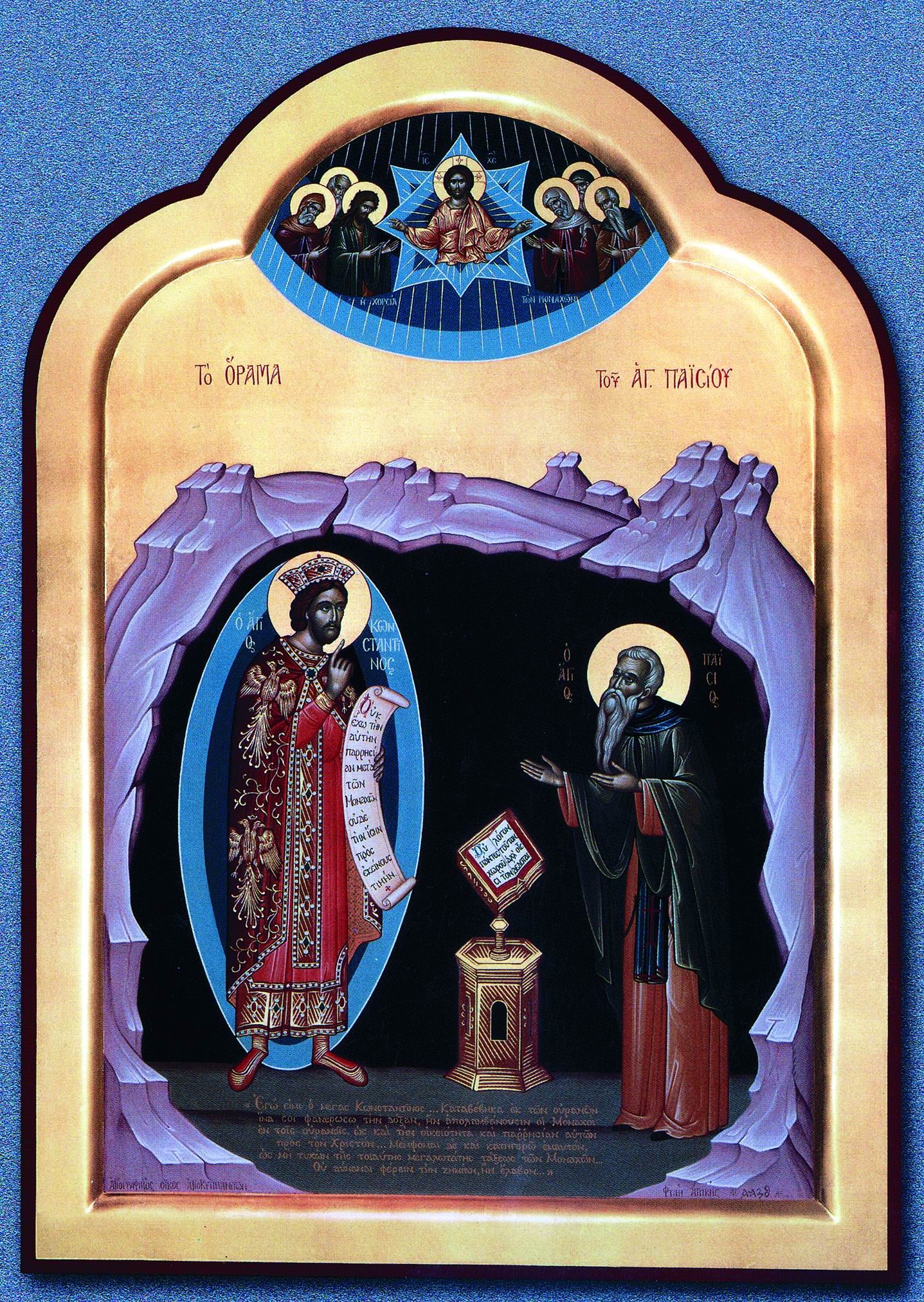
I stumbed across this interesting icon depicting a vision that St. Paisios the Great saw of St. Constantine the Great (http://www.pigizois.net/galery/agiografies/agiografies.htm).


The Vision of St. Paisios (amateur translation)
"I am Constantine the Great...
I descended from heaven to reveal
the glory which monks receive
in heaven, and the closeness [oikeiothta] and boldness
they have towards Christ...
I blame myself and I condemn myself,
for not having been granted this great rank of the Monastics...
I am unable to bear the loss, which I experienced...
I do not have the same boldness as the Monastics,
nor equal honor towards them..."
  
This event is taken from the full life of St. Paisios published in the "Neon Eklogion" ( "Νέον Εκλόγιον"), which is a compendium of numerous full lives of Saints. The full text in Greek of this event I am posting, in addition to my translation below:


Full account of the vision of St. Constantine the Great by St. Paisios (amateur translation)
Therefore (says the righteous John), desiring to see myself as I was able, his special theoria, and to taste of divine grace, I went to him [St. Paisios], and before I knocked on the door of his cell, I heard him speaking with another man. I was reluctant to knock, so I waited outside. The little sound I made, however, was heard by the precious father, and he came outside. He saw me, and was filled with joy and embraced me, and I him. He took me into his cell, where I didn't see anyone else. I was puzzled, and I wondered: who was in here previously and was talking with the Righteous Elder a short time before? And I looked around and saw no one.

The Elder asked me: "Why are you looking here and there in bewilderment, as if you were looking at something strange?"

I replied: "Indeed I see something strange, and I don't know what to think, for a short time ago, I heard the voice of another man who was speaking with you, and now I don't see anyone else. What should I think? I beseech your Holiness to reveal to me this strange mystery.

The divine father told me: "O John, God wishes to reveal to you a strange mystery today, and I must reveal to you the love which the Giver-of-Good-things has for us.

"He whom you heard speaking with me, my perfect friend, was Constantine the Great, the first King of the Christians, who descended from heaven, being sent by God, and told me: 'Blessed are you who have been made worthy of the monastic life, for truly unique is the godly blessing of the Savior towards you.'

"I asked him: And who are you, my Lord, who are saying these things, and magnifying us Monks? He replied: 'I am Constantine the Great, and I descended from the heavens, that I might reveal to you the glory which Monks receive in the heavens, and the closeness and boldness which they have towards Christ. And I magnify you, O Paisios, for you guide them in this holy path of asceticism. I therefore blame and condemn myself, for not being granted this greatest rank of the Monastics, and I cannot bear the loss which I experienced.'

"And again I said: 'Why, O wondrous one, do you judge yourself? Have you not received that eternal glory, and divine illumination?' He replied to me: 'Yes, I have received them, but I do not have that boldness of the Monks, neither glory equal to theirs, for I saw the souls of some Monks who had been separated from the body, and flew as eagles, and with great daring rise to the heavens. And the rank of demons did not dare approach them at all. Then I saw that the gates of heaven were opened for them, and they entered in, and appeared before the heavenly King, standing with great boldness before the throne of God. For this reason, therefore, I am amazed by you Monks, and I bless you, and I condemn myself for not being made worthy of boldness life this. For I wish that I could have left my passing kingdom, and the royal robe and crown, and to become poor, and to wear sackcloth, and to accept all those things that the monastic life seeks.'

"Again I said to him: 'You say this well, O most-holy King, and you console us with these words. However, this must be the judgment of our God, and and we are unable to say anything different regarding divine righteousness. For the Righteous Judge grants to each according to his worth in righteousness, and rewards for the works of everyone, for your unique life did not have the same struggles as the life of Monks, for you had a wife to help you, and your children, and your servants, and different rewards and comforts. For the Monks, disdaining all of the joys of this present life, receive God, instead of the good things of the World. And bearing Him with joy, and special richess, and to be made pleasing to Him, they consider Him their food, and their great reward. And they are, according to the Apostle, 'destitute, afflicted, ill-treated'. Therefore it is impossible, my King, for you to be equal to them.

"And at that point, therefore, you came, O my brother John, and [St. Constantine] straightaway ascended to the heavens. Therefore, now having learned this mystery that has occurred, how good must the pains of asceticism seem. Strengthen the brothers."
______________________________________

St. Constantine, such a great Saint of our Church, is admitting that the glory and boldness before Christ that monastics receive is great. The rich treasure that is Orthodox Monasticism cannot be overstated, and as Fr. Ephraim of Philotheou mentioned in his book Counsels from the Holy Mountain, "An entire army of monastics has filled heaven." May their boldness intercede for us sinners, who are unwilling to apply the teachings of Christ to our lives.
  
Apolytikion of St. Constantine the Great - Plagal of the 4th Tone
Your Apostle among the Rulers, St. Constantine, who once beheld in the sky the image of Your Cross, and who like Paul received his calling not from man, once entrusted the Ruling City into Your hand. We entreat You to restore it in peace forever, at the intercession of the Theotokos, O Lord who loves humanity.

Apolytikion of St. Paisios the Great in the Fourth Tone
The incarnate Angel, and the boast and summit of monks, the bodiless man, the citizen of Heaven, the great God-bearing Paisius celebrateth with us in divine jubilation, granting grace to all them that extol him with rev'rence. With fervour let us honour this day, off'ring him songs of praise.
  
Prayer Attributed to St. Paisios
O Lord, Jesus Christ my God, forsake me not.
O Lord, do not stand afar off from me.
O Lord, stretch out to me a helping hand.
O Lord, support me with the fear of You.
O Lord, plant this fear and the love for You in my heart.
O Lord, teach me to do Your will.
Amen.
Through the prayers of our Holy Fathers, Lord Jesus Christ our God, have mercy on us and save us! Amen!

Sunday, October 19, 2008

Quotes from St. John of Kronstadt

Greetings!

Today is one of the feasts of our Father-among-the-Saints, St. John of Kronstadt. See below for links to his biography and a few quotes by him.

"When you are praying alone, and your spirit is dejected, and you are wearied and oppressed by your loneliness, remember then, as always, that God the Trinity looks upon you with eyes brighter than the sun; also all the angels, your own Guardian Angel, and all the Saints of God. Truly they do; for they are all one in God, and where God is, there are they also. Where the sun is, thither also are directed all its rays. Try to understand what this means."


"There is nothing impossible unto those who believe; lively and unshaken faith can accomplish great miracles in the twinkling of an eye. Besides, even without our sincere and firm faith, miracles are accomplished, such as the miracles of the sacraments; for God's Mystery is always accomplished, even though we were incredulous or unbelieving at the time of its celebration. "Shall their unbelief make the faith of God without effect?" (Rom. 3:3). Our wickedness shall not overpower the unspeakable goodness and mercy of God; our dullness shall not overpower God's wisdom, nor our infirmity God's omnipotence." — My Life in Christ (autobiography of St. John)


-St. John of Kronstadt (October 19, 1829 – December 20, 1908)


Apolytikion to St. John of Kronstadt in the Fourth Tone
O Wonderworker living in Christ for ever, with love have mercy on them that are in danger; hear thy children who call upon thee with faith; be thou compassionate unto them that hope for aid from thee, O Father John of Kronstadt, our beloved shepherd.

Sources:

http://www.orthodoxphotos.com/Holy_Fathers/St._John_of_Kronstadt/index.shtml

http://goarch.org/en/chapel/saints.asp?contentid=2288

http://orthodoxwiki.org/John_of_Kronstadt

Note: Besides his awe-inspiring life and teachings, also see the great prophetic vision that St. John saw, about various topics, including the martyrdom of the Last Czar (St. Nicholas), the Antichrist, etc.