Thursday, March 18, 2010

The Saturday of the Akathist Hymn, and the miraculous icon of Panagia of the Salutations, or Panagia the Myrrh-streamer

The Akathist Hymn to the Most-Holy Theotokos (Icon courtesy of www.eikonografos.com used with permission)

Saturday of the Fifth Week of Great Lent: The Saturday of the Akathist Hymn
"About the year 626, the Persians, Avars, and Slavs came with a great host and besieged the imperial city of Constantinople while the Emperor Heraclius and the main body of the Byzantine army were absent in the East. Enemy ships filled the sea, especially the Golden Horn, and on land the adversaries were ready for attack with foot-soldiers, horses, and engines of war. Though the citizens courageously withstood them, yet they were few in number and would be unable to repulse the attack of such a great host. Hence, they could not count on any other means of salvation, except the protection of the Theotokos. And truly, suddenly a violent tempest broke up all the ships and submerged them, and the bodies of the invaders were cast out near the Blachernae quarter of the city where the famous Church of the Theotokos stood. Taking courage from this, the people went forth from the city and repulsed the remaining forces, who fled out of fear. In 673, the city was miraculously delivered yet again, this time from an invasion of the Arabs. Then in 717-718, led by the Saracen general Maslamah, the Arab fleet laid siege once more to the city. The numerical superiority of the enemy was so overwhelming that the fall of the Imperial City seemed imminent. But then the Mother of God, together with a multitude of the angelic hosts, appeared suddenly over the city walls. The enemy forces, struck with terror and thrown into a panic at this apparition, fled in disarray. Soon after this, the Arab fleet was utterly destroyed by a terrible storm in the Aegean Sea on the eve of the Annunciation, March 24, 718. Thenceforth, a special "feast of victory and of thanksgiving" was dedicated to celebrate and commemorate these benefactions. In this magnificent service, the Akathist Hymn is prominent and holds the place of honour. It appears that even before the occasion of the enemy assaults mentioned above, the Akathist Hymn was already in use as the prescribed Service for the Feast of the Annunciation, together with the kontakion, "When the bodiless one learned the secret command," which has the Annunciation as its theme. It was only on the occasion of the great miracle wrought for the Christian populace of the Imperial City on the eve of the Annunciation in 718 that the hymn "To thee, the Champion Leader" was composed, most likely by Saint Germanus, Patriarch of Constantinople.

Historians have ascribed the Akathist Hymn to Patriarch Sergius of Constantinople (638), to Saint George the Confessor, Bishop of Pisidia (818), or even to Saint Photius the Great (891), all of whom lived either at the time of or after the above-mentioned sieges. However, it appears most likely from its language, content, and style that the true composer of the Akathist Hymn is Saint Romanus the Melodist (6th century)."
(http://goarch.org/chapel/saints_view?contentid=901&PCode=5LENTSa&D=SA&date=3/20/2010)

Miraculous icon of Panagia of the Salutations, Dionysiou Monastery, Mount Athos  (Icon courtesy of www.eikonografos.com used with permission)

Holy Monastery Dionysiou - Panagia of the Salutations the Myrrhgusher
"According to an inscription on the back of this icon, it was given as a gift to Saint Dionysius, founder of the Holy Monastery of Dionysiou on Mount Athos, by Emperor Alexios Komnenos, upon his visit to Trebizond in Asia Minor. According to Holy Tradition, this is the same icon that Patriarch Sergius processed around the walls of Constantinople in 626 A.D. during the reign of Emperor Heraclius. At that time Constantinople was attacked by the Persians and "Scythians" (Avars and Slavs) but saved through the intervention of the Most Holy Theotokos. A sudden hurricane dispersed the fleet of the enemy, casting the vessels on the shore near the great Church of the Theotokos at Blachernae near the Golden Horn. The people spent the whole night in front of this icon thanking her for the unexpected deliverance. In memory of this event the Akathist Hymn is chanted in the Orthodox Church.

In 1592 Algerian pirates stole the icon, but after a fierce storm, a frightening dream, and a great miracle, the leader of the pirates was forced to return it to the monastery. They had hid it in a chest, but the icon shattered it and it was drenched in myrrh. Because of this miracle, some pirates repented and entered the monastery to become monastics.

In 1767 certain theives from Dalmatia stole the icon, and upon their return to Dalmatia were apprehended by Greek shepherds who took the icon and brought it to Skopelos. On Skopelos island the Greek community leaders elected by the Turks, known as Dimogerontes, denied to the Dionysian monks from Mount Athos the return of the icon when they came to request its return. After three months Skopelos was punished by a plague which brought great tragedy to the island, and the Dimogerontes repented and had the icon returned to Dionysiou Monastery and also established a metochion for the monastery on the island.

The icon is small and darkened by time. It is housed in a chapel dedicated to the icon at Dionysiou Monastery where the Akathist Hymn is sung daily."
 
Panagia herself, appearing to the Saints has said: “I will love, I will protect, I will shelter every faithful person who greets me every day that he us able with the beautiful hymns of My Salutations, and who lives in accordance with the law of God. And on the last day of his life, I will defend him before My Son.”

  
Apolytikion in the Plagal of the Fourth Tone
When the bodiless one learned the secret command, in haste he came and stood before Joseph's dwelling, and spake unto the Maiden who knew not wedlock: The One Who hath bowed the Heavens by His descent is held and contained unchanging wholly in thee. Seeing Him receiving the form of a servant in thy womb, I stand in awe and cry to thee: Rejoice, thou Bride unwedded.
   

Kontakion in the Plagal of the Fourth Tone
To you, Theotokos, invincible Defender, having been delivered from peril, I, your city, dedicate the victory festival as a thank offering. In your irresistible might, keep me safe from all trials, that I may call out to you: "Hail, unwedded bride!"

(taken from the Paraklesis to the icon of the Theotokos of the Akathist (in Greek): http://www.pigizois.net/latreia/paraklitikoi_kanones/pdf/paraklitikos_kanon_panagias_akathistou.pdf)

Apolytikion of the Icon of Panagia of the Akathist in the First Tone (amateur translation)
Your Holy icon of the Akathist, our Mother, we now venerate all-reverently, and we glorify You, O Lady. For our protections towards us has come and it pours forth healings from sympathy-from all dangers and sorrows drive away, as we cry out in thanksgiving: Glory to God Who glorified You, glory to Him Who magnified You, glory to You who saved us through Your giving birth!
 
Modern rendering of the wondrous Icon of the Theotokos "Of the Akathist Hymn" from Dionysiou Monastery, Mount Athos (source)
  
Through the prayers of our Holy Fathers, Lord Jesus Christ our God, have mercy on us and save us! Amen!

Wednesday, March 17, 2010

Ode 1 of the Great Canon of St. Andrew of Crete

Tomorrow, the Thursday of the Fifth Week of Great Lent, the Church chants the Great Canon of St. Andrew of Crete in its entirety. I include the first ode below. May Christ grant us all repentance before our end! Amen!

Christ asking Cain: "Where is Abel your brother?", and Lamentation over Abel's body (http://www.srpskoblago.org/Archives/Decani/exhibits/Collections/Genesis/CX4K2232_l.html)

Ode 1 of the Great Canon of St. Andrew of Crete
Eirmos
He is my Helper and Protector, and has become my salvation. This is my God and I will glorify Him. My father's God and I will exalt Him. For gloriously has He been glorified. (Exodus 15:2, 1; Psalm 117:14)

Refrain: Have mercy on me, O God, have mercy on me.
Troparia
1. Where shall I begin to lament the deeds of my wretched life? What first-fruit shall I offer, O Christ, for my present lamentation? But in Thy compassion grant me release from my falls.

2. Come, wretched soul, with your flesh, confess to the Creator of all. In future refrain from your former brutishness, and offer to God tears in repentance.

3. Having rivaled the first-created Adam by my transgression, I realize that I am stripped naked of God and of the everlasting kingdom and bliss through my sins. (Genesis 3)

4. Alas, wretched soul! Why are you like the first Eve? For you have wickedly looked and been bitterly wounded, and you have touched the tree and rashly tasted the forbidden food.

5. The place of bodily Eve has been taken for me by the Eve of my mind in the shape of a passionate thought in the flesh, showing me sweet things, yet ever making me taste and swallow bitter things.

6. Adam was rightly exiled from Eden for not keeping Thy one commandment, O Savior. But what shall I suffer who am always rejecting Thy living words? (Hebrews 12:25; Genesis 3:23)

7. I have willfully incurred the guilt of Cain's murder, since by invigorating my flesh I am the murderer of my soul's awareness, and have warred against it by my evil deeds. (Genesis 4:8)

8. I have not resembled Abel's righteousness, O Jesus. I have never offered Thee acceptable gifts, nor divine actions, nor a pure sacrifice, nor an unblemished life. (Genesis 4:4)

9. Like Cain, we too, O wretched soul, have likewise offered to the Creator of all foul deeds, defective sacrifice and a useless life. Therefore we too are condemned. (Genesis 4:5; Hebrews 11:4)

10. In molding my clay into life, O Potter, Thou didst put in me flesh and bones, breath and vitality. But, O my Creator, my Redeemer and Judge, accept me who repent. (Genesis 2:7; Jeremiah 18:1-10; Romans 9:21)

11. I confess to Thee, O Savior, the sins I have committed, and the wounds of my body and soul which murderous thoughts like robbers within have inflicted upon me. (Luke 10:30)

12. I have sinned, O Savior, yet I know that Thou art the Lover of men. Thou strikest compassionately and pitiest warmly. Thou seest me weeping and runnest towards me as the Father recalling the Prodigal. (Luke 15:20)

13. . In old age even, O Savior, do not cast me out empty to hell as I lie prostrate before Thy gates. But before my end, in Thy love for men, grant me release from my falls.

14. I am the one by my thoughts who fell among robbers; and now I am all wounded by them, full of sores. But stand by me, O Christ my Savior, and heal me. (Luke 10:30)

15. The priest saw me first and passed by on the other side. Then the Levite took a look at my sufferings and disdained my nakedness. But stand by me, O Jesus Who didst dawn out of Mary, and have compassion on me. (Luke 10:31-33)

16. O Lamb of God, Who takest away the sins of all, take from me the heavy yoke of sin, and in Thy compassion grant me tears of compunction (John 1:29)

17. It is time for repentance. I draw near to Thee, my Creator. Take from me the heavy yoke of sin, and in Thy compassion grant me tears of compunction.*

18. Abhor me not, O Savior, cast me not away from Thy face. Take from me the heavy yoke of sin, and in Thy compassion grant me release from my falls.*

19. All my sins, voluntary and involuntary, obvious and secret, known and unknown, forgive, O Savior, for Thou art God; be merciful and save me.

20. From my youth, O Christ, I have rejected Thy commandments. I have passed my whole life without caring or thinking as a slave of my passions. Therefore, O Savior, I cry to Thee: At least in the end save me.

21. I have squandered in profligacy my substance, O Savior, and I am barren of virtues and piety; but famished I cry: O Father of mercies, forestall and have compassion on me. (Luke 15:13. ,17)

22. I fall prostrate before Thee, O Jesus. I have sinned against Thee, be merciful to me. Take from me the heavy yoke of sin, and in Thy compassion grant me tears of compunction.

23. Enter not into judgment with me, by recording my deeds, demanding an account of my words, and examining my motives and desires. But in Thy compassion disregard my terrible past and save me, O God All-Powerful.

  
ANOTHER CANON, OF SAINT MARY OF EGYPT
To the same Tone and Eirmos
Refrain: Holy mother Mary, pray for us.
To St. Mary of Egypt: Grant me that illuminating grace from on high given thee by Divine Providence that I may escape the darkening of the passions and fervently sing of the thrilling achievements of thy life, O Mary.

Refrain: Holy mother Mary, pray for us.
To St. Mary of Egypt: By submitting to Christ's divine laws Thou didst draw near to Him, having left the unbridled craving for pleasure, and with all discretion thou didst achieve every virtue as one.

Refrain: Holy father Andrew, pray for us.
To St. Andrew of Crete: By thy prayers, O Andrew, deliver us from degrading passions, and make us who with faith and love sing of thee partakers now of the Kingdom of Christ, O renowned father, we pray.

Glory to the Father, and to the Son, and to the Holy Spirit
To The Trinity: Superessential Trinity, adored in Unity, take from me the heavy yoke of sin, and in Thy compassion grant me tears of compunction.

Now and ever, and to the ages of ages. Amen.
Theotokion
Mother of God, hope and intercessor of those who sing of thee, take from me the heavy yoke of sin, and as thou art our pure Lady, accept me who repent.
(http://www.orthodox.net/greatlent/great-canon-fifth-week.html; available in pdf here: http://www.orthodox.net/greatlent/great-canon-fifth-week.pdf)
  
St. Andrew Archbishop of Crete - Commemorated on July 4th (http://ocafs.oca.org/FeastSaintsViewer.asp?FSID=101894)

Through the prayers of our Holy Fathers, Lord Jesus Christ our God, have mercy on us and save us! Amen!

The Divine Fire of the Divine Liturgy

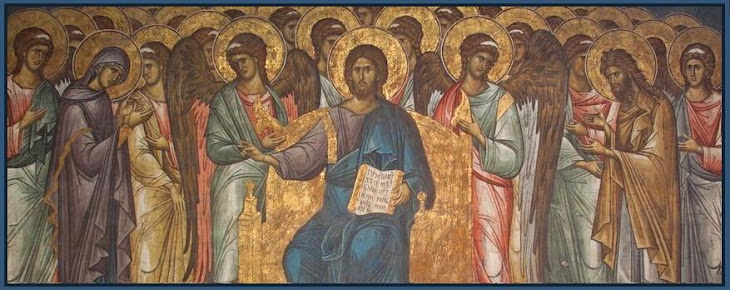
Christ on the Altar surrounded by Angels during the Divine Liturgy (http://www.srpskoblago.org/Archives/Gracanica/exhibits/digital/dome/large/dome-14.jpg)

The Divine Fire of the Divine Liturgy
"An Elder once narrated the following story:

One time, a Bishop visited a village on a Sunday and said to his deacons:

-Look for the priest of the village to celebrate for us the offering of the Holy Mysteries (i.e. the Divine Liturgy.)

Indeed, the deacons searched and found the priest. He appeared to be simple and uneducated villager. So, they led him before the Bishop and the Bishop urged him to celebrate the Divine Liturgy.

After this simple priest entered the Holy Sanctuary, the Bishop sees him, from the moment that he stood before the Holy Altar, to be fully covered with fire and not to be consumed by it.

When the Divine Liturgy was over, the Bishop calls the priest close to him at the vestry and says to him:

-Bless me, worthy servant of God.

Astonished the priest replies to him:
-How is it possible that a Bishop who ordains the priest, to be blessed by the priest?

-I do not have the power, the Bishop replied again, to bless a priest who consecrated the Holy Gifts to God being aflame from supernatural fire and not to be consumed. Certainly the lesser in value is blessed by the
greater.

With utmost humility the priest replied: Is it ever possible, Honorable Master, [for] a Bishop or a priest, to celebrate the awesome and life-giving Mysteries and not to be girdled by divine fire?

The Bishop, as soon as he heard this from the simple priest, he marveled so much, the purity of the man and the unpretendness of his ways. He departed, greatly benefited."
(Evergetinos Book 1 vol. 4 pg. 31-32; http://www.greekorthodoxmonastery.org/MAGAZINE%20ENG.pdf)

Through the prayers of our Holy Fathers, Lord Jesus Christ our God, have mercy on us and save us! Amen!

Monday, March 15, 2010

Selected Quotes of the Fathers on Vainglory, Pride, and Humility

Christ the Bridegroom (Icon courtesy of www.eikonografos.com used with permission)

Selected Quotes of the Fathers on Vainglory, Pride, and Humility
"Adam became so proud that he wished to become God and died for his pride; the Son of God humbled Himself unto death, and gave life to the fallen. O abyss of humility! Adam and Eve lost themselves through gluttony, the Lord fasted and died for them, in order to give them life. They were disobedlient, Christ fulfilled obedience."
St. John of Kronstadt - My Life in Christ

"Flee vainglory, and you will be glorified; fear pride, and you will be magnified."
St. Isaac the Syrian - "Ascetical Homilies" (Homily Five)

"Pride does not perceive that it walks in darkness and, as being darkened, it does not know the insight of wisdom. For this reason in its own murky thoughts it elevates itself above all, whereas it is more vile and more feeble than any, and it is incapable of learning the ways of the Lord. And the Lord conceals His will from it, because it did not choose to walk in the path of the humble."
St. Isaac the Syrian - "Ascetical Homilies" (Homily Nineteen)
(http://scienceofsalvation.blogspot.com/)

“The sun shines on all alike, and vainglory beams on all activities. For instance, I am vainglorious when I fast; and when I relax the fast in order to be unnoticed, I am again vainglorious over my prudence. When well-dressed I am quite overcome by vainglory, and when I put on poor clothes I am vainglorious again. When I talk I am defeated, and when I am silent I am again defeated by it. However I throw this prickly-pear, a spike stands upright.”
St. John Climacus - The Ladder of Divine Ascent (Step 22, Section 5)

“An angel fell from Heaven without any other passion except pride, and so we may ask whether it is possible to ascend to Heaven by humility alone, without any other of the virtues.”
St. John Climacus - The Ladder of Divine Ascent (Step 23, Section 12)
(http://www.hchc.edu/hellenic/campus_life/vocation/OCTEV_Resources/quotes/johnclimacus.html)

"When pride retreats from a man, humility begins to dwell in him, and the more pride is diminished, so much more does humility grow. The one gives way to the other as to its opposite. Darkness departs and light appears. Pride is darkness, but humility is light."
St. Tikhon of Zadonsk - "Journey to Heaven"

"Pride prevents the soul from setting on the path of faith."
Staretz Silouan - "Wisdom from Mount Athos"

"Humility is a Heavenly siphon which from the abyss of sins can raise the soul to Heaven."
St. John Climacus - The Ladder of Divine Ascent (Step 25)

"When blessed Anthony saw all the snares of the devil spread out everywhere, he sighed, and asked God how anyone could ever avoid them. God answered him, 'Humility. It is humility that enables you to escape them all!' And what is more astonishing, He added, 'They cannot even touch you'."
St. Dorotheos of Gaza - "Discourses and Sayings" (On Humility)

"...The work of fulfilling the Commandments generates a state of humility."
Abba Dorotheos of Gaza - "Discourses amd Sayings"

"Let us humble ourselves and the Spirit of God Himself will instruct the soul."
Staretz Silouan - "Wisdom from Mount Athos"
(http://scienceofsalvation.blogspot.com/)

Through the prayers of our Holy Fathers, Lord Jesus Christ our God, have mercy on us and save us! Amen!

Friday, March 12, 2010

St Gregory Dialogos, the Pope of Rome

St Gregory Dialogos, the Pope of Rome - Commemorated on March 12th (http://ocafs.oca.org/FeastSaintsViewer.asp?SID=4&ID=1&FSID=100789)

Life of the Saint
"Saint Gregory Dialogus, Pope of Rome, was born in Rome around the year 540. His grandfather was Pope Felix, and his mother Sylvia (November 4) and aunts Tarsilla and Emiliana were also numbered among the saints by the Roman Church. Having received a most excellent secular education, he attained high government positions.

Leading a God-pleasing life, he yearned for monasticism with all his soul. After the death of his father, St Gregory used his inheritance to establish six monasteries. At Rome he founded a monastery dedicated to the holy Apostle Andrew the First-Called, where he received monastic tonsure. Later, on a commission of Pope Pelagius II, St Gregory lived for a while in Constantinople. There he wrote his Commentary on the Book of Job.
After the death of Pope Pelagius, St Gregory was chosen to the Roman See. For seven months he would not consent to accept this service, considering himself unworthy. He finally accepted consecration only after the persistent entreaties of the clergy and flock.

Wisely leading the Church, St Gregory worked tirelessly in propagating the Word of God. St Gregory compiled the Liturgy of the Presanctified Gifts in the Latin language, which before him was known only in the verbal tradition. Affirmed by the Sixth Ecumenical Council, this liturgical service was accepted by all the Orthodox Church.

He zealously struggled against the Donatist heresy; he also converted the inhabitants of Brittany pagans and Goths, adhering to the Arian heresy to the True Faith.

St Gregory has left behind numerous written works. After the appearance of his book, DIALOGUES CONCERNING THE LIFE AND MIRACLES OF THE ITALIAN FATHERS (DIALOGI DE VITA ET MIRACULIS PATRUM ITALIORUM), the saint was called "Dialogus." His PASTORAL RULE (or LIBER REGULAE PASTORALIS) was well-known. In this work, St Gregory describes the model of the true pastor. His letters (848), dealing with moral guidance, have also survived.

["He is renowned especially for his writings and great almsgiving, and also because, on his initiative, missionary work began among the Anglo-Saxon people. It is also from him that Gregorian Chant takes its name; the chanting he had heard at Constantinople had deeply impressed him, and he imported many elements of it into the ecclesiastical chant of Rome." (http://goarch.org/chapel/saints_view?contentid=2020&type=saints)]

St Gregory headed the Church for thirteen years, ministering to all the needs of his flock. He was characterized by an extraordinary love of poverty, for which he was granted a vision of the Lord Himself.

Pope St Gregory the Great, as he is known, died in the year 604, and his relics rest in the cathedral of the holy Apostle Peter in the Vatican."
(http://ocafs.oca.org/FeastSaintsViewer.asp?SID=4&ID=1&FSID=100789)


Works by the Saint
-The Presanctified Divine Liturgy (http://www.anastasis.org.uk/presanctified.htm)
-Dialogue II: The Life of St. Benedict of Nursia (http://www.fordham.edu/halsall/basis/g1-benedict1.html)
-Pastoral Rule (http://www.newadvent.org/fathers/3601.htm)***
-Register of Letters (http://www.newadvent.org/fathers/3602.htm)***
-Morals on the Book of Job (http://www.lectionarycentral.com/GregoryMoraliaIndex.html)***
***Note: The links to definitions and the footnotes within these pages may present non-Orthodox information.

Selected Quotes from the Saint
"Every day you provide your bodies with good to keep them from failing. In the same way your good works should be the daily nourishment of your hearts. Your bodies are fed with food and your spirits with good works. You aren't to deny your soul, which is going to live forever, what you grant to your body, which is going to die."

"For to despise the present age, not to love transitory things, unreservedly to stretch out the mind in humility to God and our neighbor, to preserve patience against offered insults and, with patience guarded, to repel the pain of malice from the heart, to give one's property to the poor, not to covet that of others, to esteem the friend in God, on God's account to love even those who are hostile, to mourn at the affliction of a neighbor, not to exult in the death of one who is an enemy, this is the new creature whom the Master of the nations seeks with watchful eye amid the other disciples, saying: 'If, then, any be in Christ a new creature, the old things are passed away. Behold all things are made new' (2 Cor. 5:17)."

"We truly love God and keep His commandments if we restrain ourselves from our pleasures. For he who still abandons himself to unlawful desires certainly does not love God, since he contradicts Him in his own intentions.... Therefore, he loves God truly, whose mind is not conquered by consent to evil delight. For the more one takes pleasure in lower things, the more he is separated from heavenly love."

"I say it without the least hesitation, whoever calls himself the universal bishop, or desires this title, is, by his pride, the precursor of Antichrist, because he thus attempts to raise himself above the others. The error into which he falls springs from pride equal to that of Antichrist; for as that Wicked One wished to be regarded as exalted above other men, like a god, so likewise whoever would be called sole bishop exalteth himself above others....You know it, my brother; hath not the venerable Council of Chalcedon conferred the honorary title of 'universal' upon the bishops of this Apostolic See [Rome], whereof I am, by God's will, the servant? And yet none of us hath permitted this title to be given to him; none hath assumed this bold title, lest by assuming a special distinction in the dignity of the episcopate, we should seem to refuse it to all the brethren."
(http://orthodoxwiki.org/Gregory_the_Dialogist)

Excerpt from The Morals on the Book of Job - Commentary on Job 18:25:
"Ver. 25. For I know that my Redeemer liveth.
For he who does not say, ‘Creator,’ but ‘Redeemer,’ expressly tells of Him, Who after He created all things, appeared Incarnate amongst us, that He might redeem us from a state of bondage, and by His Passion set us free from death everlasting; and mark with what sure faith he makes himself secure in the power of His Divine Nature, of Whom it is said by Paul, For though He was crucified through weakness, yet He liveth by the power of God. [2 Cor. 13, 4] For he says, For I know that my Redeemer liveth. As if he said in express terms; ‘The unbelievers may know that He was scourged, mocked, struck with the palms of the hand, covered with a crown of thorns, besmeared with spittings, crucified, dead: I, with sure faith, believe Him to live after death; I confess with unreserved voice, ‘that my Redeemer liveth,’ Who died by the hands of wicked men.’ And how, O blessed Job, through His Resurrection, thou trustest to the resurrection of thine own flesh, declare, I pray, in open speech. It goes on; And that I shall rise at the last day from the earth."
(http://www.lectionarycentral.com/GregoryMoralia/Book14.html)

Icon of Sts. Theophanes the Confessor, Gregory Dialogos, and Symeon the New Theologian, commemorated on March 12th (http://christopherklitou.com/icon_12_march_theophan_confessor_gregory_dialogist_symeon_newtheologian.htm)

Troparion - Tone 4
Receiving divine grace from God on high, glorious Gregory, and strengthened with its power, you willed to walk in the path of the Gospel, most blessed one. Therefore you have received from Christ the reward of your labors. Entreat Him that He may save our souls.

Kontakion - Tone 3
Father Gregory, you showed yourself to be an imitator of Christ, the chief Shepherd, guiding the orders of monks to the fold of heaven. You taught the flock of Christ His commandments. Now you rejoice and dance with them in the mansions of heaven.

Through the prayers of our Holy Fathers, Lord Jesus Christ our God, have mercy on us and save us! Amen!

Thursday, March 11, 2010

St. Theodora the Righteous, Queen of Arta and Epiros


“Theodora has been one of the most emblematic figures of Arta, queen of Epirus and later on a saint of the city. Religious and modest she devoted her life to God, although she had quite an unsettling life...

Descendant of the family of Petralife, an Italian family from Alife, a town near Caserta in the south of Italy, Theodora was, according to the historical sources, related to Petro di Alife, one of the crusaders that participated in the First Crusade during the 11th century.

Icon of the Holy Royal Saints Ypomoni, Theodora of Arta and Theophano (source)
   
Her father was Ioannis Petralife, commander of Thessaly and Macedonia, while her mother Helen was member of an aristocratic family in Constantinople.

Born in 1210 in Serbia of Kozani and soon after her father’s death she was taken under protection by the ruler of Epirus, Theodoros Aggelos Komninos. From 1224 until 1230 she remained under his custody. In 1230 and soon after his defeat by the Bulgarians, Theodoros gave away his throne to his nephew Michael II and son of Michael I who founded Epirus. Komninoi Doukes settled in Epirus just after the 1204 crusades in Constantinople.

  
Michael II met young Theodora and was impressed by her beauty and her character so much that he asked her to marry him. As soon as they got married, Theodora moved to Arta where she became queen.

The couple was not at all compatible. On the one hand, Theodora was very religious and on the other hand Michael enjoyed the carnal relationships. Unable to follow Michael in his social life, Theodora was forced to withdraw and the gap between them started to grow bigger. At this point the ruler of Epirus fell in love with Gaggrini, a local woman belonging to the high society of Arta. His love for this woman pushed him to bring her in the Royal Courtyard and soon next to him on the throne of Epirus, together they had two sons. It was at this point that Queen Theodora decided to abandon the palace, wondering for almost five years on the Mountains of Tzoumerka.

According to the author of her biography, monk Job who lived in the 17th century, Theodora, escorted by her son Nikiforos, was wondering on the mountains for almost five years feeding only on cabbages. Although she was suffering, Theodora never lost her faith to God. After five troubled years a priest from Prenista, today known as Korfovouni, took her in and offered her a shelter.

The icon of St. Theodora of Arta being carried in procession (http://www.imartis.gr/imartis/eidiseis.php?action=fullnews&showcomments=1&id=87)

Theodora was eventually traced down. The people of Arta, who adored her for her modesty, religiousness and philanthropies, outraged by the vicious life of Michael II, demanded her return to the palace as the lawful Queen. Michael II was confronted with this public demand and was ‘forced’ to take Theodora back, at the same time Gaggrini was forced to leave the royal courtyard.

The queen continued her work and philanthropies more intense than ever. She had four more children; Ioannis, Demetrios, Helen and Anna and she was now following Michael everywhere. In a gesture of sincere regret for his behaviour towards his wife, Queen Theodora, Michael built many glorious byzantine monuments in Arta. He founded the monastery of Kato Panagia, owned by Theodora, the Monastery of Panagia Vlahernon in the local village of Tzoumerka Mt and the monastery of Aghios Georgios where Queen Theodora retreated after Michael’s death in 1270. In this very monastery she spent the last ten years of her life until her death in 1280 or 1281.

Theodora was procured a saint (Aghia) by the people of Arta who honoured her in this way for her devotion to God and her philanthropies. She was buried in the monastery of Aghios Georgios, which eventually became a temple named after her.

Theodora’s memory is honoured every year on 11th March and her remains are still kept in a silver case on the right hand side of the temple. The case is shown every year on 11th March around the city. Additionally, her figure is depicted on the iconographies of the monastery of Kato Panagia.”
(http://www.artainfo.gr/artagreece/artaprefecture/importantpersons/agiatheodora/index.html)

The Monastery of Kato Panagia, built by St. Theodora of Arta (http://www.imartis.gr/imartis/katopanagia.htm)

The Bishop venerating the Holy Relics of St. Theodora of Arta in her church on her feast (http://www.imartis.gr/imartis/eidiseis.php?action=fullnews&showcomments=1&id=87)

The full Greek life of the Saint is available here: http://www.imartis.gr/imartis/pdf/AgTheodora.pdf.

For the full life of the Saint in English, translated by Talbot, see: http://www.doaks.org/publications/doaks_online_publications/HolyWomen/talbch10.pdf.
 
 
Ἀπολυτίκιον. Ἦχος α’. Τῆς ἐρήμου πολίτης.
Βασιλείου ἀξίας παριδοῦσα τὴν εὔκλειαν, ἐγκρατείᾳ καὶ πόνοις καὶ ἀσκήσει ἐβίωσας, καὶ θείων ἐπληρώθης δωρεῶν, Ὁσία Θεοδώρα ἀληθῶς. Διὰ τοῦτό σε ἡ Ἄρτα χαρμονικῶς, γεραίρει ἀνακράζουσα· δόξα τῷ σὲ δοξάσαντι Χριστῷ, δόξα τῷ σὲ στεφανώσαντι, δόξα τῷ ἐνεργοῦντι διὰ σοῦ, πᾶσιν ἰάματα.

Apolytikion of St. Theodora of Arta the Righteous in First Tone (amateur translation)
You abandoned royal honors, and lived in chastity and pains and asceticism, and were truly filled with divine gifts, O Righteous Theodora. Because of this Arta harmonically praises you crying out: Glory to Christ Who glorified you, Glory to Him Who crowned you, Glory to Him Who works for us through you, healings of all.

Κοντάκιον. Ἦχος β’. Τοὺς ἀσφαλεῖς.
Βασιλικὴν τιμὴν καὶ δόξαν καταλέλοιπας, καὶ ἐν ἀσκήσει τὴν ζωὴν διήνυσας, Θεοδώρα παμμακάριστε, γέρας τῆς Ἄρτης καὶ διάδημα· διό σου τῇ σεπτῇ θήκῃ προσπίπτοντες, ἁγιασμὸν ἐκ ταύτης κομιζόμεθα, ὑμνοῦντες Χριστὸν τὸν σὲ δοξάσαντα.

Kontakion in the Second Tone (amateur translation)
You forsook royal honor and glory, and spent your life in asceticism, O Theodora most-blessed, honor and adornment of Arta, therefore bowing before your sacred relics, we partake of blessings from them, praising Christ Who glorified you.
   
Μεγαλυνάριον.
Χαίροις βασιλίδων ἡ καλλονή, χαίροις τῶν Ἀρταίων, ἐγκαλώπισμα ἱερόν· χαίροις δωρημάτων, ταμεῖον οὐρανίων, Ὁσία Θεοδώρα, ἀξιοθαύμαστε.

Megalynarion (amateur translation)
Hail the pride of rulers, hail holy boast of the people of Arta, hail treasury of heavenly gifts, O Righteous Theodora, worthy of honor.


Through the prayers of our Holy Fathers, Lord Jesus Christ our God, have mercy on us and save us! Amen!

Wednesday, March 10, 2010

Sermon of St. Theodore the Studite for the Fourth Wednesday of Great Lent

Christ the Great High Priest (Icon courtesy of www.eikonografos.com used with permission)

Catechesis 66 of St. Theodore the Studite: That This Pascha Is a Type of the Future and Eternal Pascha; and About Endurance and Courage
Given on the Fourth Wednesday of the Great Fast

"Brethren and fathers, Lent is already galloping past and the soul rejoices at the imminence of Pascha, because by it it finds rest and is relieved of many toils. Why did this thought sound for me in advance? Because it is as if our whole life directs its reason contemplating the eternal Pascha. For this present Pascha, even though it is great and revered, is nevertheless, as our fathers explain, only a type of that Pascha to come. For this Pascha is for one day and it passes, while that Pascha has no successor. From it "pain, grief and sighing have fled away"[1]; there everlasting joy, gladness and rejoicing; there the sound of those who feast[2], a choir of those who keep festival and contemplation of eternal light; where there is the blessed breakfast[3] of Christ and the new[4] drink of which Christ spoke, "I shall not drink of the fruit of this vine, until I drink it with you new in the kingdom of my Father".[5] Of this He spoke to his disciples when He was about to ascend to heaven, "I am going to prepare a place for you and, if I go, I will prepare a place for you. I am coming again and I will take you to myself, so that where I am you maybe also. And where I am going you know, and the way you know."[6] And a little further on, "On that day you will know that I am in the Father, and you are in Me, and I am in you."[7] And elsewhere, "Father, I wish that where I am they may be with Me also, so that they may see My glory, which You gave Me, because You loved from before the foundation of the world."[8] But because this concerns not only the Apostles, but also ourselves, He also said, "I do not ask this only for them, but also for those who through their word believe in Me, so that all may be one, as You, Father, are in Me and I am in You, that they may also be one in Us."[9] What could be more comforting than these words? What could be more appealing? What soul can they not soften? What heart not prick with compunction, even should someone say that the human heart is a nature of stone? With thoughts like these the saints bore all that they bore, considering afflictions as joys, constraints as freedoms[10], struggles as delights, harsh training as relaxation, deaths as lives.

I beseech you, my brother, should not we also, since we have the same aim and seek the same Pascha, bravely and courageously bear our present condition, not falling, not succumbing to despondency, but rather roused with greater fervour watching for the wicked serpent who works to deceive us by the passions, transforming himself into an angel of light,[11]and altering things from what they are; show dark as light, bitter as sweet. This was how he ensnared our forefather, bewitching his sight and depicting as beautiful what was not, and as a result through food casting him out of Paradise. But let us, who have learned by experience what a deceiver he is, not leave the paradise of God’s commandments, nor, when he indicates to us that the fruit is beautiful, let the eye of soul or body be directed there, otherwise we are being caught in the snare. But let us flee by every means from looking. What is the fruit which seems beautiful? The love of the flesh, the evil lust of every one of the destructive passions. If we avoid experiencing them, my brothers, we shall be saved and easter[12] to age on age, with all the Saints in Christ Jesus our Lord, to whom be glory and might with the Father and the Holy Spirit, now and for ever, and to the ages of ages. Amen.
  
Notes:
[1] Isaiah 35:10. The phrase is familiar from the prayer for the departed.
[2] Cf. Psa. 42:4, where the Greek has a singular. The same phrase is found, but with the plural, in the prayers after Communion.
[3] Cf. John 21:12.
[4] The Greek has koinon, ‘common’, but the word should be kainon, ‘new’, as the following citation makes clear. There is also an echo of the Paschal canon, ‘Come, let us drink a new drink’ (poma kainon).
[5] Matthew 26:29.
[6] John 14:2-4.
[7] John 14:20.
[8] John 17:24.
[9] John 17:20-21.
[10] It is difficult to reproduce the play in Greek on stenochoria and evrychoria.
[11] 2 Corinthians 11:14.
[12] St Theodore uses a very rare verb paschazein, and temptation to follow G. M. Hopkins and use ‘easter’ as a verb is irresistible. The only reference in Lampe is to St Theodore’s contemporary Theophanes, who uses it of the Quartodecimans, who ‘easter’ with the Jews.
(http://www.johnsanidopoulos.com/2010/03/sermon-for-fourth-wednesday-of-great.html)

For many excellent sermons of St. Theodore the Studite used throughout the Great Fast, see: http://www.anastasis.org.uk/lent.htm.

St. Theodore the Studite - Commemorated on November 11th (http://christopherklitou.com/icon_11_nov_theodore_the_studite.htm)
  
Through the prayers of our Holy Fathers, Lord Jesus Christ our God, have mercy on us and save us! Amen!