Monday, May 6, 2013

Sts. Raphael, Nicholas and Irene save a trauma patient

Christ is risen! Truly He is risen!
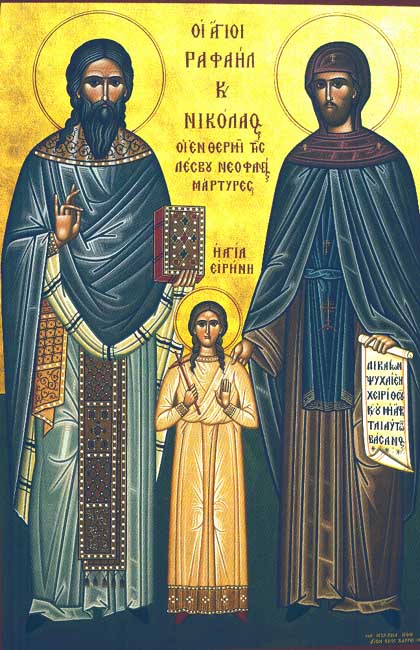
Sts. Raphael, Nicholas and Irene the Newly-revealed Martyrs - Commemorated on Bright Tuesday (source)
   
How A Cerebrally Dead Greek Young Man Was Reanimated!
On Bright Tuesday of 17th May 2000, His Eminence the Metropolitan of Goumenissa, Axioupolis and Polykastron Mr. Demetrios, the local authorities and a multitude of pilgrims gathered at the Holy Monastery of Saints Raphael, Nicholas and Irene to celebrate the feast of these three Newly-Revealed Orthodox Saints.

Closing his sermon to the congregation, the Metropolitan reported the personal testimony of pilgrims present at the congregation who had made public the outstanding experience of their miraculous healings by the Newly-Revealed Saints: Mr. Isaac Kapoulas – a policeman from Thessaloniki who had been cured from leukemia; Mrs. Aikaterini Tsotopoulou – a woman also from a suburb of Thessaloniki who had recovered from a severe craniocerebral injury; Mr. Stergios Ledas - a man from nearby Kilkis who had also recovered from heavy head injury; and Mr. Zacharias Georgousis from the local village of Vafeiohori who had been saved from an allergic shock.

Following the procession of the holy relics of the three saints, the congregation met again to listen to the astounding account by a high school pupil from the Terpni village in the neighboring area of Nigrita, Serres and his mother. The young man named Apostolos Gazepis narrated his miraculous healing from the injuries of a traffic accident on 5/5/2000, although the doctors had given up every hope for recovery and had therefore tried to persuade his parents to consent for his vital organs to be donated. The firm faith of his mother who never stopped praying for eight days to the Newly-Revealed Saints Raphael, Nicholas and Irene outside the Intensive Care Unit contributed to the reanimation and full recovery of the patient that also had the honor to see the Saints.

In her signed account of this overwhelming event, Mrs. Sophia Gazepi, mother of Apostolos, describes the tragic days until her son’s reanimation. It was on the 5th of May 2000, which was Bright Friday of the Zoodochos Pege, that her 17-year-old son Apostolos was riding a motorbike and crashed into a car. He was taken to the local hospital and then hurried to the General Hospital of Serres. Following a CT-scan of the head, the doctors informed the father that his son had suffered severe craniocerebral injury and, provided they managed to stabilize his cerebral pressure without further complications, there would be hope for recovery.

On the following day Mrs. Sophia asked for books about the miracles of Saint Raphael and began reading them and praying day and night along with the relatives and neighbours that stood by her side. In those very few moments she was allowed into the Critical Care Unit, and she blessed her son with the blessed oil from the Saints’ church.

The patient was attended by neurosurgeon Mr. Vogas. On the third day, the cerebral pressure rose high, the brain was bleeding and the young man was perishing. In their despair, his parents called for another specialist, although the attending doctor had reassured them that it was no longer a matter of medical care since the patient's condition was deteriorating. Dr. Nikolaos Baskinis was however brought from Thessaloniki, only to confirm the critical condition of the patient, especially regarding the heamatomas at the back of his head that made recovery doubtful. There was a faint hope if they operated on him, so the parents gave their consent. The operation revealed more wounds than the CT-scan and because the brain was swollen the doctors decided to leave the skull open and see what would follow. As soon as the neurosurgeons had left, the Hospital doctors announced to the parents that the young man was cerebrally dead. On Friday night, seven days after the accident, the Brain Death Determination Test was positive. The doctor on duty called the parents asking them to take courage and comfort themselves with their other child because Apostolos was dying since only his heart was beating. The mother was painfully praying to our Lord to bring her son to life as He had done with Lazarus.

All through this time, the parents, relatives, fellow-pupils, friends and acquaintances had been ceaselessly praying for Apostolos. They had talked to the Saints’ monasteries on the island of Lesvos and in the nearby location of Griva, asking for a commemoration of the young man’s name in the services. On the previous Tuesday, Apostolos’s mother had gone to the Church of the Mother of God in the town of Serres to attend the Supplication Service (Paraklesis) to the three Newly-Revealed Saints.

On Saturday there was the first evidence of relative improvement: seven Brain Death Confirmation tests were positive against two negative! By noon, his condition had further improved. Fateful visions seen by close relatives raised their hopes for the substantial assistance of the Virgin Mary and the Newly-Revealed Saints. After the 13th of May 2000, Apostolos started to recover. The neurosurgeon asked them to call him ‘Lazarus’ after that, because he had actually been ‘risen’ from death.

The medical report written by the neurosurgeon Dr. Evaggelos Vogas stated: “During his CT-exam, the patient needed intubation because of his comatose condition. The findings of the CT-scan were the following: fracture of left occipital bone with an underlying contusion of the left hemisphere of the cerebellum; extensive haemorrhagic contusions on the right frontal lobe with an ipsilateral fine subdural heamatoma; a dislocation of the median line to the left; and the receptacles of the cerebral base were closed ... On the evening hours of 5/8/2000 his Intracranial Pressure raises, which is very difficult to control ... On 5/9/2000 the patient is taken to OR for craniotomy and partial removal of contused right frontal lobe. At the end of the operation, the brain is pulsating, the subdural area is left open, while the pupils are in dilation with no reaction to light stimuli... On 5/12/2000 all Brain Death Determination tests are positive. On 5/13/2000 pupillary dilation retires and reaction to light is evident. Progressively until 5/16/2000 the patient starts breathing on his own....”

When Apostolos recovered, he had a problem with his left arm because of multiple injuries and the procedures during his intensive therapy. Among the many doctors he visited, Dr. Ilias Tsorlinis (of the Neurophysiology Laboratory) diagnosed ‘diffuse degeneration of the ulnar nerve on the left forearm, below the level of the branch projection for the ulnar flexor of the wrist, with no focal conduction block.’

One night Apostolos himself saw Saint Nicholas the Deacon in a vision talking to his father: "You have gone to so many doctors; why haven’t you come to me too?" His father answered: "How are you going to heal this?" and the Saint replied: "You know how."

In a second vision, Apostolos found himself in a chapel with icons and a table in the centre with the decapitated head of Saint Raphael. As he hesitated to approach the table, the Saint appeared in full form before him and told him how many times he had attended church lately, then grasped his arm, recited a prayer, and at this touch Apostolos’s arm was illuminated. His arm recovered fully in a short time!

In the life of Saint Symeon the New Theologian (written by Saint Nikitas Stethatos) we read: “The real visions remain in the mind for many years later, even until the end of life, as these had originally been revealed. Saint Gregory the Theologian testifies to that in his speech to Ceasarios ... And when he saw something related to his ill mother, the outcome proved that the vision had been real."

This article first appeared in Greek in issue no. 96 of 'Epaggelia' [‘The Promise’], the newsletter of the Holy Diocese of Goumenissa, Axioupolis and Polykastron, in May 2001.

   
Apolytikion in the Fourth Tone
On Lesvos, ye strove in contest for the sake of Christ God; ye also have hallowed her with the discovery of your relics, O blessed ones. O God-bearer Raphael, with thee, we all honour Nicholas the deacon and Irene the chaste virgin, as our divine protectors, who now intercede with the Lord.

Kontakion in the Fourth Tone
Ye shone on the world like stars first as ascetics, then as athletes slain for Christ, and were translated to the heights through the great torments that ye endured; and them that praise you, ye keep and protect, O Saints.
   

Christ has risen from the dead, by death he has trampled on death, and to those in the graves given life!
Truly the Lord is risen!

The 179 Venerable Martyrs of Ntaou Penteli

Christ is risen! Truly He is risen!

The 179 Holy Martyrs of Ntaou Penteli Monastery - Commemorated on Bright Tuesday (source)
   
The horrifying account of the martyrdom of the 179 holy martyrs of Pantokratoros Monastery in Ntaou Penteli was recorded soon after the event of 1680 by Cyril Degleri, abbot of Penteli Monastery. He and others record how Algerian pirates (some say they were Turkish or Albanian-Turkish pirates) docked their ship at the nearby port of Rafina during Holy Week of 1680. After failing in its raid of the fortified Ntaou Penteli Monastery in search of its treasures, under mysterious circumstances a servant of the monastery decided to betray the fathers and told the pirates of an access point otherwise unknown to outsiders (and recently discovered by archaeologists).

On Pascha, during the midnight service, after the final "Christ is Risen!" was joyfully chanted by the fathers following the Divine Liturgy, the pirates stormed into the katholikon and began the gruesome slaughter. 179 monks and hieromonks, including the abbot, were massacred by the pirates. The pirates took their treasure and escaped back to Rafina, after having set fire to the monastery.

Two escaped martyrdom however. One was a hieromonk and the other was a novice. They were not at the monastery that tragic evening, as they travelled to neighboring Nea Makri to serve the Paschal Divine Liturgy at a metochion of Pantokratoros Monastery where there were monks that kept the animals and farms of the monastery in Herotsakouli. They returned to Ntaou Penteli on Pascha Sunday evening only to find two dead monks at the entrance and their monastery burned down, save for the katholikon (which survives till today). When they entered the katholikon, they saw dozens of the fathers in a pool of blood. Some had been severely beaten, while others were cut in pieces.

On Bright Monday morning the heiromonk and the novice set out to seek help in burying the martyred monks from the neighboring fathers of Penteli Monastery, otherwise known as Dormition of the Theotokos Monastery. On the way they had a view of the port of Rafina and saw the pirates leaving. When the fathers of Penteli Monastery heard of the massacre, they went to Pantokratoros Monastery in Ntaou Penteli and helped bury all the bodies after a Bright Week funeral service was performed.

The names of the holy martyrs and the location of their burial were lost to history...until 1963.
   
The Monastery of Christ Pantocrator, Ntaou Penteli (source)
   
About the Monastery
Pantokratoros Monastery was built before the tenth century over the ruins of older churches and before that an ancient Greek temple. It is of the same architecture as Armenian and Georgian monasteries. It was named Ntaou after the ancient Greek epigram "Tao" found at the monastery. The founder was Nikos the Kamatiros and before the Ottoman occupation probably had over 600 monks. In its history it endured fires, as well as capture by the Franks and the Turks. It is in the district of Ntaou to the east of Mount Penteli. Mount Penteli, or Mount Amomon, was surrounded by many monasteries. This is why it was called the Mountain of the Pure because it was filled with monastics (Amomon means "pure"). Pantokratoros Monastery became a metochion of Penteli Monastery which was further up the mountain after its destruction in 1680. In 1692 Penteli Monastery was recognized by Ecumenical Patriarch Cyril as stavropegial along with the Holy Monastery of Ntaou Penteli and the Holy Monastery of Saint Nicholas Kalision, which means that the monasteries were now directly under the Ecumenical Patriarch and not the local bishop (today they are once again independent).

From 1680 until 1963 Pantokratoros Monastery in Ntaou Penteli was deserted, except for one monk to take care of the grounds. In 1963, 283 years after the massacre, eleven nuns from Saint Patapios Monastery in Loutraki came with the blessing of Archbishop Chrysostomos of Athens to Ntaou Penteli to revive it. It was still a metochion of Penteli at the time. The abbot of Penteli, Theoklitos, had cells built for the nuns and gave them land to farm by which to live. On March 18, 1971 under imperial edict (there was a King in Greece at the time) the metochion became autonomous from Penteli and became a coenobium once again. The monastery today looks very different from what it did in 1963, as it expanded for the needs of the nuns and has been beautified.

One of the most interesting features of the katholikon of Ntaou Penteli Monastery is that this one church has a total of eight altars. This indicates that Pantokratoros Monastery was one of the rare akoimiton monasteries of the Roman Empire, that is, it was a monastery in which there was continuous prayer twenty-four hours a day and seven days a week. Akoimiton means "unsleeping". The only reason a church would need eight altars is because canonically the sacrifice of the Holy Eucharist cannot be performed more than once on the same day by the same priest on the same altar. With eight altars eight Divine Liturgies can take place in one day with eight different priests.
   
Several graves of the Holy New Martyrs of Ntaou Penteli (source)
   
The Discovery of the 179 Martyrs
The location of the bodies of the 179 martyrs remained unknown and lost to time when the nuns arrived in 1963. All the records indicated that the martyrs were buried by the monks of Penteli Monastery, but not where they buried them nor do they give the names of the monks. The nuns tried looking for the burial spot, but came out empty handed. What was completely unknown to them however was that the murdered monks were buried inside the monastery and not outside as they had assumed. In September of 1963 work on the monastery began. The nuns prayed for forty days that a discovery of the relics would be made. In the afternoon of the fortieth day the discovery was made.

The first 65 bodies were discovered by the abbess (Styliani) and nuns inside the katholikon when workers were working on the floor tiles replacing them with new ones. It was then that they noticed a beautiful fragrance not only in the katholikon but throughout the monastery. The abbess, understanding this to be a miracle of the martyrs, then requested that an excavation be done first of all in front of the Royal Doors of the katholikon in the solea. Doing so, they discovered an entire body incorrupt. They determined that this must have been the abbot at the time of the slaughter [Through divine revelation, this was revealed to the Relic of the Abbot of the Monastery, Abbot Neilos.]  Excavating the rest of the floor, they discovered the other 64 bodies. Upon completion, the Archbishop of Athens, Chrysostmos, was notified. He arrived at the monastery and confirmed everything. Till this day the relics of the martyred fathers continue to give off a beautiful fragrance and they flow with myrrh. When one venerates their relics, one can confirm this in person.

All 179 bodies of the martyrs were not found however. 114 remained missing. Certain pilgrims, such as Elder Iakovos Tsalikes and Metropolitan Antonios of Sisani, would see lights as if from oil lamps where the graves of the martyrs are today. But [Saint] Porphyrios told the current abbess, also named Styliani, that the nuns "walk on top of the graves of other saints". With this advice an excavation was done in 1990 around the perimeters of the katholikon, and in truth many more relics were found. These relics were placed in a larnax within the katholikon, as well as within another chapel built next to it.

The 179 martyrs were not officially proclaimed saints right away. However, because of the many miracles performed by these newly-revealed martyrs after the translation of their relics, Archbishop Seraphim of Athens requested of the Ecumenical Patriarchate an official canonization. The Ecumenical Patriarchate accepted the canonization in 1992 and established Bright Tuesday as their feast day, the day they were buried by the fathers of Penteli Monastery.

We still do not know the names of these 179 martyrs. This is because the pirates burned the monastery to the ground as well as all the old records of the monastery. However, because of certain dreams of the faithful, a number of names are acknowledged. They receive these revelations accompanied with the healing done on them, whether it be cancer, disease, sickness, or whatever else. For example, one father who appears and works miracles is named Mark.
   
Several graves of the Holy New Martyrs of Ntaou Penteli (source)
   
The Monastery Today
Today the monastery is populated with over 30 nuns. They survive mainly through their work in ecclesiastical embroidery and garment making, as well as Byzantine iconography. Other nuns do the farm work to sustain themselves with. Inside the monastery is also a reputable school of Byzantine music. All but a few nuns are highly educated beyond merely a high school education. They have taken in orphans and supported their education, poor girls they have helped marry, children with psychiatric issues they have helped, and whoever visits the monastery is generously given hospitality.

Recently a new church was built at the monastery exclusively dedicated to the 179 newly-revealed martyrs. It was built with the offerings of the faithful and took a little over six years to build.

Miracles

A certain priest named Fr. Seraphim had great reverence for the holy martyrs of Ntaou Penteli. A few years ago he began to suffer from severe headaches and travelled to Thessaloniki in order to have it checked. X-Rays revealed he had a tumor on his brain. The doctor advised him of the seriousness of the situation and the necessity for an immediate surgery. Sorrowfully he telephoned the abbess of Ntaou Penteli, and she advised him to first come to the monastery and venerate the holy relics before the surgery. Indeed he went, venerated the holy relics, and prayed for their help. The abbess then gave him a very small particle from the holy relics, which he was very moved by, and he had it put in a silver box and placed on the Holy Altar of his parish. The next day when he entered the church to conduct the Divine Liturgy, he noticed that surrounding the silver box containing the relic was a circle of something like oil. With great faith he took a piece of cotton, soaked it in the oil-like substance, and made the sign of the cross with it to his head. Following the Divine Liturgy Fr. Seraphim telephoned the monastery and informed the abbess of the miracle, and eventually sent a photograph showing the oil-like substance which came from the reliquary. Because of his great faith Fr. Seraphim put off going back to the doctor for six months, all the while praying for healing. He finally went back and received an X-Ray. To the astonishment of all, the tumor was completely gone.
   
The Holy Church of the 179 New Venerable Martyrs, Pantocrator Monastery, Ntaou Penteli (decorated for the feast of the Holy Martyrs on Bright Tuesday, 2011) (source)
   
Several testimonials from Pilgrims from the Holy Feast of the Venerable Martyrs - April 17th, 2012 (amateur translations)
"The Holy Fathers began to attract all these pilgrims and more to their home through their wonderworking grace. That which I experienced during the Divine Liturgy was unrepeatable! Grace, light, radiance...but their presence is astonishing; I sensed them next to me! There were moments when I got goosebumps from the emotion!"
   
"It is one thing to read about miracles, and another to hear of them with your ears and to see them with your eyes. You become confirmed in the faith, and become another man. It is awesome how much God glorifies those who loved Him and sacrificed for His love. After the Divine Liturgy, at the reception, I struck up a conversation with some other pilgrims, and heard about some miracles which were clearly astonishing! A clinically dead person in the ICU, and another with metastatic bone canver. And both are now most healthy, and they related to me how the Saints granted them health, contradicting the doctors. Do you believe or not, after such miracles?"
   
"We came to the Monastery in the grace of the Saints, but also to offer up our pain and problems to the Fathers, and also to honor them and thank them, as they stand always ready to help, and to entreat our Lord. There are terrible difficulties in our everyday life. However, we are not alone, God has given us the Saints as consolation, in these difficult days that we live in. The Holy Fathers are near to man and his needs. How I was moved when I saw people with candles in their hands entering the church, in gratitude!"
   
"I did not know about the Saints. We were taking a walk with my family, we got lost, and we "luckily" found the Monastery on their feast. Isn't this a miracle?"
   
"I am a physician. In the Hospital of Athens where I work in pathological anatomy. I saw within the span of one month, two miracles of the Holy Fathers, and I couldn't bear it. I said that I would go find them, to see who these Saints are. Most of us physicians, unfortunately, do not have faith. However, that which I experienced changed me completely. And in these two circumstances, that which occurred was naturally impossible, but the Saints accomplished them!"
 
For an excellent 45 minute documentary on the 179 holy newly-revealed martyrs as well as life at Ntaou Penteli Monastery, see here.
   
For the website of the Holy Monastery of the Pantocrator Tao (Ntaou) Penteli, see here.
   
Some of the Holy Relics of the New Venerable Martyrs (source)
   
Απολυτίκιον: Ήχος δ΄. Ο καθαρώτατος ναός του Σωτήρος.
Ως του Κυρίου αγιόλεκτοι άρνες, εξορμημένοι εκ χωρών διαφόρων, τη ποίμνη συνεδράμετε του Παντοκράτορος, όθεν θανατούμενοι απηνεία βαρβάρων, χαίροντες εξήλθετε εις ουράνιον μάνδραν, καθάπερ όσιοι και μάρτυρες Χριστού εκδυσωπούντες υπέρ των ψυχών υμών.

Apolytikion in Tone 4
As spotless lambs of the Savior, dashing out of various nations, the flock gathers together at Pantokratoros. Having been put to death by the rage of the barbarians, rejoicing you enter into heavenly pastures. Therefore holy martyrs of Christ, interceed on behalf of our souls.


Two hymns from the Paraklesis to the Holy Venerable Martyrs of Ntaou Penteli (amateur translations)

Tone Four.

O Venerable Martyrs of Penteli, being truly sons of the light and the Resurrection, as ones who stand rejoicing before Christ with much strength, through your holy intercessions, entreat Him on behalf of all those who call upon your prayers, and grant that their requests be fulfilled.


Plagal of the Second Tone.
Having cast off the evil works of the world, you hastened towards the Savior, taking up the Cross through asceticism, O true brothers in all things, and you beheld noetically, and were transported to Tabor, O Venerable Fathers of Penteli, workers of theosis. Therefore, you were also received by the Lord in martyrdom, on the Radiant Day [of His Resurrection], and ever behold His beauty, of which, make us worthy, fervently interceding for us.


Christ has risen from the dead, by death he has trampled on death, and to those in the graves given life!

Truly the Lord is risen!

Sunday, May 5, 2013

St. Luke of Simferopol on St. George the Trophy-bearer

Christ is risen! Truly He is risen!

St. George the Great Martyr and Trophy-bearer - 12th Century Mosaic from Xenophontos Monastery, Mount Athos (source)
   
St. Luke of Simferopol on St. George the Trophy-bearer
If ye were of the world, the world would love his own: but because ye are not of the world, but I have chosen you out of the world, therefore the world hateth you… If they have persecuted me, they will also persecute you; if they have kept My saying, they will keep yours also (John 15:19-20).
These words of the Lord Jesus Christ were spoken not only to His Holy Apostles, but to all those whom He so often called His little flock.
The little flock is made up of all those who have believed in the Lord Jesus Christ and taken His law into their hearts – the law of love, His beatitudes, which are all commandments of love – and who fulfill His commandments.
In this small flock of His, the holy martyrs shine as stars of the first magnitude, serving as great examples for us of the most profound faith in the Lord Jesus Christ, of boundless love for Him, and of self-denial in sufferings and unimaginable torments and tortures.
Among the enormous host of holy martyrs, the number of which likely exceeds ten thousand, there shine the holy great martyrs, those who endured especially terrible sufferings for Christ and whose exploits have the greatest significance for the entire Christian world. And even among the great martyrs, the great George the Trophy-Bearer, whom we are now honoring, stands out as one of the very greatest.
Why do I attribute such enormous importance to the exploits of the holy martyrs?
First of all, because by their blood and boundless love for the Lord Jesus Christ they contributed greatly to the preaching of Christ’s Apostles.
Think of this: had it not been for the tens of thousands of holy martyrs, would the preaching of the Resurrection of Christ, of the Resurrection of the crucified Lord, really have had such all-conquering force?
Could all nations, over the course of a few centuries, really have come to believe in a crucified Jewish Teacher as the True Son of God, as the Savior of the entire human race?
The pagans would have laughed at faith in the Crucified One had it not been confirmed by His Resurrection from the dead; had the Apostles not possessed the right to preach Him as having been Crucified and Resurrected, as having died and risen again, as the Conqueror of death and the devil.
The holy martyrs played a most profound and effective role in this great work, for you all know what a tremendous impression their sufferings had on pagan witnesses and even on the executioners themselves, when they underwent horrific torture fearlessly and silently, sometimes even with thanksgiving on their lips.
Today, along with the memory of St. George the Trophy-Bearer, we also celebrate the memory of Alexandra, wife of the wicked Diocletian who tortured and tormented more Christians than all the other Roman emperors.
You know that witnessing the sufferings of the Great-Martyr George immediately converted this pure-hearted woman to faith in Christ. She fearlessly declared herself a Christian before her terrible spouse, suffering death for our Lord Christ along with the Great-Martyr George.
Why does the blood of the martyrs have such enormous significance for the entire Christian world? Because this blood blessed and sanctified the earth; because this blood makes the devil himself and his dark angels fear and tremble more than anything else.
The exploits of the holy martyrs have a most profound significance in other regards as well. They serve as the most vivid examples for us of absolutely unwavering faith in Christ and of love for Him. We should be ashamed if we show cowardice, fearing with fear where there is no fear[Psalm 13:15].
The martyrs themselves did not fear anyone or anything; they were not seduced by anyone or anything.
The Emperor Diocletian, who martyred St. George, loved him very much, considering him his bravest and most essential soldier. When he saw that the severest torments could not break his faith in Christ, he even reached the point of offering George the second place in his great Roman Empire if he offered sacrifice to the gods.
In reply, St. George only laughed at this pledge; he, of course, rejected even the first place in glory and honor after the Roman Emperor, for his fidelity to Christ was firmer than adamant and His love for Him was boundless.
You have heard more than once from your pastors about the terrible torments the holy Trophy-Bearer George underwent for Christ. I will not enlarge on them. You yourselves will remember well how he was tortured for days on end with his legs fixed in stocks, with an enormous stone placed on his chest that nearly crushed him; you will remember how he was broken on the wheel, being tied to an enormous wheel under which a plank with nails and blades was placed, which cut and tore his holy body; how iron boots with sharp nails inside were placed on him, and how he was driven to run through the streets of the city in these boots; how he was thrown into a pit filled with quicklime, filled from the top with lime. He was supposed to have been burned in the lime; but when, three days later, Diocletian ordered a report on how St. George had been burned, the messengers returned to report to him that George was unharmed. When the Great-Martyr was brought alive before Diocletian, the latter could not believe his eyes.
The Great-Martyr George’s exploit was a difficult one. The good favor of the Lord Jesus Christ towards him for this great exploit was shown by how He Himself came to him in prison, encouraging and blessing him for the completion of his martyrdom.
George the Trophy-Bearer feared nothing. But do we, weak and worthless Christians, face in like manner that which, in whatever small and distant a measure, threatens us with some difficulty?
Did it not happen quite recently that there were hundreds of thousands of people among us that easily renounced faith in the Lord Jesus Christ, declaring in questionnaires that they were unbelievers, fearing something that did not in any way threaten them? They were not threatened in any way; they were required only to write in the questionnaire whether they believed or did not believe. And this was enough for them to commit the terribly grave sin of denying the Lord Jesus Christ, forgetting His dread words: But whosoever shall deny Me before men, him will I also deny before My Father Which is in heaven (Matthew 10:33).
Do we not really prefer the worthless and quickly fleeting goods of this world to those of eternity? Do we really place traversing the path He pointed out to us as the goal of our lives? Do we really always remember Christ’s words: I am the way, the truth, and the life [John 14:6]?
For the holy martyr and Trophy-Bearer George, He was truly the Path and the Life; he neither followed any other path, nor did he wish to know of any other. He was not frightened by threats or fears, boldly following the way of Christ.
Therefore, we bow down before all the martyrs, and especially such great ones as George the Trophy-Bearer, commending them by our ardent love.
They strengthen our faith and love by their miracles, for the majority of them work miracles. You will know from your pastors about the miracle performed three times by the Great-Martyr George, freeing from bondage the youth who were languishing and suffering in captivity. You will remember how, as they were thinking about their native home and the Great-Martyr’s feast day while they were supposed to be serving food or wine to their masters, George the Trophy-Bearer suddenly carried them away on a white horse, transporting them in an instant to the home of their parents, who were then celebrating the memory of the Great-Martyr.
Do not such miracles serve as a great and powerful fortification of your faith in that which the Lord Jesus Christ said? After all, He said that those who believed in Him could perform not only such miracles as did He, but even greater ones. The martyrs accomplished great deeds, confirming the truth of these words of Christ.
Let us then be ashamed of our cowardice in the face of the slightest fear presented to us by our imaginations.
Let us love the Lord Jesus Christ and His martyrs with all our hearts, and especially the Holy Great-Martyr George the Trophy-Bearer, whose memory we celebrate today.
Amen.
Originally delivered on April 23 / May 6, 1954.
Translated from the Russian.
(source)
 

St. George the Great Martyr and Trophy-bearer (source)
 
Christ has risen from the dead, by death he has trampled on death, and to those in the graves given life!
Truly the Lord is risen!

Saturday, May 4, 2013

A Paschal Homily by St. Justin Popovich


Christ is risen! Truly He is risen!
The Resurrection of Christ (source)
   
A Paschal Homily by St. Justin Popovich
Man sentenced God to death; by His Resurrection, He sentenced man to immortality. In return for a beating, He gives an embrace; for abuse, a blessing; for death, immortality. Man never showed so much hate for God as when he crucified Him; and God never showed more love for man than when He arose. Man even wanted to reduce God to a mortal, but God by His Resurrection made man immortal. The crucified God is Risen and has killed death. Death is no more. Immortality has surrounded man and all the world.
By the Resurrection of the God-Man, human nature has been led irreversibly onto the path of immortality, and has become dreadful to death itself. For before the Resurrection of Christ, death was dreadful to man, but after the Resurrection of Christ, man has become more dreadful to death. When man lives by faith in the Risen God-Man, he lives above death, out of its reach; it is a footstool for his feet:
“O Death, where is thy sting? O Hades, where is thy victory?” (I Cor. 15:55).
When a man belonging to Christ dies, he simply sets aside his body like clothing, in which he will again be vested on the day of Dread Judgement.
Before the Resurrection of the God-Man, death was the second nature of man: life first, death second. But by His Resurrection, the Lord has changed everything: immortality has become the second nature of man, it has become natural for man; and death – unnatural. As before the Resurrection of Christ, it was natural for men to be mortal, so after the Resurrection of Christ, it was natural for men to be immortal.
By sin, man became mortal and transient; by the Resurrection of the God-Man, he became immortal and perpetual. In this is the power, the might, the all-mightiness of the Resurrection of Christ. Without it, there would have been no Christianity. Of all miracles, this is the greatest miracle. All other miracles have it as their source and lead to it. From it grow faith, love, hope, prayer, and love for God. Behold: the fugitive disciples, having run away from Jesus when He died, return to Him because He is risen. Behold: the Centurion confessed Christ as the Son of God when he saw the Resurrection from the grave. Behold: all the first Christians became Christian because the Lord Jesus is risen, because death was vanquished. This is what no other faith has; this is what lifts the Lord Christ above all other gods and men; this is what, in the most undoubted manner, shows and demonstrates that Jesus Christ is the One True God and Lord in all the world.
Because of the Resurrection of Christ, because of His victory over death, men have become, continue to become, and will continue becoming Christians. The entire history of Christianity is nothing other than the history of a unique miracle, namely, the Resurrection of Christ, which is unbrokenly threaded through the hearts of Christians form one day to the next, from year to year, across the centuries, until the Dread Judgment.
Man is born, in fact, not when his mother bring him into the world, but when he comes to believe in the Risen Christ, for then he is born to life eternal, whereas a mother bears children for death, for the grave. The Resurrection of Christ is the mother of us all, all Christians, the mother of immortals. By faith in the Resurrection, man is born anew, born for eternity. “That is impossible!” says the skeptic. But you listen to what the Risen God-Man says:
“All things are possible to him that believeth!” (Mark 9:23).
The believer is he who lives, with all his heart, with all his soul, with all his being, according to the Gospel of the Risen Lord Jesus.
Faith is our victory, by which we conquer death; faith in the Risen Lord Jesus. Death, where is your sting? The sting of death is sin. The Lord “has removed the sting of death.” Death is a serpent; sin is its fangs. By sin, death puts its poison into the soul and into the body of man. The more sins a man has, the more bites, through which death puts its poison in him.
When a wasp stings a man, he uses all his strength to remove the sting. But when sin wounds him, this sting of death, what should be done? One must call upon the Risen Lord Jesus in faith and prayer, that He may remove the sting of death from the soul. He, in His great loving-kindness, will do this, for He is overflowing with mercy and love. When many wasps attack a man’s body and wound it with many stings, that man is poisoned and dies. The same happens with a man’s soul, when many sins wound it with their stings: it is poisoned and dies a death with no resurrection.
Conquering sin in himself through Christ, man overcomes death. If you have lived the day without vanquishing a single sin of yours, know that you have become deadened. Vanquish one, two, or three of your sins, and behold: you have become younger than the youth which does not age, young in immortality and eternity. Never forget that to believe in the Resurrection of the Lord Christ means to carry out a continuous fight with sins, with evil, with death.
If a man fights with sins and passions, this demonstrates that he indeed believes in the Risen Lord; if the fights with them, he fights for life eternal. If he does not fight, his faith is in vain. If man’s faith is not a fight for immortality and eternity, than tell me, what is it? If faith in Christ does not bring us to resurrection and life eternal, than what use is it to us? If Christ is not risen, that meant that neither sin nor death has been vanquished, than why believe in Christ?
For the one who by faith in the Risen Lord fights with each of his sins there will be affirmed in him gradually the feeling that Christ is indeed risen, has indeed vanquished the sting of sin, has indeed vanquished death on all the fronts of combat. Sin gradually diminishes the soul in man, driving it into death, transforming it from immortality to mortality, from incorruption to corruption. The more the sins, the more the mortal man. If man does not feel immortality in himself, know that he is in sins, in bad thoughts, in languid feelings. Christianity is an appeal: Fight with death until the last breath, fight until a final victory has been reached. Every sin is a desertion; every passion is a retreat; every vice is a defeat.
One need not be surprised that Christians also die bodily. This is because the death of the body is sowing. The mortal body is sown, says the Apostle Paul, and it grows, and is raised in an immortal body (I Corinthians 15:42-44). The body dissolves, like a sown seed, that the Holy Spirit may quicken and perfect it. If the Lord Christ had not been risen in body, what use would it have for Him? He would not have saved the entire man. If His body did not rise, then why was He incarnate?
Why did He take on Himself flesh, if He gave it nothing of His Divinity?
If Christ is not risen, then why believe in Him? To be honest, I would never have believed in Him had He not risen and had not therefore vanquished death. Our greatest enemy was killed and we were given immortality. Without this, our world is a noisy display of revolting stupidity and despair, for neither in Heaven nor under Heaven is there a greater stupidity than this world without the Resurrection; and there is not a greater despair than this life without immortality. There is no being in a single world more miserable than man who does not believe in the resurrection of the dead. It would have been better for such a man never to have been born.
In our human world, death is the greatest torment and inhumane horror. Freedom from this torment and horror is salvation. Such a salvation was given the race of man by the Vanquisher of death – the Risen God-Man. He related to us all the mystery of salvation by His Resurrection. To be saved means to assure our body and soul of immortality and life eternal. How do we attain this? By no other way than by a theanthropic life, a new life, a life in the Risen Lord, in and by the Lord’s Resurrection.
For us Christians, our life on earth is a school in which we learn how to assure ourselves of resurrection and life eternal. For what use is this life if we cannot acquire by it life eternal? But, in order to be resurrected with the Lord Christ, man must first suffer with Him, and live His life as his own. If he does this, then on Pascha he can say with Saint Gregory the Theologian:
“Yesterday I was crucified with Him, today I live with Him; yesterday I was buried with Him, today I rise with Him” (Troparion 2, Ode 3, Matins, Pascha).
Christ’s Four Gospels are summed up in only four words. They are:
“Christ is Risen! Indeed He is risen!”
In each of these words is a Gospel, and in the Four Gospels is all the meaning of all God’s world, visible and invisible. When all knowledge and all the thoughts of men are concentrated in the cry of the Paschal salutation, “Christ is Risen!”, then immortal joy embraces all beings and in joy responds: “Indeed He is risen!”
   
Christ has risen from the dead, by death he has trampled on death, and to those in the graves given life!
Truly the Lord is risen!

Friday, May 3, 2013

St. Leo the Great on Christ's Passion

Christ carrying His Cross (source)
   
St. Leo the Great on Christ's Passion
IV. Christ Bearing His Own Cross is an Eternal Lesson to the Church
...And so the Lord was handed over to their savage wishes, and in mockery of His kingly state, ordered to be the bearer of His own instrument of death, that what Isaiah the prophet foresaw might be fulfilled, saying, "Behold a Child is born, and a Son is given to us whose government is upon His shoulders." When, therefore, the Lord carried the wood of the cross which should turn for Him into the sceptre of power, it was indeed in the eyes of the wicked a mighty mockery, but to the faithful a mighty mystery was set forth, seeing that He, the glorious vanquisher of the Devil, and the strong defeater of the powers that were against Him, was carrying in noble sort the trophy of His triumph, and on the shoulders of His unconquered patience bore into all realms the adorable sign of salvation: as if even then to confirm all His followers by this mere symbol of His work, and say, "He that taketh not his cross and followeth Me, is not worthy of Me."

V. The Transference of the Cross from the Lord To Simon of Cyrene Signifies the Participation of the Gentiles in His Sufferings
But as the multitudes went with Jesus to the place of punishment, a certain Simon of Cyrene was found on whom to lay the wood of the cross instead of the Lord; that even by this act might be pre-signified the Gentiles' faith, to whom the cross of Christ was to be not shame but glory. It was not accidental, therefore, but symbolical and mystical, that while the Jews were raging against Christ, a foreigner was found to share His sufferings, as the Apostle says, "if we suffer with Him, we shall also reign with Him"; so that no Hebrew nor Israelite, but a stranger, was substituted for the Saviour in His most holy degradation. For by this transference the propitiation of the spotless Lamb and the fulfilment of all mysteries passed from the circumcision to the uncircumcision, from the sons according to the flesh to the sons according to the spirit: since as the Apostle says, "Christ our Passover is sacrificed for us," Who offering Himself to the Father a new and true sacrifice of reconciliation, was crucified not in the temple, whose worship was now at an end, and not within the confines of the city which for its sin was doomed to be destroyed, but outside, "without the camp," that, on the cessation of the old symbolic victims, a new Victim might be placed on a new altar, and the cross of Christ might be the altar not of the temple but of the world.

VI. We are to See Not Only the Cross But the Meaning of It
Accordingly, dearly-beloved, Christ being lifted up upon the cross, let the eyes of your mind not dwell only on that sight which those wicked sinners saw, to whom it was said by the mouth of Moses, "And thy life shall be hanging before thine eyes, and thou shalt fear day and night, and shalt not be assured of thy life." For in the crucified Lord they could think of nothing but their wicked deed, having not the fear, by which true faith is justified, but that by which an evil conscience is racked. But let our understandings, illumined by the Spirit of Truth, foster with pure and free heart the glory of the cross which irradiates heaven and earth, and see with the inner sight what the Lord meant when He spoke of His coming Passion: "The hour is come that the Son of man may be glorified"; and below He says, "Now is My spirit troubled. And what shall I say? Father, save Me from this hour, but for this cause came I unto this hour. Father, glorify Thy Son." And when the Father's voice came from heaven, saying, "I have both glorified it and will glorify it again," Jesus in reply said to those that stood by, "This voice came not for Me but for you. Now is the world's judgment, now shall the prince of this world be cast out. And I, if I be lifted up from the earth, will draw all things unto Me."

VII. The Power of the Cross is Universally Attractive
O wondrous power of the Cross! O in effable glory of the Passion, in which is contained the Lord's tribunal, the world's judgment, and the power of the Crucified! For thou didst draw all things unto Thee, Lord and when Thou hadst stretched out Thy hands all the day, long to an unbelieving people that gainsaid Thee, the whole world at last was brought to confess Thy majesty. Thou didst draw all things unto Thee, Lord, when all the elements combined to pronounce judgment in execration of the Jews' crime, when the lights of heaven were darkened, and the day turned into night, and the earth also was shaken with unwonted shocks, and all creation refused to serve those wicked men. Thou didst draw all things unto Thee, Lord. for the veil of the temple was rent, and the Holy of Holies existed no more for those unworthy high-priests: so that type was turned into Truth, prophecy into Revelation law into Gospel. Thou didst draw all things unto Thee, Lord, so that what before was done in the one temple of the Jews in dark signs, was now to be celebrated everywhere by the piety of all the nations in full and open rite. For now there is a nobler rank of Levites, there are elders of greater dignity and priests of holier anointing: because Thy cross is the fount of all blessings, the source of all graces, and through it the believers receive strength for weakness, glory for shame, life for death. Now, too, the variety of fleshly sacrifices has ceased, and the one offering of Thy Body and Blood fulfils all those different victims: for Thou art the true "Lamb of God, that takest away the sins of the world," and in Thyself so accomplishest all mysteries, that as there is but one sacrifice instead of many victims, so there is but one kingdom instead of many nations.

VIII. We Must Live Not for Ourselves But for Christ, Who Died for Us
Let us, then, dearly-beloved, confess what the blessed teacher of the nations, the Apostle Paul, confessed, saying, "Faithful is the saying, and worthy of all acceptation, that Christ Jesus came into the world to save sinners." For God's mercy towards us is the more wonderful that Christ died not for the righteous nor for the holy, but for the unrighteous and wicked; and though the nature of the Godhead could not sustain the sting of death, yet at His birth He took from us that which He might offer for us. For of old He threatened our death with the power of His death, saying. by the mouth of Hosea the prophet, "O death, I will be thy death, and I will be thy destruction, O hell." For by dying He underwent the laws of hell, but by rising again He broke them, and so destroyed the continuity of death as to make it temporal instead of eternal. "For as in Adam all die, even so in Christ shall all be made alive." And so, dearly-beloved, let that come to pass of which S. Paul speaks, "that they that live, should henceforth not live to themselves but to Him who died for all and rose again." And because the old things have passed away and all things are become new, let none remain in his old carnal life, but let us all be renewed by daily progress and growth in piety. For however much a man be justified, yet so long as he remains in this life, he can always be more approved and better. And he that is not advancing is going back, and he that is gaining nothing is losing something. Let us run, then, with the steps of faith, by the works of mercy, in the love of righteousness, that keeping the day of our redemption spiritually, "not in the old leaven of malice and wickedness, but in the unleavened bread of sincerity and truth," we may deserve to be partakers of Christ's resurrection, Who with the Father and the Holy [Spirit] liveth and reigneth for ever and ever. Amen.
(Source)
  

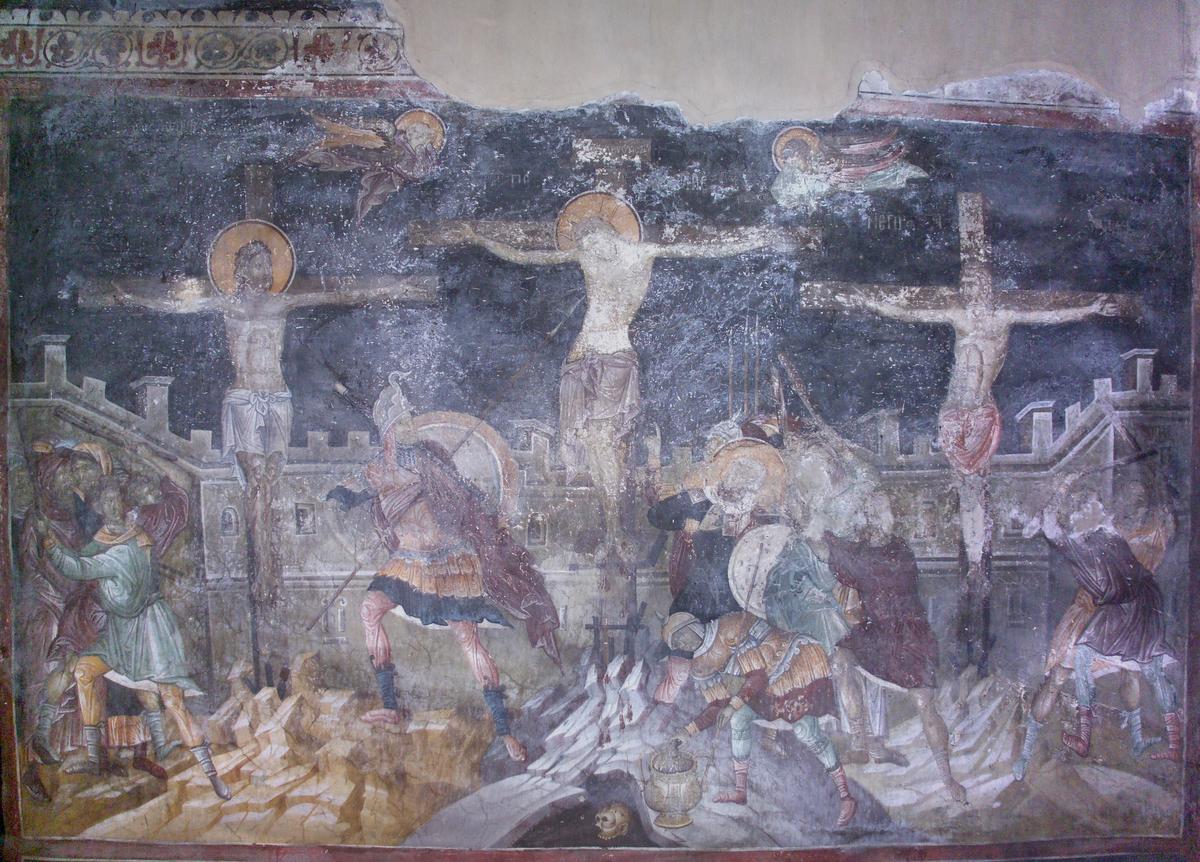
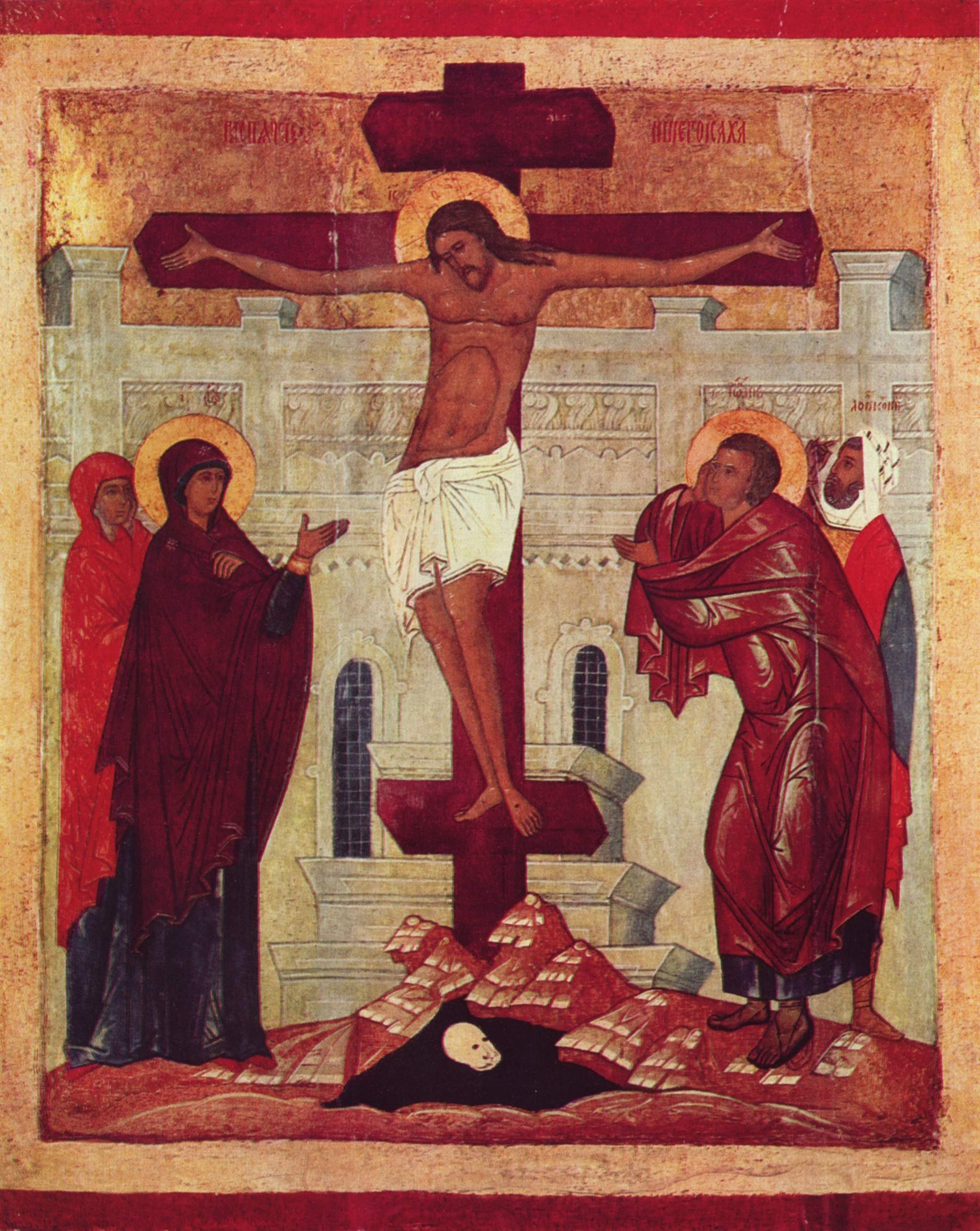
The Crucifixion of Christ (source)
  
Through the prayers of our Holy Fathers, Lord Jesus Christ our God, have mercy on us and save us! Amen!

Thursday, May 2, 2013

Discourse On the Passion of the Saviour, by St. Ephraim the Syrian

The Crucifixion of Christ (source)
  
Discourse On the Passion of the Saviour, by Our Venerable Father Ephrem the Syrian
Text copyright to Archimandrite Ephrem © (source)

  
I am afraid to speak
and touch with my tongue
this fearful narrative
concerning the Saviour.
For truly it is fearful
to narrate all this.

Our Lord
was given up today
into the hands of sinners!

For what reason then
was one who is holy
and without sin given up?

For having done no sin
he was given up today.

Come, let us examine closely
why Christ our Saviour
was given up.

For us, the ungodly,
the Master was given up.

Who would not marvel?
Who would not give glory?

When the slaves had sinned
the Master was given up.

The sons of perdition
and the children of darkness
went out in the darkness
to arrest the sun
who had the power
to consume them in an instant.

But the Master, knowing
their effrontery
and the force of their anger,
with gentleness,
by his own authority,
gave himself up
into the hands of the ungodly.

And lawless men, having bound
the most pure Master,
mocked the one
who had bound the strong one
with unbreakable bonds,
and set us free
from the bonds of sins.

They plaited a crown
of their own thorns,
the fruit borne
by the vine of the Jews.

In mockery
they called him ‘King’.
The lawless spat
in the face of the most pure,
at whose glance
all the Powers of heaven
and the ranks of Angels
quake with fear.

See, once again grief and tears
grip hold of my heart,
as I contemplate the Master
enduring outrage and insults,
scourgings, spitting
from slaves, and blows.

Come, observe well
the abundance of compassion,
the forbearance and mercy
of our sweet Master.

He had a useful slave
in the Paradise of delight,
and when he sinned
he was given to the torturers.

But when the Good One
saw his weakness of soul
he took compassion on the slave
and had mercy on him
and presented himself
to be scourged by him.

I wished to remain silent
because my mind
was utterly amazed;
but then again I was afraid
lest I reject
by my silence
my Saviour’s grace.
For my bones tremble
when I think of it.

The fashioner of all things,
our Lord himself,
was today arraigned
before Caiaphas,
like one of the condemned;
and one of the servants
struck him a blow.

My heart trembles
as I think on these things:
the slave is seated,
the Master stands,
and one full of iniquities
passes sentence
on the one who is sinless.

The heavens trembled,
earth’s foundations shuddered;
Angels and Archangels
all quailed with terror.
Gabriel and Michael
covered their faces
with their wings.

The Cherubim at the throne
were hidden beneath the wheels;
The Seraphim struck their wings
one with the other
at that moment,
when a servant gave
a blow to the Master.

How did earth’s foundations
endure the earthquake
and the tremor
at that moment,
when the Master was outraged?

I observe and I tremble
and again I am stunned,
when I see the long-suffering
of the loving Master.

For see my inward parts
tremble as I speak,
because the Creator,
who by grace fashioned
humanity from dust,
he the Fashioner is struck.

Let us fear, my brethren
and not simply listen.
The Saviour endured
all these things for us.

Wretched servant,
tell us why
you struck the Master?

All servants,
when they are set free,
receive a blow,
that they may obtain
freedom that perishes;
but you, miserable wretch,
unjustly gave a blow
to the liberator of all.

Did you perhaps expect
to receive from Caiaphas
a reward for your blow?

Had you perhaps not heard,
had you perhaps not learned
that Jesus is
the heavenly Master?

You gave a blow
to the Master of all things,
but became slave of slaves
to age on age,
a disgrace and abomination,
and condemned for ever
in unquenchable fire.

A great marvel, brethren,
it is to see the gentleness
of Christ the King!
Struck by a slave
he answered patiently,
with gentleness
and all reverence.

A servant is indignant,
the Master endures;
a servant is enraged,
the Master is kind.

At a time of anger,
who could endure
rage and disturbance?
But our Lord
submitted to all this
by his goodness.

Who can express
your long-suffering,
Master?

You that are longed for
and loved by Christ,
draw near, with compunction
and longing for the Saviour.

Come, let us learn
what took place today
in Sion, David’s city.

The longed-for and chosen
offspring of Abraham,
what did they do today?

They gave up to death
the most pure Master
on this day.

Christ our Saviour
was unjustly hanged
on the tree of the Cross
through lawless hands.

Come, let us all
wash our bodies
with tears and groans,
because our Lord,
the King of glory,
for us ungodly people
was given up to death.

If someone suddenly hears
of one truly beloved
having died,
or again, suddenly sees
the beloved himself
lying a dead corpse
before their eyes,
their appearance is altered,
and the brightness
of their sight is darkened.

So, in heaven’s height,
when it saw
the outrage to the Master
on the tree of the Cross,
the bright sun’s
appearance was altered;
it withdrew the rays
of its own brightness,
and unable to look on
the outrage to the Master,
clothed itself
in grief and darkness.

Likewise the Holy Spirit,
who is in the Father,
when he saw
the beloved Son
on the tree of the Cross,
rending the veil,
the temple’s adornment,
suddenly came forth
in the form of a dove.

All creation was
in fear and trembling
when the King of heaven,
the Saviour suffered;
while we sinners
for whom the only immortal
was given up
ever treat this with contempt.

We laugh each day
when we hear of the Saviour’s
sufferings and outrage.

We enjoy ourselves daily
filled with great zeal
to deck ourselves in fine clothing.

The sun in the sky
because of the outrage to its Master
changed its radiance
into darkness,
so that we, when we saw it,
might follow its example.

The Master on the Cross
was outraged for your sake,
while you, miserable wretch,
ever deck yourself
in splendid raiment.

Does your heart not tremble,
does your mind not quail,
when you hear such things?

The One who alone is sinless
was for you given over
to a shameful death,
to outrages and revilings,
while you hear all this
with lofty indifference.

The whole rational flock
should look intently
on its shepherd,
and ever long for him
and respect him,
because for its sake
he suffered, he
the dispassionate and all pure.

Nor should it deck itself
in corruptible garments,
nor yet indulge in pleasure
and worldly nourishment,
but should give its Maker pleasure
by ascesis and true reverence.

Let us not become
imitators of the Jews;
a people harsh and disobedient
and that ever rejects the blessings
and benefactions of God.

God Most High
for the sake of Abraham
and his covenant
from the beginning bore
the stubbornness of the people.

From heaven he gave
them Manna to eat;
but they, the unworthy,
longed for garlic,
evil-smelling foods.

Again, he gave them water
from the rock in the desert,
while they in place of these
gave him vinegar
when they hanged him on a Cross.

Let us be careful, brethren,
not to be found
as fellows of the Jews
who crucified the Master,
their own Creator.

Let us always be fearful,
keeping before our eyes
the Saviour’s sufferings.

Let us always keep in mind
his sufferings,
because it was for us he suffered,
the dispassionate Master;
for us he was crucified,
the only sinless One.

What return can we make
for all this, brethren?

Let us be attentive to ourselves
and not despise his sufferings.

Draw near all of you,
children of the Church,
bought with the precious
and holy blood
of the most pure Master.

Come, let us meditate
on his sufferings with tears,
thinking on fear,
meditating with trembling,
saying to ourselves,
‘Christ our Saviour
for us the impious
was given over to death’.

Learn well, brother,
what it is you hear:
God who is without sin,
Son of the Most High,
for you was given up.

Open your heart,
learn in detail
his sufferings
and say to yourself:
God who is without sin
today was given up,
today was mocked,
today was abused,
today was struck,
today was scourged,
today wore
a crown of thorns,
today was crucified,
he, the heavenly Lamb.

Your heart will tremble,
your soul will shudder.

Shed tears every day
by this meditation
on the Master’s sufferings.

Tears become sweet,
the soul is enlightened
that always meditates
on Christ’s sufferings.

Always meditating thus,
shedding tears every day,
giving thanks to the Master
for the sufferings
that he suffered for you,
so that in the day
of his Coming
your tears may become
your boast and exaltation
before the judgement seat.

Endure as you meditate
on the loving Master’s
sufferings,
endure temptations,
give thanks from your soul.

Blessed is the one
who has before his eyes
the heavenly Master
and his sufferings,
and has crucified himself
from all the passions
and earthly deeds,
who has become an imitator
of his own Master.

This is understanding,
this is the attitude
of servants who love God,
when they become ever
imitators of their Master
by good works.

Shameless man, do you watch
the most pure Master
hanging on the Cross,
while you pass the time
that you have to live on earth
in pleasure and laughter?

Don’t you know, miserable wretch,
that the crucified Lord
will demand an account
of all your disdainful deeds,
for which, when you hear of them, you show no concern,
and as you take your pleasure
you laugh
and enjoy yourself with indifference?

The day will come,
that fearful day,
for you to weep unceasingly
and cry out in the fire
from your pains,
and there will be no one at all
to answer
and have mercy on your soul.

I worship you, Master,
I bless you, O Good One,
I entreat you, O Holy One,
I fall down before you, Lover of humankind,
and I glorify you, O Christ,
because you, only-begotten
Master of all,
alone without sin,
for me the unworthy sinner
were given over to death,
death on a Cross,
that you might free
the sinner’s soul
from the bonds of sins.

And what shall I give you
in return for this, Master?

Glory to you, Lover of humankind!
Glory to you, O Merciful!
Glory to you, O Long-suffering!
Glory to you, who pardon
every fault!
Glory to you, who came down
to save our souls!
Glory to you, incarnate
in the Virgin’s womb!
Glory to you, who were bound!
Glory to you, who were scourged!
Glory to you, who were crucified!
Glory to you, who were buried!
Glory to you, who were raised!
Glory to you, who were proclaimed!
Glory to you, who were believed!
Glory to you, who were taken up!
Glory to you, who were enthroned
with great glory
at the Father’s right hand,
and are coming again
with the glory of the Father
and the holy Angels
to judge every soul
that has despised
your holy sufferings
in that dread
and fearful hour,
when the powers of heaven
will be shaken;
when Angels, Archangels,
Cherubim and Seraphim
will come all together
with fear and trembling
before your glory;
when all the foundations
of the earth will tremble,
and everything that has breath
will shudder at your great
and unendurable glory.

In that hour
your hand will hide me
under its wings
and my soul be delivered
from the fearful fire,
the gnashing of teeth,
the outer darkness
and unending weeping,
that blessing you, I may say,
‘Glory to the One, who wished
to save the sinner
through the many acts of pity
of his compassion.
--------------------------------------------------------------------------------  
  
The Crucifixion of Christ (source)
     
Through the prayers of our Holy Fathers, Lord Jesus Christ our God, have mercy on us and save us! Amen!