Wednesday, December 3, 2008

The Miraculous Icon of the Theotokos "Of the Three Hands" and St. John of Damascus

"Synaxis of the Icon of our Most Holy Lady the Theotokos "Of the Three Hands." [Celebrated June 28th]


Original Icon of the Theotokos "Of the Three Hands" (Icon courtesy of www.eikonografos.com used with permission)

"The great defender of the Orthodox Faith against the Iconoclasts, our righteous Father John of Damascus (See Dec. 4), was slandered to the Caliph of Damascus by the Iconoclast Emperor Leo the Isaurian (reigned 717-741). Saint John was accused of sedition and his right hand was cut off. Having asked for the severed hand, Saint John passed the night in great pain, praying for the aid of the most holy Theotokos."

[The Immaculate Virgin appeared to the sufferer in his sleep, and gazing mercifully at him said: "Thy hand is now whole; sorrow no more". (http://www.balamand.edu.lb/theology/live_of_saint_john_of_damascus.htm)]

"Awaking from sleep, he found that his hand had been miraculously restored, with only a red scar about the wrist where it had been severed, as a testimony to the wonderous healing. In thanksgiving, he had a silver hand attached to the icon to commemorate this great miracle."

   
[John composed in his soul the hymn: "In thee, O Full of Grace, all creation rejoiceth". This hymn is sung in Church till now at the Liturgy of Saint Basil the Great. (http://www.balamand.edu.lb/theology/live_of_saint_john_of_damascus.htm) (See full text below: "Because of you, O Full of grace...")]

"On becoming a monk in the lavra of Saint Sabbas the Sanctified in the Holy Land, John brought the icon with him. There it remained until the thirteenth century, when it was given to Saint Sabbas of Serbia (see Jan. 14), who brought it to Serbia, where it remained for a time. Later, it was miraculously transported by an unguided donkey that carried it to the Serbian Monastery of Hilandar on the Holy Mountain, Athos, where it remains to this day."
Note: the full service of the Tricherousa Icon of the Theotokos (in Greek), is available here: http://voutsinasilias.blogspot.com/2009/07/12.html.
  
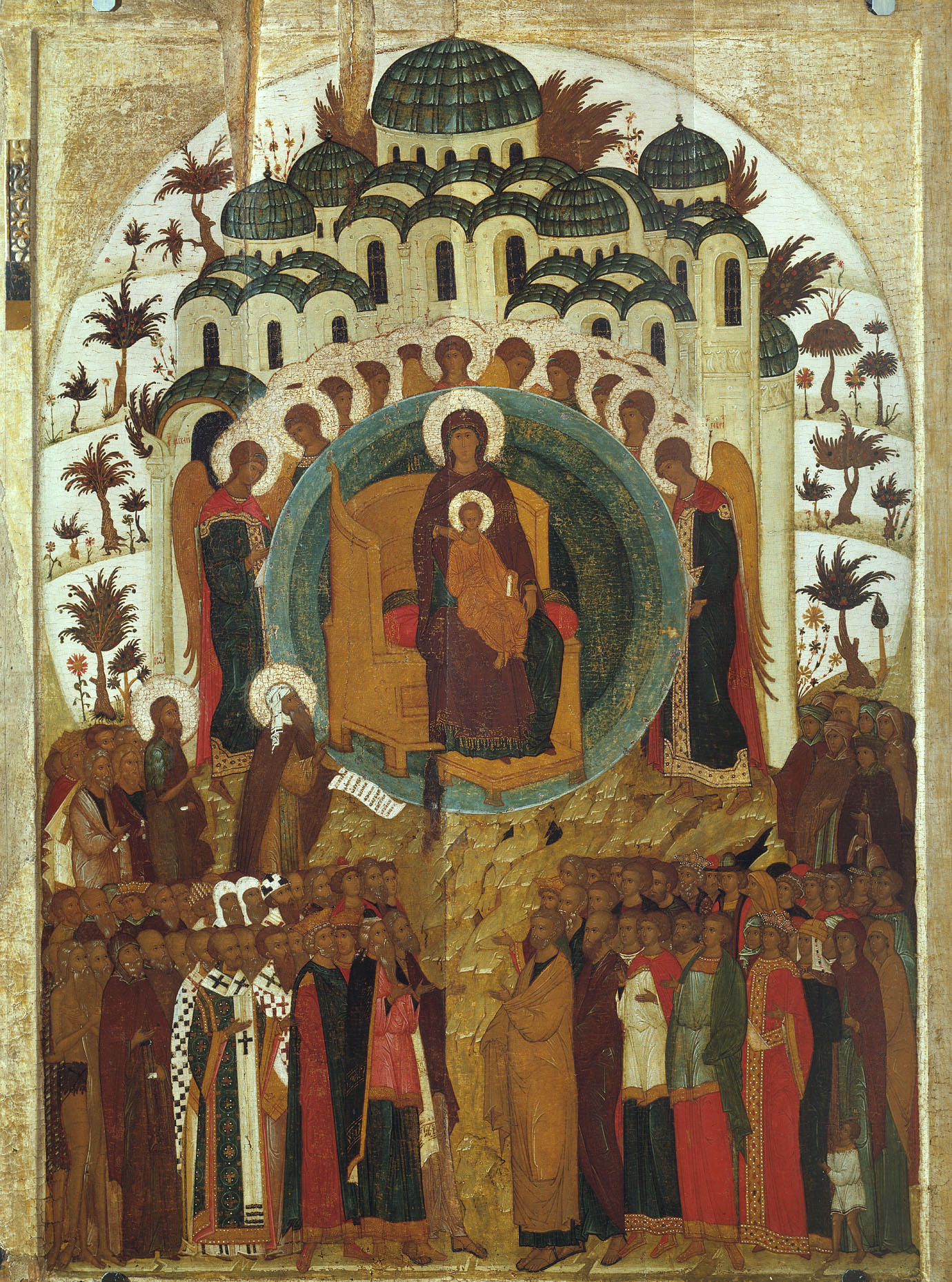
Icon of the Theotokos, "In thee, O Full-of-grace..." (http://www.belygorod.ru/img2/Ikona/Used/0Dionisiy_OTebeRaduetXVIvGTG.jpg)
  
The Great Megalynarion
Because of you, O Full of grace, all creation rejoices, the ranks of Angels and the human race; hallowed Temple and spiritual Paradise, pride of Virgins; from you God was incarnate and he, who is our God before the ages, became a little child. For He made your womb a throne and caused it to become wider than the heavens. Because of you, O Full of grace, all creation rejoices; glory to you.
(http://www.anastasis.org.uk/small_compline.htm)
  
Apolytikion of the Icon of the Theotokos "Of the Three Hands" in the Fourth Tone
From the Palestine, godly-minded Sabbas brought unto us thy ven'rable icon, which is known as Of the Three Hands, O all-holy Bride of God. Wherefore, since the monks of Hilandar now possess it as their boast, they send up hymns of praise and thanksgiving, while crying out with fervour: Rejoice, thou who art full of grace.

Kontakion in the Plagal of the Fourth Tone
Come, let us worship the famed icon of the Queen of all called: Of the Three Hands, for the fearful marvel which it wrought; and with fervent faith and longing, come, let us cry out: O pure Maiden, keep thy monastery and thy flock from all dangers, tribulations, and adversities, for we cry to thee: Rejoice, thou help and defence of all.


Icon of St. John of Damascus (Icon courtesy of http://www.eikonografos.com/ used with permission)
   
Most-holy Theotokos save us!

The Funeral Hymns of St. John of Damascus

Icon of Christ being prepared for burial (taken from: http://www.eikastikon.gr/xristianika/kris/index_2.html)

Some of the most beautiful hymns of the funeral service were written by St. John of Damascus, who celebrates tomorrow (December 4th). The story behind them, and the texts themselves are very moving:

St. John was once a powerful and wise member of the royal court. He however abandoned all this and became a monk. "Only once did John disobey the instructions that were his rule of life in the monastery. A fellow monk had lost his brother and could not be consoled. Knowing of John's ability to compose music and poetry, he begged him to write a funeral hymn for his dead brother. Because his elder had left the monastery for a few days, John refused, for he had agreed to do nothing without the elder's direction and consent. Finally, however, he felt so sorry for the bereaved monk that he consented, and wrote one of his most beautiful hymns--which has become part of the Orthodox funeral service.

The monk was very moved by the lovely hymn and thanked John for helping him in his grief. But when the elder returned and heard of John's deed, he wanted nothing more to do with him for he had disobeyed his rule. John begged the elder to forgive him, but to no avail. The other monks also petitioned the older monk to take him back, even if it meant giving John a penance. The elder finally relented. He gave him the worst job in the monastery, and also forbid him to write any more hymns. John accepted gratefully and willingly carried out all his duties.

Icon of the Theotokos "Of the Three Hands" through which St. John of Damascus was healed (Icon courtesy of www.eikonografos.com used with permission)
  
One night the elder had a vision. The mother of God appeared to him in a dream and said: "Why have you sealed the spring of fresh water for which the whole world is thirsty? Let it pour freely and comfort those in need. Let John praise God through his songs." The elder then realized that he had dealt wrongly with John and hurried to him, asking forgiveness for his sternness and bluntness. He knelt and bowed low before John to beg his pardon. The talent which had been given to John could now be used to the glory of God." (http://www.stjohnofdamascus.org/home22)
  
Icon of St. John of Damascus by Photi Kontouglou (Icons courtesy of www.eikonografos.com used with permission)
  
The hymns by St. John of Damascus, taken from http://www.goarch.org/chapel/liturgical_texts/funeral2:

Tone I
Where is the pleasure in life which is unmixed with sorrow? Where the glory which on earth has stood firm and unchanged? All things are weaker than shadow, all more illusive than dreams; comes one fell stroke, and Death in turn, prevails over all these vanities. Wherefore in the Light, O Christ, of Your countenance, the sweetness of Your beauty, to him (her) whom You have chosen grant repose, for You are the Friend of Mankind.

Tone 2
Like a blossom that wastes away, and like a dream that passes and is gone, so is every mortal into dust resolved; but again, when the trumpet sounds its call, as though at a quaking of the earth, all the dead shall arise and go forth to meet You, O Christ our God: on that day, O Lord, for him (her) whom You have withdrawn from among us appoint a place in the tentings of Your Saints;yea, for the spirit of Your servant, O Christ.

Another in Tone 2
Alas! What an agony the soul endures when from the body it is parting; how many are her tears for weeping, but there is none that will show compassion: unto the angels she turns with downcast eyes; useless are her supplications; and unto men she extends her imploring hands, but finds none to bring her rescue. Thus, my beloved brethren, let us all ponder well how brief is the span of our life; and peaceful rest for him (her) that now is gone, let us ask of Christ, and also His abundant mercy for our souls.

Tone 3
Vanity are all the works and quests of man, and they have no being after death has come; our wealth is with us no longer. How can our glory go with us? For when death has come all these things are vanished clean away. Wherefore to Christ the Immortal King let us cry, "To him (her) that has departed grant repose where a home is prepared for all those whose hearts You have filled with gladness."

Tone 4
Terror truly past compare is by the mystery of death inspired; now the soul and the body part, disjoined by resistless might, and their concord is broken; and the bond of nature which made them live and grow as one, now by the edict of God is rest in twain. Wherefore now we implore Your aid grant that Your servant now gone to rest where the just that are Yours abide, Life-bestower and Friend of Mankind.

Tone 4
Where is now our affection for earthly things? Where is now the alluring pomp of transient questing? Where is now our gold, and our silver? Where is now the surging crowd of domestics, and their busy cries? All is dust, all is ashes, all is shadow. Wherefore draw near that we may cry to our immortal King, "Lord, Your everlasting blessings vouchsafe unto him (her) that now has gone away. bringing him (her) to repose in that blessedness which never grows old."
  
Icon of St. Sisoes the Great Ascetic before the tomb of Alexander the Great (Icon courtesy of www.eikonografos.com used with permission)
  
Tone 5
I Called to mind the Prophet who shouted, "I am but earth and ash." And once again I looked with attention on the tombs, and I saw the bones therein which of flesh were naked; and I said, "Which indeed is he that is king? Or which is soldier? Which is the wealthy, which the needy? Which the righteous, or which the sinner?" But to Your servant, O Lord, grant that with the righteous he (she) may repose.

Tone 6
My beginning and foundation was the form;bestowing Word of Your commandment; for it pleased You to make me by compounding visible and invisible nature into a living thing. out of earth was my body formed and made, but a soul You gave me by the Divine and Life-creating In; breathing. Wherefore, O Christ, to Your servant in the land of the living, in the courts of the righteous, do You grant repose.

Tone 7
Bring to his (her) rest, O our Savior, You giver of life, our brother (sister) whom You have withdrawn from this transient world, for he (she) lifts up his (her) voice to cry: "Glory to You."

Another in Tone 7
When in Your own image and likeness You in the beginning did create and fashion man, You gave him a home in Paradise, and made him the chief of your creation. But by the devil's envy, alas, beguiled to eat the fruit forbidden, transgressor then of Your commandments he became; wherefore back to earth, from which he first was taken, You did sentence him to return again, O Lord, and to pray You to give him rest.

Plagal of the Fourth Tone
Weep, and with tears lament when with understanding I think on death, and see how in the graves there sleeps the beauty which once for us was fashioned in the image of God, but now is shapeless, ignoble, and bare of all the graces. O how strange a thing; what is this mystery which concerns us humans? Why were we given up to decay? And why to death united in wedlock? Truly, as it is written, these things come to pass by ordinance of God, Who to him (her) now gone gives rest

Glory to the Father and to the Son and to the Holy Spirit.
The death which You have endured, O Lord, is become the harbinger of deathlessness; if You had not been laid in Your tomb, then would not the gates of Paradise have been opened;wherefore to him (her) now gone from us give rest, for You are the Friend of Mankind.

Both now and ever and to the ages of ages. Amen.
Virgin chaste and holy, Gateway of the Word, Mother of our God, make supplication that his (her) soul find mercy.
  

Icon of the Holy Resurrection of Christ, Christ descending to Hades to raise the dead (Icon courtesy of http://www.eikonografos.com/ used with permission)

Through the prayers of our Holy Fathers, Lord Jesus Christ our God, have mercy on us and save us! Amen!
St. Angelis the Neomartyr, the Physician of Argos

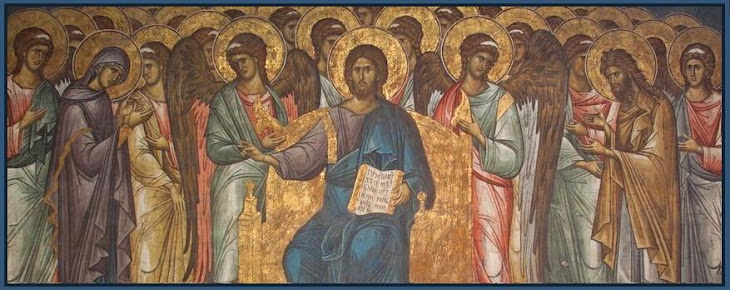
Icon of the Prophet Zephaniah and St. Angelis the New Martyr, the Physician of Argos (+1813) - Commemorated on December 3rd (taken from: http://christopherklitou.com/icon_3_dec_zephaniah_prophet_angeles_newmartyr_of_argos.htm)

(The following is an amateur translation/summary of Greek text from http://www.synaxaristis.googlepages.com/3δεκεμβριου, and Witnesses for Christ by Vaporis, the latter of which is an excellent book with translations of the lives of many Neomartyrs for Christ under the Ottoman Turks)

Fervent, silent, and obedient was the pious Angelis, who took up medicine as his profession in Argos [Greece]. In a religious debate with a Frenchman, he sought to defend the Christian faith by agreeing to duel the Frenchman, while only armed with a stick. The Frenchman, in the face of Angelis' faith backed down, and Angelis was declared the winner. Angelis despaired however, because he had decided to witness for Christ. He then abandoned medicine and closed the shop in his house. And suddenly, for unknown reasons, on the Saturday of Lazarus of the year 1813, he denied Christ and became a Muslim! Because he created a scene in a café in Nafplion, and was drunk, the authorities banished him to the island of Chios. Many of his actions seemed strange, and were reminiscent of other "fools-for-Christ". He repented there, and cried every day with tears of repentance in their temples, prayed and gave alms. He also gave reasons to the Turks, seeking martyrdom. Once he went to a Customs House and confessed that he was a Christian. The Turks mercilessly beat him and locked him in irons in the prison in the Castle of Chios. But because he remained steadfast in the Christian confession, he was beheaded on December 3rd 1813.

According to the first source above, St. Angelis is the protector of empirical doctors [i.e. practical, experienced doctors, without scientific knowledge], wrestlers, and those who suffer from psychological problems.

Icon of St. Angelis the Neomartyr, the Physician from Argos, martyred in Chios in 1813 (Icon courtesy of www.eikonografos.com, used with permission.)

Apolytikion for a Martyr - 4th Mode
Thy Martyr, O Lord, in his courageous contest for Thee, received as the prize the crowns of incorruption and Life from Thee our Immortal God. For since he possessed they strength, he cast down the tyrants, and wholly destroyed the demons' strengthless presumption. O Christ God, by his prayers, save our souls since Thou art merciful.
(translation from Holy Transfiguration Monastery and goarch.org)

Απολυτίκιον. Ήχος α`. Χορός αγγελικός.
Χορός αγγελικός Αγγελή Νεομάρτυς, και δήμος Αθλητών, επεκρότησαν άνω, την σην υπέρ της πίστεως, καρτερίαν και ένστασιν, και το πνεύμα σου μετ` ευφροσύνης λαβόντες, ανεβίβασαν, εις ουρανού μετά δόξης, Χριστώ τω Θεώ ημών.

Apolytikion for St. Angelis the New Martyr, the Physician - 1st Tone "The choirs of Angels..." (amateur translation from above Greek)
The choir of Angels, O Neomartyr Angelis, and the city of Champions, clap their hands above, at your endurance and steadfastness for the faith, and they receive your spirit, leading it to the heavens with glory, to Christ our God.

St. Angelis the New Martyr, intercede for us!
Through the prayers of our Holy Fathers, Lord Jesus Christ our God, have mercy on us and save us! Amen!

Tuesday, December 2, 2008

Miraculous Icon of St. Nicholas "O Streidas" (of the Oyster)

Greetings!

Because the feast of St. Nicholas is approaching, I'm making a few posts about various miracles, etc. associated with St. Nicholas the Wonderworker. The following is the account of a miraculous icon of St. Nicholas which is in the Monastery of Stavronikita on Mount Athos (amateur translation from the original Greek: http://ilanos.pblogs.gr/files/170169-ÁÃÉÏÓ%20ÍÉÊÏËÁÏÓ.doc):

Miraculous icon of St. Nicholas "O Streidas" (of the Oyster) from the Monastery of Stavronikita. The crack visible through the forehead of the Saint is where the oyster was imbedded, and the dried blood that flowed out is visible to this day. (taken from: http://agiooros.net/forum/viewtopic.php?f=12&t=3421&st=0&sk=t&sd=a&start=90)
   
On Mount Athos is in a monastery which is called Stavronikita which is dedicated to St. Nicholas. The monastery however was originally built in memory of St. John the Baptist. In the Iconoclast period, the monks threw many icons into the sea so they might not be contaminated by the hands of the Iconoclasts. One of those icons was of St. Nicholas, which is currently in the monastery of Stavroniketa and is one of the miraculous icons of Mount Athos.

Following the burning of the monastery by the Corsairs, the Patriarch, Jeremiah the Elder, sought to rebuild it in the name of St. John the Baptist. And while construction was started, the monks were throwing nets into the sea to catch a few fish. But when they pulled up their nets, they found within them the miraculous icon of St. Nicholas. In the icon (in the face of St. Nicholas) an oyster was stuck and imbedded. When they pulled they oyster out of the icon, they were shocked. Blood ran from the wound opened by the oyster! Because of this miracle, the icon was named Agios Nikolaos o “Streidas”. And the name remains to this day. The icon is very old. It was not made by painting, but is a mosaic (such as those in Hagia Sophia, Daphne, St. Demetrios in Thessaloniki, etc.) But such small icons on wood are rare.

On the old Proskenetarion [veneration stand which held the icon] on Mount Athos, the following is stated about the icon of the Saint: «This icon came from the sea, because it was thrown therein at the time of Iconoclasm and because of the long time it was in the sea, an oyster was embedded in the forehead, and ostreidas was how it was called, and is guilded beautifully in gold leaf?». [«είναι δε μετά μωσίου ψηφίδων χρυσών η ιεροιστορία εγκεκοσμημένη εις κάλλος»] When the Patriarch saw the miracle of this icon, he dedicated the new monastery which was being built to St. Nicholas, and not the Forerunner. One half of the shell of an oyster the Patriarch used as a disc for the elevation of the Virgin, on the Holy Altar, the other did was made into an engolpion [rounded jewelry worn by bishops with an icon of the Theotokos on it, they were once used to hold Holy Communion] and is now in the sacristy of the Patriarchate of Moscow. This miracle happened in 1553 AD.


Icon showing the finding of the Holy Icon of St. Nicholas "O Streidas" and the Monastery of Stavronikita (I don't remember where I found it online).
   
The Holy Monastery of Stavronikita, Mount Athos
"The Holy Monastery of Stavroniketa is the smallest in size on the Holy Mountain. It is on the eastern side of the peninsula between the Monasteries of Iveron and Pantocrator, looking towards the Strymonic Gulf. Its history, like that of the other monasteries, has been a turbulent one.


Its earliest history is lost in the depths of the 10th and 11th centuries. Uncertain evidence allows us simply to conjecture that a certain Nicetas or Stavronicetas Nicephorus, an officer of Tsimiskes, was the founder. The Monastery went into decline in the 12th century as a result of pirate raids and in the 13th came under the control of the Koutloumousiou Monastery, while in the 16th century it was already a dependency of Philotheou. In 1533, the Abbot of the Geromeriou Monastery, the priest-monk Grigorios, bought Stavroniketa from Philotheou and worked hard to revitalise it. By a patriarchal sigillium of the same year it was recognised as a stavropegic monstery. In 1541, the Ecumenical Patriarch Ieremias I did his very best to refound the Monastery and to see that it functioned once again, thus continuing the work of Grigorios. He endowed Stavroniketa with important metochia at Kassandra and on Lemnos. The Monastery returned to the coenobitic system. The katholikon had been completed for at least five years when its interior was decorated in 1546 with paintings of the famous representative of the Cretan School Theophanis and his son Symeon. The church is dedicated to St Nicholas. The refectory of the Monastery was also decorated by Theophanis, who was responsible for the depiction of the Twelve Great Feasts on portable icons.

In the course of its history, the Monastery has suffered five times from fires - in 1607 a large part of its buildings was reduced to ashes. In the 17th century, Serban Kantakouzinos, Prince of Wallachia, provided the Monastery with a water supply. In the next century, Alexandros Ghikas, also Prince of Wallachia, proved a its benefactor by presenting it with the Monastery of the Holy Apostles in Bucharest. The Monastery was burnt down again in 1741, 1864, 1874, and 1879, the last of these fires being the most destructive. Like the other monasteries, Stavroniketa was brought to its knees by the excessive taxes which it had to pay to the Turks. Its debt was paid as the result of superhuman efforts on the part of the Abbot of the Vatopedi Monastery, Theophilos. The arrival of a new brotherhood in 1968 saw its conversion from an idiorrhythmic monastery into a coenobium. It holds fifteenth position in the hierarchy of the 20 monasteries. One of the most valued of the Monastery's treasures is the icon of St Nicholas known as 'Streidas', a work of the 13th - 14th century. Stavroniketa has in its possession 171 manuscripts and a large number of printed books. Of particular importance is a Psalter of the 12th century with gold lettering (parchment codex No. 46). Its dependencies consist of 33 kalyves in the settlement of Kapsala, and four kellia. The Monastery has four chapels and two outlying chapels. At present it has some 30 monks.


1st Troparion from the Paraklesis to St. Nicholas (amateur translation)
The all-holy icon of the Hierarch, O Faithful let us fall before and cry out, who are emcompassed by many sins, hearken O Nicholas, Hierarch of the Lord, by your holy intercessions before the Lover-of-Man, deliver from all dangers, sorrow and corruption, and dangerous sicknesses.
Through the prayers of our Holy Fathers, Lord Jesus Christ our God, have mercy on us and save us! Amen!

Saint Porphyrios of Kapsokalyvia

Picture of St. Porphyrios with an Icon of Panagia and Christ (taken from: http://www.balamandmonastery.org.lb/fathers/fathersporph.htm)

"Elder [Porphyrios], what answer do you give to those who ask about the gifts which God gave you and seek some kind of explanation? Because others ask us and put forward the well-known proverb, "after Christ nobody is prophet."


Instead of giving a straight answer, Elder Porphyrios directed the questioner to the seventh chapter of the Old Testament book, Wisdom of Solomon* , to the twenty-seventh verse, which says the following about the grace and energy of the Holy Spirit, "...in every generation she passes into holy souls and makes them friends of God and prophets." In fact, verses 15-27 are especially enlightening on this interesting subject of the Holy Spirit acting through certain grace-filled people. The verses say the following:

"May God grant me to speak with judgment and have thoughts worthy of what I have received, for he is the guide even of wisdom and the corrector of the wise. For both e and our words are in his hands, as are all understanding and skill in crafts. For it is He who gave me unerring knowledge of what exists, to know the structure of the world and the activity of the elements; the beginning, the end and the middle of times, the alternations of the solstices and the changes of the seasons, the cycles of the year and the constellations of the stars, the nature of animals and the tempers of wild beasts, the power of spirits and the reasoning of men, the varieties of plants and the virtues of roots; I learned both what is secret and what is manifest, for wisdom the fashioner of all things taught me."


'There is in her a spirit that is intelligent holy, unique, manifold, subtle, agile, clear, immaculate, distinct, invulnerable, devoted to goodness, keen, irrisistable, beneficent, humane, steadfast, sure, carefree, all-powerful overseeing all and passing through spirits that are altogether intelligent, pure, and subtle. For wisdom is more mobile than any motion, she pervades and passes through all things by her pureness. For she is a breath of the power of God, a pure emanation of the glory of the Almighty; therefore nothing defiled gains entrance into her. For she is a reflection of eternal light, a spotless mirror of the working of God and an image of his goodness. Although she is one she can do all things, and whilst remaining in herself, she renews all things; in every generation she passes into holy souls and makes them friends of [God's] and prophets."
(http://www.oodegr.com/english/biblia/Porfyrios_Martyries_Empeiries/C1.htm)
Greetings!

Today marks the anniversary of the date when Elder Porphyrios passed away (December 2nd 1991). He was an incredible Grace-filled Elder who helped thousands come closer to Christ. There is much written about him (see the list of books below), and his life and works are worth reading. He is honored very much in Greece and all over the world. This past Sunday, the Monastery of the Transfiguration of Christ which he founded in Milesi (near Athens) had a Memorial Service for him, and I read that 3000 people were in attendance! Already some have written services in his honor. He was and continues to be a treasure of our times. May we all have his blessing!

Books on the life and teachings of Elder Porphyrios:

Wounded by Love: The Life and Wisdom of Elder Porphyrios
The Divine Flame Elder Porphyrios Lit in my Heart

For an online biography and pictures:
http://www.orthodoxphotos.com/Orthodox_Elders/Greek/Fr._Porphyrios

For passages by Elder Porphyrios on "The Upbringing of Children", see: http://www.philokalia.org/porphyrios_children.htm.

For numerous stories and teachings from Elder Porphyrios, see: http://www.oodegr.com/english/biblia/Porfyrios_Martyries_Empeiries/perieh.htm.

For a short, inspirational story from Fr. Porphyrios' life, see: http://full-of-grace-and-truth.blogspot.com/2009/06/short-story-of-elder-porphyrios.html

For an interesting post about Fr. Porphyrios and the Apollo 13 space mission, see: http://www.johnsanidopoulos.com/2009/07/elder-porphyrios-and-apollo-13.html

Here are a few quotes from Elder Porphyrios (from http://www.balamandmonastery.org.lb/fathers/fathersporph.htm):

"This is the way we should see Christ. He is our friend, our brother; He is whatever is good and beautiful. He is everything. Yet, He is still a friend and He shouts it out, 'You're my friends, don't you understand that? We're brothers. I'm not...I don't hold hell in my hands. I am not threatening you. I love you. I want you to enjoy life together with me.'"

"Christ is Everything. He is joy, He is life, He is light. He is the true light who makes man joyful, makes him soar with happiness; makes him see everything, everybody; makes him feel for everyone, to want everyone with him, everyone with Christ."

"Love Christ and put nothing before His Love. Christ is Everything. He is the source of life, the ultimate desire, He is everything. Everything beautiful is in Christ."

"Somebody who is Christ's must love Christ, and when he loves Christ he is delivered from the Devil, from hell and from death."


Photograph of St. Porphyrios holding an Icon of Panagia and Christ (taken from http://www.orthodoxphotos.com/Orthodox_Elders/Greek/Fr._Porphyrios)

Through the prayers of our Holy Fathers, Lord Jesus Christ our God, have mercy on us and save us! Amen!

Monday, December 1, 2008

Patron Saints - December

Greetings!
Here are some common Patron Saints for the month of December (and again, this is by no means a comprehensive list). The sources are http://oasigr.5.forumer.com/a/_post1688-30.html and http://orthodoxwiki.org/Patron_saint primarily.

Menaion Icon of the Saints and Feasts of the Month of December (icon taken from Holy Transfiguration Monastery: http://www.thehtm.org/catalog/product_info.php?cPath=27_33&products_id=345&osCsid=27a498fa78d0352697e3178f15e0fbd1)
December
1 – St. Filaretos [Philaretos or Philaret] - the patron of charity and charitable institutions, and he helps people in difficulties
2 – St. Avvakoum the Prophet - protector against diseases of the ears
3 - St. Angelis the Neomartyr - St. Angelis (because he was a physician) is the protector of empirical doctors [i.e. practical, experienced doctors, without scientific knowledge], wrestlers, and those who suffer from psychological problems.
4 – St. Barbara the Great-martyr – for delivery from sudden death, the patron of artillery [and/or protector against fire], protector against skin diseases (smallpox, measles, chicken pox, leprosy), protector of those pregnant, soldiers, cooks, braziers, kodonopoion [κωδωνοποιών?], prisoners, protector of those who travel, those who handle mechanical objects, those engaged in the construction of towers and fortifications.
4 – St. John, of Damascus - protector of public officials and politicians, protector of iconographers
5 – St. Savvas the Sanctified – for help to have a child
6 – St. Nicholas Archbishop of Myra the Wonderworker - protector of seafarers and ports, protector of widows, children, orphans, virgins, families, travel (especially by sea), protector against evil thoughts, for help in distress or poverty.
9 – St. Anna the Ancestor of God [the Mother of the Theotokos] – protector of childless couples and children
10 – St. Minas [or Menas] the Martyr, the Kallikelados ["most-eloquent"] - protector of journalists
11 – St. Patapios the Righteous – protector against various diseases, particularly against cancer and dropsy [edema in modern terminology]
12 – St. Spyridon Bishop of Trimythountos – the protector of ceramicists, protector from epidemics, smallpox, and diseases of the ears
13 – Holy Five Martyrs, Sts. Orestes, Eugene, Afxentios, Efstratios and Mardarios - protectors for all kinds of wounds, protection so that we not fall into heresy in times of weak faith
13 – St. Lucia of Sicily – for eyes
15 – St. Eleftherios the Hieromartyr – frees those pregnant [through safe childbirth] and prisoners and protects from wild beasts
15 – St. Anthia the Martyr, mother of St. Eleftherios – protector of breast-feeding mothers
16 – St. Modestos Patriarch of Jerusalem - protector against diseases of animals and against locusts, protector of plows
17 – St. Daniel the Prophet and the Three Children in the Furnace - protectors from fire

17 – St. Susanna (from the Old Testement) – for chastity and help in carnal warfare
18 – St. Joseph the Betrothed of the Theotokos - protector of carpenters and furniture-makers, protector of adopted children and adoptive families
19 – Sts. Boniface the Martyr and Aglais – give help to alcoholics
19 – St. Vlasios [Blaise] the Hieromartyr the Akarnan and those with him - protector against witchcraft and demonic temptations and all kinds of illness
20 – St. Ignatios the God-bearer of Antioch - the protector against ophthalmologic and eye diseases
20 – St. John of Kronstadt – for help in distress or poverty, for help in studies, for meeting a difficult situation
27 – St. Stephen the Protomartyr, the Archdeacon - protector of the marriage crowns, protector against diseases of the bile, kidney stones and cysts
30 – St. Anysia the Virgin-martyr – for chastity and help in carnal warfare
31 – St. Zotikos the Righteous, the Feeder-of-Orphans or Orphan-Keeper [ορφανοτρόφος?] - patron of orphanages and orphans

St. Philaretos (Philaret) the Merciful

Icon of St. Philaretos the Merciful (taken from http://www.synaxaristis.googlepages.com/1δεκεμβριου)
"Saint Philaret the Almsgiver [Celebrated on December 1st]
Philaret was from the village of Amnia in Paphlagonia. Early in life, Philaret was a very wealthy man, but by distributing abundant alms to the poor he himself became extremely poor. However, he was not afraid of poverty, and, not heeding the complaints of his wife and children, he continued his charitable works with hope in God, Who said: Blessed are the merciful, for they shall obtain mercy (Matthew 5:7). Once, while he was plowing in the field, a man came to him and complained that one of his oxen had died in the harness and that he was unable to plow with only one ox. Philaret then unharnessed one of his oxen and gave it to him. He even gave his remaining horse to a man who was summoned to go to war. He gave away the calf of his last cow, and when he saw how the cow pined for her missing calf, and the calf for the cow, he called the man and gave him the cow too. And thus the aged Philaret was left without food in an empty house. But he prayed to God and placed his hope in Him. And God did not abandon the righteous one to be put to shame in his hope. At that time the Empress Irene reigned with her young son, Constantine. According to the custom of that time, the empress sent men throughout the whole empire to seek the best and most distinguished maiden to whom she could wed her son, the emperor. By God's providence, these men happened to stay overnight in Philaret's house, and they saw his most beautiful and modest granddaughter Maria, the daughter of his daughter Hypatia, and took her to Constantinople. The emperor was well pleased with her, married her, and moved Philaret and all his family to the capital, giving him great honors and riches. Philaret did not become proud as a result of this unexpected good fortune, but, thankful to God, he continued to perform good works even more than he had before, and thus he continued until his death. At the age of ninety he summoned his children, blessed them, and instructed them to cleave to God and to God's law, and with his clairvoyant spirit he prophesied to all of them how they would live out this life, as once had Jacob. After that he went to the Rodolfia Monastery and gave up his soul to God. At his death his face shone like the sun, and after his death an unusual, sweet fragrance came forth from his body and miracles took place at his relics. This righteous man entered into rest in the year 797. His wife, Theosevia, and all his children and grandchildren lived a God-pleasing life and reposed in the Lord."
(taken from the Prologue of St. Nikolai: http://www.westsrbdio.org/prolog/prolog.htm)
Apolytikion - Tone 3
From the wealth of your faith in God, You distributed your riches to the poor, O Philaret. Your life was adorned with compassion And you glorified the Giver of mercy. Implore him to have compassion and mercy on those who praise you!
Kontakion - Tone 3
You possessed the spirit of Job in temptations, And compassionately distributed your wealth to the poor. You were a living fountain of almsgiving, And by your manner of life you gladden those who cry: Rejoice, O Philaret, servant of Christ God!
St. Philaretos, intercede for us!
Through the prayers of our Holy Fathers, Lord Jesus Christ our God, have mercy on us and save us! Amen!