Sunday, April 12, 2015

St. Gregory Dialogos on the Mystery of the Resurrection

Christ is risen! Truly He is risen!
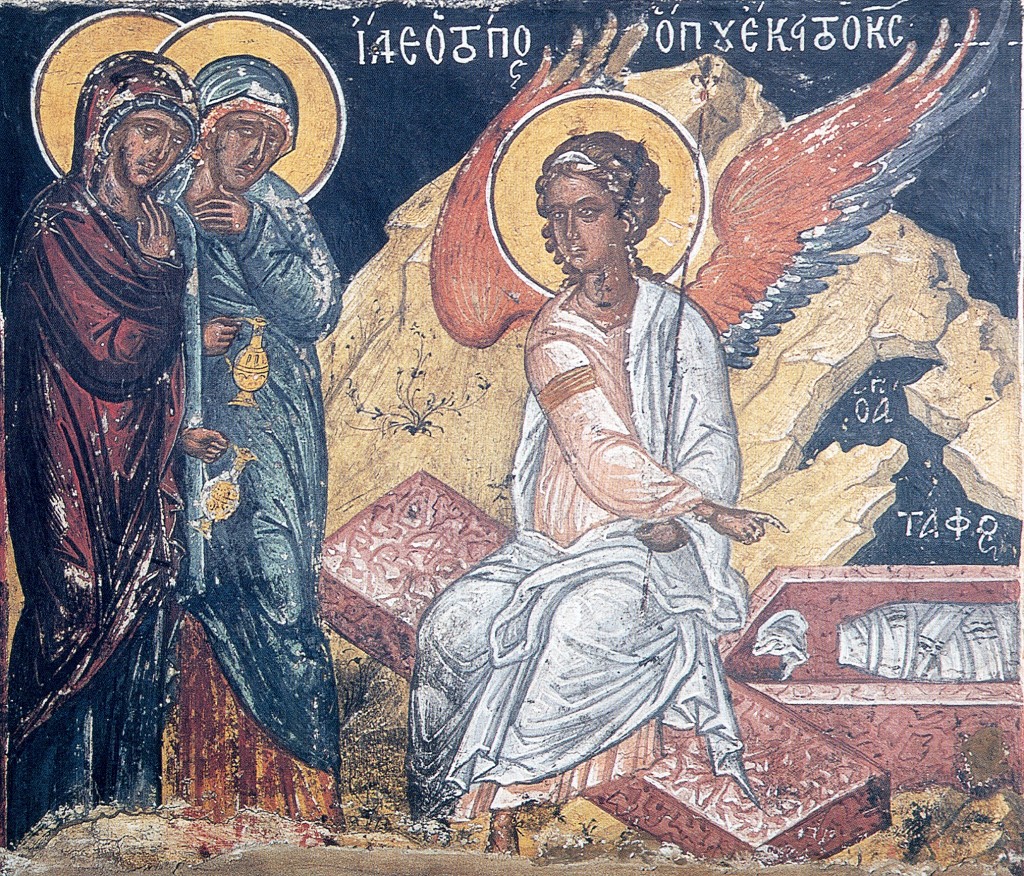
The Holy Myrrhbearers at the empty Tomb of Christ (source)
  
St. Gregory Dialogos on the Mystery of the Resurrection
Given to the People in the Basilica of the Blessed Virgin Mary, on the Holy Day of the Resurrection
1. It has been my custom, beloved brethren, to speak to you on many of the Gospel readings, by means of a sermon I had already dictated for you. But since I have been unable, because of the weakness of my throat, to read to you myself what I had prepared, I notice that some among you listen somewhat indifferently. So, contrary to my usual practice, I shall for the future make the effort during the sacred solemnities of the Mass to explain the Gospel, not through a sermon I have dictated, but by speaking directly to you myself.
  
So for the future it shall be the rule for me to speak to you in this way. For the words which are spoken directly to sluggish souls awaken them more readily than a sermon that is read to them; moving them by that touch as it were of authority, so that they listen with more attention. I am not, as I well know, competent to fulfill this office: but let your charity make good what my ignorance denies me. For I have in mind Him Who has said: Open thy mouth wide, and I will fill it (Ps. lxxx. ii). We all have in mind a good work , and it will be perfected by His divine assistance (II Tim. iii. 17). And also, this great solemnity of the Sunday of the Resurrection gives us a fitting occasion for speaking to you: for it would indeed be unfitting that the tongue of our body should be silent in the praises that are clue this day; that day on which the Body of our Author rose again from the dead.
  
2. You have heard, Beloved, how the holy women who had followed the Lord came to His tomb, bringing with them sweet spices, so that with tender affection they might tend Him in death Whom they had loved in life. And this tells us something which we should observe in the life of our holy Church. And it is important we give attention to what here took place: to see what we mint do to imitate them. And we also, who believe in Him Who died, truly come with sweet spices to His tomb, when we come seeking the Lord, bringing with us the sweet odour of virtue, and the credit of good works.
But these women who came bringing sweet spices beheld angels. And this signifies that those souls who, because of their holy love, come seeking the Lord, bearing the sweet spices of virtue, shall also see the citizens of heaven. And let us also take note of what it means that the angel is seen sitting on the right side. For what does the left side mean but this present life; and the right hand side, if not life eternal? Because of this it is written in the Canticle of Canticles: His left hand is under my head, and his right hand shall embrace me (Cant. ii. 6).
  
And so, since Our Redeemer has now passed over beyond the mortality of this present life, tightly does the Angel, who had come to announce His entry into eternal life, sit at the right side . And he came clothed in white: for he was announcing the joy of this our present solemnity. For the whiteness of his garments signifies the glory of our great Feast. Should we say ours 0t His? That we may speak truly let us say that it is both ours and His. For this day of our Redeemer’s Resurrection is also our day of great joy; for it has restored m to immortality. It is also a day of joy for the angels: for restoring us to heaven, it has filled up again the number of its citizens. On this our festival day, and His, an angel appeared, clothed in white robes, because they are rejoicing that because we are restored to heaven the losses their heavenly home had suffered are now made good.
  
3. But let us hear what is said to the women who came? Be not affrighted! As though he said to them: Let them fear who love not the coming of the heavenly citizens. Let them fear who, steeped in bodily desires, have no hope of belonging to them. But you, why should you fear, meeting your own? Matthew also, describing the appearance of the Angel, says of him: And his countenance was as lightning, and his raiment as snow (Mt. xxviii. 3). Lightning awakens dread and fear, the white radiance of snow is soothing. For Almighty God is both terrifying to sinners, and comforting to those who are good. Rightly then is the Angel, the Witness of the Resurrection, revealed to us with countenance like the lightning, and his garments white as snow: so that even by his appearance he might awaken fear in the reprobate, and bring consolation to the just.
  
And rightly also, for the same reason, there went before the Lord’s People in the desert, a column of fire by night, and a column of smoke by day (Ex. xiii: 21, 22). For in fire there is fear; but in the cloud of smoke the comforting assurance of what we can see: day also meaning the life of the just, and night the life of sinners. Because of this Paul, speaking to converted sinners, says: For you were heretofore darkness, but now light in the Lord (Eph. v. 8). So a pillar of cloud was set before them by day, and a pillar of fire by night: because Almighty God shall appear mild of countenance to the just, but fearful to the wicked. Coming to judge us, He shall comfort the one by the mildness of His countenance, and terrify the other with the severity of His justice.
  
4. Now let us hear what the angel says. You seek Jesus of Nazareth .  Jesus, in the Latin tongue, is saving ; that is, Saviour . Then however many were called Jesus, by name, not because of the reality it means. So the place is added, to make clear of what Jesus he is speaking: Of Nazareth . And to this he adds the reason they seek Him: Who was crucified . And then he goes on: He is risen, he is not here . That He was not there was said only of His Bodily Presence; for nowhere is He absent in the power of His divinity. But go , he continues, tell his disciples and Peter, that he goeth before you into Galilee .
  
Now we have to ask ourselves, why did he, speaking of the Disciples, single out Peter by name? But, had the Angel not referred to him in this way, Peter would never have dared to appear again among the Apostles. He is bidden then by name to come, so that he will not despair because of his denial of Christ. And here we must ask ourselves, why did Almighty God permit the one He had placed over the whole Church to be frightened by the voice of a maid servant, and even to deny Christ Himself? This we know was a great dispensation of the divine mercy, so that he who was to be the shepherd of the Church might learn, through his own fall, to have compassion on others. God therefore first shows him to himself, and then places him over others: to learn through his own weakness how to bear mercifully with the weakness of others.
  
5. And well did he say of Our Redeemer that: He goeth before you into Galilee; there you shall see him, as he told you . For Galilee means, passing-over . And now our Redeemer has passed over from His suffering to His Resurrection, from death to life, from punishment to glory, from mortality to immortality. And, after His Resurrection, His Disciples first see Him in Galilee; as afterwards, filled with joy, we also shall see the glory of the Resurrection, if we now pass over from the ways of sin to the heights of holy living. He therefore Who is announced to us from the tomb is shown to us by crossing over: for He Whom we acknowledge in the denial of our flesh is seen in the passing over of our soul. Because of the solemnity of the day, we have gone briefly over these points in our explanation of the Gospel. Let us now speak in more detail of this same solemnity.
  
6. There are two lives; one of which we knew, the other we did not know of. The one is mortal, the other immortal; the one linked with human infirmity, the other to incorruption; one is marked for death, the other for resurrection. The Mediator between God and man, the Man Jesus Christ, came, and took upon Himself the one, and revealed to us the other. The one He endured by dying; the other He revealed when He rose from the dead. Had He then foretold to us, who knew His mortal life, the Resurrection of His Body, and had not visibly shown it to us, who would believe in His promises? So, becoming Man, He shows Himself in our flesh; of His own will He suffered death; by His own power He rose from the dead; and by this proof He showed us that which He promises as a reward.
But perhaps some one will say: Of course He rose: for being God He could not be held in death. So, to give light to our understanding, to strengthen our weakness, He willed to give us proof, and not of His Resurrection only. In that hour He died alone; but He did not rise alone from the dead. For it is written: And many bodies of the saints that had slept arose (Mt. xxvii. 52). He has therefore taken away the argument of those who do not believe.
  
And let no one say: No man can hope that that will happen to him which the God-man proved to us in His Body; for here we learn that men did rise again with God, and we do not doubt that these were truly men. If then we are the members of our Redeemer, let us look forward to that which we know was fulfilled in our Head. Even if we should be diffident, we ought to hope that what we have heard of His worthier members will be fulfilled also in us His meanest members.
  
7. And here there comes to mind what the Jews, insulting the Crucified Son of God, cried out: If he be the king of Israel, let him come down from the cross, and we will believe him . Had He, yielding to their insults, then come down from the Cross, He would not have proved to us the power of patience. He waited for the little time left, He bore with their insults, He submitted to their mockery, He continued patient, and evoked our admiration; and He Who refused to descend from the Cross, rose again from the sepulchre. More did it matter so to rise from the sepulchre than to descend from the Cross. A far greater thing was it to overcome death by rising from the sepulchre, than to preserve life by descending from the Cross.
  
And when the Jews saw that despite their insults He would not descend from the Cross, and when they saw Him dying, they rejoiced; thinking they had overcome Him and caused His Name to be forgotten. But now through all the world His Name has grown in honour, because of the death whereby this faithless people thought they had caused Him to be forgotten. And He Whom they rejoiced over as slain, they grieved over when He was dead: for they know it was through death He had come to His glory.
The deeds of Samson, related in the Book of Judges, foreshadowed this Day (Judges xvi. 1-3). For when Samson went into Gaza, the city of the Philistines, they, learning he had come in, immediately surrounded the city and placed guards before the gates; and they rejoiced because they had Samuel in their power. What Samson did we know. At midnight he took the gates of the city, and carried them to the top of a hill outside. Whom does Samson symbolize, Beloved, in this, if not our Redeemer? What does Gaza symbolize, if not the gates of hell? And what the Philistines, if not the perfidy of the Jews, who seeing the Lord dead, and His Body in the sepulchre, placed guards before it; rejoicing that they had Him in their power, and that He Whom the Author of life had glorified was now enclosed by the gates of hell: as they had rejoiced when they thought they had captured Samson in Gaza.
  
But in the middle of the night Samson, not alone went forth from the city, but also bore off its gates, as our Redeemer, rising before day, not alone went forth free from hell, but also destroyed the very gates of hell. He took away the gates, and mounted with them to the top of a hill; for by His Resurrection He bore off the gates of hell, and by His Ascension He mounted to the kingdom of heaven.
  
Let us, Beloved, love with all our hearts this glorious Resurrection, which was first made known to us by a Figure, and then made known in deed; and for love of it let us be prepared to die. See how in the Resurrection of our Author we have come to know His ministering angels as our own fellow citizens. Let us hasten on to that great assembly of these fellow citizens. Let us, since we cannot see them face to face, join ourselves to them in heart and desire. Let us cross over from evildoing to virtue, that we may merit to see our Redeemer in Galilee. May Almighty God help us to that life which is our desire: He Who for us delivered His only Son to death, Jesus Christ our Lord, Who with Him reigns One with the Holy Ghost, for ever and ever. Amen.
  
(non-Orthodox host site)
  
Christ is risen from the dead, by dead, trampling down upon death, and to those in the tombs, He has granted life! Truly the Lord is risen!

Friday, April 10, 2015

"Let all mortal flesh keep silent..."


Christ descending to Hades to free the dead from all time (source)
  
Let all mortal flesh keep silent and in fear and trembling stand, pondering nothing earthly-minded. For the King of Kings and the Lord of Lords comes to be slain, to give himself as food to the faithful. Before him go the ranks of angels: all the principalities and powers, the many-eyed cherubim and the six-winged seraphim, covering their faces, singing the hymn: Alleluia! Alleluia! Alleluia!
-Divine Liturgy of St. Basil, Great and Holy Saturday***
(source)
  
***Note: This ancient hymn is also chanted during the Divine Liturgy of St. James, and during the Divine Liturgy at the Consecration of a Church. However, it is perfectly suited to be chanted on Great and Holy Saturday (see here for more info).
  
The Body of Christ offered on the Holy Altar (source)
  
Through the prayers of our Holy Fathers, Lord Jesus Christ our God, have mercy on us and save us! Amen!

Homily on Great and Holy Friday, by Metropolitan Avgoustinos Kantiotes

The Crucifixion of Christ (source)
  
Homily on Great and Holy Friday, by Metropolitan Avgoustinos Kantiotes (+2010)
It is Holy Friday today, my beloved and brethren fellow-sinners, a holy day full of memories, a day which calls forth strong emotions and tears. Let us, at this hour, cleanse our heart and mind of every worldly idea, every evil thought and idea, let us cleanse our mind, and with the wings of imagination let us go back centuries, and let us noetically visit the Holy Lands.
  
One can go there, but not be there, while one might not travel bodily to the Holy Lands, but be there spiritually. Therefore, let us go with our thought to that place which is called the place of the Skull, called Golgotha. There is playing out the drama of dramas, where the great battle was waged between the light and the darkness, truth and falsehood. There on Golgotha, the Redeemer of the world is now being crucified.
  
Many behold His sacrifice from heaven, the ranks of the holy Angels and Archangels, the Cherubim and Seraphim, who from the theoria of eternity behold the drama, and were ready with their flaming swords to slaughter the executioners. From the earth, that mass beheld Him, the people who four days before, on Palm Sunday, cried out: “Hosanna” (Matthew 21:9, Mark 11:9-10, John 12,13) and now they are below the Cross mocking Him. Beholding Him also are the idolatrous soldiers, the regiment which was headed by the Centurion, who received the command to ascend the place of the Skull to fulfill the judgment of the Judean court. These wild Romans, who had fought battles and were used to human blood being shed, remained unmoved, or more properly, not unmoved, but continuing the mocking which thy began in the Praetorium of Pilate.
  
Following the events, they were casting lots below the Cross and drinking...But straightaway the middle one among those three being crucified, Jesus of Nazareth, caught their attention. They saw that He was different from the others. They were blaspheming, condemning the day that they were born, throwing out sharp insults against everyone, while the Crucified One was silent. His silent is mysterious, a silence which is moving. Christ is silent. And when He opens His spotless mouth to say the seven words of the Cross, His words are not condemnation, but blessings, words which made a deep impression on everyone who heard and saw Him. These words were noted by those who crucified our Christ. The soldiers heard Him say: “Father forgive them, for they know not what they do” (Luke 23:34), they heard “I thirst” (John 19:28), they heard: “Eli, Eli, lama sabacthani?” (“My God, my God, why have you forsaken me?”) (Matthew 27:46, Mark 15:34), they heard: “It is finished” (John 19:30).
  
All of these they heard and they thought: “Who is this, who appears totally different than the other convicts...” And when at noon they saw the sun turn dark, and darkness cover all of creation, and the earth quake, and the graves open, then they believed.
  
There remained not a single hesitation or doubt, and together with the Centurion they said in fear: “Truly, this was the Son of God” (Matthew 27:54). This was truly not by chance, but He has a supernatural origin, He is the Son of God, the true God.
  
From the time that the Centurion said those words, about twenty centuries have passed. And this witness and confession does not remain alone. It is continued until today. Many, countless witnesses say that Christ is God, the God-man. Do we have examples? We have. What are they? Let me offer a few.
  
“Truly this was the Son of God.” First, His teaching cries out. Open the books of all the religions, read all the books of the philosophers, hear the words of the greatest rhetors. You will see that the teaching of Christ surpasses, is incredible. I don't doubt that the others said important things, but their words resemble small flecks of gold mixed into a ball of various metals. They resemble a small light, like the light of a candle, before the sun. The words of Christ are light and life, and always made a great impression.
  
Even His enemies who heard Him were compelled to confess: “No man ever spoke like this man” (John 7:46). "Let the human spirit goes forth", as someone said, "let science progress, let discoveries occur, for humanity will never reach the height of the teaching of Jesus Christ". And someone else said: "I don't know if there are other rational beings on other planets, but even if we hypothesize that they exist and dwell there, they could not possibly have a higher religion that that which was preached by Christ".
  
“Truly, this was the Son of God.” His teaching cries out, and so do His wonders. The wonders of Christ! Wherever He stretched forth His hands, wherever His divine command was heard, there the wind stopped, the sea was calmed, the demons fled, the blind saw, the deaf heard, the dumb spoke, the lepers were cleansed, the paralytics stood up, and even the dead were raised from their graves. True wonders, not fantasies. Wonders which occurred not at night in some unseen corner, but before the eyes of the multitude, and sometimes even by the enemies, who saw these and said in astonishment: “We never saw anything else this before” (Mark 2:12). The wonders of Christ are countless. And even if the sea would become ink and heaven paper and the trees pens, it would not be enough to recount all of the wonders that our Lord Jesus Christ worked, that He works, and that He will work until the end of the ages.
  
“Truly, this was the Son of God”. His spotless life further cries this out. Christ is holy, not in a relative sense like many men, but in the absolute sense. It is He Who never committed any wrong or vice, “there was no guile in His mouth” (Isaiah 53:9, I Peter 2:22), it is He Whose life was radiant from every angle, He Whose virtue “covered the heavens” (Amb. 3:33) Which virtue of Christ should we offer first? His poverty and simplicity, for no one else lived so humbly that He had not even “a place to lay His head” (Matthew 8:20)? His meekness and forbearance before His enemies and crucifiers? His boldness and lack of fear before rulers and Pilate when He proclaimed the truth? His humility, to the point that He bent to wash the feet of His disciples? Or before all, His love towards God and men who were suffering? All of these create the greatest icon of the life of Christ on earth. Some tried to find fault, they searched the Gospels, they scratched their heads, but they couldn't find any blemish. The sun even has its spots, but Christ is the Spotless Sun. It is He who said: “Who convicts me of sin?” (John 8:46), and the question remains unanswered throughout the centuries.
  
“Truly, this was the Son of God”. This is shown by His teaching, His wonders, His holiness of life, and ultimately by the witness of the centuries. The Centurion was not alone in bearing witness to this. Generations of generations of Saints bear witness. Small children like St. Kerykos, who were held in the arms of their mothers, chaste virgins, simple workers like fishermen, wise scientists: all confessed that Christ is truly God.
  
We also today, my beloved, behold the Passion of our Savior. How are we following this divine drama? Like the Angels, with love and worship, or like the multitude, who cried out “Hosanna”, and then “Crucify Him, crucify Him” (John 19:6)? Let us follow like the Centurion, who abandoned hesitation, and believed and confessed the Son of God. If there is any who have any doubt regarding the person of Christ, he only needs to approach, to test, to study with sincerity. And then, like the Centurion, he will be led by realities to confess also that Christ is “truly the Son of God”, that He is one of the three persons of the Holy Trinity, that He is the God-man and Redeemer. Him, O children of the Greeks, let us hymn and greatly praise, unto all the ages. Amen.
(+) Bishop Avoustinos

Recorded homily which occurred in the Church of St. Panteleimon, Florina, on April 24th, 1981.

(amateur translation of text from source)
  
Through the prayers of our Holy Fathers, Lord Jesus Christ our God, have mercy on us and save us! Amen!

Thursday, April 9, 2015

"I gave my back to scourgings..."

Christ being scourged, and being led to be crucified (source)
  
I gave my back to scourgings, while I did not turn away my face from spittings. I stood at Pilate’s judgement seat and endured the Cross for the salvation of the world.
-Matins of Great and Holy Friday
  
Through the prayers of our Holy Fathers, Lord Jesus Christ our God, have mercy on us and save us! Amen!

Monday, April 6, 2015

"I have come to serve Adam who has become poor..."

Icon of Christ "Behold the Man", with the Theotokos and "a sword piercing her heart". In the background is a portion of the Pillar on which Christ was flogged. These are treasured by the Patriarchal Church of St. George, Constantinople (source)
  
Myself rich in godhead, I have come to serve Adam who has become poor, whose form I, the Creator, have willingly put on, and to lay down my life as a ransom for his, I who am impassible in my godhead.
-Troparion from the First Ode of the Canon of Holy Monday
  
Through the prayers of our Holy Fathers, Lord Jesus Christ our God, have mercy on us and save us! Amen!

Saturday, April 4, 2015

"This is our God and there is none like Him"

Christ entering Jerusalem (source)
  
This is our God and there is none like him. He has found out every just way and given it to Israel his beloved. But after this he appeared and lived among mankind. Blessed is he who comes in the name of the Lord, our Saviour.
-Troparion from the 9th Ode
from the Canon of Palm Sunday.
(Also see Baruch 3:35-37)
  
Through the prayers of our Holy Fathers, Lord Jesus Christ our God, have mercy on us and save us! Amen!

Excerpt from the Homily on the Raising of Lazarus by St. Amphilochius of Iconium

The Raising of Lazarus (source)
  
Excerpt from the Homily on the Raising of Lazarus by St. Amphilochius of Iconium (amateur translation)
Bring the Evangelist John once again into our midst,
For it is good to relate of the beginning of the Resurrection.
For you heard when he perfectly said:
“Six days before the Passover, Jesus came to Bethany, where Lazarus was, whom He raised from the dead.”
Do you see that the beginning of the Resurrection is depicted before-hand with Lazarus, whom the whole multitudes of the faithful knew?
The multitudes knew him, and the chief priests reviled the wondrous work, transforming it into guile. Truly, they reviled the resurrection of Lazarus, because after his resurrection, as you have heard, they took counsel together to put him to death.
Do you see this utter guile?
He whom the Lord raised, him they thought to put to death, not understanding that even if they would put him to death, again the Lord could have resurrected His friend.
They took counsel together to put Lazarus to death.
Nothing had astonished the Judeans like the resurrection of Lazarus. This wonder alone they were unable to slander.
They slandered the sight of the man born blind, saying that it wasn't him, but it was someone like him.
They slandered the raising of the daughter of Jairus, saying that she was passed out, not totally dead.
They slandered the resurrection of the son of the widow [of Nain] saying that he appeared to be dead, not that He had taken him from the tyranny of death.
They slandered the withered fig tree, saying that it was picked clean, and not that the word of the Master had withered it.
They slandered the transformation of the water into wine, saying that those at the dinner were drunk, and did not see that they were joking.
Only the resurrection of Lazarus were they unable to slander.
They knew who Lazarus the man was. They followed in his funeral, they saw his tomb sealed, they and they talked about him at supper with Martha and Mary, the sisters of Lazarus.
They knew that he laid in the tomb for exactly four days, and that a person four-days-dead always began to have his flesh decompose, his bones rot, his nervous system dissolve, his internal organs separate, and his belly to become bloated.
This they kept in mind when they saw that Lazarus had been resurrected, and was complete, perfect as if from a lathe, standing in his former biological state, and they were astonished...
(source)
  
Through the prayers of our Holy Fathers, Lord Jesus Christ our God, have mercy on us and save us! Amen!