Tuesday, November 25, 2008

St. Catherine the Great Martyr and All-wise

St. Catherine the Great Martyr - Celebrated on November 25th*** (13th Century Icon of St. Catherine with Scenes from her life, from the Monastery of St. Catherine - Mount Sinai (http://pravicon.com/images/sv/s0756/s0756002.jpg)
  
***Note: According to the ancient usage, Saints Catherine and Mercurius were celebrated on the 24th of this month, whereas the holy Hieromartyrs Clement of Rome and Peter of Alexandria were celebrated on the 25th. The dates of the feasts of these Saints were interchanged at the request of the Church and Monastery of Mount Sinai, so that the festival of Saint Catherine, their patron, might be celebrated more festively together with the Apodosis of the Feast of the Entry of the Theotokos. The Slavic Churches, however, commemorate these Saints on their original dates.
"The Holy Great Martyr Katherine was the daughter of Constus, the governor of Alexandria in Egypt, during the reign of the emperor Maximian (305-313). Living in the capital, Katherine received a most splendid education, having studied the works of the finest philosophers and teachers. Young men from the most worthy families of the empire sought the hand of the beautiful Katherine, but none of them was chosen. She declared to her parents that she would only enter into marriage with someone who surpassed her in reputation, wealth, beauty and wisdom.

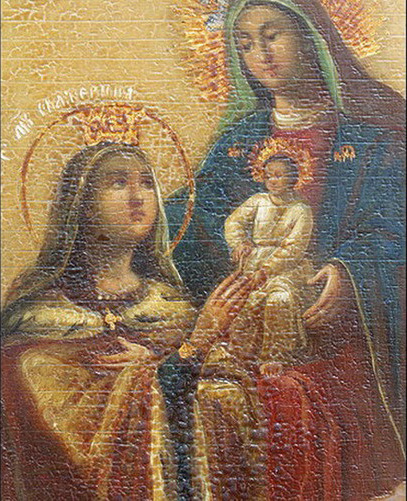
Katherine's mother, a secret Christian, sent her for advice to her own spiritual father -- a saintly elder pursuing prayerful deeds in solitude in a cave not far from the city. Having listened to Katherine, the elder said that he knew of a youth, who surpassed her in everything, such that "His beauty was more radiant than the shining of the sun, His wisdom governed all creation, His riches were spread throughout all the world ". The image of the Christ produced in the soul of the holy maiden an ardent desire to see Him. In parting, the elder handed Katherine an icon of the Mother of God with the God-Child Jesus on Her arm and bid her to pray with faith to Mary to show her a vision of Her Son.

Another icon of St. Catherine with scenes from her life (taken from: http://vatopaidi.files.wordpress.com/2009/11/agia-aikaterina-1.jpg)
  
Katherine prayed all night and was able to see the Most Holy Virgin who told Her Divine Son to look upon the kneeling of Katherine before Them. But the Child turned His face away from her saying that He was not able to look at her because she was ugly, of shabby lineage, beggarly and mindless like every person -- not washed with the waters of holy Baptism and not sealed with the seal of the Holy Spirit. Katherine returned again to the elder deeply saddened. He lovingly received her, instructed her in the faith of Christ, admonished her to preserve her purity and integrity and to pray unceasingly; he then performed over her the sacrament of holy Baptism. And again Saint Katherine had a vision of the Most Holy Mother of God with Her Child. Now the Lord looked tenderly at her and gave her a ring -- a wondrous gift of the Heavenly Bridegroom.
 
The Theotokos and Christ appearing to St. Catherine (source)
 
At this time the emperor Maximian was himself in Alexandria for a pagan feast day. Because of this, the feast was especially splendid and crowded. The cries of the sacrificial animals, the smoke and the smell of the sacrifices, the endless blazing of fires, and the bustling crowds at the arenas filled Alexandria.
  
St. Catherine before the Emperor, fresco by Alevizakis (source)
  
Human victims also were brought -- because they chose to die in the fire rather than deny Christ under torture. The Saint's love for the Christian martyrs and her fervent desire to lighten their fate impelled Katherine to go to the emperor-persecutor Maximian.
 
St. Catherine the Great Martyr (source)
 
Introducing herself, the saint confessed her Christian faith and with wisdom denounced the errors of the pagans. The beauty of the maiden captivated the emperor. In order to convince her and show the superiority of pagan wisdom, the emperor gave orders to gather 50 of the most learned men of the empire, but the Saint got the better of the wise men, such that they themselves came to believe in Christ. Saint Katherine shielded them with the sign of the cross, and they bravely accepted death for Christ and were burnt by order of the emperor.

St. Catherine debating and defeating Fifty philosophers (taken from the following link, see for the full account of St. Catherine's defense: http://www.johnsanidopoulos.com/2009/11/50-philosophers-who-converted-to.html)
  
Maximian, no longer hoping to convince the saint, tried to entice her with the promise of riches and fame. Having received an angry refusal, the emperor gave orders to subject the saint to terrible tortures and then throw her in prison. The Empress Augusta, who had heard much about Katherine, wanted to see her. Having succeeded in convincing the military-commander Porphyry to accompany her with a detachment of soldiers, Augusta went to the prison. The strong spirit of Saint Katherine, whose face glowed with Divine grace, impressed the empress. The holy martyr explained the teachings of the Christians to the people and they believed and were converted to Christ.

16th Century icon of St. Catherine (from the iconostasis of the Katholikon), holding the Cross of a Martyr, the wheel on which she was tortured, and a palm branch symbolizing victory. At her feet are books, geographical tools, etc. which symbolize her great wisdom and learning. Behind her in the icon are depicted the Prophet Moses and the Burning Bush (prefiguring the Theotokos) and the Angels transferring St. Catherine's Relic. (taken from: http://vatopaidi.files.wordpress.com/2009/11/5sf-mc-ecaterina-sinai-16.jpg)
  
On the following day they again brought the her to the judgment court where, under the threat of being tortured on a wheel of spikes and nails, they urged that she recant from the Christian faith and offer sacrifice to the pagan gods. The saint steadfastly confessed Christ and she herself approached the wheel; but an Angel smashed the sharp tools, which broke up into pieces that hit pagans who were passing by. Having beheld this wonder, the empress Augusta and the imperial courtier Porphyry with 200 soldiers confessed their faith in Christ in front of everyone, and they were beheaded. Maximian again tried to entice Saint Katherine, proposing marriage to her, and again he received a refusal. She confessed her fidelity to the Heavenly Bridegroom Christ, and with a prayer to Him she herself put her head on the block under the sword of the executioner and was beheaded." At her execution, milk flowed from her wounds instead of blood by the Grace of God."

Icon of St. Catherine's body being carried by Holy Angels to Mount Sinai (Icon courtesy of www.eikonografos.com used with permission)
  
"Following her martyrdom, angels bore her body to the peak of Mount Saint Catherine, where they rested until they were translated to the catholicon of the Holy Monastery of Sinai. Here they continue to emit a sweet fragrance, and many miracles are wrought to this day. The veneration of Saint Catherine spread throughout the West, especially after the translation of relics of Saint Catherine to Rouen by Symeon Pentaglosses, in the early eleventh century. The numerous pilgrims to the monastery from that time resulted in the gradual change of name from the Holy Monastery of Sinai to that of Saint Catherine’s Monastery." (taken from: http://www.sinaimonastery.com/en/index.php?lid=29#)
  
Reliquary of St. Catherine, Mount Sinai (taken from: http://www.sinaimonastery.com/en/index.php?lid=84#)
  
"The marble chest containing the relics of Saint Catherine is located at the south side of the sanctuary in the catholicon of the holy monastery. It is the construction of Procopius the stonecutter, who took nine years to complete the shrine in honor of Saint Catherine. This shrine replaced the earlier marble chest, which is preserved today in the monastery’s treasury. Inside are to be found two precious reliquaries given by the Russian Empire for this purpose, the one enshrining the precious head of the martyr, and the other her left hand. The relics of Saint Catherine are brought out for the veneration of the faithful on special occasions, at which time each pilgrim is given a silver ring bearing the monogram of the saint, in honor of the ring that Saint Catherine received from Christ. These are preserved by pilgrims as a blessing from the saint." (taken from: http://www.sinaimonastery.com/en/index.php?lid=84)
  
For three hymns in praise of St. Catherine, see: http://full-of-grace-and-truth.blogspot.com/2009/11/three-hymns-in-honor-st-catherine-great.html.
  
Icon of St. Catherine the Great Martyr (Icon courtesy of www.eikonografos.com used with permission)
  
Apolytikion in the Plagal of the First Tone
Let us praise the most auspicious bride of Christ, the divine Katherine, protectress of Sinai, our aid and our help. For, she brilliantly silenced the eloquence of the impious by the sword of the spirit, and now, crowned as a martyr, she asks great mercy for all.
  
Kontakion in the Second Tone
O friends of martyrs, now divinely raise up a renewed chorus, praising the all-wise Katherine. For, she proclaimed Christ in the arena, trampled on the serpent, and spat upon the knowledge of the orators.
(taken from: http://goarch.org/chapel/saints_view?contentid=307&type=saints)
  
St. Catherine the Great Martyr, with scenes from her life (http://pravicon.com/images/sv/s0756/s0756009.jpg)
  
Saint Catherine the Great-martyr, intercede for us!
Through the prayers of our Holy Fathers, Lord Jesus Christ our God, have mercy on us and save us! Amen!

Friday, November 21, 2008

The Entrance of the Holy Theotokos into the Temple

The Entry into the Temple of the Most-holy Theotokos - Commemorated on November 21st (Icon courtesy of www.eikonografos.com used with permission)

"When the Most-holy Virgin Mary reached the age of three, her holy parents Joachim and Anna took her from Nazareth to Jerusalem to dedicate her to the service of God according to their earlier promise. It was a three-day journey from Nazareth to Jerusalem but, traveling to do a God-pleasing work, this journey was not difficult for them. Many kinsmen of Joachim and Anna gathered in Jerusalem to take part in this event, at which the invisible angels of God were also present. Leading the procession into the Temple were virgins with lighted tapers in their hands, then the Most-holy Virgin, led on one side by her father and on the other side by her mother. The virgin was clad in vesture of royal magnificence and adornments as was befitting the ``King's daughter, the Bride of God'' (Psalm 45:13-15). Following them were many kinsmen and friends, all with lighted tapers. Fifteen steps led up to the Temple. Joachim and Anna lifted the Virgin onto the first step, then she ran quickly to the top herself, where she was met by the High Priest Zacharias, who was to be the father of St. John the Forerunner. Taking her by the hand, he led her not only into the Temple, but into the ``Holy of Holies,'' the holiest of holy places, into which no one but the high priest ever entered, and only once each year, at that. St. Theophylact of Ohrid says that Zacharias ``was outside himself and possessed by God'' when he led the Virgin into the holiest place in the Temple, beyond the second curtain-otherwise, his action could not be explained. Mary's parents then offered sacrifice to God according to the Law, received the priest's blessing and returned home. The Most-holy Virgin remained in the Temple and dwelt there for nine full years. While her parents were alive, they visited her often, especially Righteous Anna. When God called her parents from this world, the Most-holy Virgin was left an orphan and did not wish to leave the Temple until death or to enter into marriage. As that would have been against the Law and custom of Israel, she was given to St. Joseph, her kinsman in Nazareth, after reaching the age of twelve. Under the acceptable role of one betrothed, she could live in virginity and thus fulfill her desire and formally satisfy the Law, for it was then unknown in Israel for maidens to vow virginity to the end of their lives. The Most-holy Virgin Mary was the first of such life-vowed virgins, of the thousands and thousands of virgin men and women who would follow her in the Church of Christ."
(St. Nikolai Velimirovch - Prologue of Ochrid, taken from: http://www.westsrbdio.org/prolog/prolog.htm)

Detail from the Entrance of the Holy Theotokos into the Temple: Panagia and St. Zacharias (Icon courtesy of www.eikonografos.com used with permission)

"And the priest received her [the Theotokos], and kissed her, and blessed her, saying, "The Lord has magnified your name in all generations. In you, on the last days, the Lord will manifest his redemption to the children of Israel". And he sat her on the third step of the altar, and the Lord God sent grace upon her; and she danced with her feet, and all the house of Israel loved her."
The Protoevangelium of James. Section 17
(translated by Fr. Ephraim Lash: http://www.anastasis.org.uk/)

For a homily by St. Gregory Palamas on the Entrance of the Theotokos to the Temple, see: http://full-of-grace-and-truth.blogspot.com/2009/11/st-gregory-palamas-on-entrance-of.html.

Detail from the Entrance of the Holy Theotokos into the Temple: Panagia being fed by the angels (Icon courtesy of www.eikonografos.com used with permission)

Apolytikion in the Fourth Tone
Today is the prelude of God’s good pleasure, and the proclamation of humanity’s salvation. In the temple of God, the Virgin is presented openly, and in herself she announces Christ to all. Let us, then, with a great voice cry aloud to her: “Rejoice, you are the fulfillment of the Creator’s dispensation.”

Kontakion in the Fourth Tone
The Saviorสนs most pure and immaculate temple, the very precious bridal chamber and Virgin, who is the sacred treasure of the glory of God, on this day is introduced into the House of the Lord, and with herself she brings the grace in the divine Spirit. She is extolled by the Angels of God. A heavenly tabernacle is she.

Oikos
Seeing the grace of God’s ineffable and divine mysteries evident and manifestly fulfilled in the Virgin, I rejoice; and I am at a loss to understand the ineffable and strange manner in which the immaculate Maid alone proved to be chosen above all creation visible and invisible. Therefore, wishing to extol her, I am greatly perplexed in mind and speech. Nevertheless I dare to do it, and I proclaim and magnify: A heavenly tabernacle is she.
Most-Holy Theotokos, save us! Amen!

Thursday, November 13, 2008

Divine Inspiration and St. John Chrysostom

Icon depicting the Divine inspiration of St. John Chrysostom: St. Proclos his disciple witnessing St. Paul speaking into St. John's ear. (Icon courtesy of www.eikonografos.com used with permission.)
  
"Saint John [Chrysostom] was renowned for his explanations of the Holy Scriptures. He also interpreted the Epistles of Saint Paul, whom he admired greatly. In order to assure himself that the interpretation of the Epistles were correct, he asked God to offer him a sign.
At that same time, a nobleman had risen against Emperor Arcadius. The Emperor, in turn, confiscated all of the man's possessions and threatened to execute him. The nobleman became desperate and decided to ask for Saint John's assistance. When he arrived at the Patriarchate, Saint John could not offer him an audience immediately, but instructed him to return that evening. Saint John told the assistant priest, Proclos (who later succeeded Saint John as Patriarch), to show the nobleman to the Saint's room when he arrived. That evening, the nobleman returned and Proclos went to inform the Patriarch of his arrival. The door to the room was shut, so Proclos looked through the keyhole. He saw Saint John sitting at his desk writing, with a bald-headed man, slightly bent, looking over his shoulder. Seeing this, Proclos returned to the nobleman and told him that the Patriarch was in conference. Proclos returned to the Patriarch's room several times during the night, but the man was still talking with John. Thus the nobleman waited the entire night to see Saint John. Morning came and the Patriarch prepared to perform the orthros, realizing neither that the nobleman had waited all night for him, nor that Proclos had seen the vision.

That morning the nobleman returned to the Patriarchate since it was of the utmost importance for him to see the Patriach. Proclos went again to inform John of the nobleman's arrival, but again saw the same man in the Patriarch;s room. John looked extremely interested in what the man was telling him. Proclos was bewildered on how the man was entering, since everyone had to come by him.
The nobleman returned for the fourth time and Proclos assured him that the Patriarch was alone, for he had made certain that no one passed without his knowledge. When Proclos went to the Patriarch's room, he was shocked to find the same man still there. He returned to the nobleman and told him to go to his home for it was impossible for him to see John.

That third day, the Saint had remembered the nobleman and inquired about him. Proclos told John that the man had come three times, but each time, the Patriarch was busy talking to the same man. John asked Proclos whom he had seen in the room. Proclos told him that it looked as if it were the Apostle Paul, whose icon sat on the Saint's desk. Joyously, Saint John realized that this was the sign he had asked for from God concerning his interpretations of the Apostle's epistles. Thus, Saint John wrote The Fourteen Epistles of the Apostle Paul containing the explanation of the letters. This book is one of the greatest works in the writings of the Orthodox Church.

After conferring with the nobleman, the Patriarch agreed to act as mediator between the nobleman and the Emperor. Within a short time, the differences were settled and the nobleman was again granted his confiscated property"
(For the Glory of the Father, Son and Holy Spirit: A History of Eastern Orthodox Saints, by Michael James Fochios, translations from the Great Synaxaristes)

A real photograph of the Holy Skull of St. John Chrysostom, treasured by the Holy Monastery of Vatopedi on Mount Athos. It is clear that St. John's ear is incorrupt after 1600 years by the Grace of the Holy Spirit, as a testament to the miracle related above.
  

St. John Chrysostom's introduction to his commentary on the Epistle of St. Paul to the Romans (Downloaded from http://www.ccel.org/ccel/schaff/npnf111.vii.ii.html)

"As I keep hearing the Epistles of the blessed Paul read, and that twice every week, and often three or four times, whenever we are celebrating the memorials of the holy martyrs, gladly do I enjoy the spiritual trumpet, and get roused and warmed with desire at recognizing the voice so dear to me, and seem to fancy him all but present to my sight, and behold him conversing with me. But I grieve and am pained, that all people do not know this man, as much as they ought to know him; but some are so far ignorant of him, as not even to know for certainty the number of his Epistles. And this comes not of incapacity, but of their not having the wish to be continually conversing with this blessed man. For it is not through any natural readiness and sharpness of wit that even I am acquainted with as much as I do know, if I do know anything, but owing to a continual cleaving to the man, and an earnest affection towards him. For, what belongs to men beloved, they who love them know above all others; because they are interested in them. And this also this blessed Apostle shows in what he said to the Philippians; “Even as it is meet for me to think this of you all, because I have you in my heart, both in my bonds, and in the defence and confirmation of the Gospel.” (Phil. i. 7.) And so ye also, if ye be willing to apply to the reading of him with a ready mind, will need no other aid. For the word of Christ is true which saith, “Seek, and ye shall find; knock, and it shall be opened unto you.” (Matt. vii. 7.) But since the greater part of those who here gather themselves to us, have taken upon themselves the bringing up of children, and the care of a wife, and the charge of a family, and for this cause cannot afford to all events aroused to receive those things which have been brought together by others, and bestow as much attention upon the hearing of what is said as ye give to the gathering together of goods. For although it is unseemly to demand only so much of you, yet still one must be content if ye give as much. For from this it is that our countless evils have arisen—from ignorance of the Scriptures; from this it is that the plague of heresies has broken out; from this that there are negligent lives; from this labors without advantage. For as men deprived of this daylight would not walk aright, so they that look not to the gleaming of the Holy Scriptures must needs be frequently and constantly sinning, in that they are walking in the worst darkness. And that this fall not out, let us hold our eyes open to the bright shining of the Apostle’s words; for this man’s tongue shone forth above the sun, and he abounded more than all the rest in the word of doctrine; for since he labored more abundantly than they, he also drew upon himself a large measure of the Spirit’s grace. 336(1 Cor. xv. 10.)"

For the life of St. John Chrysostom, see http://goarch.org/chapel/saints/290, among many other sources.
  
Icon of St. John Chrysostom. (Icon courtesy of www.eikonografos.com used with permission.)
  
Apolytikion. Tone 8. Model Melody.
The grace which shone from your mouth like a torch of flame enlightened the whole earth; it laid up for the world the treasures of freedom from avarice; it showed us the height of humility. But as you train us by your words, Father John Chrysostom, intercede with Christ God, the Word, that our souls may be saved.
  
Kontakion. Tone 6.
You received divine grace from heaven, and through your lips you teach us all to worship one God in Trinity, venerable John Chrysostom, wholly blessed. Fittingly we praise you, for you are a teacher who makes clear things divine.
  
The Ikos.
I bow the knee to the Maker of all things, I stretch out my hands to the eternal Word seeking the gift of words that I may sing the praise of the Saint whom he magnified. For he who lives to the ages said to the Prophet: I glorify those who glorify me with faith. He then, who among those of old exalted Samuel, has now glorified his Hierarch. For having traded well he brought the talent with which he had been entrusted to the King. Therefore the One above all being also exalted him. For this reason I the unworthy ask that words be given me that I may have strength to sing his praise. For he is the instructor of the of the world who makes clear things divine.
  
(Hymns to St. John Chrysostom above translated by Fr. Ephraim Lash, downloaded from: http://www.anastasis.org.uk/13%20nov.htm)
  
Through the prayers of our Holy Fathers, Lord Jesus Christ our God, have mercy on us and save us! Amen!

Sunday, November 9, 2008

A Great Miracle of St. Nektarios - The Healing of Elder Nektarios Vitalis


Photograph of St. Nektarios the Wonderworker of Aegina, Archbishop of Pentapolis (taken from: http://www.rel.gr/photo/displayimage.php?album=18&pos=8; see: http://www.rel.gr/photo/thumbnails.php?album=18 for more pictures of the Saint)

A Great Miracle of St. Nektarios - The Healing of Elder Nektarios Vitalis (Amateur translation of text from: http://www.imga.gr/enories/ag_nektarios_thaumata.html)

Fr. Nektarios Vitalis, well-known in Lavrio [Attika, Greece] for his deeds and his sympathy to the poor and those written-off by the world in these difficult times, retells the following incident from when he was dying from cancer. What is said below has been told elsewhere, repeatedly, including in the book "I talked to Agios Nektarios" - Athens 1997, by the renowned writer Mr. Manolis Melinos.

Icon of St. Nektarios (taken from eikonografos.com, used with permission)

Fr. Nektarios Vitalis' words: "I was suffering from a serious form of cancer. My chest was an open wound that was continuously running blood and pus. I would tear my undershirts from the pain. It was a tragic situation, and I was headed directly to death. So you understand, I had even prepared my grave clothes...On the 26th of March 1980, in the morning, I was talking in my office in the basement of the Church with Sofia Bourdoy (the church care-taker [woman who cleans the church]) and the icon painter Helen Kitraki, when the door suddenly opened and an old, unknown man entered. He had a snow-white beard, was short and was slighty bald. He looked exactly the same as St. Nektarios appears in photographs. He took three candles without paying lit only two. He venerated all the icons of the church, but passed over the icon of St. Nektarios without the venerating. He did not see me where I was. I had terrible pains when they pulled aside the curtain of the office and went to see the old man. He faced the Beautiful Gate [the Royal Doors in the Holy Iconostasion], crossed his palms and without looking around he asked,

"Is the Gerona [Elder] here?"

The church care-taker knowing my disease wanted to "protect" me...
"No, no...he is at home with the flu..."

He replied "Never mind. Pray, and Good Resurrection [the traditional Orthodox greeting during Great Lent in anticipation of Pascha]" as he left.

The church care-taker came running to me and said "Father Nektarios, the old man who just left resembled St. Nektarios himself! His eyes flew flames. It seems to me that was the St. Nektarios and he came to help you..."

I thanked her thinking that she said this to a console me. But deep down something was wrong. I sent her along with the icon painter to find the unknown man and quickly bring him back. I walked into the sanctuary and venerated the Crucified One [the icon of Christ on the Cross in the Holy Altar] crying, and once again asking Christ to heal me. Their footsteps stopped,

"Father, the Elder has come!"

I tried to kiss his hand, but out of humilty he did not let me. He bent and kissed my own! I asked him, "What is your name?"

"Anastasios, my son," he said, relating his baptismal name that had before he become a monk...

I led him to venerate the holy relics. He took out a pair of glasses with only one arm, and as soon as we saw them we were amazed! They were the same glasses of St. Nektarios that we had in the case with the holy relics. They were given to me by the old Gerontissa Nektaria [Abbess or Eldress] of the monastery, in Aegina.

"Belief is everything!" said the stranger, as he put on his glasses.

He began with reverence to embrace all the holy relics as the church care-taker showed, except for the relics of St. Nektarios, which he passed over...

"Geronta, forgive me," I said, "but why don't you venerate the miraculous Saint Nektarios?"

He turned and looked at me smiling. I asked him, "Where are you staying Geronta? He showed me the ceiling, where we were building the new church [dedicated to St. Nektarios], saying,

"My house is still not ready and I'm worried. My position does not allow me to live here and there..."

"Geronta, I must confess, you were told a lie earlier, I have cancer! But I want to get well, to make the Holy Altar, to finish the Church first, and then I can die..."

"Do not worry," he told me. "I'm leaving now. I'm going to Paros [island in Greece] to venerate St. Arsenios and to visit Fr. Philotheos [Zervakos]." he added, starting to leave and passing by the big icon without giving it a second thought...

I stopped him and put my hands to his face.

"My Geronda, my Geronda, your face looks exactly like St. Nektarios who is honored here in our church..."

Then, tears rolled from his eyes...He crossed me and embraced [hugged] me with his hands... Taking courage I opened my hands to hug him. But when I spread out my hands, and while I was watching I could see him before my face, my arms closed back to my chest!

I shivered and crossed myself [ฮ‘ฮฝฮฑฯ„ฯฮฏฯ‡ฮนฮฑฯƒฮฑ ฮบฮฑฮน ฯƒฯ„ฮฑฯ…ฯฮฟฮบฮฟฯ€ฮฎฮธฮทฮบฮฑ].

I said again, "O my Geronta, I beg you, I want to live to do my first Liturgy. Help me to live..."

He left from being close to me and stopped in front of his icon and said,

"Oh, my child Nektarios, don't worry. It is a passing trial, and you will be well! The miracle which you are asking for will happen, and it will be told to the whole world. Don't be afraid..."

Immediately he left us by walking through a closed door...

The women ran to catch him. He came to the bus stop. He went inside and disappeared before the bus left!

This story is always told by Fr. Nektarios Vitalis, a respected and reliable person, in the presence of witnesses. Fr. Nektarios eventually became well, frustrating doctors, radiologists, and forecasters of death. Because above all is Christ, our living God, and our intercessors before God the Saints, plus our Mother the Panagia!

Because "where God wills, the laws of nature are overcome..."

Icon of St. Nektarios embracing and healing Fr. Nektarios Vitalis, along with the two women bearing witness to this to the left, and the doctors confirming the miracle to the right. The icon is from the church of St. Nektarios in Aretaieion Hospital (taken from http://www.eikastikon.gr/xristianika/kordis_erga_agios_nektarios_en.html)

See the following link for a video of Fr. Nektarios Vitalis recounting this incredible miracle himself (in Greek): http://www.pigizois.net/sinaxaristis/11/arxeia/thayma_gerontos.wmv. The following page has more videos and pictures from the pilgrimage he built: http://www.pigizois.net/ieres_mones/i_m_ag_nektariou_kamariza_lavrio_atikis/index_ag_nektarios.htm. Finally, here is the text of a Paraklesis to St. Nektarios written specifically for this great pilgrimage of St. Nektarios in Kamariza, Lavrio, Attica, where St. Nektarios works many miracles: http://voutsinasilias.blogspot.com/2009/11/9.html.


May St. Nektarios intercede for all of us and help us!

Icon of St. Nektarios the Wonderworker, Bishop of Pentapolis (taken from: http://www.rel.gr/photo/displayimage.php?album=26&pos=120)

Apolytikion of St. Nektarios the Wonderworker of Pentapolis in the First Tone
The son of Selybria, the guardian of Aegina, * and the ardent lover of virtue, * who in recent times has appeared, * the God-inspired servant of Christ, * Nektarios, O faithful, let us praise. * For he gushes forth healings of every kind * to those who cry out reverently, “Glory to Christ, who glorified you! * Glory to Him for your miracles! * Glory to Him, who, through you, effects cures for all.”

Through the prayers of our Holy Fathers, Lord Jesus Christ our God, have mercy on us and save us! Amen!

Tuesday, November 4, 2008

Patron Saints - November

Greetings!

Here are some common Patron Saints for the month of November (and again, this is by no means a comprehensive list). The sources are http://oasigr.5.forumer.com/a/_post1688-30.html and http://orthodoxwiki.org/Patron_saint primarily.


Menaion Icon of the Saints and Feasts of the Month of November (icon taken from Holy Transfiguration Monastery http://www.thehtm.org/catalog/product_info.php?cPath=27_33&products_id=344&osCsid=702c8b21d9b5844cd8db90c92ab7234b)
November
1 - Sts. Kosmas and Damianos the "Anargyroi" (Unmercenary physicians and brothers from Asia Minor) and their mother St. Theodoti - protectors of doctors, protectors against every sickness and every soul-destroying passion, and for help in meeting a difficult situation

2 - Sts. Sygklitikoi - protectors of public officials and politicians

4 - St. Porfyrios the Mime - the protector of actors and mimes

8 - The Holy Archangels Michael and Gabriel (and Raphael) - protectors of aviation, Archangel Michael as a protector at the end of one's life for a good end and for soldiers, and Archangel Raphael for meeting a difficult situation (along with all the Angels)

9 - St. Nektarios Archbishop of Pentapolis the Wonderworker - protector against and healer of many diseases (especially cancer), protector/patron of ecclesiastical training, and for help in difficult situations

10 - St. Arsenios of Cappadocia - the protector against demonic temptations and attacks, magic and spells [ฮฒฮฑฯƒฮบฮฑฮฝฮฏฮฑฯ‚]

11 - St. Minas (sometimes spelled Menas) the Great-martyr - assists in finding lost objects, protector of shepherds, protector against jaundice, fire and theft

12 - St. John the Almsgiver (the Merciful) Patriarch of Alexandria and St. Martin Bishop of Tours - for help in distress or poverty

15 - The Holy Martyrs Sts. Shamuna, Guria, and Habib - for marital difficulties

16 - The Apostle and Evangelist Matthew - protector of customs [or tax collectors? ฯ„ฮตฮปฯ‰ฮฝฮตฮนฮฑฮบฯŽฮฝ]

22 - St. Menignos the Martyr - the protector of chemists [knafefs? ฮบฮฝฮฑฯ†ฮตฯฯ‚]

23 - St. Mitrophan of Voronezh - protector against demons and witchcraft

25 - St. Aikaterina (Catherine) the Great-martyr - protector of those engaged, protector against gynecological disorders, protector of students

26 - St. Stylianos of Paflagon - protector of children, infants, birth defects? / children's diseases? / illegitimate children? [ฮฝฯŒฮธฯ‰ฮฝ ฯ€ฮฑฮนฮดฮนฯŽฮฝ], protector against disagreements? [ฮดฮนฮฑฯ€ฮปฮทฮบฯ„ฮนฯƒฮผฯŽฮฝ] between brothers

29 - St. Filoumenos the Martyr of Lykaonia - a protector of roads? [ฯ„ฯ‰ฮฝ ฮดฯฮฟฮผฮญฯ‰ฮฝ]

29 - St. Filoumenos the New Hieromartyr - protector against strokes [ฮตฮณฮบฮตฯ†ฮฑฮปฮนฮบฯŽฮฝ ฮตฯ€ฮตฮนฯƒฮฟฮดฮฏฯ‰ฮฝ]

Saturday, November 1, 2008

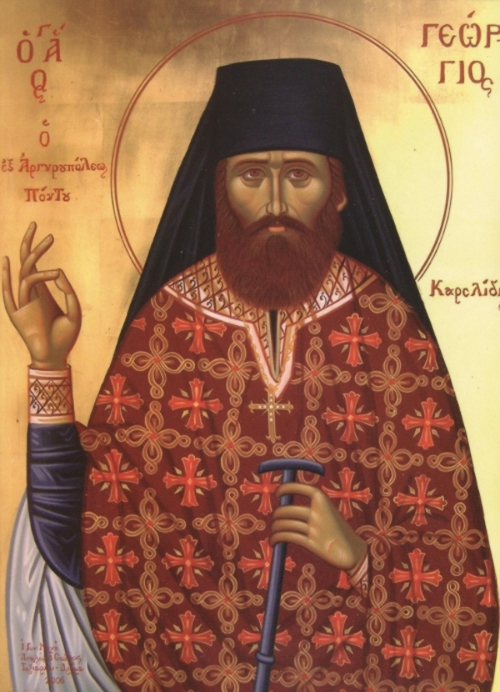
"Numbered among the Saints" - St. George Karslides of Drama (+1959)


Apolytikion of St. George Karslides the Righteous of Drama (amateur translation from the above Greek)
O river of Divine Grace, O God-bearing George, and vessel of miracles of all kinds, we praise him crying out, Ascension, Holy Monastery's Founder, and Drama's protector and shelterer, do not despise those who entreat you, and magnify you, O Righteous Father. Glory to Christ Who glorified you. Glory to Him who sanctified you, Glory to Him who showed forth this new ascetic fruitful.

Greetings!

I just thought I would upload a short clip from TV4E (http://www.tv4e.gr/) of the Patriarchical Great Vespers on the evening of November 1st (2008), at the Metropolis Church of Drama. Patriarch Bartholomew was there to help recognize St. George Karslides the Righteous as a Saint. This clip shows the chanting of his apolytikion (included above in Greek, with a first draft of a translation), and you can see the church, his icon and the case of his Holy Relics. Note: I'm not aware of any of TV4E's regulations against posting a clip like this, but if this is problematic with respect to any copyright laws, let me know.

And though I'm not an expert at all, from what I know the Orthodox Church and its hierarchs do not get together and agree to make someone a saint (which seems different from from other faiths). It is a life and struggle in Christ's Holy Church with the Grace of God that brings sanctification, enlightenment and salvation. The Orthodox Church leadership only acknowledges and brings to people's attention the presence of the Holy Spirit in the lives of the Saints and codifies the devotion of the faithful towards them. As is clear, St. George Karslides was a great grace-filled Father of our Church, and may he intercede for all of us, while we emulate his life and faith.

Picture of Patriarch Bartholomew venerating the Holy Relics of St. George in Drama (taken from: http://www.imdramas.gr/images_file/view_image.php?image_id=1093)

For more information on St. George, see the following excellent books:

-Precious Vessels of the Holy Spirit: The Lives and Counsels of Contemporary Elders of Greece, by Herman A. Middleton. Published by Protecting Veil Press 2003.

-The Blessed Elder George Karslides (1901-1959) by Monk Moses the Athonite. Published by Orthodox Kypseli Publications.


"The Christian who loves all people has a great reward, especially if he forgives those who do him evil. For if we don't love our neighbor, all the good works we do will be worthless. They amount to nothing, we will be worthless. Love, my bretheren, God requires love from us."
-St. George Karslides of Drama (+1959)
(quote from Precious Vessels of the Holy Spirit, Middleton)

Through the prayers of our Holy Fathers, Lord Jesus Christ our God, have mercy on us and save us! Amen!

Friday, October 31, 2008

St. Eleni (Helen) the New Virgin-martyr of Sinope

St. Eleni the New Virgin-martyr of Sinope - Commemorated on November 1st (icon taken from http://www.christopherklitou.com/icon_1_nov_helen_of_sinopi.htm)
  
"She was a maiden of fifteen who lived with her parents in the Christian enclave of Sinope in Pontus during the 1700s. One day, as she went to the marketplace, she passed by the house of the local Pasha (governor), who, seeing her beauty, was seized by lust for her. He ordered his servants to bring her to him, and made two attempts to defile her; each time, however, he was prevented by a mysterious power that kept him from her like an invisible wall. Determined to have his way for her, he kept her prisoner in his house; but she was able to slip away and run home to her parents' house.

Enraged that his prey had escaped, the Pasha called together the leaders of the Christian community and promised that, unless Helen were handed over to him, all the Christians in the town would be massacred. Grief-stricken and fearful, the leaders persuaded Helen's father to return the girl to the palace. The vile Pasha made several more attempts to rape the Saint, but once again he was restrained as if by an invisible wall as she recited the Six Psalms and all the prayers that she knew by heart. Realizing that he was powerless against her, the Pasha had her thrown in the common jail, then ordered that she be tortured to death. The executioners subjected the maiden to several cruel torments before killing her by driving two nails into her skull and beheading her. They then put her body in a sack and threw it in the Black Sea.

Some Greek sailors followed a heavenly light to the place where the sack had sunk, and divers retrieved the Saint's relics, which immediately revealed themselves as a source of healing for many. Her body was taken to Russia; her head was placed in the church in Sinope, where it continued to work miracles, especially for those who suffered from headaches. When the Greeks were driven from Sinope in 1924, refugees took the head with them. It is venerated today in a church near Thessalonika [St. Marina, Ano Toumpas]."
(taken from: http://www.holytrinityorthodox.com/calendar/los/November/01-06.htm)
  
The Holy Skull of St. Eleni of Sinope, the Church of St. Marina, Ano Toumpas, Thessaloniki (taken from: http://misha.pblogs.gr/files/f/275585-eleniagia_kara.jpg)
  
Another icon of St. Eleni the New Virgin-martyr of Sinope (taken from: http://vatopaidi.files.wordpress.com/2009/10/20201.jpg)
  
ฮ‘ฯ€ฮฟฮปฯ…ฯ„ฮฏฮบฮนฮฟฮฝ ฮ‰ฯ‡ฮฟฯ‚ ฯ€ฮป.ฮ‘΄ ฮคฮฟฮฝ ฯƒฯ…ฮฝฮฌฮฝฮฑฯฯ‡ฮฟฮฝ ฮปฯŒฮณฮฟฮฝ
Tฮฎฯ‚ ฮฑฮณฮฝฮตฮฏฮฑฯ‚ ฯ„ฮฟ ฮฌฮฝฮธฮฟฯ‚ ฯ„ฮฟ ฮตฯ…ฯ‰ฮดฮญฯƒฯ„ฮฑฯ„ฮฟฮฝ ฮบฮฑฮน ฮฃฮนฮฝฯŽฯ€ฮทฯ‚ ฯ„ฮฟ ฮบฮปฮญฮฟฯ‚ ฮบฮฑฮน ฮธฮตฮฏฮฟฮฝ ฮฒฮปฮฌฯƒฯ„ฮทฮผฮฑ ฮ ฮฑฯฮธฮตฮฝฮฟฮผฮฌฯฯ„ฯ…ฯ‚ ฯ„ฮฟฯ ฮงฯฮนฯƒฯ„ฮฟฯ ฮ•ฮปฮญฮฝฮท ฯ€ฮฌฮฝฯƒฮตฮผฮฝฮต, ฮท ฮฑฮธฮปฮฎฯƒฮฑฯƒฮฑ ฯƒฯ„ฮตฯฯฯŽฯ‚ , ฮบฮฑฮน ฮบฮฑฮธฮตฮปฮฟฯฯƒฮฑ ฯ„ฮฟฮฝ ฮตฯ‡ฮธฯฯŒฮฝ, ฯ„ฮทฯ‚ ฯ€ฮฏฯƒฯ„ฮตฯ‰ฯ‚ ฯ„ฮท ฮดฯ…ฮฝฮฌฮผฮตฮน ฮดฮนฮฑ ฯ€ฮฑฮฝฯ„ฯŒฯ‚ ฮตฮบฮดฯ…ฯƒฯŽฯ€ฮตฮน, ฮตฮปฮตฮทฮธฮฎฮฝฮฑฮน ฯ„ฮฑฯ‚ ฯˆฯ…ฯ‡ฮฌฯ‚ ฮทฮผฯŽฮฝ.

Apolytikion in the Plagal of the First Tone
The most-fragrant flower of purity and the boast and divine offspring of Sinope Virgin-martyr of Christ Eleni most-pure, who struggled steadfastly, and cast down the enemy, with the power of faith and entreats for everyone, to have mercy on our souls.
  
Apolytikion in the Fourth Tone
O Lord Jesus, unto Thee Thy lamb doth cry with a great voice: O my Bridegroom, Thee I love; and seeking Thee, I now contest, and with Thy baptism am crucified and buried. I suffer for Thy sake, that I may reign with Thee; for Thy sake I die, that I may live in Thee: accept me offered out of longing to Thee as a spotless sacrifice. Lord, save our souls through her intercessions, since Thou art great in mercy.
(taken from: http://goarch.org/chapel/saints_view?contentid=207)
  
ฮšฮฟฮฝฯ„ฮฌฮบฮนฮฟฮฝ ฮ‰ฯ‡ฮฟฯ‚ ฮ”΄ ฮ•ฯ€ฮตฯ†ฮฌฮฝฮทฯ‚ ฯƒฮฎฮผฮตฯฮฟฮฝ
ฮฉฯ‚ ฯ€ฮฑฯฮธฮญฮฝฮฟฯ‚ ฮฌฮผฯ‰ฮผฮฟฯ‚ ฮตฮฝ ฯ„ฮท ฮดฯ…ฮฝฮฌฮผฮตฮน ฯ„ฮฟฯ… ฮงฯฮนฯƒฯ„ฮฟฯ ฮบฮฑฯ„ฮญฮฒฮฑฮปฮตฯ‚, ฯ„ฮฟฮฝ ฯ€ฮฟฮปฯ…ฮผฮฎฯ‡ฮฑฮฝฮฟฮฝ ฮตฯ‡ฮธฯฯŒฮฝ, ฮบฮฑฮน ฮผฮฑฯฯ„ฯ…ฯฮฏฯ‰ ฮบฮตฮบฯŒฯƒฮผฮทฯƒฮฑฮน, ฮ ฮฑฯฮธฮตฮฝฮฟฮผฮฌฯฯ„ฯ…ฯ‚ ฮ•ฮปฮญฮฝฮท ฯ€ฮฑฮฝฮตฯฯ†ฮทฮผฮต.
  
Megalynarion
As an undefiled virgin in the power of Christ you cast down the much-contriving enemy, and you are arrayed in martyrdom, O Virgin-martyr Eleni the all-praised.
  
ฮœฮตฮณฮฑฮปฯ…ฮฝฮฌฯฮนฮฟฮฝ
ฮงฮฑฮฏฯฮฟฮนฯ‚ ฯ„ฮทฯ‚ ฮฃฮนฮฝฯŽฯ€ฮทฯ‚ ฮฌฮฝฮธฮฟฯ‚ ฯ„ฮตฯฯ€ฮฝฯŒฮฝ ฮบฮฑฮน ฯ„ฮทฯ‚ ฯ€ฮฑฯฮธฮตฮฝฮฏฮฑฯ‚ ฯ„ฮฟ ฮฑฮปฮฌฮฒฮฑฯƒฯ„ฯฮฟฮฝ ฯ„ฮฟ ฯƒฮตฯ€ฯ„ฯŒฮฝ ฯ‡ฮฑฮฏฯฮฟฮนฯ‚ ฯ„ฯ‰ฮฝ ฮœฮฑฯฯ„ฯฯฯ‰ฮฝ, ฮนฯƒฯŒฯ„ฮนฮผฮฟฯ‚ ฮ•ฮปฮญฮฝฮท, ฮฟฮฏฮฑ ฮ ฮฑฯฮธฮตฮฝฮฟฮผฮฌฯฯ„ฯ…ฯ‚ ฮงฯฮนฯƒฯ„ฮฟฯ ฮฑฮฎฯ„ฮทฯ„ฯ„ฮฟฯ‚.
(http://misha.pblogs.gr/2009/11/arnhthhke-na-ypokypsei-ston-aselgh-biasth-ths-kai-apokefalisthke.html, English texts are amateur translations from the Greek, except for the second apolytikion)
Through the prayers of our Holy Fathers, Lord Jesus Christ our God, have mercy on us and save us! Amen!