Tuesday, April 21, 2009

A Miracle of St. Raphael of Lesvos

Christ is risen! Truly He is risen!
  

Icon of Sts. Raphael, Nicholas and Irene - Commemorated on Tuesday of Bright Week (taken from: http://www.imgap.gr/file1/imagraf.html)
  
St. Raphael rescuing a young man from death by pulmonary embolism (amateur translation)
"Dimitris Antonios Vakalopoulos (Polykastro, 23430-22310) in February 1995 went to kick a soccer ball during a game and suffered a fractured shin which required a pin put into his right broken leg in “Agios Dimitrios" Hospital. Afterwards he went home to recover. In three weeks, however, he his healthy left leg began to bloat and he had a fever of 39-40 degrees(Celsius) with convulsions. His local doctor gave him medication for pneumonia, but then suggested hospitalization.

In Kilkis, the doctor thought he had bruising and sent him back. But he continued to have chest pains, difficulty breathing, one leg [ενηλωμένο], the other swollen, and a high fever. The doctor Panteleimon Maidanoglou diagnosed 99.5% thrombophlebitis and recommended him to go to the Hospital immediately! In the 10-15 days in Kilkis, they did not give much weight to Dr. Maidanoglou’s diagnosis, and the patient had lost half of his weight (42 kilos)! He had lost contact with the world! 'He saw Saints that would shout at him, forests, meadows, flowers, Angels in white with wings, calm waves, streams, rivers. 'A crisis happened, he was not breathing, but turning dark!

His brother Pagonis Vakalopoulos (known soccer player in the "National" Greece and the "Hercules") sent for the doctor, Dr. Philipou at 3AM. The new doctor diagnosed thrombosis and pulmonary embolism! His father signed the paper and they immediately rushed him to Papanikolaou. The scan and angiogram showed 100% occulded artery in the lungs! Professor Spyros said to his father: "He's dying. Sign the paper. I will make an incision from top to bottom. We will look for the clot or clots and take them out, and he will be in the operating room for five hours. Go to see him in the ICU, but don’t anyone cry, because the boy will stay with us from now on!"

The mother, talking and crying with the other patients, learned about St. Raphael of Mytilene, and called the Monastery requesting a supplication service be chanted. Her phone card however did not record the long time that she was talking on the phone, and this, as she would understand later, was a sign that something extraordinary started to happen. In the ICU she gave her son a small booklet about St. Raphael, and told him that he should pray to the Saint to heal him, in all seriousness. He started to look through the booklet, was impressed by the miracles and stories of St. Raphael, and then he began to pray: "St. Raphael, if you actually exist, come to me and make me well." And his mother constantly entreated the Saint with faith and tears: "St. Raphael, I am a sinner. Please, take a look at my child!"

After some hours (5 minutes? 5 hours? I don’t remember) Dimitri felt a blinding light hit his eyes, like the glare of a thousand headlights. He asked his nurse repeatedly to extinguish the lights, and she would asserting that everything was off. Slowly, from the blinding light was revealed a priest, the same as was on the booklet that he had been given, standing in the air!

With his eyes open he asked him: "How did you appear here? Who are you?"

“I am Saint Raphael and I came to make you well."

"How did you get in here? And how will you make me well?"

"Believe me, tomorrow you will be well."

He disappeared. He started to reason, how he could cure me, who that was... and the priest appeared again, but with a more austere appearance, and he said:

"Do you dare to doubt that I can cure you?".

The sick man was left amazed, wondering how the Priest could know what he was thinking. "I don’t doubt, but how will you cure me?"

"Believe me, Dimitris, and tomorrow you will be well. But you must believe."
Note that, as long as I was talking with the Saint, the nurse was trying to calm me down: "Dimitri, relax. Who are you talking to? There is nobody here, only me and you."

Then the Saint said: "They can’t see or hear me. Only you. "

But further doubts were in the mind of the sick man: "Is this Priest working for us? Have I have gone mad and am not seeing things well? What does this mean? Is it possible?"
For the third time the Saint appeared with a girl with braids, but then appeared to be walking close to him. Approaching, he said:

"Poor man, you don’t believe in me at all. Two times I came for the sake of your mother, who cries out entreating me for you, and once for you. I won’t come to you another time. For the third and final time. Believe me and tomorrow you will be well.”

And turning towards the little girl:" Rinoula [diminutive form of the Greek name Eirini, or Irene], bring me my bag" (like the ones used by doctors)."

He pulled out a white doctor’s coat, and removing his purple vestments, he put it on. "Dimitrakis, tomorrow you will be well, if you only believe. Now I am leaving, because they need me in London. Come, Rinoula the boy will be well, and his leg and the lungs are strong."

The sick man called his mother, and related to her the story, and she crossed herself and was crying from emotion.

In the morning they came to run an important test, but found on the scan that the clots had disappeared from the lungs and his veins. They only placed a filter in the lower segment. In four days he was discharged. Mr. Spyrou said to his mother: "Your family must have some Saint or someone is lucky." Mr. Philipou said to his brother: "As a scientist I cannot explain it. He has someone up there." His parents came and performed a Paraklesis at our Monastery [Sts. Raphael, Nicholas and Irene in Goumenissa]. Later they brought the young man himself. He recognized St. Raphael immediately on the large icon stand from his three appearances , however he had seen him wearing the purple mantya robe of an Abbott, illuminating his chest."
(http://www.imgap.gr/file1/sthavmata.html)
  

Note: the man who was healed can be seen telling the story himself on video (in Greek) here: http://www.imgap.gr/file1/Vakal.wmv.
  
For more information on Sts. Raphael, Nicholas and Irene, see: http://fr-d-serfes.org/writtings/straphael.htm, http://orthodoxchristian.info/pages/sts_rni.htm, http://goarch.org/chapel/saints_view?contentid=1045&PCode=1PT&D=T&date=4/21/2009.
  

Icon of Sts. Raphael, Nicholas and Irene (Icon courtesy of www.eikonografos.com used with permission)
  
Apolytikon of Sts. Raphael, Nicholas and Irene
Having contended on Lesvos for the sake of Christ God, you have sanctified the island since the discovery of your sacred relics, O blessed ones; for what reason we honour you, O God-bearing Raphael, together with Nicholas and virgin Irene, as our divine protectors and intercessors with the Lord.
  
Kontakion
Let all of us honour as our protectors and miracle-workers the holy Martyrs who manifestly contended for Christ. Whose relics were hidden under the earth for many years, and who have manifested themselves to us in wondrous ways, Raphael, Nicholas and Irene, as well as those who contended with them in a godly-minded manner.
  
Megalynarion
Let us honour with hymns the Hosiomartyrs of Christ, divine Raphael and venerable Nicholas, together with Irene, the guardians of Lesvos, for helping all.
Christ is Risen from the dead, by death, trampling down upon death, and to those in the tombs, bestowing life!
Truly the Lord is risen!

Patron Saints - February

Christ is risen! Truly He is risen!

Here are some common Patron Saints for the month of February (and again, this is by no means a comprehensive list). The sources are http://oasigr.5.forumer.com/a/_post1688.html and http://orthodoxwiki.org/Patron_saint primarily.


Menaion Icon of the Saints and Feasts of the Month of February (icon taken from Holy Transfiguration Monastery: http://www.thehtm.org/catalog/product_info.php?cPath=27_33&products_id=347&osCsid=1a3a701d63d15339386b4df7297e9c4f)
February

1 – St. Tryphon the Great-martyr (one of twenty Unmercenary Healers) - protector of farmers and poulterers, protector against pests, patron of hunters, gardens, fields, crops, trees, grape vines, geese, plants and delivering a child, and patron of the city of Moscow

3 – St. Simeon (or Symeon) the God-receiver - protects pregnant women, for captives and court cases

5 – St. Agathi (Agatha) the Virgin-martyr - protects against cancer (specifically breast cancer)

5 – St. Theodosius of Chernigov – patron for church chanting

6 – St. Photios, Patriarch of Constantinople – protector of booksellers

6 – St. Dorothea – protects from diseases of the face and from facial deformities

7 – St. Parthenios Bishop of Lampsakos – protects against cancer

8 – St. Theodore the Great-martyr, the Commander (Stratelates) - protector against eczema and gynecological problems, protector of children

10 – St. Charalambos the Hieromartyr - protector against gastric distress and dysentery, infectious diseases, against regrettable (or depressing) thoughts and meditations, the plague, protector of flocks and shepherds, trees, and protector of marble workers

10 – St. Zenon the Postman – protector of postal officials/workers

10 - St. Prochor of Kievo-Pechersk – patron of the kitchen and home

11 – St. Vlasios (Blaise) the Hieromartyr, Bishop of Sebaste - protector against diseases of the throat

13 – Sts. Akylas and Pricilla the Apostles - protectors of couples and families

13 – St. Martinian the Righteous - for chastity and help in carnal warfare

13 – St. Simeon the Myrrhstreamer, Founder of the Chilandar Monastery – protector of childless couples

15 – St. Onesimos the Apostle - patron of prisoners

15 – St. Anthimos the Righteous of Chios - protector against leprosy, protector against earthquakes17 – St. Theodore the Great-martyr, the Recruit (Tyron) - the protector against eczema, helping to find missing persons

17 – St. Theodore the Neomartyr, the Byzantine – for chastity and help in carnal warfare, deliverer from the plague, and patron of the city of Mytilene

19 – St. Philothei the Righteous Martur of Athens - protector against witchcraft and unclean spirits, protector of families and couples

19 – St. Dositheus, Disciple of Abba Dorotheus – for workers in hospitals

23 – St. Gorgonia – protector of spouses/couples

26 – St. Photini the Great-martyr, the Samaritan Woman – protector from headaches and disorders of the head, for chastity and help in carnal warfare, patron of those repenting, and those afflicted by diseases of the eyes, and patron of the city of Smyrna

27 – St. Titus the Soldier of Kievo-Pechersk – patron saint of soldiers

Christ is Risen from the dead, by death, trampling down upon death, and to those in the tombs, bestowing life!
Truly the Lord is risen!

Monday, April 20, 2009

"Bright Week", or Renewal Week following the Resurrection of Christ

Christ is risen! Truly He is risen!
Close-up icon of Christ Resurrected, telling St. Mary Magdalene "Do not hold me" (Icon courtesy of www.eikonografos.com used with permission)
   
The week after the Great and Holy Feast of Pascha in the Orthodox Church is called Bright Week or Renewal Week. It is a week of concentrated and illustrious celebration of Christ's Resurrection (In fact, tradition holds that the faithful replace morning and evening prayers with the Holy Paschal Hours, which are filled with hymns to the Resurrection. See: http://www.orthodox.net/pascha/paschalhours.html), and many other feasts. This is a fast-free week of constant celebration and spiritual exhilaration.
  
"The hymns chanted every day are identical to those chanted on the Sunday of Pascha, with the exception of a few parts that are taken from the Octoechos (the "Book of the Eight Tones"). Each day has a different tone assigned to it: Easter Sunday is Tone One, Bright Monday is Tone Two, and so on through the eight tones (skipping Tone Seven, the "Grave Tone")" (http://en.wikipedia.org/wiki/Bright_Week)
  
The OCA website compiled an excellent account of the movable feasts of Bright Week, which I summarized and added to below (taken from: http://www.oca.org/FSIndex.asp?SID=4)
  
-Litany of the “Axion Estin” Icon of the Theotokos, Karyes, Mount Athos (For more pictures of the icon and the Litany, see: http://agioritikesmnimes.pblogs.gr/2009/02/143-h-thaymatoyrgh-eikona-axion-estin.html, http://agioritikesmnimes.pblogs.gr/2010/04/995-h-litanefsh-ths-eikonas-axion-esti-th-deftera-toy-pasha.html)
  
Miraculous Icon of Christ and the Theotokos "Axion Estin" - Protaton, Mount Athos (Taken from: http://www.mountathos.gr/active.aspx?mode=en{2aee45f1-c81e-4f0c-9cf9-c2efe471cfd1}View)

-The Litany of the Glykophilousa (Sweet-kissing) icon of the Theotokos, Philotheou Monastery, Mount Athos
Miraculous Icon of Christ and Panagia "Glykophilousa" - Philotheou Monastery, Mount Athos(Taken from: http://www.mountathos.gr/active.aspx?mode=en{7a41e1a3-0425-4b51-80be-1131ca957e56}View)
  
-The Feast of St. George the Trophy-bearer (if his feast falls during Great Lent)
Fresco of St. George the Trophy-bearer (Icon courtesy of http://www.eikonografos.com/ used with permission)
   
Bright Tuesday (3rd Tone) (http://ocafs.oca.org/FeastSaintsViewer.asp?SID=4&ID=1&FSID=29)

-Litany of Panagia Portaitissa (Keeper of the Portal) of Iviron Monastery, Mount Athos (See also: http://full-of-grace-and-truth.blogspot.com/2008/10/miraculous-icon-of-panagia-portaitissa.html)
  
Miraculous Icon of Christ and Panagia "Portaitissa" - Iviron Monastery, Mount Athos (Icon courtesy of http://www.eikonografos.com/ used with permission)
  
-Litany of the "Fovera Prostasia" ("Awesome Protection") icon of the Theotokos
  
-Sts. Raphael, Nicholas and Irene, the Newely-revealed Martyrs of Thermi, Lesvos (Also see: http://full-of-grace-and-truth.blogspot.com/2012/04/sts-raphael-nicholas-and-irene-newly.html, http://fr-d-serfes.org/writtings/straphael.htm, http://orthodoxchristian.info/pages/sts_rni.htm, http://goarch.org/chapel/saints_view?contentid=1045&PCode=1PT&D=T&date=4/21/2009)
  

The Holy Newly-Revealed Martyrs of Thermi, Lesvos (Icon courtesy of http://www.eikonografos.com/ used with permission)
  
-The Finding of the Relics of St. Patapius in Loutraki, Greece (and Sts. Ypomoni and Nikon) (See: http://goarch.org/chapel/saints_view?contentid=327, http://full-of-grace-and-truth.blogspot.com/2008/12/miracle-of-st-patapios-of-thebes.html)

St. Patapios (Patapius) the Righteous of Thebes (Icon courtesy of http://www.eikonografos.com/ used with permission)


The Miraculous Icon of Panagia Vimatarissa - Vatopedi Monastery, Mount Athos (http://www.mountathos.gr/active.aspx?mode=en{0bc0e16a-bb01-422b-9e36-e3fb872c7cf6}View)

For a video of the litany of Panagia Vimatarissa on the Tuesday of Bright Week at Vatopedi Monastery, see: http://www.pemptousia.gr/%ce%b2%ce%b9%ce%bd%cf%84%ce%b5%ce%bf%ce%b8%ce%ae%ce%ba%ce%b7/?v=33442.  
  
-Miracles of the Holy Archangel Michael and the Precious Nail of Christ of Thassos (The text of the Greek service is available here: http://voutsinasilias.blogspot.com/2010/03/blog-post_27.html)
  
One of the Precious Nails that pierced Christ on the Cross, treasured by the Monastery of the Archangel Michael, Thassos (https://picasaweb.google.com/orthodoxinfo/StMichaelTheArchangelConventThassosGreece#5171401153562086034)
   
-The Martyrs of St David of Garesja Monastery in Georgia in 1616 (also April 4).  (Greek account here: http://vatopaidi.wordpress.com/2010/04/06/6000-neoi-osiomartyres-sti-georgia-1616/)

  
-St Sava "Vimataris", Hierodeacon of Vatopedi Monastery (tenth century). (Greek account here: http://vatopaidi.wordpress.com/2010/04/06/agios-savvas-o-vimataris/)
  
-179 Righteous Martyred Fathers of Ntaou Monastery, Penteli (http://www.johnsanidopoulos.com/2010/04/179-holy-martyrs-of-ntaou-penteli-in.html)
  
  
-The holy monastic Fathers who have shone forth on the God-trodden Mt Sinai
  
Synaxis of the Holy Sinaite Fathers (taken from: http://www.pigizois.net/galery/agiografies/sinaxi_sinaiton_pateron.jpg)
  
-The Kasperov Icon of the Most Holy Theotokos (See:http://ocafs.oca.org/FeastSaintsViewer.asp?SID=4&ID=1&FSID=103752)


Bright Thursday (Plagal of the 1st Tone) (http://ocafs.oca.org/FeastSaintsViewer.asp?SID=4&ID=1&FSID=31)
  
  
Bright Friday (Plagal of the 2nd Tone) (http://ocafs.oca.org/FeastSaintsViewer.asp?SID=4&ID=1&FSID=32)
  

Icon of Christ and Panagia "The Life-giving Spring" (Icon courtesy of http://www.eikonografos.com/ used with permission)


Bright Saturday (Plagal of the 4th Tone) (http://ocafs.oca.org/FeastSaintsViewer.asp?SID=4&ID=1&FSID=33)
  
-Synaxis of the Holy Kollyvades Fathers, which includes, according to the author of their service, Sts. Makarios of Corinth, Nikodemos of the Holy Mountain, Niphon the Sanctified, Nikephoros of Chios, Gregory Gravanos, Silvester of Kaisareia, Paisios Velichkovsky, Cyril of Paros, Ierotheos, from the Peloponese, Anthimos from Kephalonia, Parthenios o Skourtos, Auxentios from Andros, Kosmas Aitolos, Arsenios of Paros, Nektarios of Pentapolis, Sabbas of Kalymnos, Nicholas Planas, Parthenios of Chios, Parthenios and Evmenios of Crete, etc. (http://full-of-grace-and-truth.blogspot.com/2009/04/synaxis-of-holy-kollyvades-fathers.html)
  
Icon and Apolytikion (in Greek) of the Holy Kollyvades Fathers (taken from: http://www.pigizois.net/latreia/paraklitikoi_kanones/pdf/esperinos_kolivadon_pateron.pdf)

-Blessing of the Artos

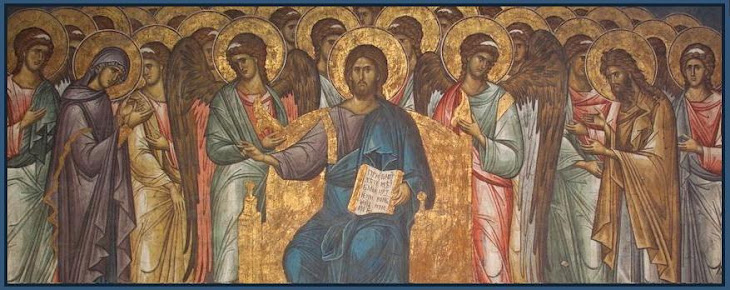
Icon entreating Christ to bless the days of the week through His servants and patrons: Ever Sunday commemorates the Resurrection, Monday the Holy Angels, Tuesday the Precious Forerunner, Wednesday Betrayal of Christ and the Most-holy Theotokos, Thursday the Holy Apostles (and St. Nicholas), Friday the Crucifixion of Christ, and Saturday the Holy Martyrs and all the Departed (source)
  
Christ is Risen from the dead, by death, trampling down upon death, and to those in the tombs, bestowing life!
Truly the Lord is risen!

Sunday, April 19, 2009

Christ is Risen!

Icon of the Resurrection, or Christ raising the dead from Hades (Icon courtesy of www.eikonografos.com used with permission)+++
Christ is risen! Truly He is risen!
+++
Glory to His Third-Day Rising! We worship His Third-Day Rising!
+++
Having seen the Resurrection of Christ, let us worship the Holy Lord Jesus, the only sinless one. Your Cross do we worship, O Christ, and Your holy Resurrection do we hymn and glorify. For You are our God, we know no other but You, we call upon Your name. Come all the faithful, let us worship the holy Resurrection of Christ; for behold through the Cross, joy has come in all the world. Ever blessing the Lord, we extol His Resurrection. For enduring the Cross for us, He destroyed death by death.(Text from Fr. Seraphim Dedes at http://sgpm.goarch.org/)
+++
The Kontakion, eighth tone:
Though Thou didst descend into the grave, O Immortal One, yet didst Thou destroy the power of hades. And didst arise as victor, O Christ God, calling to the myrrh-bearing women: Rejoice! And giving peace unto Thine apostles: Thou Who dost grant resurrection to the fallen.
(Text from the Paschal Hours available here: http://www.orthodox.net/pascha/paschalhours.html)
+++

Close-up icon of Christ Resurrected, telling St. Mary Magdalene "Do not hold me" (Icon courtesy of www.eikonografos.com used with permission)
+++
Christ is Risen from the dead, by death, trampling down upon death, and to those in the tombs, bestowing life!
Truly the Lord is risen!

Thursday, April 9, 2009

The Saturday of St. Lazarus

Icon of Christ raising St. Lazarus from the dead (Icon courtesy of http://www.eikonografos.com/ used with permission)
  
Kontakion - Mode 2. In seeking the heights.
The joy of all men, the Truth who is Christ our God, the light and the life, the resurrection of the world has appeared unto those on earth, in that He is benevolent, becoming the type of the Resurrection, and granting divine remission unto all.
  
OEkos
To Your disciples, O Creator of all You declared, saying: “Brothers and comrades, our friend has fallen asleep.” Thus You foretold them and taught that You know all things as the Creator of all things. “So, onward; let us go and see a strange burial, and behold Mary’s lament and the tomb of Lazarus. For I shall work a miracle there, preluding the Cross, and granting divine remission unto all.”
  
Selected hymns from the Praises:
Four days after he had died You raised up Lazarus in Bethany. As soon as You came to the tomb, Your voice became life to the dead man; and Hades, groaning in fear, released him. Great was the miracle! Very merciful Lord, glory to You.
  
O Lord, even as You said to Martha: I am the Resurrection; so You fulfilled Your word in action by calling back Lazarus from Hades. Resurrect me, also, for I am dead through passions. I beseech You, compassionate One who love mankind.
  
Glory. Mode 2g.
Today has a miracle been performed that is great and paradoxical. For from the grave Christ has summoned a dead man of four days and resurrected him, and called him His beloved friend. Let us sing glory to Him who is supremely glorious, so that at the intercessions of Lazarus the righteous, He might save our souls.
   (taken from Fr. Seraphim Dedes at: http://sgpm.goarch.org/ematins/bilingual/Apr11.pdf)
  

Another icon of Christ raising St. Lazarus from the dead (taken from: http://ayioslazaros.org/istoria_eng.htm)
  
"Reading:
Lazarus and his sisters Martha and Mary, the friends of the Lord Jesus, had given Him hospitality and served Him many times (Luke 10:38-4z; John 12:2-3). They were from Bethany, a village of Judea. This village is situated in the eastern parts by the foothills of the Mount of Olives, about two Roman miles from Jerusalem. When Lazarus - whose name is a Hellenized form of "Eleazar," which means "God has helped," became ill some days before the saving Passion, his sisters had this report taken to our Saviour, Who was then in Galilee. Nonetheless, He tarried yet two more days until Lazarus died; then He said to His disciples, "Let us go into Judea that I might awake My friend who sleepeth." By this, of course, He meant the deep sleep of death. On arriving at Bethany, He consoled the sisters of Lazarus, who was already four days dead. Jesus groaned in spirit and was troubled at the death of His beloved friend. He asked, "Where have ye laid his body?" and He wept over him. When He drew nigh to the tomb, He commanded that they remove the stone, and He lifted up His eyes, and giving thanks to God the Father, He cried out with a loud voice, "Lazarus, come forth." And he that had been dead four days came forth immediately, bound hand and foot with the grave clothes, and Jesus said to those standing there, "Loose him, and let him go." This is the supernatural wonder wrought by the Saviour that we celebrate on this day.

According to an ancient tradition, it is said that Lazarus was thirty years old when the Lord raised him; then he lived another thirty years on Cyprus and there reposed in the Lord. It is furthermore related that after he was raised from the dead, he never laughed till the end of his life, but that once only, when he saw someone stealing a clay vessel, he smiled and said, "Clay stealing clay." His grave is situated in the city of Kition [today known as Larnaka], having the inscription: "Lazarus the four days dead and friend of Christ." In 890 his sacred relics were transferred to Constantinople by Emperor Leo the Wise, at which time undoubtedly the Emperor composed his stichera for Vespers, "Wishing to behold the tomb of Lazarus . . .""
  
For St. John Chrysostom's Commentary on the raising of St. Lazarus, from the Gospel of St. John, see: http://www.ccel.org/ccel/schaff/npnf114.iv.lxiv.html, http://www.ccel.org/ccel/schaff/npnf114.iv.lxv.html, and http://www.ccel.org/ccel/schaff/npnf114.iv.lxvi.html.
  
 The Church of St. Lazarus, Larnaka, Cyprus (taken from: http://ayioslazaros.org/istoria3_eng.htm)
  
The Church of St. Lazarus in Larnaka, Cyprus, has an excellent website (http://ayioslazaros.org/) with the account of St. Lazarus in Cyprus, his tradition in the East and the West, the history of the church itself, and numerous pictures. To this day the church remains as a great pilgrimage for the Orthodox, where the faithful can venerate his Holy (Second) Tomb and Relics.
  
The Holy Skull of St. Lazarus, Larnaka, Cyprus (taken from: http://ayioslazaros.org/istoria_eng.htm)
  
For more on the Greek traditions for the Saturday of St. Lazarus, see: http://full-of-grace-and-truth.blogspot.com/2010/03/greek-traditions-for-saturday-of-st.html.
  
May the Lord make us worthy to see His Holy Passion and Glorious Resurrection, through the prayers of the Theotokos, St. Lazarus, and of all the Saints!
  
Icon of St. Lazarus the Four-Days-Dead, the Friend of Christ (taken from: http://ayioslazaros.org/istoria_eng.htm)
  
Through the prayers of our Holy Fathers, Lord Jesus Christ our God, have mercy on us and save us! Amen!

Sunday, April 5, 2009

St. Savvas (Sabbas) the New of Kalymnos

Photograph of St. Savvas (Sabbas) the New of Kalymnos (taken from: http://orthodoxwiki.org/Image:St-Savas-the-New.jpg)
+
"[St. Savvas'] feast day is celebrated twice annually: December 5 and the 5th Sunday of Great Lent.

St. Savvas the New is the patron saint of the Greek Island of Kalymnos, where he lived during the last twenty years of his life as the priest and spiritual father of the nuns of the Convent of All Saints. He was a great ascetic, confessor, iconographer and miracle-worker. He is one of the recently recognized saints in the Orthodox Church.

Saint Savvas was born in 1862 in Eastern Thrace and was baptized with the name of Vasilios. From a young age he had a calling for the holy monastic life and so he left for Mount Athos as a teen where he entered St. Anne's Skete. Along with the usual monastic duties, he learned iconography and Byzantine music.

After a few years, he traveled to Jerusalem for a pilgrimage to the holy sites, and there he entered the monastery of St. George Hozevitou. After a period of being a novice, he was tonsured a monk and given the name of Savvas.

In 1902, St. Savvas was ordained a deacon and a year later he was ordained to the Holy Priesthood. He spent almost 10 years in the desert by the Jordan where he led an austere life and occupied himself with prayer and iconography. His dwelling consisted of two cells which he reached by ascending up a rope ladder. This isolation was necessary for successful inner concentration and noetic prayer and he made great spiritual progress there.


Icon of St. Savvas, holding the icon of St. Nektarios (from St. Nektarios Monastery, Aegina, see: http://www.saint-nectarios-of-aegina.org/Monastery_in_Aegina.html)

Due to health reasons and the political situation in Palestine which made life unsafe, St. Savvas returned to Greece where he searched for a quiet place to continue his monastic life. He traveled throughout Greece for three years but could not find a suitable place. His prayers were answered when another saint, St. Nektarios of Aegina, had asked St. Savvas to come to the Holy Trinity Convent in Aegina and serve as a priest for nuns. There he would also be able to teach them the sacred art of iconography and Byzantine music. St. Savvas stayed at the convent for six years, from 1919 until 1925. This time at the Convent was one of the most significant events in the saint's life due to his association with St. Nektarios who was at the height of his spiritual development. St. Savvas had the opportunity to confess and receive counsel from St. Nektarios. The two had the highest esteem for each other and each considered the other a saint. As a matter of fact, St. Savvas painted the first icon of St. Nektarios: One day St. Savvas asked the Abbess not to let anyone disturb him for forty days, during which he remained confined to his cell. After 40 days, he came out of his cell holding an icon of St. Nektarios. He handed it to the Abbess and asked her to place it in the church for veneration. The Abbess was surprised since St. Nektarios had not been glorified ("canonized") as a saint yet and she was afraid that the convent would get into trouble. Although the saint was always meek and humble, he insisted, and told her in a commanding manner: "You must show obedience. Take the icon and place it on the icon stand, and do not scrutinize the will of God." He knew the holiness and purity of St. Nektarios.


The repose of St. Nektarios, showing St. Savvas, who was the only clergyman to officiate at Saint Nectarios' funeral. (taken from: http://orthodoxwiki.org/Image:St_Nectarios-_Kimisi-close-up.jpg)

After St. Nektarios reposed, more and more pilgrims would come to the convent due to the growing reputation of St. Nektarios as a miracle-worker. This disrupted the quiet life that St. Savvas loved and so he departed the convent in 1925, again for a quieter life.

St. Savvas spent the last years of his life as the priest and spiritual father at the Convent of All Saints on the island of Kalymnos. As a confessor, he combined leniency with severity. He was lenient on certain sins and severe to others. He remained an ardent spiritual striver until the end of life and practiced extreme forms of self-restraint with regard to food, drink and sleep. St. Savvas became a shining example of virtue to all who came into contact with him. Many smelled a heavenly fragrance in his presence and some even saw him rising above the ground as he stood at prayer.

Towards the end of his life, St. Savvas was in a state of intense concentration and holy contrition. For 3 days he did not receive anyone and he gave his last counsels: requested love and obedience in Christ. When he was on the point of death taking his last breath, suddenly he received strength, brought his blessed small hands together, and clapped them repeatedly saying his last holy words: "The Lord! The Lord! The Lord!". He went to the Lord in 1948 on the eve of the feast of the Annunciation. One nun saw the soul of the saint ascending in a golden cloud towards heaven. After about 10 years when the saint's grave was opened in accordance to the Greek Orthodox custom, a heavenly fragrance emanated from the grave and this was witnessed by many, including the local bishop. This was a testament to the sanctity of the saint. Numerous miracles and healings have since been attributed to St. Savvas the New of Kalymnos.

Through the intercessions of St. Savvas the New, have mercy on us O Lord and save us! Amen."
(taken from: http://www.panagiavlahernon.org/st-savvas.html)

For more information, see: Modern Orthodox Saints Vol. 8 - St. Savvas the New by Dr. Constantine Cavarnos and http://orthodoxwiki.org/Savvas_the_New_of_Kalymnos.

Also, see the following link for a panoramic view of St. Savvas' church in Kalymnos: http://www.360cities.net/image/the-monastery-of-agios-savvas.


Icon of St. Savvas of Kalymnos (taken from: http://orthodoxwiki.org/Image:Saint_Savvas-_Icon_from_his_church.jpg)

Apolytikion of St. Savvas of Kalymnos
Let us faithful praise Holy Savvas, the glory and protector of Kalymnos, and peer of the Holy Ascetics of old; for he has been glorified resplendently as a servant of Christ, with the gift of working miracles, and he bestows upon all God's grace and mercy.

Kontakion

Today the island of the Kalymnians celebrates your holy memory with a rejoicing heart; for it possesses as truly God-given wealth, your sacred body that has been glorified by God, O Father Savvas, approaching which they receive health of both soul and body.

Megalynarion

Rejoice thou new star of the Church, the offspring of Thrace and the beauty of Kalymnos, O God-inspired Savvas, fellow citizens of angels and equal of all the saints.
(taken from: http://www.panagiavlahernon.org/st-savvas.html)
+
  
St. Sabbas of Kalymnos (Source)

 
Through the prayers of our Holy Fathers, Lord Jesus Christ our God, have mercy on us and save us! Amen!

Thursday, April 2, 2009

The Great Canon of St. Andrew of Crete

Detail of Fresco showing Christ and St. Peter, from Gracanica Monastery (http://www.srpskoblago.org/Archives/Gracanica/exhibits/digital/s3-e5w5/s3-e5w5-10.html)

Kontakion, tone 6:My soul, my soul, arise! Why are you sleeping? The end is drawing near, and you will be confounded. Awake, then, and be watchful, that Christ our God may spare you, Who is everywhere present and fills all things.


Icon of St. Andrew of Crete (taken from: http://christopherklitou.com/icon_4_july_andrew_of_crete.htm)

Through the prayers of our Holy Fathers, Lord Jesus Christ our God, have mercy on us and save us! Amen!